
- Release Year: 2013
- Platforms: Windows
- Publisher: Big Fish Games, Inc
- Developer: ERS G-Studio
- Genre: Adventure, Puzzle
- Perspective: Fixed / flip-screen
- Game Mode: Single-player
- Gameplay: Hidden object, Mini-games
- Setting: Fantasy
- Average Score: 80/100
Description
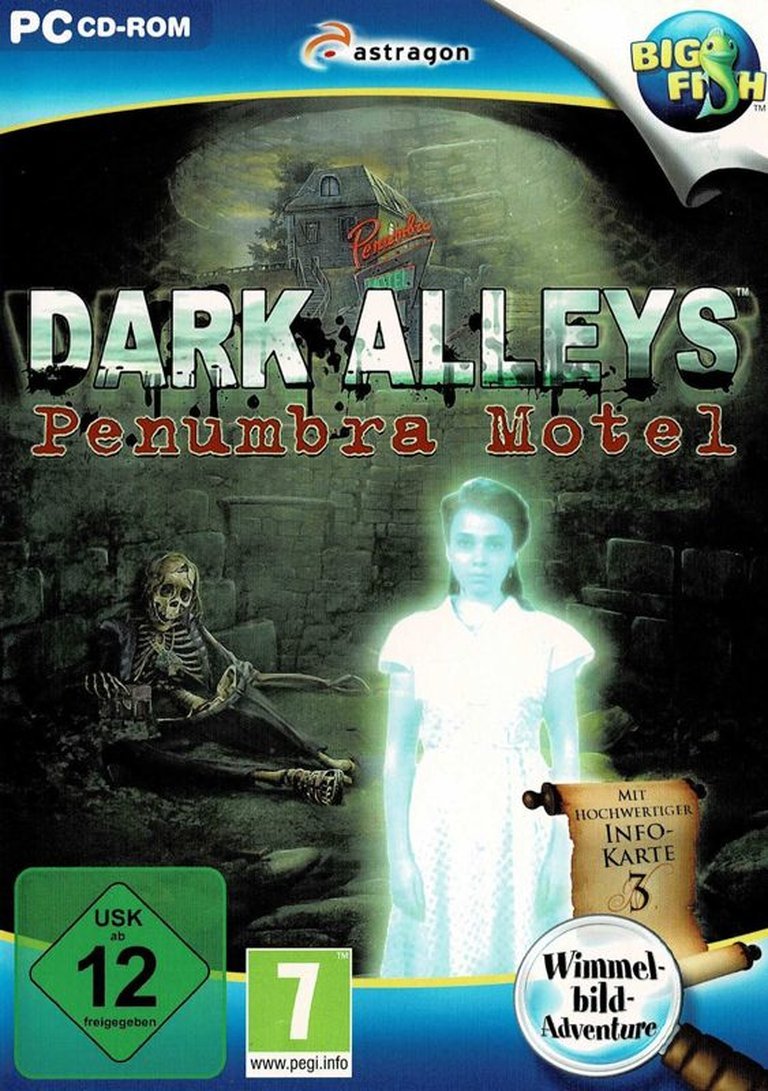
Dark Alleys: Penumbra Motel is a hidden object adventure game developed by ERS G-Studio and published by Big Fish Games, where players must locate a friend’s missing little girl by solving a fifty-year-old mystery involving the brutal murders of the Penum family at the eerie Penumbra Motel, featuring puzzle-solving, mini-games, and detective narrative in a fantasy setting.
Gameplay Videos
Dark Alleys: Penumbra Motel Guides & Walkthroughs
Dark Alleys: Penumbra Motel Reviews & Reception
gamezebo.com : never really comes together. In the end it does little justice to the ERS name.
adventuregamers.com : this lite adventure is something of a hidden gem itself
jayisgames.com : a gorgeous and engrossing creepy experience to sink into
bdstudiogames.com (80/100): is definitely a excellent hidden object game
Dark Alleys: Penumbra Motel: Review
Introduction
Imagine pulling into a desolate gas station at dusk, only for the child in your care to vanish into thin air, drawing you into a web of ghostly apparitions, cursed family legacies, and mechanical riddles that span five decades. Dark Alleys: Penumbra Motel (2013), developed by ERS G-Studio and published by Big Fish Games, is a point-and-click adventure that transforms this nightmare into a delightfully campy puzzle odyssey. As ERS’s inaugural foray into pure adventure gaming without hidden-object scenes, it stands as a testament to the casual gaming boom of the early 2010s, blending detective mystery with supernatural fantasy. This review argues that while its over-the-top horror and occasional logic leaps prevent masterpiece status, Penumbra Motel excels as an accessible, atmospheric gem that rewards patient explorers with inventive puzzles and a richly layered backstory, cementing its niche legacy in browser-era casual adventures.
Development History & Context
ERS G-Studio, a Ukrainian developer known for polished casual titles like the Mystery Case Files series contributions, released Dark Alleys: Penumbra Motel on January 23, 2013, exclusively for Windows via Big Fish Games’ digital distribution platform. This was a pivotal shift for ERS, moving from hybrid hidden-object adventures (HOGs) to a straightforward point-and-click format, likely inspired by the success of titles like Mystery Age: The Dark Angel (another ERS effort). Big Fish Games, dominant in the casual market during the post-Flash era, positioned it as a commercial release with a Collector’s Edition (CE) offering bonuses like an extra chapter, strategy guide, and art gallery—standard for the platform’s premium model.
Technological constraints of 2013 PC gaming were minimal for casual fare: fixed/flip-screen visuals optimized for standard-definition screens, CD-ROM media support (though downloads prevailed), and simple point-and-select interfaces. The era’s landscape featured a surge in browser and downloadable adventures amid the decline of Flash portals, with competitors like The Secret Order series echoing its puzzle-heavy style. ERS’s vision emphasized narrative-driven exploration over timed challenges, catering to Big Fish’s audience of relaxed players seeking 4-5 hour escapes. No patches or expansions beyond CE are noted, reflecting the self-contained nature of Big Fish titles, but its PEGI 7 rating underscores family-friendly horror, aligning with the market’s aversion to intense scares.
Narrative & Thematic Deep Dive
Plot Summary and Structure
The story unfolds in five chapters, framed as a detective/mystery in a fantasy setting. You play a nameless protagonist tasked with babysitting Monica, who disappears at a eerie gas station. Pursuing ghostly leads—like a spectral boy and a demonic dog—unravels the Penumbra family’s 50-year-old tragedy: war hero Jack Penum’s return unleashes curses tied to military footage, brutal murders, and restless spirits haunting the titular motel, cinema, barn, and nearby mansion.
Key plot beats include:
– Chapter 1 (Gas Station): Retrieve Monica’s glimpses via film reels; navigate abandoned cars and a cryptic old man for access to the motel path.
– Chapter 2 (Motel Lobby/Cinema): Unlock rooms with keys and medals; collect war medals from skeletons to solve door puzzles.
– Chapter 3 (Cinema/Barn): Repair projectors, descend wells, and confront Professor ghosts for film-glued clues.
– Chapter 4 (Road to Mansion): Explosives and tractors clear ghostly dogs; garage skeletons yield tools.
– Chapter 5 (Mansion): Multi-room puzzles culminate in attic rescues amid exploding boilers and magic buttons.
Storyline films and diary entries (letters, photos, flyers) bridge scenes, with a green projector box for replayable reels revealing lore like Jack’s wartime horrors.
Characters and Dialogue
Characters are archetypal yet memorable: the vanishing Monica (innocent bait), ghostly dogs (recurring menace), old man (酒-drunk info-dumper), Professor (ammonia-revived ally), and Penumbra specters (puppets, skeletons). Dialogue is sparse, narrated via text boxes during cutscenes—skippable but essential for context. Lines like evil-laugh echoes add camp, prioritizing puzzle progression over depth.
Themes
Penumbra Motel explores familial curses and buried secrets, with the Penumbras symbolizing war’s lingering trauma (medals as keys literalize redemption). Supernatural motifs—ghosts possessing skeletons, magic dogs—blend gothic horror with whimsy, critiquing isolation (desolate motels as metaphors for entrapment). Themes of memory and revelation shine via diaries and films, where piecing clues mirrors psychological excavation. Yet, its PEGI 7 tone tempers dread into playful mysticism, evoking Tales from the Darkside more than Silent Hill.
Gameplay Mechanics & Systems
Core Loops and Puzzles
A classic point-and-click loop: explore fixed scenes, collect inventory items (e.g., glue, hooks, scissors), combine/use them on hotspots (gears cursor), solve mini-games. No HOGs—pure adventure. Inventory hides at screen bottom; diary (bottom-left book) logs clues/goals; TV hint (bottom-right) circles areas (recharge: 1min Casual, 3min Hard, 5min Advanced).
Puzzles escalate inventively:
– Combinatorial: Repair shovels (glue+hook+tape), cars (wires mini-game with color jumpers).
– Mini-Games: Frequent, 10-20 per chapter—e.g., cash register (button order: yellow, light blue, dark green, red, purple); postcard assembly; gem-matching medals (rotate for line colors); film alignment; pipe grids; rock-paper-scissors tiles; train tracks; finger-ordering skeletons.
– Backtracking: Heavy but logical (e.g., fetch boiling water across sites).
UI/Controls: Intuitive cursors (arrow, hand, magnifier, gears). No map forces scene memory. Modes:
| Mode | Sparkles | Hint Recharge | Tips |
|---|---|---|---|
| Casual | Yes | 60s | Yes |
| Hard | No | 3min | No |
| Advanced | No | 5min | No |
Flaws: Obscure combines (e.g., magnet for needles); pixel-hunting minimal but present.
Progression and Innovation
Medals (7-8 total) gate major doors; film reels advance lore. CE bonuses extend play. Innovative: Multi-use items return to inventory; diary clues (numbers like 15637, 2754) directly solve codes.
World-Building, Art & Sound
The flip-screen world spans gas station outskirts, crumbling motel (lobby, rooms, basement), derelict cinema/barn/well, fiery mansion—each richly detailed with interactive debris (e.g., flickering jukeboxes, steam vents). Atmosphere builds via surreal horror: eyeball shadows, puppet-men, possessed skeletons evoke campy dread without jumpscares.
Visuals: Hand-painted 2D art pops with moody palettes—dusky blues/grays for exteriors, warm ambers for interiors. Fixed screens encourage thorough scans; animations (crumbling stairs, exploding rockets) add polish.
Sound: Ambient creaks, ghostly whispers, and orchestral stings heighten tension; puzzle chimes and narrator voiceovers (skippable films) immerse. Music swells cinematically, though repetitive—options adjust volume/custom cursors.
Elements synergize: Dark alleys symbolize narrative shadows; sound cues (dog barks) guide exploration, crafting a “surreal episode” vibe per Jayisgames.
Reception & Legacy
Launch reception was muted: No MobyGames critic/player reviews (n/a score); Big Fish/Gamezebo hosted walkthroughs, praising accessibility. Jayisgames (2012 preview/review) lauded its “gorgeous, engrossing creepy experience” (17 votes, positive average), critiquing backtracking but recommending for ERS fans. Commercial success tied to Big Fish’s model—CE at $13.99/credits, demos converted casuals.
Legacy endures obscurely: Added to MobyGames August 2025, it influenced no blockbusters but epitomizes 2010s casual adventures (e.g., parallels Surface series puzzles). Related titles (Penumbra Collection, Dark Moon Motel) highlight “motel horror” trope. Post-Flash, it persists via downloads, a cult pick for puzzle purists valuing narrative whimsy over scares. No remakes, but CE extras preserve it.
Conclusion
Dark Alleys: Penumbra Motel masterfully balances campy fantasy with meticulous puzzling, its medal-gem doors and reel lore etching a memorable if flawed adventure. Strengths—creative mechanics, evocative art—outweigh backtracking gripes, delivering 4-5 hours of relaxed thrills. In video game history, it occupies a cozy corner of Big Fish’s golden age: not revolutionary like Myst, but a definitive casual evolution for ERS, warranting 8.5/10 for genre enthusiasts. Play the demo; rescue Monica in this shadowy delight—history’s hidden alleys await.