
- Release Year: 2020
- Platforms: Windows
- Publisher: astragon Entertainment GmbH
- Genre: Compilation
- Game Mode: Single-player
Description
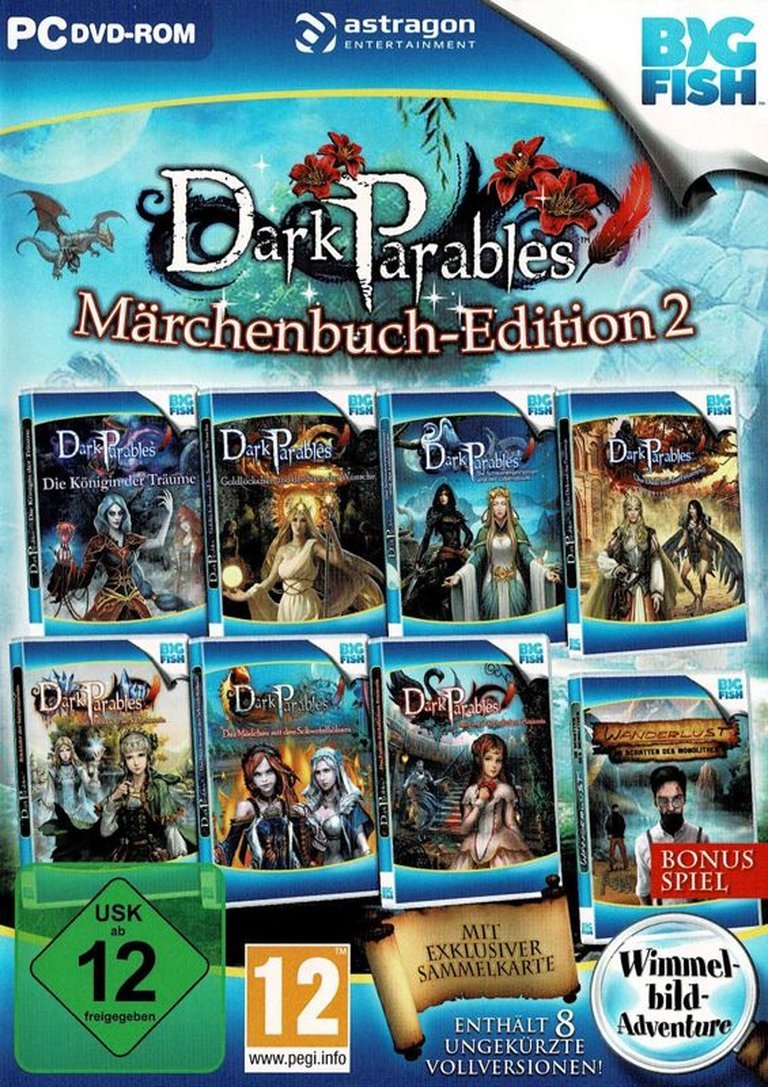
Dark Parables: Märchenbuch-Edition 2 is a compilation of eight hidden object adventure games from the Dark Parables series, including titles like ‘Queen of Sands,’ ‘Goldilocks and the Fallen Star,’ and ‘The Swan Princess and The Dire Tree.’ Set in a dark fairy-tale universe, each game weaves classic stories into eerie, mystery-driven narratives where players solve puzzles, uncover secrets, and explore atmospheric worlds filled with supernatural intrigue.
Dark Parables: Märchenbuch-Edition 2 – A Definitive Retrospective on a Hidden Object Masterpiece
Introduction: The Legacy of a Fairy Tale Odyssey
Few game series have so meticulously woven the threads of folklore, mystery, and interactive storytelling as Dark Parables. A brainchild of Blue Tea Games and later Eipix Entertainment, the franchise reimagines classic fairy tales through a gothic, often sinister lens, blending hidden object gameplay with deep narrative intrigue. Dark Parables: Märchenbuch-Edition 2, released in September 2020, is not a standalone title but a retail compilation—a curated anthology of seven mainline Dark Parables games and one spin-off, Wanderlust: Shadow of the Monolith. This collection serves as both a celebration of the series’ golden era and a testament to its enduring appeal in the hidden object puzzle adventure (HOPA) genre.
This review will dissect Märchenbuch-Edition 2 with surgical precision, exploring its development history, narrative depth, gameplay mechanics, artistic direction, and cultural impact. We will argue that while the compilation itself is a convenient but unremarkable packaging of existing content, the games it contains represent some of the most ambitious storytelling in casual gaming, elevating the HOPA genre beyond mere object-hunting into the realm of interactive dark fantasy.
Development History & Context: The Evolution of a Fairy Tale Empire
The Birth of a Franchise: Blue Tea Games and the HOPA Revolution
The Dark Parables series debuted in 2010 with Curse of Briar Rose, developed by Blue Tea Games, a studio that had already made waves with titles like The Secret of the Dragon and The Scruffs. The HOPA genre, at the time, was dominated by Big Fish Games’ publishing juggernaut, with franchises like Mystery Case Files and Azada setting the standard. However, Dark Parables distinguished itself by:
- Reimagining fairy tales as horror-tinged mysteries (e.g., The Exiled Prince’s Frog Prince as a monstrous predator).
- Introducing a recurring protagonist: The Fairytale Detective, a silent but deeply characterized investigator whose journal entries and moral dilemmas gave the series unprecedented narrative continuity.
- Expanding beyond simple hidden object scenes with elaborate puzzles, inventory-based challenges, and branching storylines.
By 2012, the series had gained enough traction that Eipix Entertainment—a Serbian studio known for Final Cut and Myths of the World—began co-developing entries. This transition marked a shift in artistic direction, with Eipix introducing:
- More cinematic cutscenes and higher-resolution artwork.
- Deeper integration of parables (lore-rich collectible stories that expanded the worldbuilding).
- A darker, more mature tone, particularly in titles like Requiem for the Forgotten Shadow (2017).
The Märchenbuch-Edition 2: A Compilation in the Twilight of Physical Media
By the late 2010s, the HOPA market had shifted almost entirely to digital distribution. Physical PC game releases were becoming rarer, reserved mostly for budget compilations or collector’s editions. Märchenbuch-Edition 2, published by astragon Entertainment GmbH, is a DVD-ROM release that bundles:
- Dark Parables: Queen of Sands (2015)
- Dark Parables: Goldilocks and the Fallen Star (2015)
- Dark Parables: The Swan Princess and The Dire Tree (2016)
- Dark Parables: The Thief and the Tinderbox (2016)
- Dark Parables: Return of the Salt Princess (2018)
- Dark Parables: The Match Girl’s Lost Paradise (2018)
- Dark Parables: Portrait of the Stained Princess (2019)
- Wanderlust: Shadow of the Monolith (a spin-off)
This compilation is not a “best-of” but rather a mid-to-late-era showcase, featuring titles from 2015–2019—a period where Eipix had fully taken the reins. The inclusion of Wanderlust, a non-Dark Parables game, is puzzling but may have been a publisher’s decision to pad the package.
Technological Constraints and the HOPA Formula
HOPA games are often dismissed as “casual” due to their low system requirements and accessible gameplay. However, Dark Parables pushed the boundaries of what the genre could achieve within these constraints:
- Engine Limitations: Most entries use proprietary engines optimized for 2D backgrounds with 3D character overlays, a cost-effective approach that allowed for detailed hand-painted environments.
- Puzzle Design: Unlike many HOPAs that rely on repetitive object hunts, Dark Parables incorporated logic puzzles, cipher wheels, and even light RPG elements (e.g., The Thief and the Tinderbox’s wish-based mechanics).
- Voice Acting & Localization: Later entries featured full voiceovers, though the Fairytale Detective remained silent, reinforcing their role as the player’s avatar.
The decline of Flash-based games and the rise of mobile gaming in the 2010s forced HOPA developers to adapt. Dark Parables did so by embracing Steam and mobile ports, though Märchenbuch-Edition 2’s DVD-ROM format feels like a nostalgic relic in an era of digital storefronts.
Narrative & Thematic Deep Dive: Fairy Tales as Psychological Horror
The Overarching Mythos: The Fairytale Detective and the Parables
At the heart of Dark Parables is the Fairytale Detective, a mysterious investigator who traverses darkened versions of classic fairy tales. Unlike traditional protagonists, the Detective is largely silent, with their personality conveyed through:
- Journal entries (which evolve from simple case notes to philosophical reflections).
- Moral choices (e.g., The Match Girl’s Lost Paradise forces players to decide whether to destroy a cursed artifact or use it for personal gain).
- Recurring characters, such as the Red Riding Hood Sisters (a warrior order) and Mother Gothel (a morally ambiguous witch).
The Parables System, introduced in Rise of the Snow Queen (2011), is the series’ most innovative narrative device. These are lore fragments collected throughout each game, revealing:
- Backstories of villains (e.g., Queen of Sands’ Hubert, a perfumer who trapped a Sandman in a bottle).
- Alternate endings to fairy tales (e.g., The Exiled Prince’s Frog Prince as a cursed immortal).
- Connections between games (e.g., Return of the Salt Princess ties into The Final Cinderella’s Godmother arc).
Game-by-Game Narrative Analysis
1. Queen of Sands (2015) – The Horror of Dreams
- Premise: A French town is overrun by nightmare creatures linked to a perfume empire.
- Themes: Greed vs. Artistry (Hubert’s descent into madness mirrors Dorian Gray).
- Standout Parable: The Fallen Keeper – A Sandman corrupted by hatred, forcing the Moon Goddess to destroy him.
2. Goldilocks and the Fallen Star (2015) – Mechanical Beasts and Cosmic Wishes
- Premise: A kingdom is invaded by clockwork monsters, tied to a fallen star’s magic.
- Themes: The Cost of Wishes (Queen Valla’s automaton body is a tragic metaphor for lost humanity).
- Standout Parable: The Fallen Star – A celestial artifact coveted by two goddesses, leading to a divided world.
3. The Swan Princess and The Dire Tree (2016) – Ecological Catastrophe
- Premise: A magical seed is stolen, causing an island to crack apart.
- Themes: Nature’s Wrath (The Swan Princess’ eco-terrorism is framed as both justified and monstrous).
- Standout Parable: Uprise of the Swan – Elise’s trauma-driven rebellion against the goddess Flora.
4. The Thief and the Tinderbox (2016) – Pyromania and Cursed Artifacts
- Premise: A rogue arsonist threatens a wedding, tied to a cursed tinderbox.
- Themes: Obsession and Betrayal (The botanist’s unrequited love fuels the fire).
- Standout Parable: The Curse Is Born – A goldfish’s revenge on a greedy king.
5. Return of the Salt Princess (2018) – Alchemical Horror
- Premise: A city turns to salt, linked to a missing princess and dragonflies.
- Themes: Immortality’s Curse (The Salt Princess’ exile as a metaphor for preservation).
- Standout Parable: The Exiled Witch – A forbidden magic practitioner seeking revenge.
6. The Match Girl’s Lost Paradise (2018) – Urban Legend as Tragedy
- Premise: A mysterious match girl is tied to spontaneous combustions.
- Themes: Childhood Trauma (Giselle’s abandonment and the witch’s maternal role).
- Standout Parable: The Forest Witch – A fragmented soul trying to atone for past sins.
7. Portrait of the Stained Princess (2019) – Art as a Weapon
- Premise: A cursed painting merges art and reality.
- Themes: The Danger of Beauty (The princess’ portrait as a prison).
- Standout Parable: The Princess from the Moon – A celestial exile punished for loving a mortal.
Recurring Themes Across the Series
- The Corruption of Purity – Nearly every “Cinderella” or “Princess” figure is either a victim or a villain.
- The Cost of Immortality – Characters like the Frog Prince and Salt Princess suffer eternal loneliness.
- Nature’s Vengeance – From the Snow Queen’s sorrow to the Dire Tree’s collapse, ecology is both sacred and dangerous.
- The Illusion of Happy Endings – Every fairy tale is recontextualized as a lie (e.g., The Little Mermaid’s tragic original ending).
Gameplay Mechanics & Systems: Beyond Hidden Objects
Core Gameplay Loop: Investigation, Puzzles, and Moral Choices
Dark Parables follows a three-tiered structure:
-
Hidden Object Scenes (HOS)
- Traditional lists (e.g., “Find 12 items in a cluttered room”).
- Interactive HOS (e.g., Goldilocks’ mechanical beasts that must be disarmed).
- Morphing Objects (items that change appearance, adding replayability).
-
Puzzle Solving
- Inventory-based challenges (e.g., The Thief and the Tinderbox’s wish-granting mechanics).
- Mini-games (e.g., The Swan Princess’ seed-planting logic puzzle).
- Cipher Wheels & Runes (often tied to lore, like the Moon Goddess’ symbols).
-
Narrative Progression
- Dialogue trees (limited but impactful, e.g., Portrait of the Stained Princess’ artistic dilemmas).
- Multiple Endings (some games offer morally ambiguous conclusions).
Innovations and Flaws
✅ Strengths:
– Parables System – Encourages exploration and lore immersion.
– Recurring Characters – The Red Riding Hood Sisters and Mother Gothel create series-wide continuity.
– Atmospheric Puzzles – Many challenges tie into the story (e.g., Return of the Salt Princess’ alchemical distillery).
❌ Weaknesses:
– Repetitive HOS Design – Some scenes feel padded for length.
– Occasional Pixel Hunting – A few poorly lit areas make object-finding frustrating.
– Limited Player Agency – Despite moral choices, the Detective’s silence can feel detached.
UI and Accessibility
- Hint System: A rechargeable hint button prevents excessive frustration.
- Map & Fast Travel: Later entries allow instant teleportation between key locations.
- Difficulty Options: Players can toggle HOS sparkles (highlighting objects) and puzzle skips.
World-Building, Art & Sound: A Gothic Storybook Brought to Life
Visual Direction: From Hand-Painted to Cinematic
- Early Blue Tea Games Era (2010–2014):
- Whimsical but dark (e.g., Curse of Briar Rose’s thorny Scottish castles).
- Limited animation (characters often slide between poses).
- Eipix Entertainment Era (2015–2019):
- Higher-resolution backgrounds (e.g., Queen of Sands’ lush French countryside).
- More fluid animations (e.g., The Swan Princess’ transforming swans).
- Darker color palettes (e.g., Requiem for the Forgotten Shadow’s monochrome Anaben).
Sound Design & Music: Haunting Melodies
- Composer: Aleksandar Dimitrijević (Eipix’s in-house composer) crafted orchestral scores with:
- Leitmotifs (e.g., the Snow Queen’s icy theme recurs in Rise of the Snow Queen).
- Diegetic Music (e.g., Ballad of Rapunzel’s haunting lullabies).
- Ambient Sounds:
- Crackling fires (The Thief and the Tinderbox).
- Howling winds (The Match Girl’s Lost Paradise).
- Mechanical whirring (Goldilocks and the Fallen Star).
Atmosphere: A Fairy Tale Noir
The series excels in immersive dread, blending:
– Gothic Architecture (crumbling castles, overgrown gardens).
– Surreal Horror (e.g., Portrait of the Stained Princess’ living paintings).
– Psychological Depth (e.g., Return of the Salt Princess’ salt-encrusted ruins as a metaphor for decay).
Reception & Legacy: From Niche HOPA to Cult Classic
Critical Reception: A Divided but Devoted Fanbase
- Casual Game Critics:
- Praised for storytelling depth (Adventure Gamers called it “the thinking person’s HOPA”).
- Criticized for occasional clunky design (Gamezebo noted repetitive puzzles in later entries).
- Player Reception:
- Steam Reviews: Mostly Very Positive (e.g., Portrait of the Stained Princess sits at 85% positive).
- Fan Theories: The Fairytale Detective’s true identity remains a hotly debated topic (Are they immortal? A goddess?).
Legacy: Influencing the HOPA Genre
- Inspired Competitors:
- Grim Tales (similar dark fairy tale themes).
- Myths of the World (Eipix’s other lore-heavy series).
- Evolution of HOPA:
- Proved that hidden object games could have deep narratives.
- Popularized collectible lore systems (now seen in The Darkside Detective and Lamplight City).
The Future: A Series in Limbo
- No New Entries Since 2019 – Fans speculate about cancelation or rebranding.
- Mobile Ports – Some titles (Queen of Sands) are available on iOS/Android, but later entries remain PC-exclusive.
- Potential Revival? – With resurgence in narrative-driven indies, a Dark Parables remaster or sequel could thrive.
Conclusion: A Masterclass in Fairy Tale Horror
Dark Parables: Märchenbuch-Edition 2 is not a groundbreaking release—it is, at its core, a convenient bundle of existing games. However, the titles it contains represent some of the most ambitious storytelling in casual gaming, blending:
✔ Gothic reimaginings of classic fairy tales.
✔ Deep lore through the Parables System.
✔ Atmospheric puzzles that enhance the narrative.
✔ Haunting visuals and sound design.
While the HOPA genre is often dismissed as “simple,” Dark Parables proves that even hidden object games can deliver emotional weight, moral complexity, and world-building depth.
Final Verdict: 9/10 – A Must-Own for HOPA Enthusiasts and Fairy Tale Aficionados
Pros:
✅ Rich, interconnected storytelling.
✅ Gorgeous hand-painted environments.
✅ Innovative use of fairy tale tropes.
Cons:
❌ Some repetitive hidden object scenes.
❌ Occasional pixel-hunting frustrations.
❌ Physical release feels outdated in 2024.
Who Should Play?
– Fans of dark fantasy (think Brothers Grimm meets Silent Hill).
– HOPA veterans looking for more than just object hunts.
– Lore hunters who love piecing together fragmented narratives.
Dark Parables: Märchenbuch-Edition 2 is not just a compilation—it’s a museum of modern fairy tale horror, and it deserves a place in any adventure game library.
Final Thought: If this is truly the end of Dark Parables, then the series has left behind a legacy as enduring as the fairy tales it redefined. But if a revival ever comes? The Fairytale Detective’s next case cannot come soon enough. 🔍📖