
- Release Year: 2019
- Platforms: PlayStation 4, Windows, Xbox One
- Publisher: Bandai Namco Entertainment America Inc.
- Developer: FromSoftware
- Genre: Compilation
- Perspective: Third-person
- Game Mode: Online Co-op, Single-player
- Gameplay: Action RPG
- Setting: Dark fantasy
- Average Score: 82/100
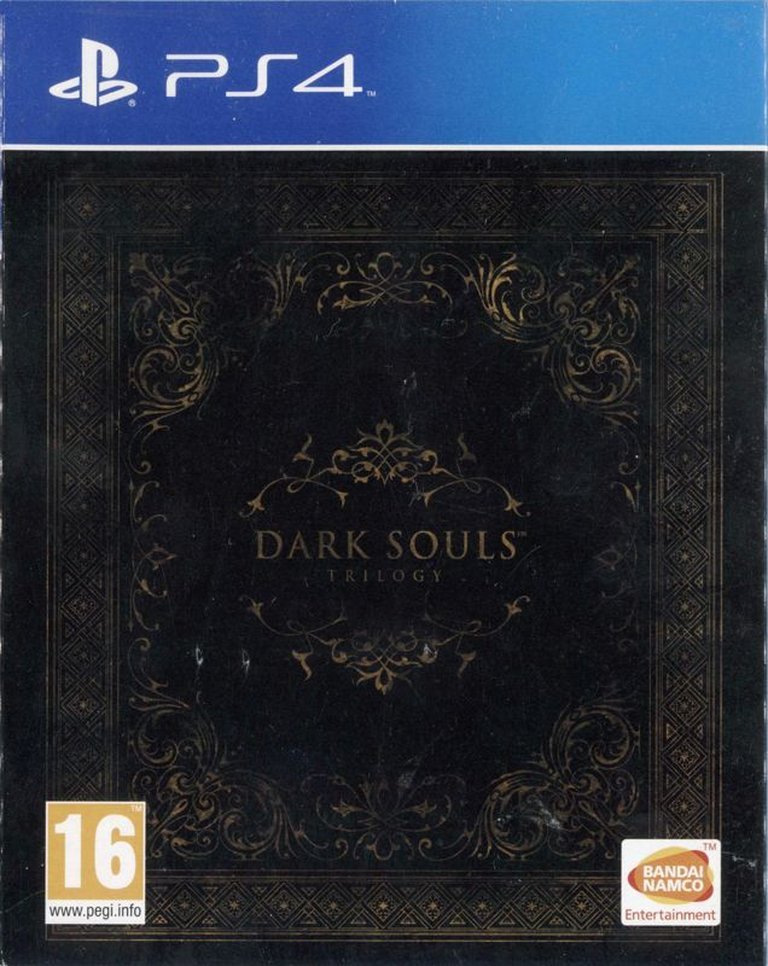
Description
Dark Souls Trilogy is a comprehensive compilation bundling the entire acclaimed action RPG series, including Dark Souls: Remastered, Dark Souls II: Scholar of the First Sin, and Dark Souls III: The Fire Fades Edition, alongside all their respective DLC expansions. Set in a dark, decaying fantasy world where the fading First Flame divides light from shadow, players navigate perilous environments filled with formidable foes and intricate lore, uncovering the epic saga of gods, dragons, and humanity’s struggle against eternal cycles of death and rebirth.
Gameplay Videos
Where to Buy Dark Souls Trilogy
PC
Dark Souls Trilogy Reviews & Reception
reddit.com : It was an absolute experience to say the least. One of the finest moments in my entire time playing videogames.
pixeldie.com : Dark Souls II stands as it’s finest achievement.
gameluster.com : I can see why Dark Souls is seen as one of the most influential games of all time
Dark Souls Trilogy: Review
Introduction
In the pantheon of video game masterpieces, few series command the reverence and scholarly attention as Dark Souls. FromSoftware’s trilogy—Dark Souls (2011), Dark Souls II (2014), and Dark Souls III (2016)—redefined the action-RPG genre through its punishing difficulty, intricate lore, and philosophical depth. Hidetaka Miyazaki’s magnum opus is not merely a collection of games but a haunting meditation on cycles, sacrifice, and the nature of existence. This trilogy transcends entertainment, becoming a cultural touchstone that birthed the “Soulslike” subgenre and cemented itself as a benchmark for narrative ambiguity and world-building. Its legacy endures not in linear storytelling but in the echoes of its themes—fire fading, darkness rising, and the burden of immortality. This review dissects the trilogy’s development, narrative, mechanics, art, and enduring impact, arguing that Dark Souls is a watershed moment that elevated video games to the realm of mythic literature.
Development History & Context
The trilogy emerged from the ashes of Demon’s Souls (2009), FromSoftware’s PS3-exclusive “spiritual successor” to its own King’s Field series. When Sony retained the Demon’s Souls IP, Miyazaki pivoted to create Dark Souls as a multi-platform experience, leveraging the PS3 and Xbox 360’s capabilities to build interconnected worlds. The first game’s development was constrained by limited hardware, forcing Miyazaki to innovate through environmental storytelling and minimalist design—resulting in a labyrinthine world where geography itself told stories of decay and grandeur.
Dark Souls II, directed by Tomohiro Shibuya under Miyazaki’s supervision, faced a unique challenge: sustaining the series’ identity without its visionary. Released in 2014 amid the PS4/Xbox One transition, it addressed fan feedback by refining mechanics (e.g., adaptability stat) but diluted the lore’s cohesion. The 2015 Scholar of the First Sin re-edition rebalanced difficulty and added narrative layers, framing King Vendrick’s kingdom as a tragic experiment in breaking the curse.
Dark Souls III (2016) served as Miyazaki’s swan song. Faster-paced, influenced by Bloodborne, and designed as a “conclusion” to the cycle, it capitalized on the PS4/XB1’s power for grander vistas and tighter combat. The trilogy’s arc mirrored its own narrative: a fading flame reignited by ambition, a temporary staving of decay, and a final, somber acknowledgment of inevitability.
Narrative & Thematic Deep Dive
The trilogy’s narrative is a fractal of cyclical tragedy, rooted in cosmology and philosophy. Its core mythos—detailed across item descriptions, environmental cues, and pieced-together lore by scholars like those at Dark Souls Store—begins in the “Age of Ancients,” an era of fog and immortal dragons. The First Flame’s birth introduced disparity: light/dark, life/death, and the four Lord Souls claimed by Gwyn (Light), the Witch of Izalith (Life), Nito (Death), and the Furtive Pygmy (Dark).
Gwyn’s war against the dragons and subsequent reign ushered in the “Age of Fire,” a golden age marked by prosperity but built on a lie. As the Flame faded, Gwyn sacrificed himself to link it, cursing humanity with undeath. This act birthed the central conflict: perpetuate the fire (and suffering) or embrace the Age of Dark, where humanity’s inherent dark soul would rise.
- Dark Souls: The player, the “Chosen Undead,” is a pawn in gods’ schemes. Frampt and Kaathe, primordial serpents, represent opposing factions: one advocating for fire, the other for dark. The Kiln of the First Flame offers a binary choice: rekindle the flame or become a Dark Lord. Both endings perpetuate the cycle, underscoring the futility of choice.
- Dark Souls II: Set in Drangleic, the story explores the curse’s perversion. King Vendrick, manipulated by Nashandra (a shard of Manus, the “Father of the Abyss”), wages war against giants, only to seal himself away in defeat. The “Bearer of the Curse” confronts Nashandra at the Throne of Want, again facing the rekindle-or-darkness dilemma. Aldia’s research, however, hints at a third path: usurping the flame to break the cycle, a theme expanded in the trilogy’s finale.
- Dark Souls III: The “Ashen One” gathers Lords of Cinder—resurrected heroes who abandoned their duty—to confront the fading flame. The Soul of Cinder, a amalgamation of all past Lords, embodies the cycle’s weight. Endings include rekindling the flame, letting it die, or usurping it to become a “Lord of Hollows,” proposing a new equilibrium.
Themes permeate these narratives: the burden of immortality (Hollowing), the corruption of power (Seath’s experiments, the Abyss), and the tragedy of inherited will. Even secondary stories—Artorias’s fall to the Abyss, the Painted World of Ariandel’s rot—echo the cycle, making the trilogy a grim tapestry of cause and consequence.
Gameplay Mechanics & Systems
Dark Souls redefined progression by integrating failure as feedback. Its core loop—explore, die, learn, adapt—demands mastery through repetition. Souls, dropped upon death, act as currency and experience points, creating high-stakes risk-reward. Bonfires serve as checkpoints, restoring health and but respawning enemies, turning retreat into a strategic dilemma. The “bloodstain” mechanic, allowing recovery of lost souls if the player reaches their death point, balanced punishment with redemption.
Combat emphasizes weight, timing, and resource management. Stamina governs attacks, dodges, and blocking, punishing aggression. Parrying and backstaps reward precision, while magic (pyromancy, sorcery) and miracles cater to diverse playstyles. Multiplayer, seamlessly woven into single-player, includes co-op (summoning phantoms), PvP (invasion), and asynchronous messages (warnings, tips), fostering emergent community.
Dark Souls II refined systems like adaptability (reducing stun and increasing i-frames) and introduced durability, but its PvP-focused design diluted the first game’s atmospheric tension. Dark Souls III accelerated combat, borrowing Bloodborne’s agility, yet retained the series’ soulful weight. All three games share a genius for accessibility: difficulty stems from player skill, not artificial barriers, turning frustration into triumph.
World-Building, Art & Sound
FromSoftware’s worlds are characters in themselves. Lordran (Dark Souls) is a decaying kingdom of gothic spires (Anor Londo), toxic swamps (Blighttown), and catacombs, all linked by verticality and decay. Drangleic (Dark Souls II) is a fragmented ruin, mirroring its fractured narrative, while Lothric (Dark Souls III) blends ash, fire, and haunting echoes of past ages. Art direction emphasizes subtlety: crumbling statues, overgrown ruins, and enemy design (e.g., Bed of Chaos’s organic horror) reflect themes of entropy and hubris.
Sound design complements this desolation. Motoi Sakuraba’s and Yuka Kitamura’s score blends choir and orchestral dread, with leitmotifs for locations (Gwyn’s haunting piano) and bosses (Kalameet’s thunderous strings). Ambient sounds—wind, creaking wood, distant screams—immerse players in worlds where silence is more terrifying than noise. The trilogy’s aesthetic, rooted in Western gothic and Lovecraftian horror, creates a persistent sense of dread, making every bonfire a rare respite.
Reception & Legacy
Upon release, Dark Souls was hailed as a “masterpiece” (Metacritic: 89/100) for its innovation, despite initial criticism of its difficulty. Dark Souls II (91/100) polarized fans for its departure from Miyazaki’s vision but sold millions. Dark Souls III (89/100) was celebrated as a fitting, if melancholic, conclusion, selling over 10 million copies and becoming Bandai Namco’s fastest-selling game until Elden Ring.
Culturally, the trilogy birthed “Soulslikes” (e.g., Sekiro, Elden Ring) and influenced industry standards for difficulty and environmental storytelling. Its lore became a cottage industry of fan theories, academic papers, and YouTube deep-dives. Patches the Hyena, recurring across games, symbolized the series’ love for recurring motifs. The trilogy’s legacy extends beyond gaming: its themes of cyclical suffering resonate in modern discourse on capitalism, climate change, and existentialism. As of 2024, the series has shipped 37+ million copies, cementing its place in the canon.
Conclusion
Dark Souls Trilogy is more than a series of games; it is a philosophical opus etched in fire and ash. FromSoftware’s triumph lies in transforming mechanical rigor into existential poetry—every death, every boss, every bonfire tells a story of struggle against inevitability. While its narrative thrives on ambiguity, its gameplay innovations and world-building set new standards for interactive art. The trilogy’s cyclical structure mirrors its own creation: a rebirth of ideas refined across three acts.
In the end, Dark Souls is a testament to the medium’s potential: it challenges players not with cheap tricks, but with questions about choice, consequence, and the will to persist. Its legacy is one of resilience—a reminder that in a world of fading flames, the human spirit persists, hollowed yet unbroken. For historians, it is a landmark; for players, it is a crucible. Verdict: An unparalleled masterpiece that redefined gaming’s boundaries and will echo through the ages.