
- Release Year: 2010
- Platforms: Windows
- Publisher: Iceberg Interactive B.V., Noviy Disk
- Developer: Zoetrope Interactive
- Genre: Adventure
- Perspective: First-person
- Game Mode: Single-player
- Gameplay: Puzzle
- Setting: Lovecraftian
- Average Score: 78/100
Description
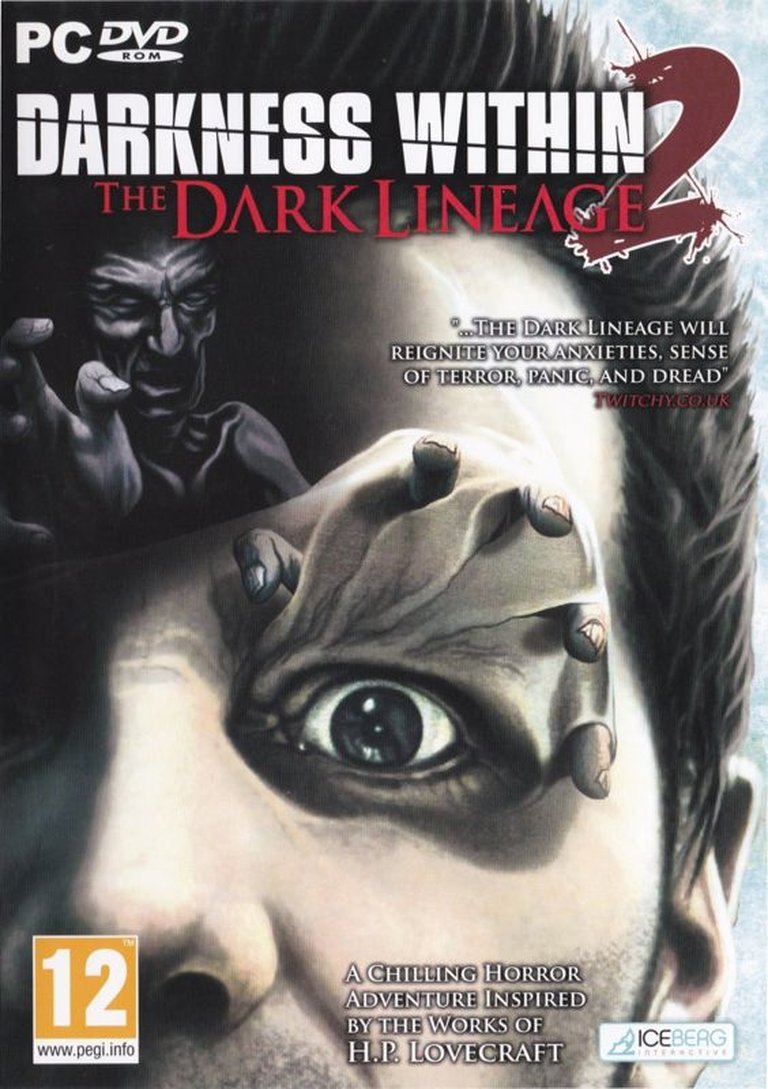
Darkness Within 2: The Dark Lineage is a first-person puzzle adventure game immersed in a mysterious, depressive atmosphere inspired by H.P. Lovecraft’s mythos. Players follow detective Howard Loreid, who awakens with amnesia in a remote cottage and is compelled by a cryptic letter to investigate the sinister town of Arkhamend. The game features full 3D exploration, fluid movement similar to first-person shooters, and an inventory system where players combine items and use ‘thinking’ mechanics to extract clues, all while navigating horror elements and detective storytelling.
Gameplay Videos
Where to Buy Darkness Within 2: The Dark Lineage
PC
Darkness Within 2: The Dark Lineage Cracks & Fixes
Darkness Within 2: The Dark Lineage Patches & Updates
Darkness Within 2: The Dark Lineage Mods
Darkness Within 2: The Dark Lineage Guides & Walkthroughs
Darkness Within 2: The Dark Lineage Reviews & Reception
gamepressure.com (67/100): Sound effects create an atmosphere full of darkness and horror.
adventureclassicgaming.com : Darkness Within 2: The Dark Lineage is a brilliant and worthy sequel to Darkness Within: In Pursuit of Loath Nolder.
gamesreviews2010.com (90/100): A Must-Play for Horror Fans
Darkness Within 2: The Dark Lineage: A Cult Classic’s Descent into Lovecraftian Horror
Introduction: The Shadows of a Niche Sequel
In the landscape of 2010’s video game industry, dominated by cinematic action blockbusters and the nascent boom of independent digital storefronts, Darkness Within 2: The Dark Lineage existed as a defiant, almost anachronistic artifact. Developed by the Turkish studio Zoetrope Interactive and published by Iceberg Interactive, this first-person adventure horror title was a direct sequel to the 2007 game Darkness Within: In Pursuit of Loath Nolder. Its central thesis was audacious: to translate the ineffable, psychological dread of H.P. Lovecraft’s Cthulhu Mythos into the interactive language of a point-and-click adventure, but with the spatial freedom of a first-person shooter. The result is a game that is profoundly ambitious, deeply atmospheric, and yet fundamentally fissured by its own design contradictions. This review will argue that The Dark Lineage is a critical, if flawed, evolution in the niche genre of narrative-driven horror adventures—a game that successfully captures the cosmic terror of its literary inspirations while being intermittently undermined by clunky mechanics and a narrative that struggles under the weight of its own mythology. Its legacy is not one of mainstream acclaim, but of a potent, enduring cult fascination that cemented a specific, tactile approach to Lovecraftian game design.
Development History & Context: A Studio Forging a Path in the Dark
Darkness Within 2 was the product of Zoetrope Interactive, a developer whose very name evokes a sense of classic, mechanistic artistry. Founded in Turkey, the studio’s core team—led by the Şamlı brothers (Onur and Oral) and programmer Galip Kartoğlu—was small, passionate, and deeply conversant with the horror genre. Their vision for the Darkness Within series was explicitly, proudly Lovecraftian, positioning themselves as inheritors of a tradition that emphasized atmospheric buildup, existential dread, and the fragility of the human mind over visceral action.
The development context is defined by a single, pivotal technological leap. The original Darkness Within employed pre-rendered backgrounds and static, Myst-style navigation, a common approach for PC adventure games of the mid-2000s. For the sequel, Zoetrope made a decisive shift to a proprietary, fully 3D real-time engine powered by NVIDIA’s PhysX technology. This was a significant technical undertaking for a small studio. The move granted players free first-person movement, dynamic lighting with real-time soft shadows, and—most distinctively—the ability to physically interact with the environment: lifting, pushing, pulling, and throwing objects. As per the official descriptions, this was marketed as creating “a fresh and realistic gaming experience which was not seen in any other adventure game.” It placed the game in a unique interstitial space: part puzzle adventure, part immersive simulator, all filtered through a horror lens. This era (2010) saw adventure games in a state of flux, with traditional click-and-move titles increasingly seen as retro, while the industry standard for first-person experiences was firmly in the FPS/RPG domain. The Dark Lineage tried to carve a new path, merging the contemplative pacing of adventures with the environmental interactivity of newer engines.
The gaming landscape of 2010 was also witnessing a resurgence of horror, but primarily through action-oriented titles like Amnesia: The Dark Descent (released later that year) and the Dead Space series. Zoetrope’s game was more classical, relying on slow-burn tension, extensive textual lore, and puzzle-solving as its primary verbs, making it a decidedly niche product upon release.
Narrative & Thematic Deep Dive: The Haunting of Howard Loreid
The narrative of The Dark Lineage is a direct continuation of its predecessor, returning players to the beleaguered psyche of Police Detective Howard Loreid. If the first game was about a man grappling with external paranormal horrors, the second turns the lens inward with terrifying precision. The plot begins with a disoriented Howard awakening in an isolated cottage, amnesiac regarding his arrival, with only a cryptic letter instructing him to find the town of Arkhamend. This premise immediately establishes the core themes: the unreliability of memory, the porosity of sanity, and the inescapability of bloodline.
The story unfolds as a conspiracy of history. Howard’s investigation in Arkhamend—a “sleepy, depressing town” that serves as a perfect Lovecraftian stand-in for Innsmouth or Arkham—reveals that his own grandfather was a pivotal figure in a dark occult lineage. The “Dark Lineage” of the title is literal: a hereditary curse or pact that dooms Howard to a fate intertwined with cosmic, incomprehensible entities. The narrative is delivered through a classic adventure game trope—the collected document—but leverages it with superb effect. As chronicled in detailed reviews, Howard must “read journals, notes, and books very carefully,” and the world is saturated with them. These texts do more than provide clues; they build the tragic history of the Loreid family. His grandmother’s diaries offer moments of poignant self-sacrifice, adding emotional gravity to what could have been a simple tale of ancestral evil. This familial grounding makes the cosmic horror personal, a technique that aligns with Lovecraft’s own best work, where the terror is most potent when it invades the domestic and the familiar.
Thematically, the game is a masterclass in psychological horror. Howard’s sanity is a visible gameplay mechanic; his vision “blurs whenever he is scared,” a brilliant diegetic effect that makes the player complicit in his deteriorating mental state. The line between dream, hallucination, and reality is constantly blurred. Are the monstrous visions glimpses of true cosmic entities, or are they the projections of a mind snaping under the weight of forbidden knowledge? The game smartly never fully clarifies, forcing the player to question what they are seeing. The central, Lovecraftian idea—that some truths are too vast and terrible for the human mind to bear—is operationalized in Howard’s journey. The ultimate revelation is not of a monster to be killed, but of a legacy and a truth that threatens to consume his identity. The existence of two possible endings (as noted in the Adventure Classic Gaming review) speaks to this, offering a choice between a grim acceptance of this lineage or a desperate, likely futile, resistance—both valid responses to cosmic horror’s indifference.
Gameplay Mechanics & Systems: Freedom Fractured
Darkness Within 2’s most significant and discussed innovation is its first-person 3D movement with Physics-Based Interaction. Replacing the static Myst-style navigation, this system allows Howard to walk freely through environments, carry a lantern or flashlight, and physically manipulate objects. The NVIDIA PhysX integration is the star: boxes can be pushed aside to reveal hidden switches, heavy objects must be dragged, and environmental puzzles require spatial reasoning. This immediately elevates the game from a slideshow to an immersive space, making exploration feel active and investigative. Finding a key under a rug or moving a wardrobe to access a passage has a tangible, satisfying weight that point-and-click lacks.
However, this freedom is tempered by two major, persistent systems. The first is the “Thought” Inventory System. Building on the first game, Howard has a “brain icon” that allows him to “think” about collected items, potentially combining them or extracting narrative clues. While conceptually fascinating—making item combination an act of deduction rather than arbitrary alchemy—its implementation is notoriously cumbersome. As the Adventure Classic Gaming review critiqued, “it is tedious clicking through all of them when trying to select an object” and “the mechanics of combining inventory items need to be better implemented. It is not clear to me which items… can be combined.” This creates friction, turning a system meant to enhance thematic connection into a source of frustration. The second major system is the Hint System with three difficulty levels: Standard, Detective, and Senior Detective. This is a genuinely progressive feature for a hardcore adventure game, allowing players to tailor the obscurity of clues. The “Standard” mode is even recommended by reviewers for its subtle guidance, acknowledging that the dense text and environmental cues can be overwhelming without some scaffolding.
The puzzle design is a mixed bag. On the positive side, they are integral to the narrative and environment. Puzzles involve deciphering family crests from documents, operating complex machinery based on Victorian-era mechanisms, mixing chemicals found in a laboratory, and using the camera’s flash to reveal hidden ink. There is a commendable coherence; you are not solving abstract puzzles but engaging with the world’s history and logic. The inclusion of “Easter Eggs” like the monkey’s paw (a nod to W.W. Jacobs) rewards observant players and deepens the literary horror atmosphere. On the negative side, several critics, including GameBoomers, found some puzzles “overly convoluted” and the endgame “messy.” The freedom of movement can sometimes work against puzzle clarity; what can be interacted with isn’t always telegraphed, leading to pixel-hunting frustrations despite the 3D space.
Finally, the combat and threat system is minimal, as expected for the genre. Danger comes from environmental hazards, psychological distress, and the ever-present threat of “what’s around the corner.” There is no health bar in a traditional sense; the blurring vision is the primary indicator of peril. This reinforces the game’s identity as a horror experience based on suspense and atmosphere, not combat prowess.
World-Building, Art & Sound: An Isle of Masterful Atmosphere
Where The Dark Lineage achieves undeniable, consistent success is in its world-building, art direction, and sound design. This is the game’s saving grace and its primary claim to historical significance. The environments—a “sleepy, depressing town,” a “Victorian mansion that conceals dark secrets,” “a dilapidated building hidden within forbidding, snow-clad woods,” and “dim underground buildings and tunnels”—are rendered with a consistently oppressive, gothic-decay aesthetic. The art team (led by Onur Şamlı, Oral Şamlı, and Erkan Ertürk) leverages the 3D engine’s lighting to spectacular effect. Light sources (the player’s lantern, flickering bulbs, rare daylight) cast dynamic, soft shadows that make every corner feel potentially alive with menace. The textures are detailed yet muted, favoring browns, grays, and deep blues to create a palette of exhaustion and morbidity. The “snow-clad woods” are not bright and serene but grim and muffling, a brilliant subversion of a typically peaceful setting.
The sound design and music, credited largely to Onur and Oral Şamlı with additional effects from notable industry freelancers, is equally masterful. The soundtrack is described as “dark and somber, more ambient than melodic,” comprising “haunting music” that lingers in the memory. Diegetic sound is used with precision: the frantic heartbeat during moments of fear is a genius touch, making the player’s own生理 response part of the feedback loop. Faint whisperings in empty halls, the distant howl of wolves (as noted in the Adventure Classic Gaming screenshots), and the creak of floorboards all contribute to an aural landscape of perpetual unease. The real-time cut scenes are praised for being “chilling,” avoiding pre-rendered video and maintaining immersion. This sensory cohesion—the look of a place where light struggles to exist, the sound of a world that is actively hostile—is what truly sells the Lovecraftian premise. You are not just exploring a scary place; you are inhabiting a place where reality itself feels thin, a perfect analog for Howard’s fracturing sanity.
Reception & Legacy: A Divisive Descent into Cult Status
Upon its May 2010 release, Darkness Within 2 received mixed-to-positive reviews from the dedicated adventure game press, reflected in its 70% average critic score on MobyGames (based on 6 reviews). The divide was stark and consistent.
* The Praise (80% – Adventure Island, Adventure Classic Gaming, Games Finder): Reviews in this camp celebrated its atmospheric supremacy, narrative ambition, and successful adaptation of Lovecraft. They highlighted the “superb” writing, the “spooky and immersive” environments, and the effective sanity mechanics. For Lovecraft fans, its commitment to theme over cheap jump-scares was its highest virtue.
* The Criticism (50-67% – Adventure Gamers, GameBoomers, Adventure Lantern): These reviews, while acknowledging the “impressive technical upgrade” and “excellent” graphics, consistently cited gameplay friction as the primary flaw. The “cumbersome” inventory, “overly convoluted” puzzles, and a plot that becomes “messy” and ends with “too many questions left unanswered” were recurring criticisms. Adventure Gamers succinctly stated that its “eerie atmosphere is somewhat spoiled by a few key issues that drain the potential enjoyment.”
Commercially, the game existed in the crowded, low-margin world of retail PC adventure games. Its exact sales figures are obscure, but its modest MobyScore (7.0, ranking outside the top 15,000 on the site) and low collection numbers (16 on MobyGames) suggest a limited commercial reach, confined mostly to European retail and digital storefronts like Steam (where it holds a “Mixed” rating with over 264 reviews as of recent data).
Its legacy is that of a cult artifact and a technical benchmark. For a specific subset of players—horror aficionados and adventure game traditionalists—it is remembered fondly as one of the most authentically Lovecraftian game experiences of its era. It proved that the Cthulhu Mythos could work in a slow, text-heavy, puzzle-based format, not just as backdrop for action. The 2014 Director’s Cut Edition, released on Steam, is a crucial part of this legacy. It addressed many original criticisms with “graphical refreshes,” a “brand new location,” “more balanced gameplay with new additional puzzles,” and post-processing effects that gave it a more “cinematic” look. This re-release significantly improved its accessibility and visual coherence, extending its lifespan and allowing a new audience to experience the game in a more polished state.
Its influence is subtle but present. It demonstrated the viability of dynamic lighting and physics for horror atmosphere in non-action games, a concept later refined by titles like Alien: Isolation (though that game took a different design tack). It also showed that a niche, story-first horror adventure could find an audience willing to forgive mechanical roughness for unparalleled mood. It sits in a direct lineage with other deliberate, literary horror adventures like The Black Mirror series or The Whale Voyage, emphasizing investigation and existential dread over survival mechanics.
Conclusion: A Flawed Jewel in the Cosmic Dark
Darkness Within 2: The Dark Lineage is a study in profound compromise and singular achievement. As a piece of software, it is undeniably janky. Its inventory system is a relic of a less-user-friendly era, some puzzles will infuriate with their opacity, and its narrative pacing stumbles toward a conclusion that feels both abrupt and over-explained. As an artifact of horror design, however, it is nearly peerless among its 2010 contemporaries. Zoetrope Interactive’s obsession with translating Lovecraft’s “cosmic horror”—the terror of the infinite, the ancestral, and the incomprehensible—into game mechanics and environments is largely successful. The blurring vision, the oppressive soundscape, the decaying yet beautiful 3D world, and the deeply personal family tragedy at the heart of the cosmic plot create an experience that lingers in the psyche long after the final, haunting cutscene.
Its place in video game history is not as a bestselling milestone or a genre-defining revolution. Instead, it is as a cult classic and a cautionary tale. It stands as a testament to what can be achieved when a small team with a pure, focused vision—to make you feel Lovecraft’s horror—is given just enough technological rope to build something truly immersive, even if that same rope sometimes tangles into frustrating knots. For the patient player willing to navigate its cumbersome interfaces and obtuse puzzles, The Dark Lineage offers a Journey into darkness that is uniquely its own: a slow, deliberate, and deeply unsettling descent into a lineage of madness that remains, in its best moments, a powerful interactive translation of literary horror’s greatest master. It is a flawed jewel, but its facets catch the light of a very particular and enduring type of dread.
Final Verdict: 7.5/10 – A cult classic for Lovecraftian purists and patient adventure gamers, held back from true greatness by dated interface design but elevated by an unparalleled atmosphere and thematic devotion.