
- Release Year: 2010
- Platforms: Windows
- Publisher: UIG Entertainment GmbH
- Developer: Contendo Media GmbH
- Genre: Puzzle
- Perspective: Fixed / flip-screen
- Game Mode: Single-player
- Gameplay: Tile matching puzzle
- Setting: Aztec, Pre-Columbian Americas
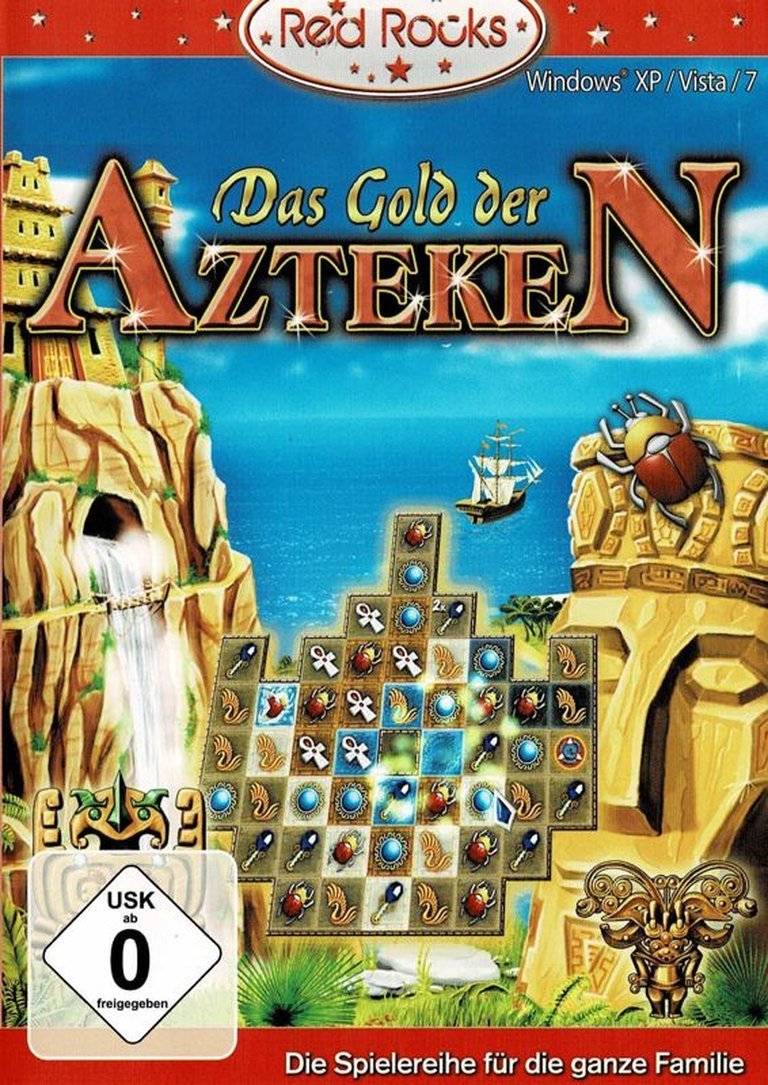
Description
Das Gold der Azteken is a tile-matching puzzle game set in the ancient Pre-Columbian Americas, specifically inspired by Aztec culture, where players embark on a quest to uncover 18 hidden objects across 90 challenging levels. By sliding rows of symbols to align and connect at least three identical ones, players score points and must meet specific targets in each level to progress, blending exploration with addictive match-3 gameplay.
Das Gold der Azteken: Review
Introduction
Imagine stumbling upon a dusty map in a dimly lit museum, its faded lines whispering of lost Aztec treasures buried for millennia amid ancient ruins and jagged peaks. This is the tantalizing hook of Das Gold der Azteken, a 2010 casual puzzle game that transports players to the sun-baked heart of Pre-Columbian Americas without ever leaving the comfort of their PC. Released as part of the budget-friendly Red Rocks series by UIG Entertainment, this title emerged in an era when casual gaming was exploding as a gateway for non-hardcore players, particularly families and those seeking bite-sized escapism. Its legacy lies in embodying the unpretentious charm of early 2010s match-3 puzzles—simple mechanics wrapped in exotic theming that could hook you for hours, yet fade into obscurity amid the flood of similar titles. As a game historian, I see it as a microcosm of the casual boom: accessible, thematic, and endlessly replayable, but lacking the depth to endure as a classic. My thesis? Das Gold der Azteken shines as a relaxing, family-oriented gem that cleverly adapts the match-3 formula with Aztec flair, offering addictive progression and visual allure, though its brevity and lack of innovation prevent it from transcending its genre confines.
Development History & Context
Das Gold der Azteken was developed by Contendo Media GmbH, a modest German studio known for producing low-budget casual titles in the late 2000s and early 2010s, often focusing on puzzle and hidden-object hybrids tailored for the European market. Published by UIG Entertainment GmbH (under the Red Rocks imprint), the game hit shelves on March 5, 2010, exclusively for Windows PCs, arriving as a CD-ROM physical release priced affordably at around €5-10. UIG, a specialist in distributing Eastern European and German-developed casual games, envisioned this as a family-friendly entry in their lineup of “no-handbook-needed” experiences—quick to learn, devoid of tutorials, and perfect for short sessions. The creators drew inspiration from the burgeoning casual gaming scene, where studios like PopCap and Big Fish were dominating with titles like Bejeweled and Zuma, emphasizing relaxation over complexity.
The technological constraints of 2010 shaped its unassuming design: built for Windows XP/Vista/7 with minimal specs (300 MHz CPU, 128 MB RAM, DirectX 9.x), it leveraged basic 2D graphics engines common to the era’s Flash-inspired PC games. Fixed/flip-screen visuals and point-and-select interfaces kept development costs low, allowing Contendo to prioritize thematic assets over cutting-edge tech. This was the heyday of the casual puzzle explosion, fueled by the rise of browser games and budget retail bundles; the market was saturated with match-3 variants, but Das Gold der Azteken stood out by tying mechanics to an Aztec narrative, capitalizing on the era’s fascination with ancient civilizations (echoed in games like The Settlers: Heritage of Kings Gold Edition from 2005). Amid economic recovery post-2008, casual titles like this thrived as affordable entertainment, targeting demographics underserved by AAA blockbusters—women, families, and casual players seeking stress relief. The developers’ vision was clear: blend addictive gameplay loops with cultural mystique to create “süchtig machend” (addictively fun) sessions, as noted by Red Rocks product manager Robin Gibbels, who highlighted its bunte (colorful) and spannend (exciting) appeal without overwhelming players.
Narrative & Thematic Deep Dive
At its core, Das Gold der Azteken weaves a lightweight adventure narrative that serves more as atmospheric framing than a deep story, fitting its casual roots. The plot kicks off in the Museum of World History, where the player—embodied as an anonymous explorer—stumbles upon a hidden map revealing 90 secret locations harboring 18 ancient artifacts and hoards of Aztec gold, concealed for thousands of years. This inciting incident propels a treasure-hunting odyssey across Pre-Columbian landscapes, evoking the historical allure of Hernán Cortés’ conquests without delving into the darker colonial implications. The story unfolds episodically across levels, with each puzzle representing a “dig site” where symbols like golden scepters, ruby scarabs, Ankh crosses, jeweled brooches, and ornate rings materialize as clues to the lost riches.
Characters are sparse and archetypal, limited by the genre’s focus on mechanics over role-playing. The player is a silent protagonist, customizable via family profiles (each member logs in with their name for separate saves), emphasizing communal play. No voiced dialogue exists—text is minimal, confined to level intros and shop prompts—creating a dialogue-free experience that relies on environmental storytelling. Pop-up hints and score recaps provide narrative nudges, like “Uncover the gold!” or “The Aztecs’ secrets await,” reinforcing the theme of discovery.
Thematically, the game romanticizes Aztec mysticism and the perils of greed, drawing loose parallels to historical lore (e.g., the Montezuma-era lyrics in unrelated cultural references about gold’s curse). Symbols evoke opulence and enigma—gold motifs symbolize wealth’s allure, while “thick stones” blocking rows hint at ancient traps guarding treasures. Underlying motifs include exploration’s thrill versus time’s pressure, with the optional relaxed mode underscoring relaxation over conquest. This light touch critiques avarice subtly: amassing points (gold) leads to power-ups, but failure resets rows, mirroring how unchecked ambition can backfire. Critically, the narrative lacks depth—no branching paths, moral choices, or character arcs—serving as a mere scaffold for puzzles. Yet, in its era, this simplicity was a strength, making it accessible for all ages and aligning with casual gaming’s ethos of escapist fantasy without heavy lore.
Gameplay Mechanics & Systems
Das Gold der Azteken revolves around a refined tile-matching puzzle loop, innovating on the match-3 staple by emphasizing row and column manipulation over individual swaps, creating a rhythmic, strategic flow. The core mechanic: players shift entire rows or columns of symbols on a vertical grid (starting small, expanding to larger boards) using point-and-click mouse controls. Align three or more identical symbols horizontally or vertically to “burst” them, earning points as new tiles cascade from above. Unlike Bejeweled‘s swaps, failed moves snap rows back, adding tension and punishing hasty plays— a clever constraint that demands foresight.
Progression ties to 90 levels across 18 artifact hunts, with escalating difficulty: boards grow complex, introducing immovable “thick stones” that limit shifts and colored backgrounds requiring full clearance to advance (decolorizing tiles “uncovers” the map’s secrets). Points thresholds per level gate progress, blending score-chasing with puzzle-solving. Earned currency unlocks the “Magieladen” (magic shop) for runes/power-ups: vanishing blockers, swapping tiles, or explosive symbols that clear radii when matched beyond threes. Combos yield supers (high-score icons) and bombs, rewarding chain reactions. Two modes enhance replayability—timed for adrenaline-fueled rushes (with time bonuses) or relaxed for zen-like sessions—catering to varied paces.
UI is intuitive and era-appropriate: a clean interface with profile selection, level map, score tracker, and shop tab; no clutter, but the fixed-screen view feels dated, lacking zoom or dynamic angles. Character progression is score-based, with family saves preserving high scores and unlocks, fostering competition. Innovations shine in the row-shift mechanic, promoting spatial planning over luck, and the artifact-collection meta-goal, which adds purpose beyond endless modes. Flaws include repetition—90 levels risk monotony without varied objectives—and limited depth; no multiplayer or post-game challenges. Overall, it’s flawlessly executed for casuals: addictive loops that Gibbels called “schnell, bunt und spannend,” clocking 5-10 hours for completionists, with bugs minimal per user reports.
World-Building, Art & Sound
The game’s world-building conjures a vivid, if stylized, Aztec-inspired realm without venturing into full simulation. Set in Pre-Columbian Americas, levels evoke hidden temples, jungle ruins, and sacred pyramids through symbolic tiles—golden idols, feathered serpents (Quetzalcoatl nods), and gem-encrusted relics—framing puzzles as excavation rituals. The overarching map serves as a lore hub, marking 90 sites from misty highlands to sun-drenched ziggurats, building immersion via progressive unlocks that reveal the “lost empire’s” grandeur. Atmosphere thrives on this exotic veneer: the treasure hunt narrative infuses puzzles with purpose, turning abstract matching into a mythic quest, though it stops short of interactive exploration or lore codexes.
Visually, the art direction is a highlight—lovevoll gestaltete (lovingly designed) 2D animations bring symbols to life with sparkling bursts, cascading falls, and explosive flair. Fixed-screen boards use vibrant palettes: golds and rubies pop against earthy backgrounds, with subtle Aztec motifs (stepped pyramids, calendar stones) in borders. Flip-screen transitions between levels maintain momentum, and power-up effects (e.g., rune glows) add polish. It’s not revolutionary—tied to 2010’s casual aesthetics—but the lebendige (lively) graphics ensure accessibility, drawing players (especially women, per market notes) into its colorful haze.
Sound design complements this with understated rhythms: tribal percussion and flutes underscore shifts, building tension in timed mode, while soft chimes reward matches for satisfying feedback. No voice acting keeps it light, but looping tracks vary by level (mystical drones for deep ruins, upbeat for surface digs), enhancing atmosphere without distraction. These elements synergize to create a cozy, immersive bubble—puzzles feel like unraveling ancient magic—elevating a simple game into an evocative escape that guarantees “unzählige Stunden Spielspaß” (countless hours of fun) for families.
Reception & Legacy
Upon 2010 release, Das Gold der Azteken flew under mainstream radar, typical for Red Rocks’ budget casuals—no major critic reviews on MobyGames, and sparse coverage beyond German sites like GamersGlobal (user average 5.5/10 from few votes) and Games-Guide previews praising its “moderne, vielseitige” (modern, versatile) take. Commercially, it succeeded modestly as a €5 retail staple, bundling well in Aztec-themed packs (e.g., Schatz der Azteken collections by 2011), with Amazon users lauding it 5/5 for family play (“Wer Spaß am match 3 hat, hört nicht auf”). Positive notes highlighted addictiveness and visuals; criticisms were absent, but low visibility suggests niche appeal—strong among casual PC players, weak against mobile rivals like early Candy Crush.
Over time, its reputation has solidified as a forgotten charmer in casual history. Post-2010, it spawned sequels (Das Gold der Azteken 2, 2011) and bundles (Der Stamm der Azteken 1 & 2), influencing UIG’s output of thematic match-3s (e.g., Egyptian mummies, Marie Antoinette). In the broader industry, it exemplifies the 2010s casual pivot to cultural theming, paving for mobile hits like Aztec Puzzle clones, though its row-shift mechanic echoes in modern titles like Matchington Mansion. Legacy-wise, it’s preserved on databases like MobyGames (added 2024), underscoring the era’s ephemera—valuable for historians studying accessible gaming’s democratization, but no genre-definer like Tetris. Today, secondhand copies fetch €1-5 on eBay, a testament to enduring, if quiet, charm.
Conclusion
Das Gold der Azteken masterfully distills the casual puzzle essence into an Aztec-tinged adventure, with innovative row mechanics, escalating challenges, and family-friendly design delivering genuine, bite-sized joy across 90 levels. Its narrative hook, vibrant art, and rhythmic sound craft an atmospheric retreat, while modes and power-ups ensure broad appeal. Yet, repetition and simplicity cap its ambition, rendering it a solid but unremarkable entry in the match-3 canon. In video game history, it holds a niche spot as a bridge between PC casuals and the mobile era—a relaxing ode to lost treasures that, like Aztec gold itself, captivates briefly but doesn’t redefine empires. Verdict: 7/10—recommended for puzzle fans seeking low-stakes nostalgia, but play the sequels for more depth. If you’re dusting off old CDs, this one’s worth the dig.