
- Release Year: 2007
- Platforms: Windows
- Publisher: Halycon Media GmbH & Co. KG
- Genre: Compilation
Description
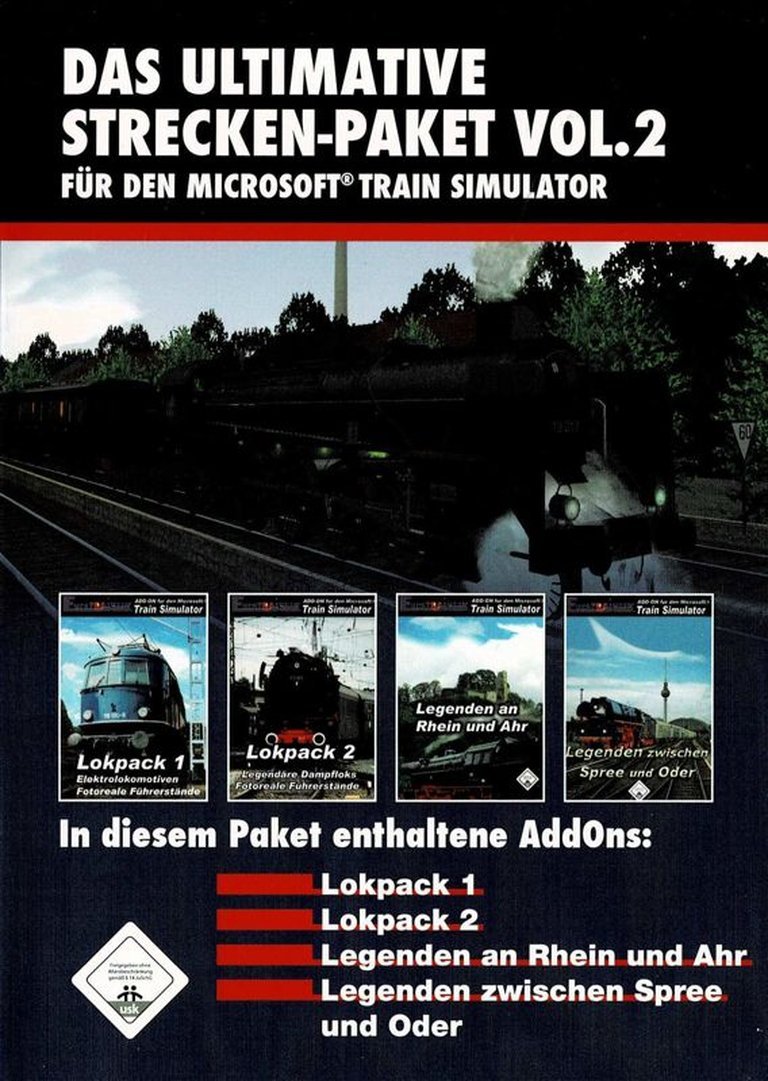
Das Ultimative Strecken-Paket Vol.2 is a 2007 compilation add-on for Microsoft Train Simulator, featuring two detailed German routes: one between Berlin and Stettin, and another through the scenic Ahrtal region from Rolandseck to Andernach. The package includes over 50 historically accurate locomotives (steam, diesel, and electric) along with numerous passenger and freight wagons, allowing players to master train-driving tasks or freely explore the meticulously crafted landscapes in exploration mode.
Das Ultimative Strecken-Paket Vol.2: Review
Introduction
In the annals of simulation gaming, few niches evoke as much reverence and technical passion as railway simulations. Released in 2007 by Halycon Media GmbH & Co. KG, Das Ultimative Strecken-Paket Vol.2 (The Ultimate Track Package Vol.2) stands as a monument to this subgenre’s golden age. This compilation, bundling four meticulously crafted add-ons for Microsoft Train Simulator (MSTS), promised German-speaking enthusiasts an expansive journey through the nation’s most iconic rail corridors. As a product of an era when modding communities drove innovation, it represents both a high-water mark of enthusiast-driven content and a time capsule of simulation’s technical constraints. This review dissects its legacy, arguing that while limited by its aging foundation, the package remains a vital artifact—a lovingly detailed tribute to European railway history that defined the aspirations of a generation of simmers.
Development History & Context
Das Ultimative Strecken-Paket Vol.2 emerged from a unique confluence of technological ambition and market timing. Released in June 2007, it operated within the twilight years of Microsoft Train Simulator (2001), a once-revolutionary simulator now grappling with aging graphics and physics engines. Yet, MSTS still boasted a fervent modding community, particularly in Germany and Eastern Europe, where EuroTrainSim—the collective behind the bundled content—excelled at transforming raw data into immersive experiences.
Halycon Media, a German publisher specializing in value-driven simulation bundles, positioned the compilation as the definitive “ultimate” package for MSTS owners. Their vision was clear: consolidate four standalone add-ons—Lokpack 1, Lokpack 2, Legenden an Rhein und Ahr, and Legenden zwischen Spree und Oder—into a single, accessible retail product. Technically, the package pushed MSTS to its limits: while the base engine could only handle polygons and textures optimally on Pentium III-era hardware (minimum 500 MHz, 256 MB RAM), EuroTrainSim countered by prioritizing geographical accuracy over graphical fidelity. The result was a product tailored for niche enthusiasts willing to endure installation complexities and system tweaks, reflecting the era’s modding ethos where community knowledge (e.g., the TSSF.eu forum’s patch guides) was as crucial as the software itself.
Narrative & Thematic Deep Dive
As a simulation, Das Ultimative Strecken-Paket Vol.2 eschews traditional narratives, instead embedding history and atmosphere into its routes and rolling stock. The bundle’s thematic core revolves around engineering reverence and cultural nostalgia, divided into two distinct journeys:
-
Legenden an Rhein und Ahr (Legends on the Rhine and Ahr): This route traverses the Romantic Rhine Valley, evoking the grandeur of 19th-century German industrial prowess. The narrative is architectural and geological: players navigate UNESCO-listed castles (like Marksburg), steep vineyard terraces, and the iconic Ahr Valley Railway’s tight tunnels. The theme is one of timeless beauty, with the landscape serving as a character itself. The included scenarios—timed freight deliveries and passenger runs—frame the player as a custodian of heritage, emphasizing precision over drama.
-
Legenden zwischen Spree und Oder (Legends between the Spree and Oder): This route shifts focus to historical transition, connecting Berlin to Stettin (now Szczecin, Poland). The narrative is rooted in Cold War-era division and reunification, with stations like Berlin Ostbahnhof and Frankfurt (Oder) acting as waypoints through shifting German identities. The route’s industrial zones—smokestacks, freight yards, and communist-era housing—contrast with pastoral stretches, embodying themes of resilience and change. The bundled locomotives (e.g., BR 50 steam engines) become symbols of a bygone era, their steel frames echoing the weight of history.
The Lokpacks deepen this thematic tapestry. With over 50 locomotives spanning steam, diesel, and electric eras, they function as rolling encyclopedias. The BR 03 “Pacific” steam engine in Lokpack 1 embodies early 20th-century elegance, while the BR 103 “TEE” electric in Lokpack 2 symbolizes post-war modernity. Their detailed cabs—complete with period-accurate gauges and controls—transform operational procedures into storytelling. There is no dialogue, but the click-clack of tracks, whistles, and station announcements create a silent narrative of technological evolution.
Gameplay Mechanics & Systems
Das Ultimative Strecken-Paket Vol.2 is a masterclass in MSTS-driven gameplay, prioritizing authenticity over spectacle. Its core loop revolves around precision control and logistical mastery, segmented into two modes:
-
Mission Mode: Players undertake scripted scenarios, such as hauling coal from industrial zones to Berlin or maintaining tight schedules on the Rhine’s steep gradients. Success hinges on managing steam pressure (for locomotives like the BR 01), adhering to signal rules, and balancing speed with safety. The inclusion of weather effects (e.g., fog in the Ahrtal) and dynamic track conditions adds layers of challenge, demanding intimate knowledge of each route’s quirks.
-
Exploration Mode: This free-roam option rewards curiosity, allowing players to discover hidden vistas—like the Rhine’s Loreley Cliff or Oder’s river deltas—or experiment with different consist combinations. The Lokpacks shine here, with over 50 locomotives (e.g., the V 200 diesel) and hundreds of wagons (passenger coaches, cattle cars, flatbeds) offering near-endless configurability.
Mechanically, the package builds on MSTS’s template but refines it with niche enhancements:
– Realistic Physics: Steam engines require boiler management; diesel locomotives simulate transmission lag; electrics demand catenary contact. The BR 103’s top speed of 200 km/h tests nerve on Berlin’s curved approach.
– UI/UX: A 102-page manual demystifies complex systems, detailing braking curves for the Spree-Oder route or braking procedures for heavy freight. MSTS’s dated interface remains, but the package’s custom menus streamline access to rolling stock and scenarios.
– Innovations: The “Activity Patch” referenced in the TSSF.eu forum allowed users to generate custom scenarios, leveraging the routes’ rich detail. However, installation hurdles (e.g., manual patching for Windows XP compatibility) underscore the era’s DIY ethos.
World-Building, Art & Sound
The package’s world-building is its crowning achievement, transforming geographical data into living dioramas:
-
Visual Design:
- Rhine-Ahr: Photorealistic textures capture vineyard terraces, slate roofs, and the Rhine’s shimmering waters. Landmarks like the Rolandseck bridge are rendered with obsessive detail, down to graffiti on support pillars.
- Spree-Oder: Berlin’s urban sprawl blends with Oder’s rural marshes, using MSTS’s limited polygons to convey scale via industrial smoke and distant cranes.
- Rolling Stock: Lokpack locomotives boast hand-painted rivets and weathered effects. The BR 41 steam engine’s soot-streaked boiler feels lived-in, while the modern BR 151 electric’s aerodynamic lines symbolize progress.
-
Atmosphere: Routes are steeped in temporal authenticity. Spree-Oder’s stations feature 1980s-era billboards and East German architecture, while Rhine-Ahr’s half-timbered towns evoke 19th-century Romanticism.
-
Sound Design: Custom audio layers elevate immersion: the V 200 diesel’s throaty growl, the BR 50’s steam hiss, and the clatter of carriages on uneven tracks. Environmental sounds—church bells in Ahr villages or factory sirens in Berlin—ground players in their surroundings. The bundled screensaver, looping through route highlights, extends this sensory immersion even when offline.
Reception & Legacy
Upon release, Das Ultimative Strecken-Paket Vol.2 was embraced as a value trove for MSTS devotees. Critics praised its density (four add-ons for ~€15), with the 102-page manual hailed as a “mini-museum” of German rail history. However, mainstream reviews were sparse, reflecting the niche appeal. Commercially, it thrived in German retail and on platforms like eBay, where it remains a budget staple (€7–€10 as of 2025).
Its legacy is dual-edged:
– Innovation: It exemplified the modding community’s role in extending a game’s lifespan. EuroTrainSim’s work set standards for route accuracy, influencing later titles like Trainz.
– Obsolescence: MSTS’s technical limitations—jagged graphics, brittle physics—made the package feel dated as Dovetail Games’ Train Simulator (2013) offered superior visuals. The TSSF.eu forum’s active patching culture underscores how the community sustained it beyond its shelf life.
Historically, it preserves critical German rail corridors at risk of erasure, such as the Ahrtal route, later devastated by floods. For preservationists, it’s a digital archive; for gamers, it’s a relic of a pre-streaming era where depth trumped gloss.
Conclusion
Das Ultimative Strecken-Paket Vol.2 is a paradox: a product of limitations that transcends them. It is, at its core, a love letter to German railway history, packaged with the technical fervor of a community that refused to accept MSTS’ aging bones as its end. Its routes, rolling stock, and systems are not just gameplay elements but testaments to engineering artistry. While modern players may balk at its dated visuals and installation quirks, its legacy as a cultural artifact is undeniable. It captures a moment when simulation gaming was less about spectacle and more about stewardship—of history, of geography, and of the iron rails that connect them. For the enthusiast, it remains indispensable; for the historian, it is an invaluable time capsule. In the pantheon of simulation, it stands not as a technical masterpiece, but as a heartfelt monument to a bygone era of digital craftsmanship.
Final Verdict: Essential for MSTS historians and German rail enthusiasts; a charming but dated relic for newcomers. Its place in gaming history is secure—not as a trendsetter, but as a testament to the enduring power of passionate niche creation.