
- Release Year: 2023
- Platforms: Windows
- Publisher: Gear Worx Productions
- Developer: Gear Worx Productions
- Genre: Adventure
- Perspective: 1st-person
- Game Mode: Single-player
- Gameplay: Graphic adventure
- Setting: Contemporary, North America
- Average Score: 86/100
Description
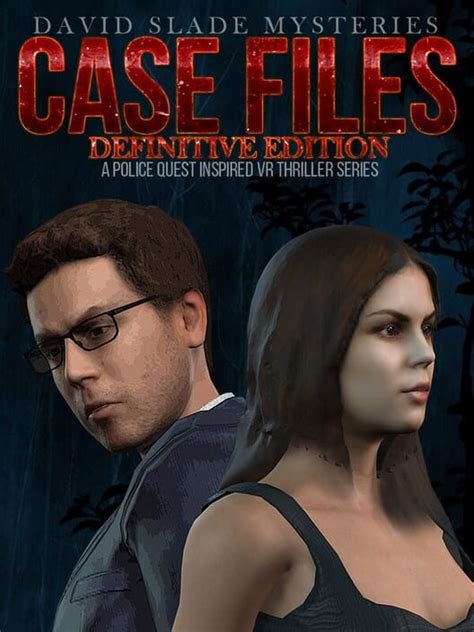
David Slade Mysteries: Case Files is an episodic VR adventure game set in the gritty streets of River Side, where players take on the role of homicide detective David Slade. Tasked with solving gruesome and mysterious cases throughout his career, players must investigate crime scenes, gather and document evidence, and survive dangerous encounters. The game features immersive environments, forensic tools, cinematic cutscenes, and a rich narrative driven by full spoken dialogue and a dynamic soundtrack. With a complete redesign in version 2.0, the game introduces enhanced visuals, new gameplay mechanics, and an office hub to manage cases.
Gameplay Videos
Where to Buy David Slade Mysteries: Case Files
PC
David Slade Mysteries: Case Files Patches & Updates
David Slade Mysteries: Case Files Guides & Walkthroughs
David Slade Mysteries: Case Files Reviews & Reception
steambase.io (86/100): A triumphant return to form for the series.
store.steampowered.com (84/100): Positive (84% of 13 user reviews for this game are positive).
vrdb.app (88/100): Very Positive (4.4★ from 137 reviews).
David Slade Mysteries: Case Files: A Gritty, Immersive VR Detective Experience
Introduction: A Modern Homage to Classic Detective Adventures
David Slade Mysteries: Case Files is a bold, ambitious VR adventure that thrusts players into the grimy, bloodstained streets of Riverside as rookie homicide detective David Slade. Developed by the one-man powerhouse Gear Worx Productions, this episodic thriller is a love letter to the golden age of detective games—particularly Police Quest—while embracing the immersive potential of virtual reality. With its unflinching portrayal of violent crime, meticulous forensic gameplay, and a narrative that weaves personal tragedy with procedural investigation, Case Files carves out a niche in the VR landscape as a game that demands patience, attention to detail, and a strong stomach.
This review will dissect every facet of David Slade Mysteries: Case Files, from its development journey and narrative depth to its gameplay mechanics, world-building, and legacy. By the end, we’ll determine whether this indie VR title is a hidden gem or a flawed diamond in the rough.
Development History & Context: A Labor of Love in the VR Renaissance
The Studio Behind the Badge: Gear Worx Productions
Gear Worx Productions is the brainchild of a single developer, Steve “GWP” Gear, who has taken on the Herculean task of designing, coding, writing, and composing David Slade Mysteries: Case Files almost entirely solo. This level of solo development is rare in modern gaming, especially for a VR title with such ambitious scope. Gear’s background is rooted in a passion for classic adventure games and a desire to modernize them for VR, a medium he clearly believes is perfect for detective narratives.
The game’s development has been a rollercoaster of iterations, with Version 2.0 representing a complete overhaul of the original release. This “Definitive Edition” wasn’t just a polish pass—it was a ground-up rebuild of the game’s code, visuals, and core mechanics. Such a drastic revision speaks to Gear’s commitment to quality, even if it meant delaying subsequent episodes. The shift from Itch.io to Meta’s App Lab and Steam also highlights the challenges indie VR developers face in distribution and piracy protection.
Technological Constraints and VR’s Evolution
Case Files launched in 2023, a time when VR was still finding its footing beyond niche audiences. The game’s initial release on the Oculus Quest (via App Lab) and later on SteamVR showcases the balancing act developers must perform between accessibility and graphical fidelity. The Quest version, while impressive for standalone VR, naturally sacrifices some visual polish compared to the PCVR edition, which boasts real-time lighting and enhanced textures.
The game’s system requirements are steep for VR—recommending an RTX 2070 or equivalent—reflecting its ambition to deliver a visually rich, atmospheric experience. However, this also limits its audience to those with high-end VR setups, a common hurdle for VR titles aiming for realism.
The Gaming Landscape: A Revival of Detective Games
David Slade Mysteries arrives amid a resurgence of detective and narrative-driven games, from Disco Elysium to The Council and Return of the Obra Dinn. Yet, few of these titles have embraced VR, making Case Files a pioneer in the genre. Its inspiration from Police Quest is evident not just in its procedural storytelling but in its unapologetic difficulty and lack of hand-holding—a design philosophy that harkens back to the Sierra On-Line era.
The game’s episodic structure also reflects a broader trend in indie gaming, where developers opt for smaller, self-contained narratives rather than monolithic, open-world designs. This approach allows Gear Worx to refine mechanics and storytelling with each episode, though it also means players must wait for resolutions to cliffhangers.
Narrative & Thematic Deep Dive: Crime, Trauma, and the Weight of the Badge
Plot Overview: Two Cases, One Haunted Detective
Case Files currently comprises two episodes, each a self-contained mystery that also advances David Slade’s personal arc.
-
Episode One: Apartment 202
Fresh out of the academy, David is thrust into a decades-old murder case tied to a new homicide in a rundown apartment complex. The case is a baptism by fire, forcing David to navigate a web of clues, red herrings, and a killer who’s always one step ahead. The narrative’s strength lies in its slow-burn tension, as David pieces together a conspiracy that spans generations. -
Episode Two: Memories of the Past
Five years later, David—now a seasoned detective—is drawn into a case that hits far too close to home. After a car accident strands him near a seemingly abandoned house, he uncovers horrors tied to his sister’s unsolved murder. This episode leans heavier into psychological horror, with surreal, nightmarish sequences that blur the line between reality and David’s trauma.
Characters & Dialogue: A Lone Wolf in a Corrupt World
David Slade is a compelling protagonist, not because he’s particularly likable, but because he’s deeply human. His dialogue is gruff, often sarcastic, and laced with the cynicism of a man who’s seen too much. The voice acting, while not AAA-level, sells his weariness and determination.
Supporting characters are sparse but memorable:
– Captain Reynolds, David’s no-nonsense superior, serves as both mentor and foil.
– The Killers, whose identities and motives are revealed through environmental storytelling rather than exposition, are chilling in their banality.
The game’s writing shines in its environmental narrative. Notes, bloodstains, and forensic evidence tell stories without a single line of dialogue. However, some players may find the lack of NPC interaction limiting, as Riverside feels eerily empty outside of crime scenes.
Themes: The Cost of Justice
Case Files explores several heavy themes:
1. The Cyclical Nature of Violence: Both episodes tie present-day crimes to past atrocities, suggesting that evil lingers like a stain.
2. Trauma and Obsession: David’s sister’s murder haunts him, driving his investigative fervor but also blinding him to his own well-being.
3. Moral Ambiguity: The game doesn’t shy away from the ethical dilemmas of policing, though it stops short of outright critique.
The mature content warning is no joke—Case Files features dismemberment, gore, and psychological horror that will unsettle even seasoned players. This isn’t L.A. Noire’s glamorous noir; it’s a grimy, brutal descent into the worst of humanity.
Gameplay Mechanics & Systems: Forensic Investigation in VR
Core Gameplay Loop: The Detective’s Toolkit
Case Files is, at its heart, a forensic simulator. Players use a variety of tools to:
– Examine crime scenes with a flashlight, magnifying glass, and UV light.
– Collect evidence (blood samples, fingerprints, documents) and log them in a case file.
– Analyze clues in David’s office, cross-referencing them to uncover leads.
– Solve puzzles, from safes to cipher codes, to progress the investigation.
The game’s VR implementation is where it truly shines. Interacting with objects feels tactile—turning over a bloodied photo, prying open a drawer, or dusting for prints all require physical engagement. The hand physics and climb system (introduced in v2.0) add layers of immersion, though the latter can feel clunky in tight spaces.
Combat & Survival: A Minimalist Approach
Unlike action-heavy VR games, Case Files keeps combat to a minimum. When it does appear, it’s tense and brutal—often involving quick-time events or stealth sequences. The lack of traditional combat will disappoint some, but it stays true to the detective genre’s focus on intellect over firepower.
Progression & Difficulty: No Hand-Holding Here
The game’s most polarizing aspect is its lack of guidance. There are no waypoints, no objective markers, and no in-game hints. Players must meticulously document every clue, often revisiting scenes to connect dots. This design choice is refreshing for fans of classic adventures but frustrating for those accustomed to modern conveniences.
The inventory and tools system is intuitive, with a radial menu for quick access. However, the save system (also revamped in v2.0) is manual, adding another layer of old-school challenge.
UI & Accessibility: A Work in Progress
The UI is functional but sparse. The case file system, while immersive, can be cumbersome to navigate, especially when juggling multiple pieces of evidence. Subtitles are available in multiple languages, but the lack of an in-game hint system or difficulty options may alienate casual players.
World-Building, Art & Sound: Riverside’s Bleak Beauty
Setting & Atmosphere: A City Steeped in Sin
Riverside is a character unto itself—a decaying urban sprawl where neon signs flicker over bloodstained alleys. The game’s visual direction leans into gritty realism, with dimly lit apartments, cluttered police stations, and eerie rural locales (in Episode Two). The remastered visuals in the Definitive Edition improve textures and lighting, though some assets still betray the game’s indie roots.
The office hub, introduced in v2.0, serves as a welcome respite between cases, allowing players to organize evidence and reflect on the narrative.
Sound Design & Music: A Symphony of Dread
The cinematic soundtrack by Michael Gordon Shapiro is a standout, blending haunting piano melodies with pulsating electronic beats during tense moments. The ambient sound design is equally impressive—creaking floorboards, distant sirens, and the hum of fluorescent lights all contribute to the oppressive atmosphere.
Voice acting is serviceable, though some lines lack emotional weight. The full spoken dialogue is a welcome addition, but the delivery occasionally feels stiff.
Reception & Legacy: A Cult Classic in the Making?
Critical & Commercial Reception
David Slade Mysteries: Case Files has flown under the radar of major critics, with no Metacritic reviews at launch. However, player reception has been overwhelmingly positive, with an 86/100 Steambase score and an 84% positive rating on Steam. Players praise its:
– Immersive VR mechanics
– Challenging, rewarding detective gameplay
– Gritty, mature storytelling
Criticisms largely revolve around:
– Technical hiccups (e.g., the infamous “stuck in door” bug in Episode Two)
– The steep learning curve
– The lack of NPC interaction
Influence & Future Potential
While Case Files hasn’t yet sparked a wave of imitators, its success proves there’s an audience for hardcore detective sims in VR. The game’s episodic model and focus on forensic realism could inspire future titles, especially as VR hardware becomes more accessible.
Gear Worx’s commitment to free updates (Episode Two was added post-launch) and community engagement (via Discord) bodes well for the series’ longevity. If future episodes expand on the lore and refine the mechanics, David Slade Mysteries could become a benchmark for VR storytelling.
Conclusion: A Flawed Masterpiece for the Patient Detective
David Slade Mysteries: Case Files is not a game for everyone. It’s punishingly difficult, unapologetically grim, and demands patience. But for those willing to meet its challenges, it offers one of the most immersive, atmospheric detective experiences in VR.
Final Verdict: 8.5/10 – A Must-Play for VR Detective Fans
- Strengths: Immersive VR mechanics, gripping narrative, haunting atmosphere, rewarding detective gameplay.
- Weaknesses: Steep difficulty curve, occasional technical issues, sparse NPC interaction.
Case Files is a testament to what a single, passionate developer can achieve in VR. It’s a game that respects its players’ intelligence, trusts them to piece together its mysteries, and isn’t afraid to leave them unsettled. If you’ve ever dreamed of stepping into the shoes of a hardboiled detective—flaws, frustrations, and all—this is the closest you’ll get.
Now, grab your flashlight and start digging. Riverside’s secrets won’t uncover themselves.