
- Release Year: 2016
- Platforms: PlayStation 4, Windows, Xbox One
- Publisher: Koei Tecmo Games Co., Ltd.
- Genre: Compilation
- Game Mode: Single-player
- Adult Content: Yes
Description
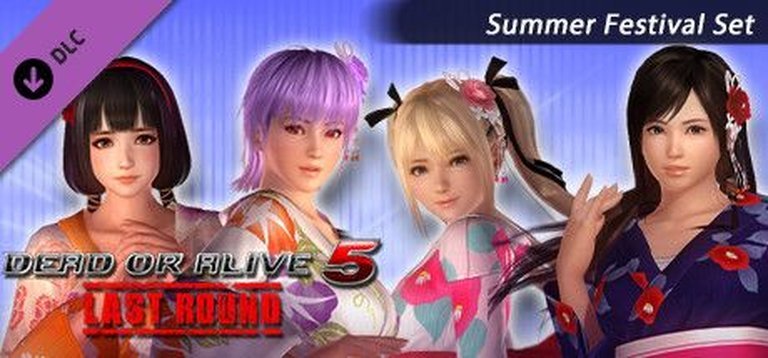
Dead or Alive 5: Last Round – Summer Festival Costume Set is a downloadable content pack for the fighting game Dead or Alive 5: Last Round, featuring yutaka-themed summer festival outfits for 18 female characters, including Kasumi, Ayane, Marie Rose, Helena, and others. This DLC enhances the game by adding vibrant, culturally inspired costumes without altering core gameplay, allowing players to customize their fighters with traditional festival attire within the established Dead or Alive universe.
Dead or Alive 5: Last Round – Summer Festival Costume Set Guides & Walkthroughs
Dead or Alive 5: Last Round – Summer Festival Costume Set Cheats & Codes
PC
At the options menu, press LB + LT + RB + RT.
| Code | Effect |
|---|---|
| LB + LT + RB + RT | Unlock costumes (excluding Raidou and Marie Rose), Story mode progress, system voices, music, and some movies. |
PlayStation 3
Go to Options and input the code.
| Code | Effect |
|---|---|
| L1+R1+L2+R2 | Unlock costumes (for characters except Honoka and Raidou), Story Mode progress, movies, system voices, music, and the OMG breast motion setting. |
PlayStation 4
Go to Options and press L1 + L2 + R1 + R2.
| Code | Effect |
|---|---|
| L1 + L2 + R1 + R2 | Unlock Costumes, Story Mode progress, movies, system voices and music (excludes DLC costumes). |
Xbox One
Go to Help & Options screen and hold LT+RT+LB+RB.
| Code | Effect |
|---|---|
| LT+RT+LB+RB | Unlock all non-downloadable costumes, music, and movies. |
Dead or Alive 5: Last Round – Summer Festival Costume Set: Review
Introduction
The vibrant yukata of the Summer Festival Costume Set cascade across the screen, a fleeting burst of color in the relentless combat of Dead or Alive. To understand this seemingly simple DLC is to peer into the heart of a modern gaming phenomenon: the monetization of aesthetics. Released on November 14, 2016, this downloadable content package for Dead or Alive 5: Last Round offers 17 playable female characters (including the guest Naotora Ii) traditional Japanese yukata (referred to as “yutaka” in the official description). This review argues that while the Summer Festival Costume Set is undeniably a visually appealing and culturally resonant addition, its true significance lies in its role as a microcosm of Team NINJA and Koei Tecmo’s late-game DLC strategy – a blend of genuine celebration, meticulous technical execution, and aggressive monetization practices that defined the latter days of the DOA5 lifecycle. It represents a moment where artistry and commerce collide on the digital battlefield.
Development History & Context
Summer Festival emerged from Koei Tecmo Games Co., Ltd., specifically developed by the veteran Team NINJA studio, operating under the established creative vision of Tomonobu Itagaki and later directed by Yosuke Hayashi. By 2016, Dead or Alive 5: Last Round itself was a mature title, representing the fifth iteration of the series on modern consoles (PS4, Xbox One) and PC, significantly expanded beyond its original 2012 release. The technological landscape of the era saw the PS4 and Xbox One pushing graphical fidelity, enabling features like dynamic costume destruction – a key selling point highlighted for this DLC. The gaming climate was dominated by the rise of season passes and the monetization of live-service games post-launch. DOA5LR exemplified this, boasting an unprecedented and exhaustive library of DLC, with the Summer Festival set falling squarely within Season Pass 5 + Character (released August 9, 2016). This context is crucial: the DLC wasn’t born in a vacuum but as a calculated, monetized extension of a game already saturated with content, reflecting the studio’s deep understanding of its dedicated (and highly lucrative) fanbase.
Narrative & Thematic Deep Dive
Summer Festival possesses no narrative of its own. It exists purely within the established Dead or Alive universe, offering no new story threads, character development, or lore. Its thematic significance is entirely aesthetic and cultural. The yukata, a type of casual kimono traditionally worn during Japanese summer festivals (bon odori), evokes themes of celebration, tradition, and ephemeral beauty. This choice is deeply rooted in Japanese culture, contrasting sharply with the series’ usual focus on high-stakes martial arts tournaments, corporate espionage (DOATEC), and ninja clan conflicts. The DLC transforms these hardened warriors and fighters into participants in a communal, joyous event. This juxtaposition is central to its appeal: seeing characters like the stoic Kasumi, the vengeful Ayane, or the bombastic Tina Armstrong adorned in festive, relatively modest traditional wear creates a fascinating and deliberate tonal shift. It celebrates cultural heritage while offering fans a chance to engage with their favorite characters in a completely different, visually distinct context. The exclusion of characters like Alpha-152 and Mai Shiranui (despite her later inclusion in the same pass) highlights the DLC’s specific focus on the core female roster represented, further emphasizing its thematic cohesion around these specific archetypes.
Gameplay Mechanics & Systems
Functionally, the Summer Festival Costume Set operates entirely within DOA5LR‘s established combat framework. The yukata do not alter core gameplay mechanics – movesets, hitboxes, damage values, or character stats remain identical. The primary “gameplay” interaction comes from the destructibility feature, a key selling point marketed heavily (especially on PS4 and Xbox One). Landing powerful strikes, particularly critical holds, Power Blows, or Power Launchers, can cause the yukata to show damage: sleeves and the bottom hem fray and shorten, and the garment may tear to reveal the character’s shoulders. This destruction is purely visual and cosmetic. It adds a layer of dynamic feedback to combat but has no bearing on the outcome of the fight. On the PC (Steam) version, this feature was not implemented, a significant limitation noted in the official description and store pages. The costume selection UI integrates these outfits as standard costume swaps, requiring the base game and a specific free “Costume Catalog LR39” download to function. The absence of new stages, modes, or gameplay systems relegates this DLC entirely to the realm of visual customization. Its “gameplay loop” is simply selecting the costume and enjoying the visual spectacle during matches, with the destructibility offering momentary, non-impactful feedback.
World-Building, Art & Sound
The visual direction of the Summer Festival costumes is a triumph of specific cultural artistry. The yukata designs are meticulously crafted, featuring vibrant floral patterns (cherry blossoms, peonies, etc.) and traditional color schemes (indigo, crimson, pastels) that vary significantly per character, respecting their established personalities while adhering to the yukata aesthetic. Kasumi’s might be more understated and elegant, while Honoka’s could be more playful and brightly colored. The quality of the models and textures is high, consistent with Last Round‘s graphical standards on PS4 and Xbox One, showcasing the character models’ detail even in these more covered outfits. The world-building is subtle but effective: the costumes create an alternate visual plane within the existing stages, imagining the characters participating in a cultural festival rather than a deathmatch. This expands the perceived world of DOA5 beyond just the tournament. The sound design is entirely inherited from the base game – the yukata adds no unique sound effects, voice lines, or music. The clash of blows, grunts of effort, and stage ambiance remain unchanged. This lack of audio identity reinforces that the DLC is purely a visual layer, a silent celebration of culture draped over the familiar sounds of combat.
Reception & Legacy
Critically and commercially, the Summer Festival Costume Set, like much of DOA5LR‘s DLC, received minimal standalone critical attention. Reviews of such niche cosmetic packs are rare, and MobyGames shows no critic reviews specifically for this set. Its reception was almost entirely consumer-driven and integrated into the broader discourse on DOA5LR‘s monetization. Player reactions likely mirrored general DLC sentiment: enthusiasm for the specific designs and characters (especially for beloved ninjas like Kasumi and Ayane, or newcomers like Honoka and Naotora), balanced with fatigue and criticism regarding the sheer volume and cost of content ($19.99 for the set, ~$2.99 per costume on consoles). Its legacy is defined by several factors:
1. Cultural Representation: It stands as a relatively authentic and well-executed example of incorporating specific Japanese cultural elements into a global fighting game, appealing to fans of both the series and Japanese aesthetics.
2. Monetization Blueprint: It exemplifies the season pass model and the fragmentation of content (individual vs. bundle sales) that defined late-gen DLC practices. Its inclusion in Season Pass 5 solidified this pass’s value for collectors.
3. Destructibility Showcase: On consoles, it served as a prominent example of the game’s dynamic costume damage system, a technical feature Team NINJA emphasized.
4. Exclusionary Platform Limitation: The lack of destructibility on Steam became a noted point of differentiation and potential disappointment for PC players.
5. Pillar of Completeness: For dedicated DOA fans and completionists, it became an essential, albeit cosmetic, addition to their extensive character wardrobes, representing a specific cultural theme in the ever-growing DLC catalog.
Conclusion
The Dead or Alive 5: Last Round – Summer Festival Costume Set is a double-edged blade. On one hand, it is a visually stunning, culturally relevant, and technically proficient piece of cosmetic DLC. The beautifully rendered yukata offer fans a delightful alternative view of their favorite characters, celebrating Japanese tradition with genuine artistry. On the other hand, it is an undeniable product of aggressive monetization, released within a season pass and sold individually at a premium cost, representing the peak of DOA5LR‘s extensive post-launch content push. It adds nothing mechanically to the core gameplay, relying solely on visual appeal and the novelty of destructible fabric. While it lacks narrative depth or gameplay innovation, its success lies in fulfilling its purpose: providing fans with high-quality, thematically distinct customization options. As a snapshot of Team NINJA’s late-era DOA strategy and a testament to the niche appeal of character-centric DLC, the Summer Festival Costume Set holds a specific place in video game history. It is less a standalone game and more a culturally resonant pixel in the vast tapestry of modern fighting game monetization – a beautiful, fleeting moment of tradition amidst the digital commerce of the fighting genre. For its aesthetic execution and cultural specificity, it earns respect; for its role in the monetization ecosystem, it serves as a case study. Its legacy is as vibrant, niche, and commercially calculated as the yukata it adorns.