
- Release Year: 2015
- Platforms: Android, Blacknut, iPad, Linux, Macintosh, Nintendo Switch, PlayStation 4, Windows
- Publisher: BadLand Games Publishing, S.L., BadLandGames S.L., Daedalic Entertainment GmbH
- Developer: Fictiorama Studios
- Genre: Adventure
- Perspective: Side view
- Game Mode: Single-player
- Gameplay: Graphic adventure, Puzzle elements
- Setting: Post-apocalyptic
- Average Score: 71/100
Description
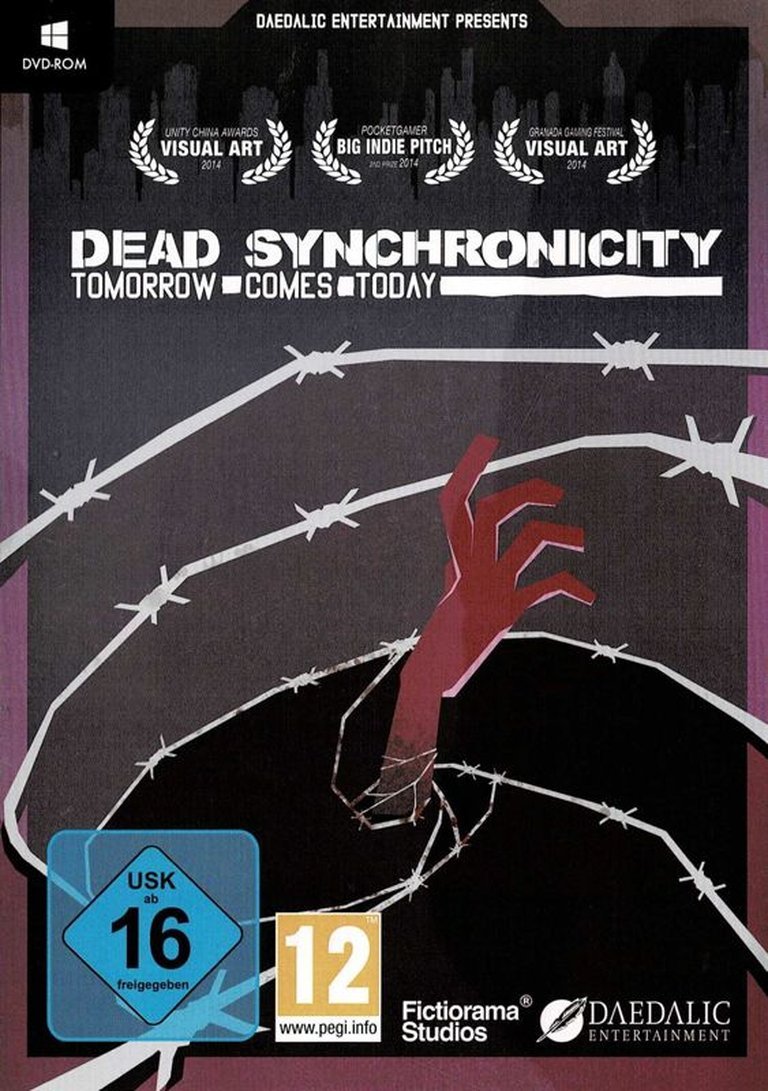
In ‘Dead Synchronicity: Tomorrow Comes Today’, you play as Michael, a man with no memory of his past, navigating a post-apocalyptic world ravaged by natural disasters and a pandemic that turns humans into the Dissolved, beings with special cognitive powers before they dissolve into blood. Michael must uncover his identity and decode the events that led to this dystopian future, all while avoiding the impending ‘dead synchronicity’, when time itself begins to dissolve. The game is a homage to classic adventure titles, featuring a hand-drawn 2D art style and classic point-and-click gameplay.
Gameplay Videos
Where to Buy Dead Synchronicity: Tomorrow Comes Today
Dead Synchronicity: Tomorrow Comes Today Cracks & Fixes
Dead Synchronicity: Tomorrow Comes Today Guides & Walkthroughs
Dead Synchronicity: Tomorrow Comes Today Reviews & Reception
opencritic.com (70/100): A fun, worthwhile point-and-click adventure that tells an engaging story.
metacritic.com (70/100): A great old-school graphic adventure made in Spain by four people.
techraptor.net : It synthesizes the best aspects of each into one extremely well done point-and-click adventure.
cgmagonline.com (70/100): A dark apocalypse setting where corruption, rampant acts of vile inhumanity, and a complete sense of immorality are the norm.
mygamer.com (75/100): A dark, post-apocalyptic point-and-click with loads of style and spirit.
Dead Synchronicity: Tomorrow Comes Today: Review
Introduction
In a gaming landscape saturated with cookie-cutter dystopias, Dead Synchronicity: Tomorrow Comes Today (2015) emerges as a grim love letter to the dark, psychological adventures of the 1990s. Developed by Spanish indie studio Fictiorama and published by Daedalic Entertainment, this point-and-click title channels the oppressive atmospheres of I Have No Mouth, and I Must Scream and Sanitarium, weaving a tale of societal collapse, existential dread, and fractured time. While its abrupt ending and financial failure left its story unfinished, Dead Synchronicity remains a haunting testament to the power of narrative ambition in indie gaming. This review argues that the game’s strengths—its art, sound, and thematic depth—outweigh its flaws, securing its place as a cult classic in the adventure genre.
Development History & Context
The Vision of Fictiorama Studios
Founded by brothers Alberto, Luis, and Mario Oliván alongside artist Martín Martínez, Fictiorama Studios sought to revive the spirit of “mature, thought-provoking” graphic adventures. Drawing inspiration from The Secret of Monkey Island, 12 Monkeys, and The Road, the team crafted a narrative steeped in existential horror and sci-fi surrealism. Alberto Oliván, the lead writer, described the game as “Guybrush meets Mad Max meets 12 Monkeys,” blending traditional puzzles with a bleak, avant-garde aesthetic.
Kickstarter and Technological Constraints
Funded via Kickstarter in April 2014 with $51,501, Dead Synchronicity was developed using Unity, leveraging hand-drawn 2D art to compensate for limited animation budgets. The team utilized articy:draft software to manage its branching dialogue and non-linear plot—a necessity given the game’s complex narrative structure. Released in April 2015, it debuted amid a resurgence of point-and-click adventures (Broken Age, Grim Fandango Remastered), but its gritty tone set it apart from more whimsical contemporaries.
Commercial Struggles
Despite critical praise, the game sold only “a few thousand units” (per Daedalic’s Carsten Fichtelmann), dooming plans for a sequel. This financial failure left the story unresolved, a wound that still irks fans.
Narrative & Thematic Deep Dive
Plot and Characters
Players assume the role of Michael, an amnesiac who awakens in a refugee camp after the Great Wave—a cataclysmic event that triggered natural disasters and a pandemic called the Dissolved. Victims of this plague gain psychic abilities before dissolving into blood, while authoritarian forces exploit the chaos. Michael’s journey to uncover his identity intertwines with a race to stop dead synchronicity, a phenomenon where time itself disintegrates.
Themes of Decay and Morality
The game explores:
– The fragility of reality: Time distortions manifest as haunting visions, warping environments into past or future states.
– Ethical decay: Characters face morally ambiguous choices, such as mutilating corpses for survival or betraying allies.
– Class struggle: The camp’s hierarchy—guards, “moles,” and Dissolved—mirrors real-world oppression.
Strengths and Shortcomings
Praised for its “tightly written” dialogue (Adventure Gamers), the story falters in its finale. Critics noted the abrupt ending “feels like a prologue” (Rock, Paper, Shotgun), leaving key threads—like Michael’s past and the Dissolved’s origins—untied.
Gameplay Mechanics & Systems
Classic Point-and-Click Foundations
The game adheres to traditional adventure staples:
– Inventory puzzles: Combining items (e.g., a broken sign + wire = makeshift weapon) often requires lateral thinking.
– Dialogue trees: Choices impact relationships but rarely alter the plot’s trajectory.
– Hotspot highlighting: A spacebar key mitigates pixel-hunting frustrations.
Innovations and Flaws
- Notebook system: Tracks objectives, easing navigation through the grim world.
- Repetitive visions: Frequent, unskippable hallucinations disrupt pacing.
- Uneven difficulty: Puzzles range from intuitive (distracting guards) to obtuse (using a severed hand to fix a camera).
Interface and Controls
The minimalist UI features a briefcase-style inventory, though some critics found mouse controls “clunky” on consoles (Video Chums).
World-Building, Art & Sound
Visual Style
The game’s expressionistic art—angular characters, washed-out browns and reds—evokes The Cabinet of Dr. Caligari, mirroring the world’s psychological decay. Environments, from a suicide-filled park to a derelict hospital, are richly detailed, though animations are intentionally stilted to amplify unease.
Sound Design
The soundtrack by indie band Kovalski blends eerie guitars and synths, channeling Silent Hill’s dissonance. Voice acting is divisive: Michael’s gruff delivery clashes with his gaunt design, while side characters like the childlike Rose leave a lasting impression.
Atmosphere
“Every screen feels like a painting,” noted TechRaptor, praising the fusion of Goya-esque brutality and dystopian科幻. The Dissolved’s gurgling deaths and ambient camp noises cement the oppressive mood.
Reception & Legacy
Critical Response
The game holds a 73% average on MobyGames (18 critics), with highs from Garage Band Gamers (90%) and lows from Hooked Gamers (50%). Praise centered on its “macabre setting” (IGN Spain) and “mature storytelling” (Adventure Gamers), while detractors cited “frustrating puzzles” (Digitally Downloaded) and the “unfinished” narrative (Rock, Paper, Shotgun).
Commercial Impact and Influence
Despite its commercial failure, Dead Synchronicity influenced later titles like Tormentum: Dark Sorrow and Whispers of a Machine, proving that niche, narrative-driven adventures could thrive. Its Kickstarter model also paved the way for Spanish indie successes like The Red Strings Club.
Conclusion
Dead Synchronicity: Tomorrow Comes Today is a flawed gem—a game that marries stellar art and provocative themes with uneven execution. While its abrupt ending and financial demise prevent it from joining the pantheon of classic adventures, its audacious vision and atmospheric depth ensure its longevity as a cult favorite. For players willing to endure its darkness, it offers a poignant reminder of how indie studios can challenge conventions, even when time runs out.
Final Verdict: A haunting, incomplete masterpiece that deserves a second chance—and a sequel.