
- Release Year: 2018
- Platforms: Android, Linux, Macintosh, Windows
- Publisher: Choice of Games LLC
- Developer: Choice of Games LLC
- Genre: Adventure
- Perspective: Text-based
- Game Mode: Single-player
- Gameplay: Interactive fiction, RPG elements, Text adventure
- Setting: Fantasy
- Average Score: 50/100
Description
Death Collector is a text-based interactive fiction game set in a fantasy world where you play as a collector of souls, navigating a morally complex narrative filled with intrigue and secrets. The game offers RPG elements and multiple endings, allowing players to shape their journey through choices that impact the story’s outcome. Developed by Choice of Games LLC, it was released in 2018 for various platforms, including Windows, Linux, Mac, and Android.
Where to Buy Death Collector
PC
Death Collector Mods
Death Collector Guides & Walkthroughs
Death Collector Reviews & Reception
steambase.io (30/100): Mostly Negative
forum.sbenny.com (70/100): pretty good
Death Collector: Review
Introduction
In the shadowed corners of interactive fiction, where narrative reigns supreme and player choice shapes reality, Death Collector emerges as a darkly fascinating anomaly. Released in December 2018 by Choice of Games LLC, this text-based fantasy novel from New Zealand author Jordan Reyne promises a visceral exploration of identity, power, and the commodification of memory. At its core lies a haunting premise: the player assumes the role of a “Death Collector,” a operative who harvests the severed tongues of the dying to steal their stories and memories for a dystopian Ministry. Despite its alluring atmosphere and intricate world-building, Death Collector ultimately collapses under the weight of its own ambition, leaving players stranded in a narrative cul-de-sac that betrays the very promise of interactive storytelling. This review dissects the game’s triumphs and tragedies, arguing that while its foundation is brilliant, its execution—particularly in the final act—renders it a frustrating, cautionary tale in the annals of gaming history.
Development History & Context
Death Collector was crafted by Jordan Reyne, a writer and musician with two prior interactive fiction works (including Choice of the Cat) and a background in experimental music. Under the stewardship of Choice of Games—a studio renowned for accessible, branching narrative experiences—the game leveraged the ChoiceScript engine, a minimalist platform designed for text-based interactivity without graphical or sonic frills. Reyne’s vision was explicitly philosophical, drawing from her observation of a “morbid, desperate archeology of identity” in modern societies. She sought to translate this into a world where physical and existential suffering are intertwined, where harvesting tongues becomes a grotesque metaphor for how nations construct heroes and erase histories.
Technologically, the game operated within the constraints of its format: no graphics, no sound, and a reliance on pure textual immersion. This choice aligned with the studio’s niche expertise, though it limited accessibility for players accustomed to richer sensory inputs. The 2018 gaming landscape was dominated by AAA graphical epics, but a dedicated audience for interactive fiction persisted, particularly on platforms like Steam and mobile. Choice of Games occupied a unique space, offering bite-sized, player-driven narratives, yet Death Collector aimed for grander thematic ambitions than its predecessors. Despite a roster of 20 contributors—including artist Abigail Larson and beta testers from diverse backgrounds—the game’s development was hampered by its writer’s unyielding focus on thematic abstraction over player satisfaction, a tension that would define its legacy.
Narrative & Thematic Deep Dive
The narrative of Death Collector is a tapestry woven with intrigue and existential dread. Set in a vaguely European-flavored dystopia, the player navigates a society where the Ministry of History employs Death Collectors to enforce a rigid social hierarchy. The core premise—harvesting tongues to preserve memories—unfolds through 300,000 words of text, exploring the ethics of historical revisionism and the fragility of identity. Characters like the enigmatic Roza, the pragmatic courtier, and the rebellious library attendant are sharply defined, their clashing ideologies forcing players into agonizing moral compromises. Dialogue is richly textured, blending bureaucratic jargon with visceral descriptions of the “gore-work” of tongue harvesting, creating a sense of unease that permeates every interaction.
Thematically, the game interrogates the construction of heroism and demonization. Reyne’s world mirrors modern anxieties about collective identity, where “creating heroes” is exposed as a dangerous act that erases complexity. The Ministry’s propaganda machine, the stealth of the invisible cloak, and the hushed reverence for harvested tongues all serve as metaphors for how power narratives are manufactured and suppressed. Yet the narrative’s brilliance is sabotaged by structural flaws. Repetitive dialogue across different character arcs—where minor variations in phrasing lead to identical conclusions—undermines player agency. Romance subplots feel tacked on, and the central mystery of the Ministry’s corruption remains unresolved. Most damningly, the ending—a sudden, anticlimactic flight from the city after a contrived assassination list—arrives just as the narrative gains momentum. This abrupt conclusion, described by one player as feeling “like a rock falls and kills you,” reduces hours of strategic role-playing to a hollow, deterministic escape, shattering the thematic promise of player-driven agency.
Gameplay Mechanics & Systems
Death Collector’s gameplay hinges on a deceptively simple framework: text-based choices that shape the story. Players navigate menus and select dialogue options to influence character stats, relationships, and plot outcomes. The stat system, however, is its Achilles’ heel. Four core traits—procedural, intuitive, cunning, and charming—overlap with opposed personality pairs (e.g., idealistic vs. maverick), creating a confusing matrix where it’s impossible to predict how choices will affect progression. For instance, breaking into a room might increment cunning or shameless arbitrarily, while comforting a dying character could alter empathetic or charming with no clear logic. This opacity turns strategic stat-building into a guessing game, punishing players who seek meaningful character growth.
Character progression is equally flawed. Skills rise linearly, opposed stats fluctuate, and side-arcs offer illusory variety. Players are urged to “romance” characters, yet these interactions lack depth, often resolving in repetitive vignettes that fail to impact the narrative. The “gore-work” of tongue harvesting is described in visceral detail but never evolves into a satisfying mechanic—it’s a narrative flourish without gameplay consequence. UI elements are functional but utilitarian, relying on point-and-click navigation that lacks innovation. Ultimately, the gameplay loop—making choices to steer an unyielding plot toward a predetermined end—feels like a rigged illusion of agency. As one critic lamented, “Your choices don’t matter in the end, only the character you ticked off the least.”
World-Building, Art & Sound
Death Collector’s greatest strength lies in its atmospheric world-building. The setting—a decaying European-inspired metropolis under the Ministry’s iron grip—is rendered through meticulous textual detail. The “glamor” magic that disguises reality, the bureaucratic labyrinth of the Ministry, and the taboo of “silent harvests” (tongues lacking memories) create a sense of dread and wonder. Reyne’s background in Europe informs the setting’s cultural texture, contrasting with her New Zealand roots to evoke a world steeped in history and paranoia. The invisible cloak, a symbiotic entity enabling stealth, is a standout element, symbolizing both protection and alienation.
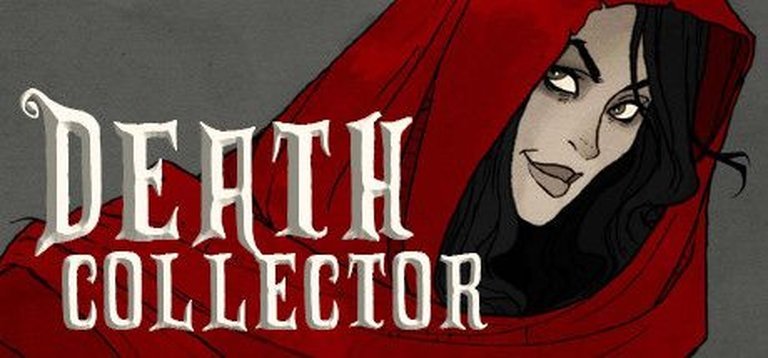
Artistically, the game is a study in restraint. With no in-game graphics, visual direction falls entirely to the imagination, supported by Abigail Larson’s evocative cover art. Sound design is absent, relying on prose to build tension—shrieks during harvests, the rustle of cloaks, the silence of a “silent tongue.” This minimalist approach immerses players in the game’s grim poetry but also highlights its limitations. The world’s rich lore is often delivered via infodumps, slowing the pace and disrupting immersion. Yet when the writing excels, it transcends the format’s constraints. The mountain harvests, with their “spitting lizards and hours-long chanting,” transform mundane tasks into rituals of horror, while the Ministry’s propaganda machines pulse with bureaucratic menace. In these moments, Death Collector achieves a rare synthesis of horror and beauty, proving that text alone can craft unforgettable worlds.
Reception & Legacy
Upon release, Death Collector polarized audiences. On Steam, it garnered a “Mostly Negative” rating (7 negative reviews out of 9), with players praising its premise but lambasting its ending. User reviews like SeymourG’s 30-playthrough deep dive lamented the “absolutely miserable ending” and the “illusion of choice,” while others critiqued the stat system’s opacity. Positive reviews highlighted the world-building and character dynamics, but these were drowned out by frustration. Commercially, it was a modest success for Choice of Games, priced at $4.89–$6.99, but it failed to break into mainstream consciousness.
Legacy-wise, the game is now remembered as a missed opportunity. Its abrupt ending became a cautionary tale in interactive fiction circles, cited as an example of narrative betrayal. The ChoiceScript engine’s limitations were exposed, showcasing how even flexible systems cannot compensate for structural flaws. Influence on subsequent titles is minimal, though the game’s themes of identity and power echo in works like The Magician’s Workshop and Weyrwood. Jordan Reyne’s departure from the project after beta-testing debates—where she clashed with players over “respecting their time”—further cemented its divisive reputation. Today, Death Collector endures as a niche curiosity, studied for its bold concepts but avoided for its execution.
Conclusion
Death Collector is a paradox: a game of profound artistic ambition crippled by profound narrative failure. Its exploration of identity, power, and historical memory is intellectually stimulating, and its world-building is nothing short of masterful. Yet the journey is sabotaged by a game system that confuses players and a finale that feels like a developer’s hastily scrawled “The End.” The illusion of choice dissolves into a predetermined escape, rendering hours of strategic investment meaningless. While its dark themes and atmospheric prose secure it a place in interactive fiction’s avant-garde, Death Collector ultimately fails as a satisfying experience. It is a testament to the power of text-based storytelling—and its perils. For historians and critics, it stands as a flawed gem: a brilliant idea executed with such recklessness that it becomes a warning about the sacred contract between creator and player. In the pantheon of gaming, it is less a classic and more a ghost story—a reminder that even the most compelling worlds can crumble under the weight of an ending that refuses to deliver.