
- Release Year: 1997
- Platforms: Windows
- Publisher: Viacom New Media
- Developer: Zipper Interactive, Inc.
- Genre: Action
- Perspective: 1st-person
- Game Mode: LAN, Single-player
- Gameplay: Shooter, Vehicular combat
- Setting: Futuristic, Sci-fi
- Average Score: 80/100
Description
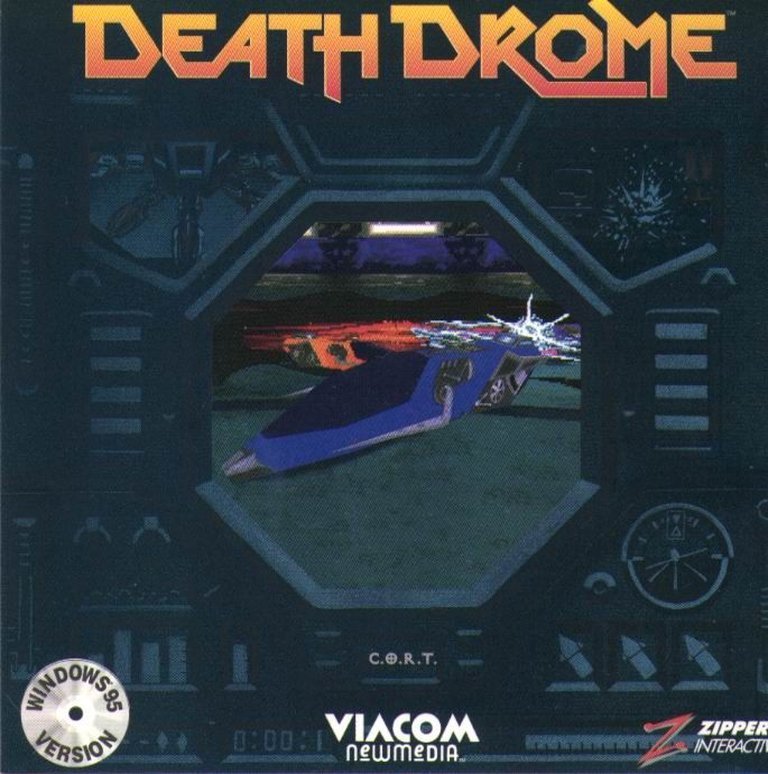
In the year 2057, the world’s prisons are overflowing with dangerous criminals, leading the Committee of Recreational Termination (CORT) to create DeathDrome—a brutal, gladiatorial combat spectacle where condemned inmates fight for their freedom. Players must survive three rounds of deadly vehicular combat across eight treacherous domains, blending high-speed action with futuristic sci-fi settings. Originally released in 1997, the game offers a mix of first-person and behind-view perspectives, supporting both single-player and multiplayer modes via LAN or modem.
Gameplay Videos
Death Drome Reviews & Reception
en.wikipedia.org (74/100): one of the best games of its kind to arrive on the scene in quite some time.
mobygames.com (71/100): Death Drome had a poor retail reception. It was later picked up by SegaSoft’s HEAT Network as a “free” online game.
myabandonware.com (96/100): Death Drome is a fun, although a bit simplistic, futuristic first-person action/sport game that deserves much more attention than it received.
collectionchamber.blogspot.com : DeathDrome, in my humble opinion, beats all of them.
Death Drome Cheats & Codes
PC
Enter each code to skip to that level:
| Code | Effect |
|---|---|
| 2REVOLT | Unlock The Abyss |
| 3ACCUSED | Unlock The Outpost |
| SHORT4TIME | Unlock Citadel |
| 5GETAWAYS | Unlock The Inferno |
| BOLT6DOWN | Unlock The Wall |
| ARREST7 | Unlock The Spike |
| LASTMEAL8 | Unlock Purgatory |
Death Drome: A Forgotten Gem of the 90s Arena Shooter Renaissance
Introduction
In the annals of video game history, certain titles emerge as unsung heroes—games that, despite their innovative mechanics or unique charm, fade into obscurity due to timing, marketing, or the relentless march of progress. Death Drome (1996), developed by Zipper Interactive and published by Viacom New Media, is one such title. A futuristic vehicular combat arena shooter, Death Drome arrived at a pivotal moment in gaming history, straddling the transition from LAN-based multiplayer to the burgeoning online gaming era. While it may not have achieved the commercial success or cultural impact of contemporaries like Quake or Twisted Metal, Death Drome remains a fascinating artifact of its time—a game that, in many ways, was ahead of its curve.
This review aims to dissect Death Drome in exhaustive detail, exploring its development history, narrative and thematic underpinnings, gameplay mechanics, artistic and auditory design, critical reception, and lasting legacy. By the end, we will argue that Death Drome is not merely a relic of the 90s but a title worthy of reconsideration—a game that, despite its flaws, offered a glimpse into the future of competitive multiplayer gaming.
Development History & Context
The Birth of Zipper Interactive
Death Drome marked the debut of Zipper Interactive, a studio that would later become synonymous with tactical military shooters like the SOCOM series. Founded in 1995, Zipper Interactive was a product of its era—a time when small, ambitious studios sought to carve out niches in an industry increasingly dominated by blockbuster titles. The studio’s early focus on multiplayer experiences foreshadowed its later work, with Death Drome serving as a proving ground for the team’s ability to craft competitive, adrenaline-fueled gameplay.
The game’s development was spearheaded by a team of 43 developers, including key figures like producer Tom Gibson, game designer Peter Giokaris, and composer Anthony Hudson (credited as Anthony H). The credits also reveal a collaboration with former U.S. military simulation experts, hinting at the game’s emphasis on tactical, high-stakes combat. This military influence is palpable in the AI’s behavior, which, as noted by reviewers, was unusually competent for the era.
Technological Constraints and Innovations
Death Drome was released in 1996, a year that saw the rise of 3D acceleration and the slow decline of software rendering. The game was built for Windows 95, leveraging the nascent capabilities of early 3D graphics cards while remaining accessible to systems with more modest hardware. To maintain a consistent frame rate, the developers employed a clever technical solution: dividing each arena into four distinct sections. This segmentation allowed the game to render only the immediate environment, reducing the strain on the CPU and GPU. While this approach limited the game’s visual ambition, it ensured smooth performance—a critical factor in competitive multiplayer.
The game also utilized Intel’s MMX technology, a then-cutting-edge instruction set designed to enhance multimedia performance. This allowed Death Drome to deliver faster, more fluid gameplay, though it also introduced compatibility issues that would later plague players attempting to run the game on modern systems.
The Gaming Landscape of 1996
The mid-90s were a period of rapid evolution in the gaming industry. The first-person shooter (FPS) genre was in the midst of a revolution, with Doom (1993) and Quake (1996) setting new standards for 3D environments and multiplayer competition. Meanwhile, vehicular combat games like Twisted Metal (1995) and Vigilante 8 (1998) were carving out their own niches, blending driving mechanics with explosive, arena-based combat.
Death Drome occupied a unique space within this landscape. It was neither a pure FPS nor a traditional vehicular combat game but a hybrid—a first-person shooter where players controlled futuristic motorbikes (dubbed “Runners”) in enclosed arenas. This fusion of genres gave Death Drome a distinct identity, though it also made it difficult to market. The game’s emphasis on multiplayer further complicated its commercial prospects, as the infrastructure for online gaming was still in its infancy. While LAN parties were popular among hardcore gamers, the broader audience lacked the means to fully experience Death Drome’s competitive potential.
The Role of Viacom New Media
Viacom New Media, the game’s publisher, was a subsidiary of the entertainment conglomerate Viacom. The company had a mixed track record in the gaming industry, with titles like Star Trek: Deep Space Nine – Harbinger and Congo: The Movie – Descent into Zinj receiving lukewarm receptions. Death Drome was no exception, suffering from poor retail performance despite its critical acclaim. This commercial failure led to the game being picked up by SegaSoft’s HEAT Network, where it was offered as a free online title—a move that extended its lifespan but did little to bolster its reputation.
Narrative & Thematic Deep Dive
The Premise: A Dystopian Bloodsport
Death Drome is set in the year 2057, a future where overpopulation and rampant crime have led to a dystopian society. The world’s prisons are overflowing with condemned criminals, and the government has devised a macabre solution: the Committee of Recreational Termination (C.O.R.T.). This shadowy organization oversees the DeathDrome, a gladiatorial arena where prisoners are forced to compete in lethal combat for the amusement of the masses. The rules are simple: survive three rounds of combat in each of the eight deadly domains, and you earn your freedom. Fail, and you die.
The game’s premise is unabashedly derivative, drawing inspiration from classic dystopian narratives like The Running Man (1987) and Death Race 2000 (1975). The influence of these films is evident in the game’s tone, which blends dark humor with grim brutality. The narrative is delivered through sparse, atmospheric cutscenes and the occasional voiceover from a disembodied female announcer—a trope that would become a staple of the genre. Her chilling declarations—“You are now entering The Domain” and “You may now exit The Domain”—serve as the game’s most memorable narrative moments, reinforcing the oppressive, inescapable nature of the DeathDrome.
Themes: Survival, Exploitation, and the Spectacle of Violence
At its core, Death Drome is a meditation on the commodification of violence. The game’s setting—a future where prisoners are forced to fight for their lives as entertainment—mirrors real-world critiques of media sensationalism and the exploitation of marginalized groups. The DeathDrome is not merely a prison but a spectacle, a televised bloodsport that reduces human life to a commodity. This theme is underscored by the game’s mechanical design, which rewards players for efficiency and ruthlessness. The “kill quota” system, wherein players must eliminate a set number of opponents to progress, reinforces the idea that survival is contingent on participation in the system’s brutality.
The game also explores the theme of agency—or, more accurately, the lack thereof. The protagonist is an unnamed prisoner, stripped of identity and reduced to a participant in C.O.R.T.’s deadly game. There is no backstory, no character development—only the imperative to survive. This anonymity serves a dual purpose: it allows players to project themselves onto the protagonist while also emphasizing the dehumanizing nature of the DeathDrome. The prisoner is not a hero but a pawn, and the game’s narrative reflects this reality.
The Absence of Storytelling
While Death Drome’s premise is compelling, its narrative execution is minimalist to the point of being nonexistent. The game offers no dialogue, no character interactions, and no meaningful plot progression. The story is conveyed through environmental details—the grim, industrial aesthetics of the arenas—and the occasional voiceover. This lack of narrative depth is not necessarily a flaw; rather, it reflects the game’s focus on gameplay over storytelling. Death Drome is, at its heart, a competitive multiplayer experience, and its narrative serves primarily as a backdrop for the action.
That said, the game’s sparse storytelling does limit its emotional impact. Unlike The Running Man, which used its narrative to critique media and government corruption, Death Drome offers little in the way of social commentary. The dystopian setting is window dressing, a justification for the game’s violent mechanics rather than a vehicle for deeper themes. This is not to say that the game is devoid of meaning—far from it—but its themes are implied rather than explored.
Gameplay Mechanics & Systems
Core Gameplay Loop
Death Drome’s gameplay is deceptively simple. Players select one of eight “Runners”—futuristic motorbikes equipped with weapons—and enter a series of arenas known as “Domains.” Each Domain is divided into four combat zones, connected by a central hub. The objective is straightforward: eliminate a set number of opponents (the “kill quota”) within a time limit, then return to the hub to exit the Domain. Survive three rounds in each Domain, and you progress to the next.
This structure is reminiscent of classic arcade games, where the focus is on high scores and survival rather than narrative progression. The game’s simplicity is one of its greatest strengths, allowing players to quickly grasp the mechanics and dive into the action. However, it also contributes to the game’s lack of long-term replayability. Once the initial thrill of mastering the controls and weapons wears off, the repetitive nature of the gameplay becomes apparent.
The Runners: Customization and Strategy
One of Death Drome’s most innovative features is its vehicle customization system. Players can choose from eight distinct Runners, each with unique attributes in four categories: speed, handling, armor, and weapons. This system allows for a degree of strategic depth, as players must weigh the trade-offs between different stats. For example, a Runner with high armor may survive longer in combat but will be slower and less maneuverable, while a Runner with high speed may excel at hit-and-run tactics but will be more vulnerable to sustained fire.
The differences between Runners are subtle but meaningful. Handling, in particular, has a significant impact on gameplay, as tighter turning circles allow for more precise maneuvering in tight spaces. Armor, meanwhile, determines how quickly a Runner’s shields deplete—a critical factor in prolonged engagements. The weapon stat, however, is less impactful, as the game’s power-up system ensures that all players have access to the same arsenal.
Weapons and Combat
Death Drome’s combat is fast-paced and chaotic, with an emphasis on movement and positioning. The game’s primary weapon is a laser cannon, which fires rapidly but deals relatively low damage. This weapon is effective for whittling down opponents’ shields but is less useful in direct confrontations. To supplement the laser cannon, players can collect a variety of secondary weapons scattered throughout the arenas:
- Skorch Missiles: Heat-seeking projectiles that home in on targets.
- Nitro Ram: A temporary speed boost that turns the Runner into a battering ram.
- Shockwave: An area-of-effect attack that damages all nearby opponents.
- Disruptor: A weapon that drains an opponent’s energy, leaving them vulnerable.
- Ion Sword: A melee weapon that temporarily incapacitates opponents.
Each of these weapons offers a distinct tactical advantage, and mastering their use is key to success. The Skorch Missiles, for example, are ideal for long-range engagements, while the Nitro Ram is best suited for hit-and-run tactics. The Shockwave, meanwhile, is a powerful tool for clearing out groups of opponents in tight spaces.
In addition to these weapons, each Runner is equipped with an Electro Barrier, a defensive ability inspired by Tron (1982). When activated, the Runner leaves a trail of electrified energy that damages any opponent who crosses it. This ability is particularly effective in multiplayer matches, where it can be used to trap unsuspecting foes or block off escape routes.
Arena Design and Level Progression
Death Drome’s arenas are among its most impressive features. The game includes eight distinct Domains, each with its own unique layout and environmental hazards. The opening arena, Alcatraz II, features multi-level platforms and raised hills, while The Abyss includes undulating water that affects movement. Other arenas, like The Well, are maze-like, with narrow corridors and hidden passages that encourage tactical play.
Each Domain is divided into four combat zones, connected by a central hub. This structure ensures that players are constantly on the move, searching for opponents and power-ups while avoiding ambushes. The hub serves as a neutral zone, where players can regroup before venturing back into the fray. This design choice is both practical and strategic, as it prevents players from camping in one area and forces them to engage with the entire arena.
The game’s level progression is linear, with each Domain unlocked sequentially. However, the game does not save progress between sessions—a design choice that, while frustrating, reinforces the arcade-like nature of the experience. Players who wish to skip ahead can use passwords, which are provided upon completing each Domain.
AI and Multiplayer
Death Drome’s single-player mode pits the player against computer-controlled opponents, whose AI was praised by reviewers for its competence and aggression. The AI is programmed to adapt to the player’s tactics, becoming more aggressive as the game progresses. This ensures that the single-player experience remains challenging, even for experienced players.
However, the game’s true potential lies in its multiplayer mode. Death Drome supports up to eight players via LAN, with each player controlling a Runner in a free-for-all deathmatch. The multiplayer mode is where the game’s strengths—its fast-paced combat, strategic depth, and arena design—shine brightest. The absence of a modem-based multiplayer option is a notable omission, particularly given the game’s release in 1996, when online gaming was still in its infancy. This limitation likely contributed to the game’s poor retail performance, as it restricted the multiplayer experience to players with access to LAN setups.
Technical Limitations and Modern Playability
Death Drome’s technical constraints are evident in its visual presentation. The game is locked at a resolution of 640×480, with only a “details” slider in the options menu offering any visual customization. The vehicles and environments are blocky and lack the polish of later 3D games, though the art direction—grim, industrial, and futuristic—helps to mask these limitations.
Running Death Drome on modern systems is a challenge. The game was designed for Windows 95 and relies on outdated APIs and hardware acceleration. As a result, players attempting to run the game on modern Windows versions (7/8/10/11) must use compatibility tools like DXWnd or community-created installers. These solutions are not without their issues, as evidenced by the numerous comments on forums like The Collection Chamber and My Abandonware, where players report difficulties getting the game to launch properly.
Despite these challenges, Death Drome remains playable, thanks in large part to the efforts of dedicated fans. Community-created patches and installers have addressed many of the game’s compatibility issues, and online multiplayer has been revived through tools like Hamachi and Tunngle. These efforts are a testament to the game’s enduring appeal and the passion of its fanbase.
World-Building, Art & Sound
Visual Design: A Grim, Futuristic Aesthetic
Death Drome’s visual design is a product of its time, blending the industrial grit of Doom with the neon-lit futurism of Tron. The game’s arenas are sprawling, multi-level structures, filled with metallic walkways, flickering lights, and ominous machinery. The color palette is dominated by shades of gray and blue, with occasional splashes of red and green to denote interactive elements.
The Runners themselves are sleek, missile-shaped vehicles, equipped with an array of weapons and defensive systems. Their design is functional rather than flashy, reflecting the game’s focus on combat over aesthetics. The enemies, meanwhile, are similarly utilitarian, with blocky, low-poly models that prioritize visibility over detail.
While Death Drome’s graphics may appear primitive by modern standards, they are effective in conveying the game’s oppressive atmosphere. The arenas feel like prisons, with their cold, metallic surfaces and claustrophobic corridors. The occasional environmental hazard—such as the undulating water in The Abyss—adds a layer of dynamism to the otherwise static environments.
Sound Design: A Pulse-Pounding Soundtrack
The game’s sound design is one of its most underrated aspects. The soundtrack, composed by Anthony Hudson (credited as Anthony H), is a high-energy mix of electronic and industrial tracks that perfectly complement the game’s fast-paced action. The music is dynamic, shifting in intensity to match the on-screen action, and it can be played separately on an audio CD—a feature that was relatively rare at the time.
The sound effects are equally impressive, with the laser cannons, explosions, and engine roars all contributing to the game’s immersive atmosphere. The voiceovers, particularly the announcer’s chilling declarations, are a standout feature, adding a layer of narrative depth to the otherwise sparse storytelling.
Atmosphere: The Weight of the DeathDrome
Death Drome’s greatest strength lies in its atmosphere. The game’s combination of visual and auditory elements creates a sense of oppressive tension, reinforcing the idea that the player is trapped in a deadly, inescapable arena. The announcer’s voiceovers, the flickering lights, and the industrial aesthetics all contribute to this atmosphere, making the DeathDrome feel like a living, breathing entity—a machine designed to consume its participants.
This atmosphere is further enhanced by the game’s mechanical design. The kill quota system, the time limits, and the lack of a pause feature all contribute to a sense of urgency, forcing players to remain constantly engaged. The game’s difficulty curve is steep, with later Domains introducing more aggressive opponents and complex arena layouts. This ensures that the tension remains high throughout the experience, even as the gameplay loop begins to feel repetitive.
Reception & Legacy
Critical Reception: A Mixed but Positive Response
Death Drome received generally favorable reviews upon its release, with critics praising its innovative gameplay, creative weapons, and tense multiplayer matches. The game holds a 71% average score on MobyGames, based on seven critic reviews, and a 2.9/5 average score from players.
- Gamezilla (83%): “Death Drome is not a great game, but it’s an enthusiastic game, an addictive game… shortcomings aside, it’s just fun.”
- PC Games (83%): “DeathDrome is one of those games that sneaks up on you without a barrage of hype and turns out to be just plain fun.”
- CNET (80%): “Drive-‘n’-shoot-’em-up fans and those who enjoyed the old Tron coin-op game will be pleasantly surprised by DeathDrome.”
- GameSpot (74%): “A bit different and a bit innovative, this 3-D first-person shooter is very well done.”
- PC Gamer (68%): “Fast and furious but seriously flawed, DeathDrome is an action game with little replay value.”
- Computer Games Magazine (30%): “DeathDrome is too flawed to even consider.”
The criticism leveled at Death Drome primarily focused on its repetitive gameplay, lack of narrative depth, and technical limitations. The absence of a modem-based multiplayer mode was also a common point of contention, as it restricted the game’s competitive potential to players with LAN setups.
Commercial Performance: A Retail Flop
Despite its critical acclaim, Death Drome was a commercial failure. The game’s poor retail performance led to it being picked up by SegaSoft’s HEAT Network, where it was offered as a free online title. This move extended the game’s lifespan but did little to bolster its reputation. The reasons for its commercial failure are multifaceted:
- Timing: Death Drome was released in 1996, a year that saw the rise of online gaming. While LAN multiplayer was popular among hardcore gamers, the broader audience lacked the infrastructure to fully experience the game’s competitive potential.
- Marketing: Viacom New Media’s marketing efforts were lackluster, failing to generate significant buzz around the game’s release.
- Genre Hybridization: Death Drome’s blend of FPS and vehicular combat mechanics made it difficult to categorize, limiting its appeal to fans of either genre.
Legacy: A Cult Classic
Despite its commercial failure, Death Drome has developed a cult following in the years since its release. The game’s innovative mechanics, creative weapons, and tense multiplayer matches have earned it a place in the hearts of retro gaming enthusiasts. Community efforts to revive the game’s online multiplayer and address its compatibility issues have further cemented its status as a hidden gem of the 90s.
Death Drome also holds historical significance as the debut title of Zipper Interactive. The studio’s later work on the SOCOM series would establish it as a major player in the tactical shooter genre, but Death Drome remains a testament to its early ambition and creativity.
Influence on Subsequent Games
While Death Drome did not spawn a direct sequel, its influence can be seen in later vehicular combat and arena shooter titles. Games like Necrodome (1996) and Rocket Jockey (1996) share Death Drome’s emphasis on fast-paced, multiplayer-focused combat, while titles like Twisted Metal: Black (2001) and Vigilante 8: Second Offense (1999) expand on its vehicular combat mechanics.
The game’s use of segmented arenas to maintain performance also foreshadowed later technical innovations, such as the “portals” used in Quake and other 3D shooters. In this sense, Death Drome can be seen as a transitional title—a game that bridged the gap between the technical limitations of the mid-90s and the more ambitious designs of the late 90s and early 2000s.
Conclusion: A Game Worth Remembering
Death Drome is a game of contradictions. It is innovative yet derivative, ambitious yet flawed, addictive yet repetitive. It arrived at a time when the gaming industry was in flux, straddling the line between LAN-based multiplayer and the emerging online gaming era. Its commercial failure was perhaps inevitable, given the limitations of its technology and the challenges of its marketing. Yet, despite these obstacles, Death Drome remains a compelling and unique experience—a game that, in many ways, was ahead of its time.
Its greatest strength lies in its gameplay. The combination of fast-paced vehicular combat, creative weapons, and strategic arena design creates a tense, adrenaline-fueled experience that is as engaging today as it was in 1996. The game’s multiplayer mode, in particular, is a standout feature, offering a level of competitive depth that was rare for its time.
That said, Death Drome is not without its flaws. The repetitive gameplay loop, lack of narrative depth, and technical limitations all detract from the overall experience. The absence of a modem-based multiplayer mode is a particularly glaring omission, one that likely contributed to the game’s poor retail performance.
Yet, for all its flaws, Death Drome is a game worth remembering. It is a testament to the creativity and ambition of its developers, a snapshot of a pivotal moment in gaming history, and a reminder that even the most overlooked titles can leave a lasting impact. In the pantheon of 90s arena shooters, Death Drome may not be a Quake or a Unreal, but it is a game that deserves its place in the conversation—a hidden gem that, with a little polish, could have been a classic.
Final Verdict: 7.5/10 – A flawed but fascinating relic of the 90s, Death Drome is a game that punches above its weight, offering a unique and engaging multiplayer experience that still holds up today.