
- Release Year: 2013
- Platforms: Macintosh, Windows
- Publisher: Big Fish Games, Inc
- Developer: Elephant Games AR LLC
- Genre: Puzzle
- Game Mode: Single-player
- Gameplay: Hidden object
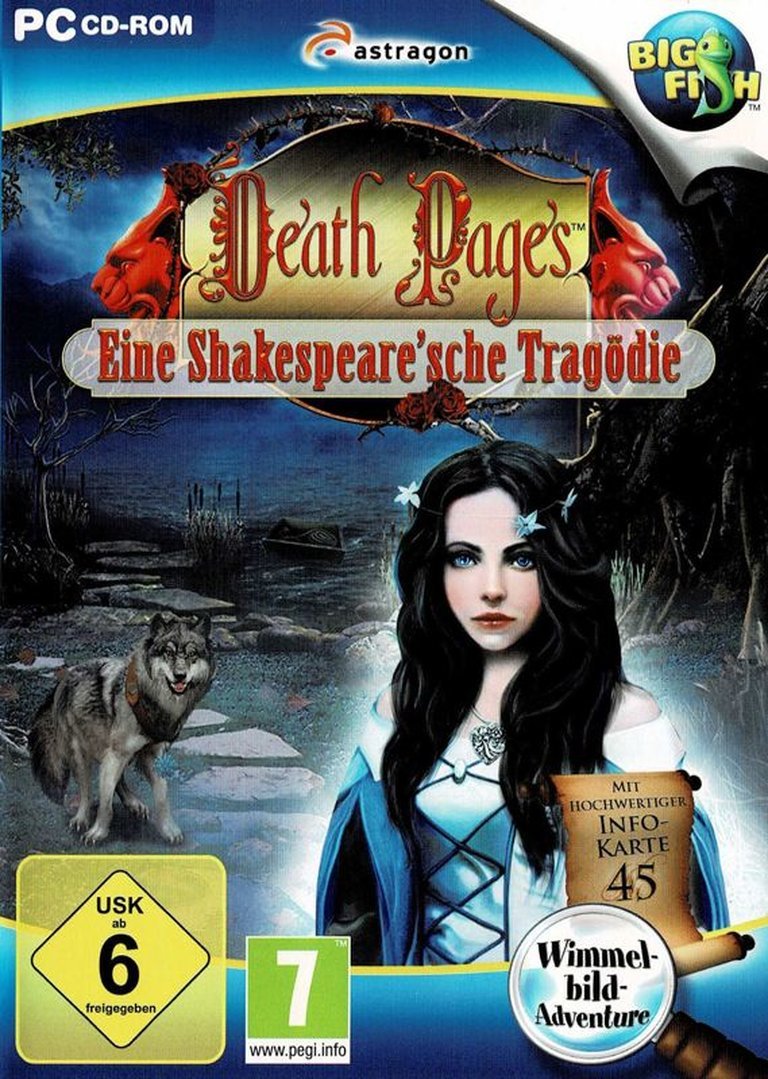
Description
Death Pages: Ghost Library is a hidden object puzzle game developed by Elephant Games, where players investigate the mysterious disappearance of three teenagers in a city library. The library serves as a gateway to literary realms, and the teens’ souls are imprisoned by a malicious spirit called the Alchemist within Shakespeare’s ‘Romeo and Juliet’, forcing them to act out the tragic roles. The player must explore scenes from the play, solve hidden object challenges, and rewrite the story to rescue the teens and stop the Alchemist’s evil plans, with additional adventures in works like ‘Portrait of Dorian Grey’ in bonus chapters.
Gameplay Videos
Death Pages: Ghost Library Guides & Walkthroughs
Death Pages: Ghost Library Reviews & Reception
gamezebo.com : Ghost Library, while exhibiting a good number of noticeable imperfections, offers enough creativity and beauty to make it worth your time.
jayisgames.com : Despite the ominous sounding title, Death Pages: Ghost Library, the latest adventure hybrid from Elephant Games, is less about ghosts and death and more about living vicariously through one of William Shakespeare’s most well known works.
Death Pages: Ghost Library: A Scholarly Dissection of Literary Liminality in Casual Gaming
Introduction: The Page as Portal
In the sprawling ecosystem of casual puzzle-adventure games, few titles dare to premise themselves on the foundational texts of Western literature. Death Pages: Ghost Library, a 2013 release from prolific developer Elephant Games and publisher Big Fish Games, stands as a peculiar and ambitious artifact. It is not a ghost story in any traditional sense, but a meta-narrative about narrative itself—a game where the printed word becomes a prison, a playground, and a battleground. This review posits that Ghost Library is a critically imperfect yet profoundly influential experiment. Its core mechanic of “rewriting reality” within Shakespeare’s Romeo and Juliet represents a significant, if clumsily executed, leap in the casual adventure genre’s capacity for literary pastiche and thematic play. It is a game that dreams of living inside a book, and in doing so, reveals both the intoxicating potential and the perilous narrative disjunction of such a dream.
Development History & Context: The Elephant in the Library
Studio & Vision: Death Pages: Ghost Library emerged from Elephant Games AR LLC, a developer already synonymous with the casual adventure boom of the late 2000s and early 2010s. Their portfolio, including the long-running Grim Tales and Mystery Trackers series, established a formula of mysterious settings, hidden object gameplay, and serialized storytelling. With the “Death Pages” moniker, Elephant Games signaled an intent to anchor each entry in a distinct literary or historical “page” of death or tragedy. Ghost Library was the inaugural title, aiming to fuse the accessibility of hidden-object games (HOGs) with the prestige of Shakespeare. The vision was clear: leverage the public domain familiarity of Romeo and Juliet to create an emotionally resonant stakes-driven puzzle experience where saving teenagers meant altering a canonical tragedy.
Technological & Market Context: Released in January/February 2013 for Windows and Macintosh, the game was a product of the height of the downloadable casual game market. Big Fish Games was a dominant distributor, and titles like Mystery Case Files and Dark Parables had proven that core HOG players craved atmosphere and adventure integration. Technologically, the game utilized standard 2.5D slideshow presentation with pre-rendered, hyper-saturated backgrounds—a cost-effective method that prioritized painterly art over real-time 3D. The “Collector’s Edition” model, with bonuses like wallpapers and a built-in strategy guide, was the industry standard for monetizing dedicated fans. Ghost Library operated within these constraints but pushed them in two key ways: the ambition of its literary crossover and the sophistication of its puzzle design.
Narrative & Thematic Deep Dive: Trapped in the Quarto
Plot Deconstruction: The narrative is a high-concept shell. The player, an anonymous librarian, investigates the disappearance of three teenagers—Ronald, Julie, and Martin—from a city library. The antagonist is “the Alchemist,” a former librarian, and his perverse puppet, Mr. Fool. Their method is literal soul-theft, projecting the teens’ consciousnesses into a “living” version of Shakespeare’s Romeo and Juliet, forcing them to play the roles of Romeo, Juliet, and Mercutio. The player’s goal is to traverse between the “real” gloomy library and the Renaissance Verona of the play, solving puzzles to intervene and change the story’s fatal ending, ultimately rescuing the souls.
Characters & Dialogue: Character development is minimal, serviceable to the puzzle-adventure genre. The player protagonist is a silent cipher, a tradition in the genre. The three teens are archetypes: the lovesick Romeo (Ronald), the beleaguered Juliet (Julie), and the witty Mercutio (Martin). The Alchemist is a fascinating failure. As noted by critics, he is a collection of sinister tropes—a bald, snaggle-toothed figure with a creepy puppet—lacking coherent motivation. His “pages” of backstory are expositional dumps that fail to build a believable psychology, undermining the narrative’s thematic weight. Mr. Fool, the puppet, is a perverse Perverse Puppet trope (as identified on TV Tropes) that evokes more confusion than dread.
Underlying Themes: The game gestures at several rich themes it cannot fully explore:
1. Literary Determinism vs. Free Will: The core premise is a literalization of the “all the world’s a stage” idea. Can an external agent rewrite a canonical text? The game answers “yes” through gameplay, but the theme is muddied by the Alchemist’s vague goals.
2. The Power of Reading: The library is a liminal space where reading is an act of transportation and transformation. Books are not passive objects but active portals (Portal Book trope).
3. Appropriation & Authorship: By inserting modern teenagers into a Renaissance text, the game asks who “owns” a story. However, it shies away from critiquing this act, instead framing it as pure rescue.
4. The Tragic vs. The Happy Ending: The explicit goal is to subvert tragedy, offering a “what if” fantasy. Yet, the forced inclusion of Hamlet (with his skull, Yorick) and the bonus chapter’s Dorian Gray mash-up creates a Crossover Cosmology that feels less like thematic depth and more like narrative sprawl, as critics sharply observed. The tonal clash between a 16th-century Italian feud and a 19th-century Gothic morality tale is jarring and breaks immersion.
Gameplay Mechanics & Systems: The Engine of Intervention
Core Loops & Hybrid Design: Ghost Library is a classic adventure-HOG hybrid. The loop is: explore a scene (library or Verona) → find hidden objects (often “reverse” scenes where you place items) → collect inventory items → use items on environmental puzzles → unlock new areas via key/code puzzles → advance the narrative. This is punctuated by standalone minigames (sliding puzzles, gear assemblies, color-matching).
Innovative Systems:
* Reverse Hidden Objects: A standout mechanic. Instead of “find the bucket,” you often “place the bucket back on the well.” This creates a satisfying sense of restoring order to the chaotic worlds. It aligns perfectly with the theme of “fixing” the stories.
* The Dual-Map System: Arguably the game’s most praised feature. The journal contains a 3D rotatable model of the entire game world (library and Verona) alongside a 2D blueprint. It clearly marks locations with unfinished objectives, allowing fast travel and drastically reducing aimless backtracking—a common flaw in the genre.
* Objective-Tracking Journal: Replaces the traditional story log with a checklist of active tasks, providing clarity in a multi-layered narrative.
Flawed Systems:
* Inventory Management: While items are clearly marked in CAPS in guides, in-game the inventory bar is a bottom-loading “pocket” with vague limits. The game often arbitrarily restricts what you can carry, leading to frustrating trips back and forth.
* Puzzle Repetition & Obscurity: Despite some creative puzzles (the lens combination for the UV lamp, the teapot Tetris, the scale-balancing), the game suffers from “key-and-key-piece” fatigue. Many puzzles are simple fetch-quests for a fragment (e.g., stained glass pieces, heart pieces) to assemble on a lock. Hints for environmental puzzles can be obscure.
* Objective Marker Lag: As noted by Gamezebo, the map’s objective markers sometimes fail to update after completing a task in an area, forcing pointless revisits.
* The Alchemist’s Puppet: Mr. Fool’s appearances are less a gameplay system and more a tautological threat. He offers no tangible obstacle beyond cackling, making him a weak and unintegrated antagonist.
World-Building, Art & Sound: A Study in Contrasts
Setting & Atmosphere: The game’s world is its greatest strength and its most evident weakness. The Library is a masterpiece of gloomy, gothic ambiance. It feels vast, dusty, and labyrinthine, with deep shadows, towering bookshelves, and secret passages. It successfully embodies the “death” in Death Pages. In stark contrast, Verona is rendered in a hyper-saturated, almost cartoonish palette. The streets are bright, the buildings colorful, and the overall feel is that of a storybook illustration come to life. This dichotomy visually reinforces the “real vs. textual” divide but can feel tonally disjointed.
Visual Direction: Elephant Games’ art is consistently high-quality for its budget. Character designs are expressive if stylized. The environmental art is detailed and clear, with hidden objects well-hidden but discernible (a crucial balance). The “reverse object” scenes are particularly clever, with items needing to be placed in logically appropriate nooks. However, some scenes suffer from “sparkle fatigue”— overly glittery hotspots—and occasional debug text remnants mar the polish.
Sound Design: The orchestral score is dramatic and effective, swelling during puzzles and moments of discovery. It leans into the adventure fantasy genre. Voice acting, as repeatedly noted, is a mixed bag. The delivery is competent, but the decision to have all characters (including the American teens) use exaggerated, “bad British accents” is a bizarre and distracting choice that undermines immersion. It creates an unintentional comedy that clashes with the intended ominous tone. Sound effects for inventory interactions and puzzle mechanisms are crisp and satisfying.
Reception & Legacy: The Page Turns
Critical & Commercial Reception: Launched to a muted critical response, with the few professional reviews (like Gamezebo’s 70/100) praising its creativity and puzzle design while panning its weak villain and narrative incoherence. Player reception on platforms like Big Fish Games was more positive (4.2/5), likely due to the game’s adherence to genre expectations (plenty of HOS, clear objectives, attractive art) and the appeal of its Shakespearean hook. It was a commercially viable, mid-tier success in the crowded 2013 casual market.
Industry Influence: Death Pages: Ghost Library did not spawn a major franchise like Dark Parables, but its “literary portal” concept proved fertile. It directly influenced later Elephant Games titles and other developers exploring “book-based” adventures. It demonstrated that public domain literature could be used not just for aesthetic skin-deep licensing (like * Edgar Allan Poe* games often were), but as an active gameplay space—a world to enter, manipulate, and rewrite. This paved the way for more sophisticated literary adaptations in casual games. Its most enduring legacy is the “reverse hidden object” mechanic, which was refined and became a staple in Elephant’s later series and inspired imitators.
Evolving Reputation: In retrospect, Ghost Library is remembered as a fascinating curiosity. It is often cited in discussions about “what if” scenarios for casual games—what if the narrative ambition matched the mechanical competence? Its flaws (the villain, the Hamlet/Dorian Gray non-sequiturs) are frequently highlighted as cautionary tales about overreaching in tightly scoped projects. Yet, its core fantasy remains potent. For a generation of casual gamers, it was their first exposure to the idea of intervening in a classic story, not just observing it.
Conclusion: A Flawed but Foundational Text
Death Pages: Ghost Library is not a great game by any conventional measure. Its narrative is a patchwork of unused ideas, its antagonist a hollow trope, and its tonal coherence sacrificed for the sake of “more literary references.” However, to dismiss it solely on these grounds is to ignore its considerable achievements. It delivered a technically competent, visually appealing, and mechanically innovative hidden-object adventure with a premise of breathtaking audacity. Its dual-map system set a new standard for navigation. Its reverse-hog mechanic offered a fresh perspective on a tired formula. Most importantly, it dared to ask: “What if you could save Romeo and Juliet?”
In the canon of video game history, Ghost Library occupies a niche analogous to a “lost” Broadway play adaptation—flawed, occasionally cringe-worthy, but brimming with a creative courage that its more polished successors often lack. It is a testament to the casual adventure genre’s potential to engage with high culture in a direct, interactive way. For scholars of game narratology, it is a primary case study in the challenges of literary adaptation and “world-as-text” game design. For players, it remains a charming, if uneven, eight-hour journey into the pages of a dream of agency. Its final verdict is not one of quality, but of significance: a pioneering, problematic, and perpetually intriguing artifact from the golden age of downloadable adventures. It earns its place not on a pedestal, but on a shelf in the library itself—a curious, slightly dusty, but undeniably magical volume.