
- Release Year: 2007
- Platforms: Android, Arcade, iPad, iPhone, Windows, Xbox 360
- Publisher: Amusement Marketing International, CAVE Co., Ltd., Degica Co., Ltd., GMO GameCenter USA, Inc
- Developer: CAVE Co., Ltd.
- Genre: Action, Bullet hell, Danmaku, Scrolling shoot ’em up
- Perspective: Side view
- Game Mode: Co-op, Online Co-op, Single-player
- Gameplay: Arcade, Bullet hell, Shooter
- Setting: Fantasy, Gothic horror
- Average Score: 82/100
Description
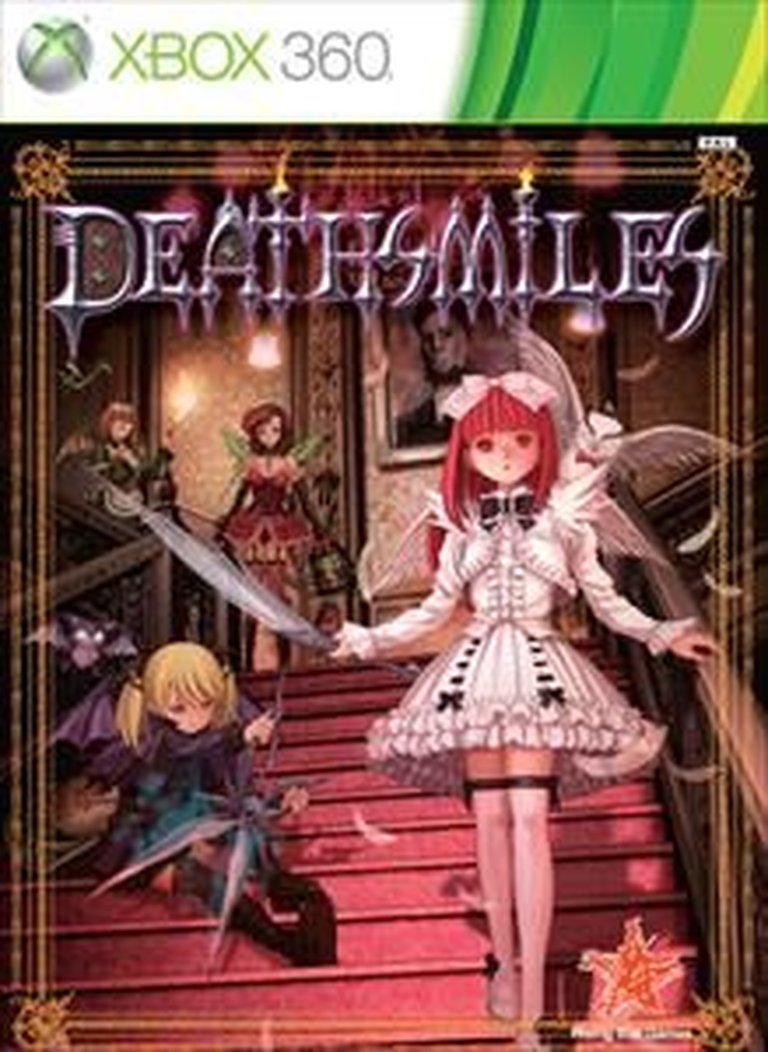
In the mystical kingdom of Gilverado, filled with magic, monsters, and lost souls, overwhelming demonic creatures have invaded, prompting four young lolita-style witches—kidnapped from the human world and raised with immense powers—to seek out and destroy the source of the threat. Deathsmiles is a gothic horror-themed bullet hell shooter featuring side-scrolling action where players blast through stages with bi-directional firing, companion familiars for special attacks, screen-clearing magic bombs, multiple paths, difficulties, and secret bosses across various modes including arcade ports and enhanced versions.
Gameplay Videos
Where to Buy Deathsmiles
PC
Deathsmiles Free Download
Deathsmiles Cracks & Fixes
Deathsmiles Guides & Walkthroughs
Deathsmiles Reviews & Reception
metacritic.com (76/100): Beneath all of the beautiful levels and endless bullets there is an emotional story, which is a bit surprising considering that most of the games in the genre don’t have any.
ign.com (75/100): Gothic horror and shoot-em-up action collide in Deathsmiles, the bullet-hell shoot-’em-up from Cave.
gamerevolution.com : Deathsmiles stands head and shoulders above the vast majority of recent shooters.
steambase.io (96/100): Overwhelmingly Positive
Deathsmiles Cheats & Codes
Arcade
Insert credit and keep holding A, B and C on the player 2 side while entering the codes.
| Code | Effect |
|---|---|
| C, C, C, A, Up, Left, Right, Down, B, C, C, C, Down, Down, A, B, C, B, A. | Unlock EXTRA stage |
| Up, Up, Up, Up, B, B, A, A, Left, Left, Right, Right, C, C, C, Down, C. | Unlock Follet. |
| C, B, A, C, B, Up, A, Right, C, Left, B, Down, C, B, A, A, A. | Unlock Rosa. |
Deathsmiles: Review
Introduction
In the shadowed realms of bullet hell shooters, where screens erupt in cascades of lethal patterns and survival demands pixel-perfect precision, Deathsmiles emerges as a gothic beacon of innovation. Released in arcades on October 19, 2007, by Cave—the undisputed masters of manic danmaku—this horizontal scroller dared to humanize the genre’s punishing elitism with lolita witches wielding wind, fire, and spectral fury against demonic hordes. Its legacy endures through ports to Xbox 360, iOS, Android, Windows, and modern compilations like Deathsmiles I & II (2021), proving that a game can seduce newcomers with accessibility while intoxicating veterans with depth. Thesis: Deathsmiles masterfully democratizes bullet hell by fusing per-stage difficulty selection, bidirectional combat, and a haunting gothic narrative into a symphony of chaos, cementing Cave’s evolution from arcade purists to genre revolutionaries.
Development History & Context
Cave Co., Ltd., born from the ashes of Toaplan in 1994, had already redefined shoot ’em ups with vertical masterpieces like DoDonPachi and Espgaluda II. By 2007, the arcade landscape was waning, overshadowed by home consoles and casual gaming, yet Cave persisted as danmaku’s vanguard. Deathsmiles marked a bold pivot: their second horizontal shooter since Progear (2001), powered by the CAVE CV1000-B hardware (Hitachi SH-3 CPU at 133 MHz, Yamaha YMZ770C-F sound).
Producer Kenichi Takano and Director Junya Inoue (aka “Joker JUN,” handling art, design, and even voicing boss Jitterbug) envisioned broadening appeal beyond hardcore fans. Programmer Tsuneki Ikeda, reflecting on Progear‘s limitations for bullet-dodging, pitched a “busy but not full danmaku” concept, instructing lead programmer Takashi Ichimura to eschew Cave’s signature intensity. Designers Atsushi Aburano, Toshiyuki Kuroiwa, Akira Wakabayashi, and Hiroyuki Tanaka crafted gothic lolita protagonists—tapping Japan’s booming fashion subculture—to infuse “cute” visuals into horror. Manabu Namiki’s soundtrack (Basiscape) blended pipe organs, electronics, and Bach’s Toccata and Fugue in D Minor for the finale.
Technological constraints of mid-2000s arcades demanded sprite efficiency, yielding destructible environments and multi-directional foes. Amid a shooter drought in the West, Deathsmiles arrived as Cave’s gambit for global reach, paving ports by Aksys (NA, 2010), Rising Star (EU, 2011), and Degica (Steam, 2016). Mega Black Label (2008, limited 150-200 boards) added extremes like Level 999, foreshadowing home enhancements.
Narrative & Thematic Deep Dive
Deathsmiles elevates shmups from plotless abstractions to a poignant gothic fairy tale. In Gilverado—a twilight kingdom of magic, monsters, and lost souls—”spirited away” children from our world manifest powers to combat demonic invasions. Adopted by benevolent Count Dior, four witches—Windia (wind-wielding Londoner, owl familiar Hoo; emotional newcomer), Casper (phantom-manipulating Berlin orphan, bat Kiki; repressed trauma fuels ferocity), Follett (fiery Parisian bookworm, dragon Bobo; unlockable via code), Rosa (piercing fairy-summoner from California, Tee-Tee; laid-back leader)—embark from Port Town through Graveyard, Swamp, and Volcano to Hades Castle.
Themes probe loss and belonging: abducted on death’s brink (e.g., Windia’s kidnapping flash, Follett’s icy flood, Rosa’s crash), the girls grapple with homesickness versus found family. Dialogue—sparse but evocative—reveals backstories: Casper’s amnesia masks abduction horrors; Rosa’s nonchalance hides survivor’s guilt. Multiple endings bifurcate: “Leave” portals them home (Casper vengeance-kills kidnappers; Sakura, Windia’s real-world friend and Swamp boss, turns criminal with her father), or “Stay” affirms Gilverado bonds, canonized in sequels.
Undercurrents of gothic horror shine: Jitterbug’s paternal abuse (bashing Sakura), Tyrannosatan’s eldritch emergence (devouring Jitterbug), and motifs like pulsating hearts (Jordan boss) evoke body horror amid frilly elegance. Mega Black Label adds Sakura (broom-riding witch, birds Karko/Kuta), deepening tragedy—her family’s exile humanizes invaders. Sequels expand: Deathsmiles II‘s Christmas carnage kills Dior, spawning Wishing Notes quests; iOS’s Tiara (parasol princess, pig Mu) introduces RPG-lite progression. Junya Inoue’s vision—characters as narrative core—transforms shmups into emotional odysseys.
Gameplay Mechanics & Systems
Deathsmiles deconstructs bullet hell orthodoxy with bidirectional fluidity. Core loop: Navigate six branching stages (A/B/C sets: Port/Forest/Lake → Graveyard/Swamp/Volcano), optional Gorge/ICE Palace, finale Hades. Enemies spawn omnidirectionally; dual shot buttons (A-left, B-right) enable responsive fire. Tap for peashot spread; hold for focused pierce (slows movement); dual-hold spawns Targeting Area (auto-destroys entrants, drains item counter).
Familiar system innovates: Invincible companions (orbit/freeze variably) block specials, amplify damage. Life bar (3 bars: bullet=1 bar, collision=0.5) trumps lives—extends at score thresholds (20M/40M, mode-variant). Bombs (3-1 per stage difficulty) screen-clear. Item counter (max 1000) fuels Power-Up Mode (dual-tap at cap: destroys bullets, boosts shots/items, collision immunity; drains rapidly—recharge via grazing drops).
Per-stage difficulty (1-3, MBL=999) is genius: Lv1=easy patterns/3 bombs; Lv3=suicide bullets/1 bomb, hidden 1UPs/parfaits. Arcade locks repeats; consoles freeform. Scoring: Graze counter-bullets (yellow enemy-death orbs) for items (skulls/crowns); maximize via shot-type (weak/strong/lock); Power-Up multipliers (10K/pop); “recharging” sustains uptime. Suicide cancels yield items in Ver1.1.
Modes layer depth:
– Arcade: Faithful port.
– Xbox 360: HD sprites, no lockouts.
– Ver1.1: Familiar control, suicide everywhere, 100-item Power-Up, 99,999 multiplier.
– MBL: Sakura, ICE Palace, Lv999.
UI shines: Heart hitbox, counters prominent, warnings for spawns. 2P co-op/XL modes foster chaos. Flaws? Short length demands replays; iOS RPG (Tiara equip/shop) grinds. Yet, it’s exhaustive: training, replays, leaderboards.
| Mechanic | Innovation | Impact |
|---|---|---|
| Dual Shots | Bidirectional combat | Omnidirectional threats feel fair |
| Per-Stage Rank | Player agency | Accessibility + scoring strategy |
| Item Counter/Power-Up | Risk-reward chaining | Depth for all skill levels |
| Life Bar | Partial hits | Forgiving yet tense |
World-Building, Art & Sound
Gilverado pulses with immersive gothic decay: misty graveyards teeming skeletons, fog-shrouded forests with corpse-littered paths, lava-veined volcanoes, Escher-castles. Destructible elements (trees, pumpkins) enhance interactivity; stages branch dynamically, culminating in Hades’ ballroom blitz.
Visuals (Junya Inoue): Anime sprites burst detail—frilly lolita gowns, expressive familiars—against haunted backdrops. HD Xbox/Steam upgrades crisp HD; iOS Mori-redesigns soften for mobile. Atmosphere? Opulent horror: grinning apples (Whroon), cleaver-pigs, cyclopes; bosses morph (Bavaria’s extra head).
Sound elevates: Namiki’s OST fuses gothic organs, electronica, rock (lead guitar Noriyuki Kamikura). “Burning Halloween Town” samples Mondo Keyhole; finale’s Bach rendition thrills. SFX crisp (booms, screeches); voices sparse but thematic (Natsuko Tauchi’s Rosa). Basiscape’s polish—Reeb effects, Miki Ito management—immerses, amplifying bullet symphony’s dread-euphoria.
Elements synergize: visuals’ cute-dark contrast mirrors themes; sound’s bombast underscores power fantasies, forging hypnotic tension-release.
Reception & Legacy
Launch acclaim: MobyGames 7.8/10 (#3,982/27K); critics 80% (Le Geek 100%, Retro Gamer 90%, GameSpot 80%). Praised accessibility (“eases newcomers” – NTSC-uk), visuals/music (“marvelous” – LevelUp), modes (“glut of play” – GameSpot). Xbox Metacritic 76/100; iOS 84/100. Commercial win: Cave’s first Western console hit (Aksys NA Limited Edition sold briskly); Steam ports revived interest.
Reputation evolved: Initially divisive (lolita controversy), now hailed for broadening shmups—”breath of fresh air” (Video Game Critic). Patches fixed US slowdown. Influence profound: Pioneered horizontal danmaku revival (Akai Katana); per-rank inspired indies; gothic lolita normalized in shooters. Sequels (II, 2009), ports (2021 compilation w/ DLC), merch (dramas, OSTs) sustain cult. Cave’s “how to revive shmups” blueprint (Games TM) endures, proving niche viability.
Conclusion
Deathsmiles synthesizes Cave’s manic mastery with empathetic design—bidirectional chaos, scalable peril, heartfelt lore—into a bullet hell pinnacle. Its gothic tapestry captivates, mechanics empower, legacy endures: not just a game, but shmups’ gateway drug. Verdict: Essential masterpiece, eternally smiling in video game history’s pantheon—9.5/10. Play it; let the smiles (and bullets) consume you.