
- Release Year: 1999
- Platforms: Windows
- Publisher: Global Software Publishing Ltd.
- Developer: MVP Software
- Genre: Action
- Perspective: Top-down
- Game Mode: Co-op, Single-player
- Gameplay: Arcade, Level editor, Shooter
- Setting: Futuristic, Sci-fi
- Average Score: 59/100
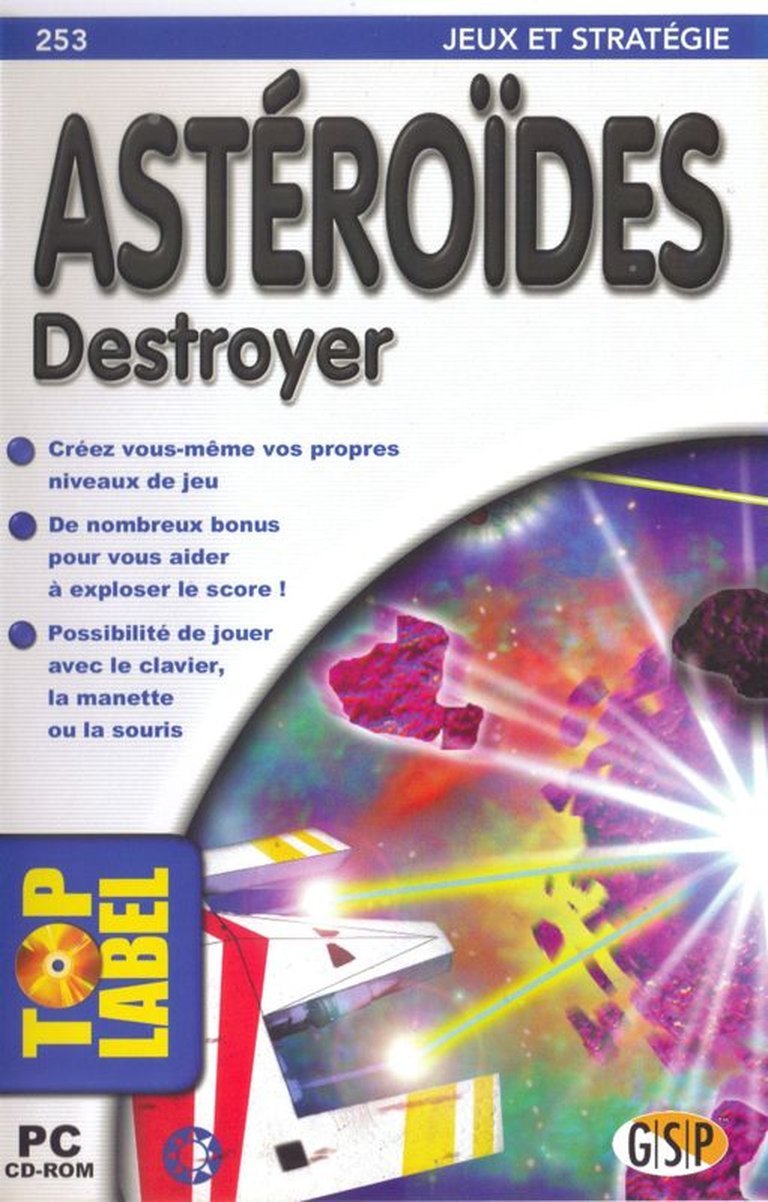
Description
Debris is a Windows-based Asteroids clone where players control a spaceship in a 2D environment, shooting and destroying asteroids into smaller pieces. The game features both cooperative and competitive two-player modes, a Wave Editor for level creation, and retro settings to mimic the original game’s feel. It also includes end-level boss ships and a Rapid Fire bonus, adding depth to the classic arcade gameplay.
Gameplay Videos
Where to Buy Debris
PC
Debris Cracks & Fixes
Debris Guides & Walkthroughs
Debris Reviews & Reception
opencritic.com (59/100): If you don’t mind minimal visuals for an interesting story, Debris is worth checking out.
olivigarden.ca : Not only did diving deeper into the foreboding Arctic caverns yield all manner of dangerous, luminous beings, it brought with it the greatest horror of all: a drop from 80 to 30 FPS (and below).
jannekeparrish.com : It may not have gore or jump scares, but it does have the slow, creeping sensation of time running out, and never knowing what lurks in the dark just beyond.
thirdcoastreview.com : Debris manages to be atmospheric, but sadly, it’s rarely scary.
Debris Cheats & Codes
PC v1.2
During the game press the backspace key to open up the command prompt window. Type in one of the following cheats and press Ok.
| Code | Effect |
|---|---|
| GIMME GUNS | three-way forward guns |
| GIMME SHIPS | extra lives |
| GIMME GOD | invulnerability |
| GIMME SPRAY | maximum width spray gun |
| GIMME RAINBOW | lots of colorful guns |
| GIMME DAMAGE | increase damage |
| GIMME ETICKET | ensure trip to bonus wave |
| GIMME GREASE | reduce friction |
| GIMME ARMOR | increase armor |
| GIMME GILLIGAN | outrigger |
| GIMME BOMBS | grenades |
| GIMME TURBO | turbo engines |
| GIMME AMMO# | replace # with 1..9 |
| GIMME ENERGY | full energy |
| GIMME RANGE | more speed and range for weapons |
| GIMME DEATH BLOSSOM | lots of weapons powerups |
| GIMME DEFAULTS | restore defaults |
| GIMME OUTAHERE | warp to next wave |
| GIMME A BREAK | rocks slow down |
| SHOW ROCKSET | shows filename |
| LOAD ROCKSET | loads random new rocks |
| LOAD BACKDROP | loads random new backdrop image |
| ADD ROCK | adds a rock |
| KILL ROCK | removes a rock |
| EXPLODE ROCK | breaks a rock just like you had shot it |
| ADD MINE | adds a mine |
| KILL MINE | removes a mine |
| EXPLODE MINE | breaks a mine just like you had shot it |
| ADD BONUS | adds a powerup |
| ADD JUNK | adds a big “junk” rock |
| ADD FRAGFEST | adds an explosion effect |
| DISCO INFERNO | adds a fire pattern, funny! |
| ADD ALIEN | adds an alien |
| KILL ALIEN | removes an alien |
Debris: Review
Introduction
In the frigid, lightless abyss of the Arctic Ocean, where survival hangs by a thread and sanity frays at the edges, Debris (2017) by Moonray Studios plunges players into a harrowing journey of paranoia, isolation, and psychological unraveling. This atmospheric first-person adventure, often mislabeled a “walking simulator,” distinguishes itself through its ambitious attempt to simulate trauma-induced psychosis while demanding players navigate labyrinthine underwater caverns. Yet, beneath its promising veneer of innovative storytelling lies a game fundamentally at odds with its own mechanics. This review argues that Debris excels in world-building and thematic depth but collapses under the weight of repetitive gameplay, flawed AI, and technical missteps, ultimately squandering its potential as a landmark in interactive narrative design.
Development History & Context
Moonray Studios, a small Canadian team, crafted Debris as their debut title with a uniquely collaborative vision. Partnering with a PhD neuroscientist, the developers sought to raise awareness of psychosis—specifically, the delusional episodes triggered by trauma—by embedding psychological authenticity into gameplay. Released on October 23, 2017, for Windows (later ported to Mac and PS4), the game arrived amid a flourishing indie scene where narrative-driven experiences like Hellblade: Senua’s Sacrifice (2017) were gaining critical acclaim for tackling mental health. Technologically, Debris operated modestly: its Unreal Engine-based visuals were functional but unremarkable, while its focus on sound design and claustrophobic spatiality demanded precise execution. However, the team’s noble ambition clashed with resource constraints. Optimization issues—such as crippling frame drops in deep waters, jarring 30-second loading screens between chapters, and a minimap system that hindered rather than aided navigation—plagued the launch. This technical fragility reflected the game’s core tension: a vision of immersive horror undermined by the very mechanics meant to deliver it.
Narrative & Thematic Deep Dive
The narrative unfolds through the eyes of Ryan, a videographer trapped beneath Arctic ice after an accident during a corporate expedition for “debris,” a meteoric energy source. Stranded and injured, Ryan is guided remotely by Sonya, a colleague whose voice crackles through his intercom as she pilots a squid-like ROV to assist. Their fractured dialogue—overlapping, distorted, and occasionally unintelligible—mirrors Ryan’s deteriorating mental state. The story masterfully layers paranoia: Ryan’s suspicion that the corporation Alta orchestrated the accident intensifies as he encounters hallucinations, equipment malfunctions, and cryptic Montipora logs (bioluminescent corals storing fragmented memories). Key choices—signaled by Ryan’s movement cues (forward/backward) when queried by Sonya—branch the narrative into four distinct delusion-based endings: Grandiosity (megalomaniacal delusions), Persecution (paranoia of corporate conspiracy), Control (obsessive need to master the environment), and Somatic (belief of physical decay).
This structure is a triumph of thematic integration. The twist—that Ryan’s entire ordeal is a psychotic break—recontextualizes every gameplay element. The “monsters” (bioluminescent fish, sharks, and Bobbit worms) are manifestations of his trauma, while the linear, oppressive levels symbolize the inescapable spiral of mental illness. Yet, the narrative’s subtlety is a double-edged sword. Without prior knowledge of psychosis, players may miss the allegory, mistaking intentional design flaws (e.g., unreliable audio) for poor execution. The corporate conspiracy thread, initially compelling, is sidelined in favor of psychological introspection, leaving Alta’s motives underdeveloped.
Gameplay Mechanics & Systems
Debris’s core loop—exploration, resource management, and combat—feels like three separate games fighting for dominance. Movement is deliberately slow and weightless, emphasizing helplessness as players navigate currents and tight corridors. The oxygen/power meter, depleting from combat, environmental hazards, and tool usage, creates tension but is rendered moot by abundant “debris” (energy nodes) and Sonya’s ROV. This companion, crucial for harvesting power and providing light, suffers from baffling AI. It frequently charges into enemy swarms, ignores resources when low, or gets stuck, forcing players into tedious rescue missions. Combat, involving a “tool” that fires flares (1 MP) or spears (3 MP), is sparse and unsatisfying. Enemies like “Guardian” fish or sharks respawn predictably, turning encounters into resource-draining slogs rather than strategic challenges.
Level design exacerbates these issues. Chapters are repetitive gauntlets—e.g., “Light and Teeth” forces players through shark-infested corridors with no alternative paths—rewarding memorization over skill. Co-op, added post-launch, alleviates some AI frustrations by letting a friend control Sonya, but the base game’s fundamental design flaws persist. The Montipora log system (24 per playthrough) offers lore but requires multiple playthroughs to “collect all,” a tedious grind compounded by buggy achievements. Ultimately, Debris’s mechanics prioritize atmosphere over engagement, leading to frustration rather than immersion.
World-Building, Art & Sound
Debris’s world is its undeniable strength. The Arctic seabed—a vast, cavernous expanse of ice formations, bioluminescent flora, and eerie silence—is rendered with painterly detail. Bioluminescent corals pulse like living memories, while the oppressive darkness, pierced only by flares or the ROV’s glow, evokes genuine dread. The art direction leans into minimalism: monochrome ice contrasts with the sickly orange of energy nodes, creating a stark, unsettling palette. Though textures are often rudimentary, the lighting and particle effects (e.g., floating debris, shimmering water) elevate the environment.
Sound design is equally masterful. Composer Austin Wintory’s score—throbbing, dissonant strings—swells during tense encounters, while ambient sounds (cracking ice, distant clicks) amplify isolation. Voice performances are strong, but mixing flaws render dialogue incomprehensible at times, an issue likely intentional to reflect Ryan’s fractured psyche. Yet, these strengths cannot compensate for the world’s repetition. After hours of identical ice tunnels and identical enemy encounters, the initial wonder curdles into monotony.
Reception & Legacy
Upon release, Debris received mixed reviews. On Steam, it holds a “Mixed” 60% approval rating, with players praising its atmosphere but criticizing gameplay. Critics echoed these sentiments: Third Coast Review lauded its co-op update as a “fix” but called the base game a “slog,” while Janneke Parrish’s scathing review condemned the companion AI as “miserable” and immersion-breaking. Sales were modest, and the game faded quickly from the spotlight.
Over time, Debris gained niche recognition for its psychiatric themes. Forums buzzed with theories about its endings, and players revisited it to uncover Montipora logs or complete buggy achievement sets. Its legacy lies in its ambitious failure: a rare attempt to simulate psychosis interactivity, despite its flawed execution. It influenced few directly but remains a case study in thematic ambition vs. gameplay coherence. The 2017 launch of Debris Infinity, a modernized reimagining, underscores the original’s cult status but does little to address its core issues.
Conclusion
Debris is a game of profound contrasts: a masterclass in atmospheric storytelling marred by inept gameplay, a bold exploration of psychosis undermined by technical flaws, and a visually stunning world trapped in repetitive design loops. Its narrative twist is a genuine gut-punch, and its commitment to simulating psychological decay is commendable. Yet, the constant battle with Sonya’s AI, the monotony of level traversal, and the optimization issues transform survival into a chore. For players seeking cerebral, immersive storytelling, Debris offers a haunting, if flawed, experience. For those valuing polished mechanics, it is a cautionary tale. In the end, Debris sinks under its own weight, a reminder that even the most ambitious vision can founder when gameplay and narrative fail to harmonize. It is not a masterpiece, but it is a fascinating artifact—a brave, if flawed, dive into the depths of the human mind.