
- Release Year: 2008
- Platforms: Windows
- Publisher: Atari, Inc.
- Developer: Southlogic Studios
- Genre: Simulation, Sports
- Perspective: 3rd-person
- Game Mode: LAN, Online PVP, Single-player
- Gameplay: Bag Limits, Hunting, Simulation, Trophy Hunting, Weapon customization
- Average Score: 64/100
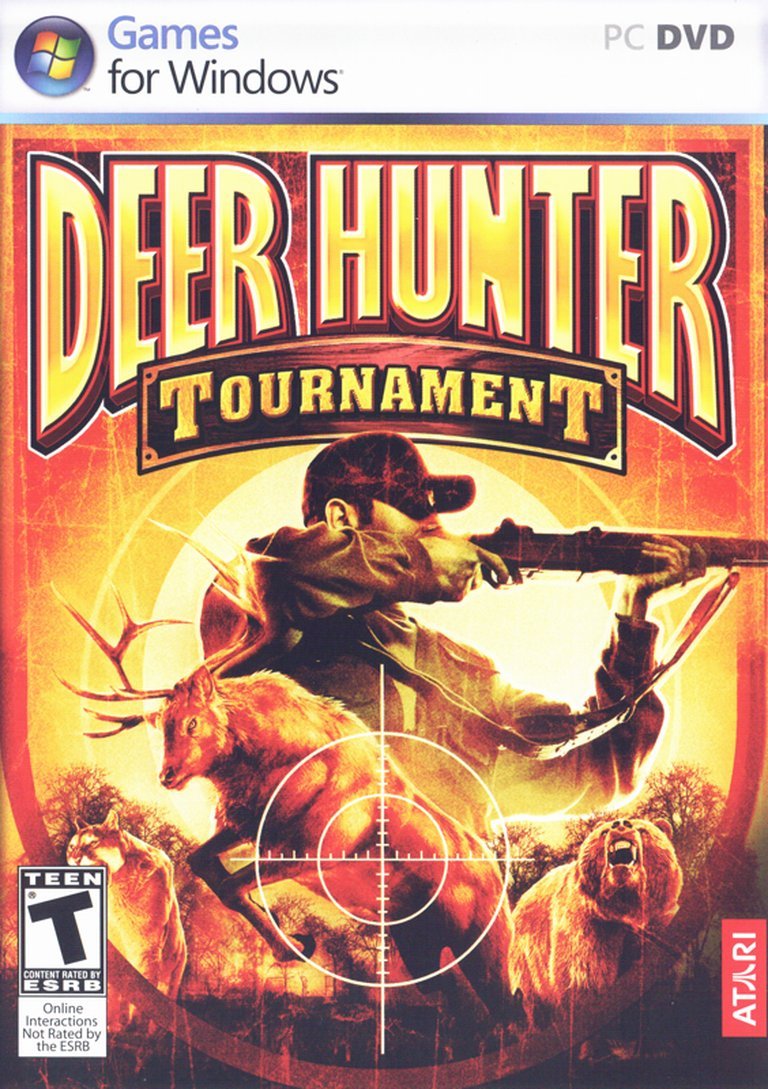
Description
Deer Hunter Tournament is a hunting simulation game that continues the Deer Hunter series, set in diverse new hunting grounds populated by various wildlife including bears, mountain lions, wild turkeys, and rare birds. Players engage in realistic hunts using 10 customizable weapons like shotguns, rifles, and bows, with options for scopes and specialized ammo, while participating in single-player modes or extensive online tournaments that track global stats and enforce bag limits for trophy hunting.
Gameplay Videos
Deer Hunter Tournament Free Download
Deer Hunter Tournament Cracks & Fixes
Deer Hunter Tournament Patches & Updates
Deer Hunter Tournament Reviews & Reception
ign.com : Deer Hunter Tournament isn’t a terrible game at all, but it is by no means a great game either.
Deer Hunter Tournament: The Swan Song of a PC Hunting Sim Dynasty
Introduction: A Legacy Stuck in the Mud
For a generation of PC gamers in the late 1990s and early 2000s, the name Deer Hunter was synonymous with a peculiar, almost meditative form of digital escapism. It was a series that found immense commercial success by simulating not high-octane action, but the patient, methodical, and often lonely pursuit of wildlife across stylized American landscapes. Deer Hunter Tournament, released in October 2008 by Atari and developed by Southlogic Studios, arrived as the ninth mainline entry and a clear statement of intent: this was to be the franchise’s definitive, competitive, online-focused evolution. Yet, it would also become the last major, full-priced PC release in the series before the brand’s definitive migration to mobile platforms. This review argues that Deer Hunter Tournament is a fascinating, deeply flawed capstone—a game that ambitiously attempted to modernize a beloved niche simulator with multiplayer and progression systems but was ultimately hamstrung by technical infelicities, repetitive design, and an identity crisis. It represents both the peak of the series’ mechanical complexity and the precise moment its core formula began to show its age, buckling under the weight of its own ambitions and the changing tides of the gaming market.
Development History & Context: From WizardWorks to Atari’s Last Stand
The Deer Hunter franchise began in 1997 with Deer Hunter: Interactive Hunting Experience, developed by Sunstorm Interactive and published by WizardWorks. It was a prime example of the “casual game” market of the era—simple, accessible, and oddly compelling. The series churned out annual-ish sequels (Deer Hunter II, III, IV, V) and seasonal updates (2003, 2004, 2005), all building on the same core loop of methodical tracking and shooting.
A pivotal shift occurred in 2003. Southlogic Studios, a Brazilian developer, was commissioned by WizardWorks (then under Infogrames/Atari) to develop Trophy Hunter 2003. Its success led Southlogic to take over the flagship Deer Hunter series with Deer Hunter 2004 and 2005. This transfer of development custody marked a significant technical and design evolution. Southlogic introduced more sophisticated 3D environments, improved animal AI, and began layering on more complex simulation mechanics.
By 2008, the gaming landscape had transformed. Multiplayer and online community features were no longer optional for mainstream PC titles. The rise of Big Buck Hunter arcade cabinets and more graphical competitors like Cabela’s Big Game Hunter increased pressure. Deer Hunter Tournament was Southlogic’s and Atari’s answer: a game explicitly designed around “Tournament” play, with worldwide stat tracking, online matchmaking, and a competitive bag-limit scoring system. It was conceived as a bridge between the solitary, contemplative sim of old and the socially-connected, competitive game of the future. However, the technological foundation, built on iterative upgrades of the series’ aging TERRENG-derived engine (used since the Sunstorm days), was struggling to keep pace. The planned Xbox 360 version’s cancellation (per Wikipedia) is a telling footnote, hinting at the project’s technical or strategic difficulties on more powerful hardware.
Narrative & Thematic Deep Dive: The Unspoken Ethics of the Hunt
It is crucial to state upfront: Deer Hunter Tournament possesses no traditional narrative, plot, or characters in any storytelling sense. There is no campaign, no protagonist with a backstory, no villain to pursue. The “narrative” is entirely emergent, systemic, and player-driven, framed by the implicit story of the hunter’s progression from novice to tournament champion.
The thematic core, therefore, lies in its simulation of a regulated, “sporting” hunt. The game’s central mechanic—the bag limit system—is its most significant narrative device. It doesn’t just score you; it codes your actions as legal or illegal. Shooting a protected species, exceeding your quota, or even shooting an animal in the water (where bullets can ricochet) marks you an “illegal hunter.” This introduces a moral and regulatory framework absent from pure action shooters. You are not a rampaging agent of destruction but a participant in a managed ecosystem, your success measured against a set of rules designed to simulate conservation ethics and hunting regulations.
The pursuit of the trophy buck deepens this theme. Not all deer are equal. The game’s detailed antler modeling means a high-scoring “trophy” with large, symmetrical antlers is the ultimate goal, while a small “non-trophy” doe is a lesser prize. This mirrors the real-world culture of big-game hunting, where the emphasis is on the quality of the specimen, not just the kill. The player’s internal narrative becomes one of patience, skill, and legacy-building—filling a virtual trophy wall with increasingly prestigious mounts. The inclusion of other exotic animals (bears, mountain lions, turkeys) expands this “trophy hunter’s paradise” fantasy but also creates dissonance; the game is titled Deer Hunter, yet the most dangerous and valuable trophies are often other species, subtly undermining the core premise.
The complete absence of a human-centric story is, in itself, a statement. The wilderness is the star; the human is a transient, rule-bound visitor. The only “character” is the off-screen hunting instructor from the tutorial, whose intermittent and buggy voiceovers (a noted flaw) are the game’s only attempt at direct human guidance, further emphasizing the solitude of the experience.
Gameplay Mechanics & Systems: A Framework of Frustration and Reward
Deer Hunter Tournament’s gameplay is a intricate, often clunky, dance of simulation and shooter mechanics.
1. The Core Loop & Stealth: The fundamental loop is: Choose a location/weather/time → equip gear → traverse terrain → locate animal → execute a clean, legal kill → retrieve carcass → repeat. Success depends entirely on animal AI. Creatures use sight, sound, and (critically) smell. The wind meter on the player’s compass is a vital UI element; moving upwind of an animal is essential to avoid detection. This creates a genuine stealth puzzle. Animals will flee if spotted or heard, utilizing the hilly, cluttered terrain to escape. The act of going prone, moving slowly, and managing noise (from your own footsteps or vehicles) is paramount. This is not a run-and-gun experience; it is a patient stalk.
2. Weaponry & Customization: The game offers 10 base weapons—rifles, shotguns, and bows—each with distinct ballistics. Customization is deep: scopes with variable zoom calibrations, specialized ammunition (e.g., slugs for shotguns), and other accessories. This allows players to tailor their loadout for specific situations (e.g., a high-power scoped rifle for long-distance trophy shots, a shotgun with slug for closer, heavy game like bears). The bow and arrow adds a significant challenge, requiring lead estimation and immense patience.
3. The Bag Limit & Scoring System: This is the game’s central, defining mechanic. You register for a “tournament” with a specific bag (e.g., 2 elk, 3 deer). You may only kill animals for which you have a bag. Killing others is illegal and penalized. Furthermore, within a species, quality matters. A deer’s score is determined by its antler size/symmetry, tracked via a “score calculator” after a kill. This creates a compelling risk/reward: do you take a sure, small kill to fill your bag, or risk a long shot at a larger, more elusive trophy that might get away? It perfectly encapsulates the tournament scoring mindset.
4. Traversal & Its Quirks: Players can move on foot, on horseback, or via ATV. Horses are quieter but slower; ATVs are fast but noisy, alerting every animal for miles. Both have significant control and camera issues. As the IGN review sharply notes, mounting a vehicle snaps the camera to the vehicle’s orientation, frequently causing disorientation. The lack of a minimap exacerbates this, making navigation in the large, visually repetitive forest environments a chore. This is a critical flaw: a game about traversal makes traversal itself frustrating.
5. Multiplayer & The Big Failure: The “Tournament” mode was the game’s headline feature. It promised online competition, global leaderboards, and customizable match rules (first kill, most points, best trophy, etc.). This is where the game catastrophically failed at launch and, for most of its lifespan. As documented in user comments on My Abandonware and the IGN review, server connectivity was notoriously broken. Many players, including the IGN reviewer, could not register a username or connect to any match. This wasn’t a minor bug; it was a fundamental breakage of the game’s selling point, rendering a major portion of the package useless for the vast majority of players. Any analysis of the game’s systems must acknowledge that its flagship competitive mode was, for all intents and purposes, vaporware for most consumers.
World-Building, Art & Sound: A Pretty, Empty, and Noisy Wilderness
The game’s world is a collection of large, open maps representing various North American biomes: deciduous forests, coniferous woods, snowy tundras, and arid deserts. The visual presentation is competent for its time and budget but unspectacular. Textures are muddy, geometry is simple, and the draw distance is limited. The famous “Deer Hunter” lighting model—a slightly dreamy, soft-focus look—is present but now feels dated. The environments are vast but lack meaningful detail or points of interest outside of animal spawn points. The repetition of tree models and the copy-paste feel of landscapes contribute to the navigational disorientation. Clipping issues are common, with vegetation pushing the player away rather than behaving physically, and animals occasionally appearing as “mutated hybrids” on lower settings (per IGN).
Where the world excels is in its ambient sound design. This is, without question, the game’s strongest artistic asset. The crickets chirping, birdsong in the distance, the crunch of snow or grass underfoot, and the howling blizzard winds are exceptionally effective. They create a palpable sense of place and solitude. The crack of a rifle or the twang of a bowstring also carry satisfying weight. The only major audio flaw is the sporadic failure of the tutorial narrator’s voice lines, forcing reliance on subtitles, and the oddly silent ATV engine after startup.
The UI/HUD is functional but cluttered. The compass/wind meter is well-integrated. The scoring and bag-limit information is clear. However, the absence of a minimap, as repeatedly stressed, is a major omission for navigation in such visually homogenous spaces.
Reception & Legacy: A Critical Misfire and the End of an Era
Deer Hunter Tournament met with largely mixed to negative reviews at launch. Metacritic aggregates scores of 64 (IGN, GameZone) and 50 (Gamervision). The consensus, perfectly captured by Jimmy Thang’s IGN review (score 6.4), was that the game had a solid, passionate core simulation but was buried under a mountain of bugs, balance issues, and the fatal flaw of broken online services. The IGN review’s headline, “Oh deer, here we go again,” sets a tone of weary familiarity, acknowledging the series’ niche appeal while dismissing its execution.
Commercially, concrete sales figures for this specific installment are scarce in the provided sources. However, the Wikipedia entry notes that combined sales of all Deer Hunter PC titles from 2000-2006 reached 1.4 million in the US. The series’ commercial peak was likely behind it by 2008. The fact that no full-priced, mainline PC sequel followed—with the next major release, Deer Hunter 2014, being a mobile title—is the most significant part of its legacy. Deer Hunter Tournament was the last gasp of the traditional PC hunting sim from this franchise.
Its influence is therefore one of culmination and caution. It tried to adapt a single-player, patience-based sim to the era of online multiplayer and stat-tracking, but its failure to deliver a functional online experience highlighted the risks of bolting fashionable features onto a niche, resource-constrained engine. The game became a case study in how not to transition a legacy franchise online. Meanwhile, the mobile games that followed (by Glu Mobile) stripped the formula down to its barest, most free-to-play-friendly elements: quick sessions, simpler mechanics, and microtransactions. In this light, Tournament represents a lost middle path—a complex, “hardcore” hunting sim that the market, and perhaps the series’ own audience, was no longer interested in or able to access due to technical barriers.
Conclusion: A Flawed Trophy on the Wall
Deer Hunter Tournament is not a “bad” game in the sense of being insulting or incompetently made. It is a deeply problematic game. Its underlying simulation of hunting—the stealth, the wind mechanics, the animal AI, the trophy scoring, the weight of the bag limit—is sophisticated and clearly crafted by developers who understood (and perhaps loved) the sport’s nuances. For the lone player with immense patience, on a system that can run it well, there are moments of genuine, quiet immersion to be found standing silently in a virtual forest, waiting for the perfect shot.
However, those moments are buried under an avalanche of issues: an empty world that feels under-populated, navigation so poor it actively hinders the core loop, a vehicle system that fights the player, and, most damningly, a flagship online mode that simply does not work for most people. These are not minor dents; they are foundational cracks.
In the grand history of video games, Deer Hunter Tournament is a fascinating footnote. It is the elaborate, ambitious, and ultimately failed effort to drag a quirky PC-only success story into the modern, online era. Its legacy is twofold: it is the epitome of the complex, PC-native hunting simulator, a genre now nearly extinct, and it is the catalyst for the franchise’s pivot to mobile, where simplicity and accessibility trumped simulation depth. It stands as a digital猎物 (prey) caught between the crosshairs of a changing industry—a game that aimed for the prestigious trophy of a sustainable online community but was brought down by the unglamorous, fatal shot of its own technical shortcomings and a market that had already moved on. It is, in the end, a fittingly ironic title for the tournament it could never quite win.