
- Release Year: 2007
- Platforms: Windows
- Publisher: Cinemaware, Inc., Noviy Disk, rondomedia Marketing & Vertriebs GmbH
- Developer: TechFront Studios, Ltd.
- Genre: Strategy, Tactics
- Perspective: Top-down
- Game Mode: Single-player
- Gameplay: Card-based, Mini-games, Tactical, Territorial Conquest, Turn-based
- Setting: Post-Norman Conquest England
- Average Score: 73/100
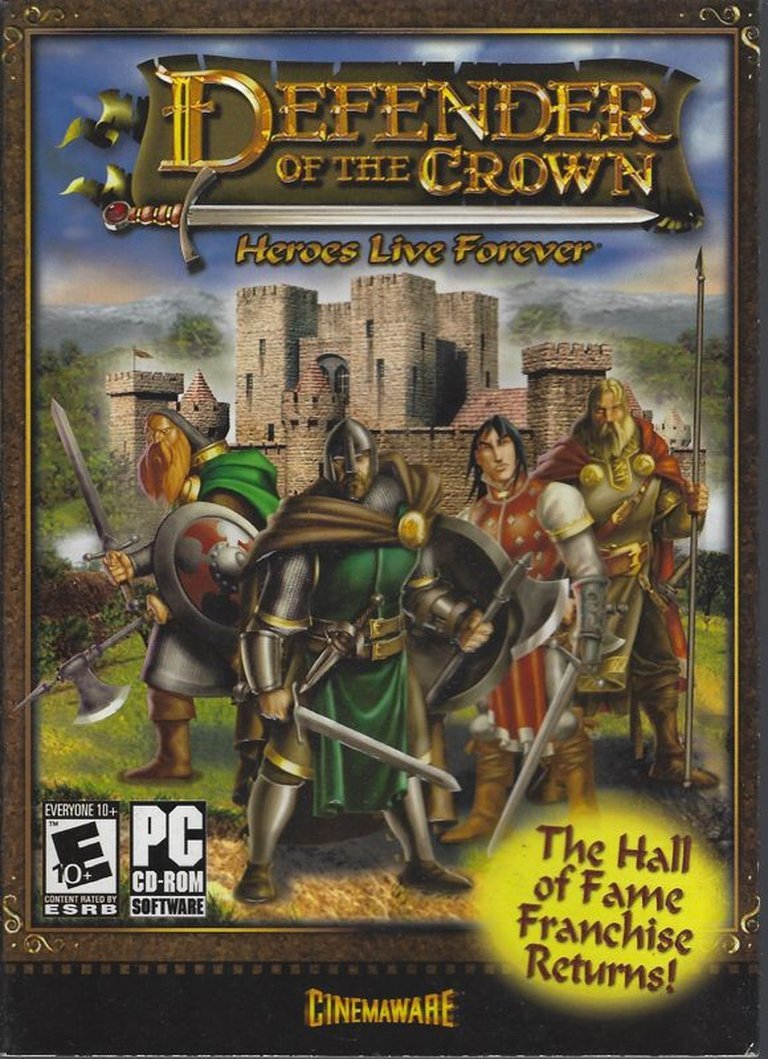
Description
Defender of the Crown: Heroes Live Forever is a casual remake of the classic strategy game set in post-Norman Conquest England, where players assume the role of a Saxon lord aiming to eliminate rival Norman lords and reunite the fractured kingdom. The gameplay combines territorial conquest on a Risk-like map with tactical battles involving five unit types (infantry, knights, crossbowmen, bowmen, catapults) and special tactics cards for strategic advantages. Mini-games such as jousts, archery contests, castle raids, and princess rescues provide additional rewards, while historical figures like Robin Hood offer assistance to Saxon lords—though Norman lords can counter with the Black Templars.
Gameplay Videos
Defender of the Crown: Heroes Live Forever Free Download
Defender of the Crown: Heroes Live Forever Reviews & Reception
metacritic.com : Any Defender of the Crown lovers from the ’80s should leave their good memories intact and ignore this desecration.
mobygames.com (58/100): Another loveless clone, ok as free side dish, like, at work, but not challenging and not worth your money. I’m glad I got it for free.
Defender of the Crown: Heroes Live Forever Cheats & Codes
Nintendo (NES)
Enter codes using a Game Genie or similar device.
| Code | Effect |
|---|---|
| ZAVVALGO | Only 10 soldiers in your Garrison |
| AZVVALGO | 40 soldiers in your Garrison |
| AAEOUPPA | Soldiers for free |
| LAEOUPPA | Triple the cost of soldiers |
| GAEOKOAA | Halve the cost of knights |
| APEOKOAA | Double the cost of knights |
| YAEOSOYA | Halve the cost of catapults |
| ZAEOVPGO | Halve the cost of castles |
| NYVVALGO | 255 Soldiers In Your Garrison |
| AAEOKOAA | Knights Cost Nothing |
| AAEOSOYA | Catapults Cost Nothing |
| AAEOVPGP | Castles Cost Nothing |
| 05D7:FF | Infinite Money |
| 0647:32 | Infinite Catapult Boulders |
| 0645:32 | Infinite Catapult Greek Fire |
| 0511:0E | Great Mace Power |
| 067F:3C | Great Siege Defense / Battle Power |
| 0593:FF | 255 Soldiers Army |
| 0555:FF | 255 Soldiers Garrison |
| 0599:FF | 255 Knights Army |
| 0568:FF | 255 Knights Garrison |
| 059F:FF | 255 Catapults Army |
| 057B:FF | 255 Catapults Garrison |
| 00CB:06 | Infinite Catapult Shots |
| 05D7:55 | Infinite Money (Always 255) |
| 0647:50 | Infinite Catapult Boulders |
| 0645:50 | Infinite Catapult Greek Fire |
PC
Hold the specified key during the game loading or battle sequence.
| Code | Effect |
|---|---|
| Hold K | 1024 Knights in your army and 1024 Knights protecting the castle |
| Hold R | 1024 Knights available for defense or offense |
Game Boy Advance (GBA)
Enter codes using a CodeBreaker device.
| Code | Effect |
|---|---|
| 00000E4F 000A 1000064C 0007 | Master Code |
| 83001150 270F | Unlimited Cash |
| 33004EBC 0009 | Unlimited Boulders |
| 33004E9C 0009 | Unlimited Greek Fires |
| 33004F08 0009 | Unlimited Diseases |
| 83000FB6 03E7 | 999 Soldiers (Home Artillary) |
| 83000FB8 03E7 | 999 Knights (Home Artillary) |
| 83000FBA 03E7 | 999 Catapults (Home Artillary) |
| 83001154 03E7 | 999 Soldiers (Campaign Artillary) |
| 83001156 03E7 | 999 Knights (Campaign Artillary) |
| 83001158 03E7 | 999 Catapults (Campaign Artillary) |
| 73001ACA 000E 33001AC4 000F | Unlimited Health (1 On 1 Combat) |
| 73001AEA 000E 33001AF0 000E | Weak Enemies (1 On 1 Combat) |
Defender of the Crown: Heroes Live Forever: A Critical Reappraisal of a Misguided Remake
1. Introduction
To step into the digital realm of medieval England is to confront a legacy defined by visceral spectacle and accessible strategy. Cinemaware’s 1986 masterpiece, Defender of the Crown, wasn’t merely a game; it was a revelation. It married the sweeping romance of Ivanhoe and Robin Hood with innovative Risk-like territorial control and unforgettable mini-games, all draped in graphics and animation that pushed the boundaries of 8-bit and 16-bit home computers. It became a benchmark for presentation and a beloved icon of the golden age of Amiga gaming. Decades later, amidst the casual gaming boom, the Cinemaware brand was revived, promising to breathe new life into its classic. Thus arrived Defender of the Crown: Heroes Live Forever in 2007. This review posits that while the title evokes cherished nostalgia and attempts to modernize the core loop, it ultimately emerges as a deeply flawed, passionless iteration. It succeeds only in highlighting why the original was revolutionary and serves as a cautionary tale about the perils of remastering without reverence or understanding.
2. Development History & Context
The story of Heroes Live Forever is inextricably linked to the turbulent journey of the Cinemaware brand itself. The original studio declared bankruptcy in the mid-90s, but its legacy lived on. In 2000, entrepreneurs Lars Fuhrken-Batista and Sean Vesce acquired the Cinemaware name and assets, successfully launching a remake titled Robin Hood: Defender of the Crown in 2003 for PS2, Xbox, and PC. This project aimed to translate the original’s charm for a modern audience. However, the company faced challenges, and in 2005, eGames acquired Cinemaware. This shift in corporate ownership proved pivotal for the 2007 sequel/remake, Heroes Live Forever.
Development was entrusted to TechFront Studios, Ltd., a studio with little prior pedigree in the strategy or action genres, primarily known for casual titles like Burger Island and Purrfect Pet Shop (as evidenced by shared credits on MobyGames). The vision was explicitly framed as a “casual” remake. This label, signaling accessibility and streamlined mechanics, inevitably clashed with the strategic depth and cinematic bombast prized by fans of the original. Technologically, operating in 2007 for Windows, TechFront had vastly superior hardware at their disposal compared to the Amiga or C64. Yet, the final product felt constrained and uninspired. The gaming landscape of 2007 was dominated by the rise of the casual market (populated by The Sims, Diner Dash, and downloadable PC titles) alongside increasingly sophisticated strategy games (Civilization IV, Company of Heroes). Heroes Live Forever awkwardly positioned itself between these worlds, lacking the depth for hardcore strategists and the engaging hook for true casual players, ultimately failing to capture the zeitgeist of either era. The adaptation of the original design, credited to James Farley, felt perfunctory rather than inspired.
3. Narrative & Thematic Deep Dive
The narrative framework remains steadfastly loyal to its origins: post-Norman Conquest England, 1149 AD. King Richard’s death (though historically inaccurate, as Richard was Norman) plunges the realm into chaos. The player assumes the role of a Saxon lord (Wilfred of Ivanhoe, Cedric of Rotherwood, Geoffrey Longsword, or Wolfric the Wild) with the singular objective of eliminating all rival lords and uniting the kingdom under their banner. This premise, rooted in the romanticized Anglo-Norman conflict popularized by Walter Scott’s Ivanhoe, offers a clear, heroic narrative drive.
However, the thematic execution in Heroes Live Forever feels threadbare and devoid of the original’s charm. The core themes of heroic resistance against oppression, chivalry, and the struggle for Saxon freedom are present but delivered with remarkable flatness. Where the original Amiga version used simple animated sequences and dramatic text to convey events like a princess kidnapping or Robin Hood’s intervention, Heroes Live Forever relies on static screens and uninspired prose. The “epic atmosphere,” as lamented by one player review, is utterly absent.
Character interactions are minimal and lack personality. Robin Hood’s return, a key Saxon ally limited to three assists per campaign, feels tacked on. His aid now requires the player’s army to travel to his location – a mechanic often impractical or wasteful, stripping away the mythic convenience of his legendary status. More significantly, the introduction of the “Black Templars” as a Norman counterpart is a thematic misstep. While adding a new wrinkle, it feels shoehorned, lacking the folklore weight of Robin Hood and serving more as a gameplay balance feature than a compelling narrative element. The dialogue is sparse and functional, failing to evoke the courtly intrigue or rustic charm that could have enriched the medieval setting. The shallow “Honour” system, which builds quickly from various sources and can be easily ignored, further undermines any potential thematic depth related to chivalry or reputation. Ultimately, the narrative feels like a mere backdrop for the gameplay, lacking the storytelling ambition that made the original feel like an interactive storybook.
4. Gameplay Mechanics & Systems
Heroes Live Forever revolves around a core loop familiar to fans: a turn-based, top-down map reminiscent of Risk, where players manage territories, collect gold, build armies, and engage rivals. The fundamental structure remains intact. Players purchase garrisons and five distinct unit types: Infantry (basic troops), Knights (cavalry, strong melee), Bowmen (ranged), Crossbowmen (faster, less powerful ranged), and Catapults (siege weapons). These units clash in tactical battles presented as animated, round-based skirmishes viewed from a side perspective.
The most significant new mechanic introduced is the “Tactics Cards” system. Players can win these cards in battle or purchase them with gold. These cards, when played during tactical engagements, provide bonuses like boosting unit morale, weakening enemy formations, or inflicting damage. This deck-building element adds a layer of unpredictability and potential strategy to battles, offering the one genuinely innovative feature noted by positive reviews. However, its impact is limited. The battles themselves remain simplistic: units move, attack, and are destroyed in a largely deterministic fashion, lacking the tactical depth of later strategy titles. The animation, while smoother than the original’s sprites, feels superficial and doesn’t translate to meaningful tactical choices.
The game attempts to replicate the original’s famous mini-games:
* Jousting & Archery Contests: These return as opportunities to win gold or fame. However, as critics noted, they feel “of negligible impact,” lacking the strategic weight they sometimes held in the original. Winning rarely provides a decisive advantage.
* Castle Raids: Players can attempt to infiltrate enemy castles. These simplified sequences offer quick rewards but feel perfunctory.
* Princess Kidnappings/Rescues: A staple, but stripped of narrative context. Rescuing a damsel no longer grants a significant leadership boost (“new respect”) tied to the original’s charming, slightly risqué encounter. It’s a simple, isolated event.
* Castle Sieges: Players can bombard castle walls with catapults before attacking, but this mechanic is poorly integrated and often feels like a pointless delay.
The core map strategy suffers severely from implementation flaws:
* Catastrophic AI: This is the game’s most damning failure, as repeatedly highlighted in reviews. The AI rivals are notoriously incompetent. They often engage in nonsensical wars of attrition, repeatedly attacking each other’s strongest armies in rich territories while leaving their own castles vulnerable. As one player bluntly stated: “Just stand back, watch them kill off each others army after army at the richest territory and then strike their main castles!” This renders the conquest path almost trivially easy once the player understands the AI’s predictability.
* Broken Systems: The “Honour” system is botched, rising too quickly and being easily ignored. Resource management is simplistic, and the choice of which territory to conquer loses strategic nuance due to the AI’s behavior.
* Streamlined to Simplicity: The “casual” focus translated to a significant reduction in strategic depth. Complex decision-making about army composition, timing of attacks, and alliances (with other Saxons who inevitably become rivals) is largely absent. The game prioritizes accessibility at the cost of challenge and meaningful player choice.
The UI is functional but uninspired, lacking the charm and clear presentation of the original. While technically sound for its time (2007 Windows), the gameplay loop is ultimately hollow due to the AI and systemic flaws.
5. World-Building, Art & Sound
Heroes Live Forever inherits its setting – a romanticized, idealized medieval England – directly from the original. The map is a recognizable, albeit simplified, representation of the British Isles divided into territories. The core world-building premise remains strong. However, the execution fails to bring this world to life.
Visuals: The art direction represents a significant step down from the original Cinemaware vision. Where James D. Sachs’ work on the Amiga version was renowned for its lush colors, detailed character sprites, and fluid animation that set new standards, Heroes Live Forever adopts a colorful but generic, almost cartoonish 2D style. The map view uses simple, flat colors for territories and basic icons for armies and castles. While clear and functional, it lacks the detail and atmosphere that made the original’s map feel like a living, breathing realm. The mini-game cut-ins feature hand-painted illustrations, but they lack the dynamic flair and cinematic quality of the original’s “movie” sequences. The tactical battle screens, while animated, utilize simple 3D models or sprites that lack the personality and impact of the original’s sprite-based clashes. The overall aesthetic feels like a budget-friendly mobile or casual PC game from the era, not a worthy successor to a graphical benchmark. The visual spectacle is gone.
Sound Design: The audio experience is similarly uninspired. The original Amiga soundtrack, composed by Jim Cuomo, was memorable and helped establish the medieval atmosphere. Heroes Live Forever features generic, looping tunes that lack distinction. Sound effects are present but lack the punch or character that could have enhanced the combat or mini-games. There’s no sense of grandeur, tension, or adventure conveyed through the audio. The sound design is purely functional, failing to contribute significantly to the atmosphere or immersion. The complete absence of the original’s iconic theme music is a notable omission that underscores the disconnect with the heritage.
In essence, the world of post-Norman Conquest England is present on the map and in the premise, but the art and sound fail to evoke the sense of place, romance, and epic scale that made the original such a sensory delight. The game looks and sounds like a competent, but utterly passionless, casual title, not a revival of a classic.
6. Reception & Legacy
The critical reception of Defender of the Crown: Heroes Live Forever at launch was decidedly mixed, leaning heavily towards negative, reflecting the deep divisions it caused among reviewers and players.
-
Critical Reception: On Metacritic, it holds a Metascore of 20 based on one review (GameSpot’s scathing condemnation). MobyGames aggregates critic scores to a low 54%, based on five reviews:
- GameSpot (PC – 20%): Utterly damning, calling it “Another childhood memory destroyed,” “so awful that it tarnishes whatever happy memories you might have,” and comparing it to Reaganomics and Cyndi Lauper relics.
- Jeuxvideo.com (PC – 35%): Found it “sympathique et prenant” (nice and gripping) but criticized its “trop faible durée de vie” (too short lifespan) and “exagéré” (exaggerated) price for an old remake, recommending it only to “fans, aux vrais!”
- Gameplay (Benelux) (PC – 67%): Called it “a fun interlude” (“een leuk tussendoortje”) but conceded it failed to conquer the place the original held in fans’ hearts.
- Casual Review (PC – 70%): Acknowledged a confusing tutorial but praised it as a “pleasant blast from the past” for fans and noted that “medieval battle is FUN.”
- GameZebo (PC – 80%): Offered the most positive take, arguing it proved the strength of the original concept, attracting fans from 10 to 100, with “slick looks and polished excitement.”
-
Player Reception: Player sentiment, reflected in MobyGames’ average player score (2.9/5) and detailed reviews, was significantly harsher. The lone detailed review by “Tomthesecond” (2009) encapsulates the dominant player view: an “Unloving careless remake to rake in some cash.” It praised the Tactics Cards as a “nice feature” but relentlessly criticized the “terrible AI,” the absence of “epic atmosphere,” the impracticality of Robin’s help, the negligible impact of mini-games, the broken Honour system, and the lack of strategy, concluding it was “not challenging and not worth your money.”
-
Commercial Performance: Exact sales figures are elusive, but given the niche market for strategy remakes and the overwhelmingly negative critical/player reception, it’s unlikely to have been a significant commercial success, especially compared to the original’s multi-million sales.
-
Legacy: Defender of the Crown: Heroes Live Forever holds a negligible legacy in the broader gaming landscape. It did not spawn sequels or inspire significant imitations. Its primary legacy is negative: it serves as a stark reminder of how not to remake a beloved classic. It highlights the dangers of stripping a game’s soul in the name of “casual” appeal, of underestimating the original’s strengths (especially its AI and presentation), and of entrusting a cherished IP to a development team lacking the necessary vision or reverence. For fans of the original, it’s largely forgotten as a disappointing misstep. For the casual market, it was likely lost among numerous similar titles. It stands as a footnote in the Cinemaware saga, overshadowed by both the 1986 masterpiece and the more faithful (though also flawed) 2003 Robin Hood remake. Its reputation has solidified as a cautionary tale rather than a noteworthy entry in the strategy genre.
7. Conclusion
Defender of the Crown: Heroes Live Forever is a profoundly disappointing venture. It arrives bearing the name of a legend, leveraging a beloved setting and core mechanics, yet utterly fails to capture the magic that made the 1986 original a timeless classic. Its ambitions for “casual” accessibility translated into a significant dilution of strategic depth and challenge. The introduction of the Tactics Cards system offered a spark of genuine innovation, but it was a single candle in a vast, dark room.
The game’s most critical failure lies in its catastrophic AI rendering the conquest path trivial and devoid of tension, compounded by broken systems like the Honour mechanic. This, combined with the complete absence of the original’s cinematic presentation, epic atmosphere, and memorable audio, leaves the game feeling hollow and soulless. The art, while colorful, is generic and fails to evoke the romance of medieval England, while the sound is forgettable.
Reception at the time reflected this schism, with critics ranging from outright condemnation (GameSpot) to guarded appreciation for its core concept (GameZebo), but the overwhelmingly negative player consensus and the game’s utter lack of lasting impact speak volumes. Its legacy is not one of innovation or fond remembrance, but as a stark lesson in the perils of remastering without passion, understanding, or respect for the source material’s essence.
For historians and fans, Heroes Live Forever is a curio, a fascinating example of a property mismanaged and mishandled. It demonstrates that updating classic games requires more than a fresh coat of paint and simplified mechanics; it demands a deep reverence for what made the original endure. In the grand tapestry of video game history, Defender of the Crown remains a vibrant, influential thread. Defender of the Crown: Heroes Live Forever is a loose, frayed end, best remembered as a reminder of the heights the original achieved and the depths this remake plumbed. It is, unequivocally, a footnote, not a sequel, to a true legend.