
- Release Year: 2002
- Platforms: Windows Mobile, Windows
- Publisher: Llamasoft Ltd.
- Developer: Llamasoft Ltd.
- Genre: Action
- Perspective: Fixed / flip-screen
- Game Mode: Single-player
- Gameplay: Arcade
Description
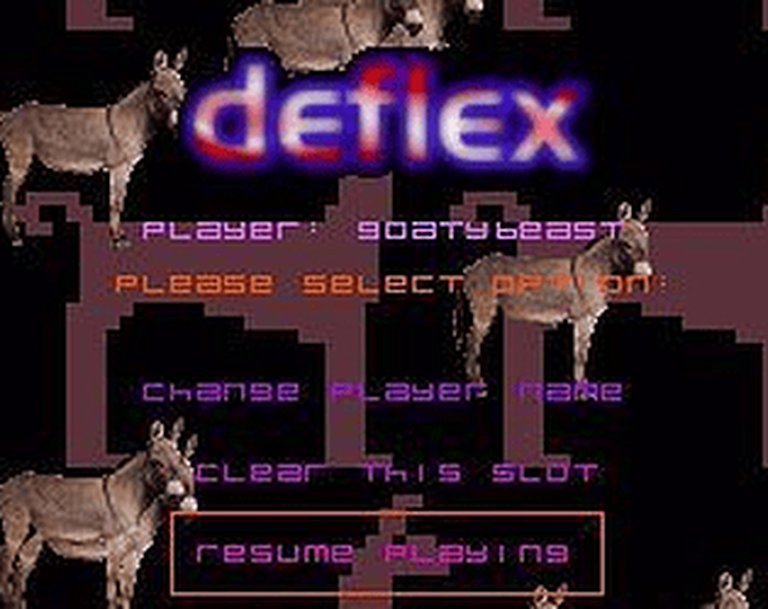
Deflex is an action-puzzle game developed by Jeff Minter where players guide a bouncing ball to strike all targets by strategically placing flipping deflectors called ‘bats’. Originating in the late 1970s as a home computer title, the game challenges players to hit 15 numbered targets across 20 difficulty levels with minimalistic sci-fi visuals. As bats flip on impact and fill the playfield, players must anticipate the ball’s trajectory to clear targets efficiently—a mechanic adapted across systems from ZX Spectrum to modern Windows and iOS ports.
Deflex Free Download
PC
Deflex Guides & Walkthroughs
Deflex Reviews & Reception
killscreen.com : a once-vexing game bloomed into a novel, engrossing, and outright genius work of programming.
Deflex: Review
Introduction
In the annals of video game history, few titles embody the raw, unfiltered essence of indie experimentation like Jeff Minter’s Deflex. Born in the twilight of the 8-bit era, this deceptively simple action-puzzle game has traversed decades of technological upheaval, evolving from a Commodore PET hobby project into a cult phenomenon across multiple platforms. At its core, Deflex is a masterclass in emergent complexity—a minimalist ballet of bouncing balls, flipping deflectors, and strategic anticipation. Yet its true legacy lies in how it encapsulates Minter’s philosophy of distilling arcade euphoria into cerebral, introspective experiences. This review dissects Deflex not merely as a game, but as a living artifact of computing history—a testament to how constraints breed creativity and how a single mechanic can yield infinite permutations.
Development History & Context
The Birth of a Vision
Deflex emerged in 1979–1980 from the mind of Jeff Minter, then a precocious teenager honing his skills on Queen Mary’s College Commodore PET. Frustrated by BASIC’s limitations in replicating arcade physics, Minter and collaborator Mark Rawlinson prototyped a ball-deflection system inspired by Pong and Breakout. Their breakthrough was elegant: diagonal “bats” placed by the player would flip orientation upon impact, transforming predictable bounces into chaotic, trajectory-shifting puzzles. This innovation—born from hardware constraints like the PET’s 1KB RAM—redefined emergent gameplay.
Technological Constraints and the Home Computing Boom
Deflex arrived amid Britain’s 1981 microcomputer revolution. Platforms like the ZX81 (with its flickering monochrome display and £69.95 price tag) and VIC-20 (offering color at £199) democratized gaming, but forced brutal design choices. Minter’s ZX81 port (1981, published by DK’Tronics) used character-based vector graphics and machine code (1,000x faster than BASIC) to achieve smooth ball physics. The VIC-20 version (1982) added sound effects and flashing colors, yet both games omitted audio due to hardware limitations. These constraints forged Deflex’s purity: no enemies, no lives—just a ball, bats, and targets.
The Llamasoft Ethos
As Minter’s first commercial title under Llamasoft (founded 1982), Deflex established his design credo: accessible yet profound. Self-distributed via mail-order (£5.95 per cassette) and magazines like ZX Computing, it rejected the era’s trend of arcade clones. Instead, it offered “totally new, very addictive gameplay” that rewarded pattern recognition over reflexes—a proto-indie manifesto.
Narrative & Thematic Deep Dive
Abstract Ambiguity: The Story in Mechanics
Deflex lacks traditional narrative, but its gameplay is its story. The perpetual motion of the ball symbolizes futility and persistence, while the flipping bats represent duality and consequence. Each successful target hit spawns a new challenge, creating an endless loop of achievement and reset—a metaphor for the ludic cycle. Later versions (e.g., 2011 iOS) injected whimsy with “sheep” and “Queen Mothers,” but these never overshadowed the game’s existential core: meaning derived from player-imposed order on chaos.
Thematic Resonance: Control vs. Chaos
Central to Deflex is the tension between player agency and systemic randomness. The player cannot steer the ball—only react to its path. This mirrors life’s unpredictability: we can shape outcomes, but never fully control them. The persistent bats accumulate like scars, transforming the playfield into a personal topography of trials and errors. In the 2002 Windows/Pocket PC iteration, hazards like “clumsy donkey” errors reinforced this theme: failure is inevitable, but learning is eternal.
Characterization: The Player as Geometric Oracle
The player is never a hero, but a conductor. The ball is their instrument, the bats their baton. In iOS’ voiceovers (“yay,” “way to go”), the game acknowledges the player’s triumphs, framing them as a virtuoso navigating spatial harmonies. This absence of traditional characters shifts focus inward, making each session a dialogue between player and geometry.
Gameplay Mechanics & Systems
Core Loop: The Physics of Anticipation
Deflex’s genius lies in its orthogonal physics. The ball moves exclusively in cardinal directions, bouncing 180° off screen edges. Players place diagonal bats (/ or ) at the ball’s position, deflecting it 90° left or right. Crucially, bats flip on impact—/ becomes \, and vice versa. This simple rule creates cascading effects: one bat can alter the ball’s path indefinitely, while multiple bats generate labyrinthine trajectories. The goal—hitting sequential targets (1–F)—demands spatial calculus: “Where will the ball be, and how will my bat flip its future?”
Progression and Complexity
The original 1981 endless mode (single targets, no time limits) gave way to structured levels in later versions:
– VIC-20 (1982): 20 difficulty levels with static/moving targets.
– Windows/Pocket PC (2002): 50 levels, walls, hazards (e.g., plushies), and a lives system. Missing a target triggered “Clumsy Donkey Error,” a cheeky nod to failure-as-learning.
– iOS (2011): 52 levels with time limits per target, evaporation mechanics (ball shrinks if idle), and combo multipliers for simultaneous hits.
UI and Control Innovations
Controls evolved with platforms:
– ZX81/VIC-20: Keyboard keys (N/M for bats) or joystick.
– Windows: Mouse clicks (left/right for bat orientation).
– iOS: Touchscreen buttons.
Despite simplicity, precision was paramount. iOS’ initial controls were criticized for imprecise mirror flipping, yet this mirrored the game’s core lesson: mastery demands adaptation.
Systems: The Elegance of Persistence
The most innovative system was “persistent obstacles.” Bats never disappear, turning the playfield into a dynamic puzzle board. Each level becomes a Rube Goldberg device, where solutions are discovered, not memorized. The 2002 version’s time-extendable targets and 2011’s piano soundtrack triggered by gameplay added layers, but the core deflection loop remained untouchable.
World-Building, Art & Sound
Visual Minimalism and Psychedelia
Deflex’s aesthetics shifted with technology but retained Minter’s signature blend of minimalism and psychedelia:
– 8-Bit Era: ZX81’s flickering monochrome lines; VIC-20’s flashing colors.
– 2002 Windows: Crisp vector graphics with cheeky hazards (e.g., goat plushies).
– 2011 iOS: Soft pastels, particle effects, and “fluffy” textures that injected whimsy without sacrificing clarity.
The visual language—abstract shapes, no characters—forced players to project meaning onto the playfield.
Sound Design: The Music of Motion
Early versions were silent, but later iterations transformed sound into gameplay:
– VIC-20: Basic beeps on ball-bat collisions.
– 2002: Retro synth effects.
– 2011 iOS: A piano arpeggio soundtrack that shifted with player actions (e.g., ascending chords on combos). Voiceovers (“yay”) added warmth, but the real star was the ball’s bounce—each impact a percussive note in a living composition.
Atmosphere: Hypnotic Flow
Deflex induces a hypnotic state. The ball’s rhythmic motion, combined with strategic focus, creates flow. In later versions, themes like “sheep” (2002) or the iOS’ Fluttershy-esque voiceovers injected personality, but the core atmosphere remained meditative—a digital zen garden where geometry and harmony collide.
Reception & Legacy
Launch: Obscurity in a Crowded Market
Deflex’s 1981 release met muted coverage. Magazines like ZX Computing praised its “addictiveness,” but it was overshadowed by arcade clones and shoot ’em ups. Its niche audience—home computing enthusiasts—valued its ingenuity, but commercial success was modest.
Retrospective Reappraisal: Cult Classic Status
By the 2000s, Deflex was reevaluated as a foundational indie title:
– 2002 Windows/Pocket PC: Called a “fluffy, frolicsome” puzzle hybrid, but criticized for repetitive core gameplay.
– 2011 iOS: Scored 70–80/100. Critics lauded its “charming” visuals and “relaxing” soundtrack but noted touch-control frustration. Edge later praised it for “emergent complexity.”
– 2024 Compilation: Llamasoft: The Jeff Minter Story (Digital Eclipse) cemented its legacy as a “pioneering indie design.”
Influence: Deflecting the Future of Puzzles
Deflex’s impact is subtle but profound:
– Minter’s Work: Directly inspired flipping mechanics in Matrix (1983) and its easter egg in Iridis Alpha (1986).
– Genre Evolution: Preceded modern dexterity-puzzles like Super Hexagon (2012) by emphasizing emergent systems over rigid design.
– Cultural Preservation: Its inclusion in compilations alongside Tempest 2000 (which earned a rare Edge 9/10 in 1993) positioned Minter as a bridge between arcade and indie eras.
Conclusion
Deflex is not merely a game—it is a fossil of computing history, a Rosetta Stone for understanding how constraints birth genius. From its 8-bit origins to its modern incarnations, it remains a paragon of minimalist design: a bouncing ball, flipping bats, and infinite possibilities. While its abstract nature limits mass appeal, its legacy is undeniable. It taught players that the most profound experiences arise not from spectacle, but from the elegant interplay of rules and reactions.
In the pantheon of video games, Deflex is the quiet masterpiece. It never shouted for attention but whispered invitations to those who dared to listen. For this, it is not just a relic—it is a testament to the enduring power of play itself. Verdict: Essential.