
- Release Year: 2002
- Platforms: Macintosh, Windows
- Publisher: Sierra Entertainment, Inc.
- Developer: Sierra Entertainment, Inc.
- Genre: Puzzle
- Perspective: 1st-person, Top-down
- Game Mode: Co-op, Hotseat, Single-player
- Gameplay: Crossword puzzle, Turn-based
- Average Score: 95/100
Description
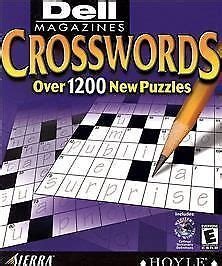
Dell Magazines Crosswords is a digital puzzle game developed by Sierra Entertainment as part of their Hoyle series, compiling 1,200 crossword puzzles from Dell Magazine. It supports both single-player and two-player gameplay, with solo modes offering six difficulty settings, timers, three background themes, optional music, and statistics tracking, while multiplayer allows competitive timed rounds or cooperative solving, with features like marking solved clues and printing puzzles.
Dell Magazines Crosswords Reviews & Reception
ign.com (95/100): Six letter word for this game? A-W-E-S-O-M-E.
Dell Magazines Crosswords: A Scholarly Examination of a Digital Puzzle Artifact
Introduction: The Quiet Legacy of a Crossword Collection
In the vast and often sensationalist canon of video game history, titles like Dell Magazines Crosswords (2002) represent a fascinating and frequently overlooked stratum: the earnest, utility-focused software that existed at the intersection of traditional pastime and emerging digital distribution. Released by Sierra On-Line as part of their venerable Hoyle series, this title was not a narrative adventure, a competitive shooter, or a graphical showcase. It was, and remains, a meticulously compiled digital archive of 1,200 crossword puzzles from Dell Magazines, wrapped in a simple, functional interface. This review posits that while Dell Magazines Crosswords may lack the cultural footprint of its contemporaries, its true significance lies in its role as a transitional artifact. It embodies a specific moment—the early 2000s—when established print media (Dell’s long-running puzzle magazines) and software publishers (Sierra, a titan of PC gaming) collaborated to digitize and monetize a pre-internet, analog hobby for a home computing audience. It is a case study in pragmatic game design, where the “gameplay” is entirely derived from its source material, and the software’s value is measured in convenience, features, and fidelity to a classic form.
Development History & Context: Sierra’s Hoyle Empire and the Casual Pivot
The Hoyle License and Sierra’s Strategy
To understand Dell Magazines Crosswords, one must first understand the Hoyle brand. By the late 1990s and early 2000s, Sierra On-Line (then a subsidiary of Vivendi Universal Games) had transformed Edmond Hoyle’s name from a synonym for card game rules into a multi-platform franchise. The Hoyle series was a cash cow built on low-cost, high-margin compilations of traditional games—casino games, board games, card games, and word games. These titles required minimal new creative development, leveraged existing brand recognition in the non-digital space (Hoyle’s official rulebooks), and targeted a demographic often underserved by the era’s blockbuster-focused industry: older players, families, and casual gamers.
Dell Magazines Crosswords (2002) for Windows and Macintosh was a direct entry in this line, following Hoyle Crosswords (2000). The choice of Dell Magazines as a puzzle source was astute. Dell had been publishing crossword puzzle books since 1925, and their “official” puzzle magazines were a household name for dedicated solvers. This partnership provided instant credibility and a vast, ready-made library of professionally edited puzzles, eliminating the massive overhead of original content creation.
Technological Constraints and Design Philosophy
The game was developed for the “Windows 9x/2000/XP” and classic Mac OS era. The technical requirements were trivial by modern standards, reflecting its target audience’s likely hardware—mid-range family PCs. This constraint dictated the design: a fixed-screen, point-and-select interface with no hardware-accelerated 3D, no complex animations, and minimal audio. The primary “innovation” was not graphical but logistical: the digitization of 1,200 puzzles, the implementation of a hint/assist system (“solving any letter, word or the whole puzzle”), and the ability to print puzzles in a clean, formatted way—a killer feature for those who preferred pen and paper.
The credited team (35 individuals) reveals a standard late-era Sierra production structure, with leads like Roger Key (Project Lead/Sr. Software Engineer) and Paul Horn (Designer/Software Engineer) likely managing a small team to port a proven concept. The presence of a dedicated Art Director (Rabih AbouJaoudé) and 2D/3D artists suggests Sierra still maintained a baseline of aesthetic polish, even for a utility title, resulting in the three selectable backgrounds (grape satin, lime, newspaper). The music, composed by Guy Whitmore (a Sierra staple known for Phantasmagoria and Leisure Suit Larry), was optional and likely intended to add a layer of contemplative atmosphere without being intrusive.
Narrative & Thematic Deep Dive: The Puzzle as Protagonist
Dell Magazines Crosswords possesses no traditional narrative, characters, or plot. To analyze it through this lens requires a shift in perspective: the puzzle itself is the narrative vessel, and the solver is the protagonist.
The “story” of each puzzle is a micro-narrative of deduction. A grid of black and white squares, a list of cryptic clues spanning two centuries of crossword construction tropes (anagrams, charades, homophones, abbreviations). The player’s journey is one of linguistic archaeology. A clue like “Greek god of war” (ARES) is a simple fetch quest. “Mimic” (APE) is a wordplay revelation. “Started to laugh, holding back a sound” (HA) is a complex riddle requiring parsing of “started to” (first letter) and “holding back” (containment). Each solved clue is a plot point; the completion of the grid is the resolution. The thematic core is intellectual mastery over linguistic chaos. The grid is a controlled wilderness, and the solver imposes order through vocabulary, trivia, and pattern recognition.
The six difficulty settings (“any” to “hard only”) represent a crude difficulty curve, but the true “theme” is consistency of experience. Unlike video games with escalating stakes, the crossword’s challenge is inherent to its construction. The software’s role is to be a neutral, incorruptible arbiter—marking clues as solved, tracking statistics, providing hints. This strips away any romanticized “hero’s journey” and substitutes a pure, meditative engagement with language and knowledge. The optional timer for two-player modes introduces a layer of competitive tension, transforming the solitary contemplative act into a duel of lexical speed, but the core theme remains: the supremacy of the word.
Gameplay Mechanics & Systems: Elegance in Simplicity
Core Loop and Interface
The gameplay loop is immediately accessible and循环 (xúnhuán – cyclical): Select a puzzle from the library (filterable by difficulty) -> Read grid and clue list -> Input letters via keyboard or (presumably) mouse -> Validate entries (automatically or manually) -> Complete grid -> Statistics updated. The interface is a paradigm of “point and select” clarity. The grid is central, the clue list flanking it or below, with minimalist toolbars for puzzles, hints, and options. There is no learning curve because there is no complex system to learn. The “game” is the puzzle; the software is the container.
Innovative (for its context) or Flawed Systems
What set Dell Magazines Crosswords apart from a simply printed puzzle book were its digital affordances, all of which are foregrounded in the source description:
1. Dynamic Assistance: The ability to reveal a single letter, an entire word, or the whole solution fundamentally changes the puzzle’s nature. For the frustrated solver, it’s a lifeline; for the completionist, a potential crutch. This creates a “cheat spectrum” that traditional puzzles lack.
2. Statistical Tracking: The game keeps records of puzzles solved, times, hints used. This introduces a meta-game of personal improvement and quantification absent from paper. It gamifies the gameless.
3. Collaborative & Competitive Multiplayer: This is the title’s most significant mechanical addition. Two players can share a screen, either working together (“collaboratively”) or taking timed turns (“head-to-head” with 30/45/60-second limits). This social mechanic transforms a solitary intellectual pursuit into a shared, potentially contentious experience, a precursor to modern co-op puzzle games but with zero in-game communication tools.
4. Print Functionality: The ability to print a pristine, formatted puzzle is a critical feature. It respects the user’s preference for analog solving while providing the convenience of digital storage and selection.
5. Customization: The three backgrounds and optional music are minor but meaningful touches. The “newspaper” background directly evokes the tactile feel of a daily puzzle, while the solid colors offer visual simplicity. The music, by Guy Whitmore, likely consisted of calm, unobtrusive loops, a hallmark of Sierra’s casual titles.
Flaws are inherent to its minimalist design: There is no hint at why a clue is correct beyond the answer itself. No built-in thesaurus, no encyclopedia (beyond the mentioned bonus Webster’s dictionary), no clue-explanation system. The software is a dumb terminal for puzzle entry, not a tutor. The “six difficulty settings” are entirely dependent on Dell’s own puzzle grading, offering no adaptive challenge. The interface, while clear, is static and offers no modern comforts like cloud syncing or touch controls (the 2002 release predates the smartphone boom by years).
World-Building, Art & Sound: The Aesthetics of Utility
Setting & Atmosphere
The “world” is not a fantastical realm but the desk. The game’s atmosphere is one of quiet Concentration. The visual choices—especially the “newspaper” texture—are a direct nod to the physical environment where crosswords have been solved for generations: a kitchen table, a park bench, an airplane tray table. The game’s world is the player’s immediate surroundings, enhanced by a clean, glare-free digital surface. It is the antithesis of immersive; it is intentionally transparent. The art direction’s goal is to disappear, to not distract from the grid.
Visual Direction
Art Director Rabih AbouJaoudé and the 2D team produced precisely what was needed: legible, high-contrast grids; clear, readable clue fonts; and three tastefully muted background patterns. The “grape satin” and “lime” options are curious, perhaps aiming for a soft, non-eye-straining aesthetic, but the “newspaper” option is the conceptually pure one. There is no attempt at 3D flair (the credited 3D artist, Will Barker, likely worked on other Sierra titles). The visual language is that of 1990s/early 2000s productivity software: beveled edges, standard Windows controls, a focus on utility over flair.
Sound Design
Composer Guy Whitmore’s contribution is the definition of optional ambiance. The music, if turned on, would be light, melodic, and repetitive—designed to occupy the subconscious auditory channel without demanding attention. Its purpose is to mask the dead silence of a focused room, not to build tension or emotion. Sound effects are likely limited to definitive clicks for letter entry, a chime for puzzle completion, and perhaps a soft error buzz. The sound design philosophy mirrors the visual: support the mental process, do not interfere with it.
Reception & Legacy: The Silence of the Niche
Critical and Commercial Reception at Launch
There is a profound absence of contemporary critical reception for this specific title in the provided sources. No reviews exist on MobyGames, Backloggd, or Grouvee. This is telling. In the early 2000s, print magazines and early web portals (like IGN, which does have a review for a Dell Magazines Crossword mobile game by a different developer in 2003) largely ignored utility and compilation software unless it was a massive phenomenon (like Microsoft Solitaire Collection later). Dell Magazines Crosswords was a catalog item, a shelf filler for Sierra’s Hoyle line, sold in software aisles and bundled with PCs. Its commercial performance is not publicly known but can be inferred: it was not a blockbuster, but as part of the evergreen Hoyle franchise, it likely sold steadily to a specific, non-gaming-enthusiast audience for years.
Evolution of Reputation and Influence
The title’s reputation has evolved into obscurity. It is a footnote in Sierra’s corporate history and a minor branch on the Hoyle family tree. Its influence is not seen in game design—it pioneered no mechanics—but in business model and platform adaptation. It represents the last gasp of the “shrinkwrap CD-ROM puzzle compilation” before:
1. The web made free, daily crosswords instantly accessible (e.g., The New York Times Crossword app).
2. Smartphones created a thriving market for casual, bite-sized puzzle games (Wordscapes, Bonza).
3. The print crossword industry declined, with digitization becoming the primary (and often subscription-based) mode of distribution.
Dell Magazines Crosswords is a transitional fossil. It shows the Hoyle model being applied to a licensed print property, creating a premium, one-time-purchase product. Later, this model would be supplanted by subscription-based digital services (like NYT Games) or free, ad-supported mobile apps. Its legacy is in proving there was a market for “feature-complete” digital puzzle books, but it could not withstand the convenience and network effects of the internet and mobile platforms.
Place in the Crossword Game Genre
Within the niche genre of “digital crossword puzzle games,” it sits between early DOS efforts (like Dell Crossword Puzzles from 1984) and later, more feature-rich attempts like CrossworDS for Nintendo DS (2007) or Crosswords Plus for 3DS (2012). Its significance is as a mature, PC-native iteration of the concept, perfecting the print-parity formula before that formula became obsolete. It offered more puzzles and better features than most early efforts but lacked the portability, daily update capability, and social integration of its successors.
Conclusion: A Digital Relic of Analog Serenity
Dell Magazines Crosswords (2002) is not a “great” video game by conventional metrics. It has no story to analyze, no skill curve to master, no artistic vision to deconstruct. It is, instead, a perfectly serviceable tool. Its historical value lies in its exceptionally clear demonstration of a specific business and design logic: take a beloved non-digital pastime, digitize its core content with fidelity, add digital conveniences (hints, stats, printing), and sell it to an audience that may not identify as “gamers” but recognizes the value of a well-made utility.
In the grand narrative of interactive entertainment, it is a quiet, functional interlude. It speaks to an era when “casual gaming” meant a CD-ROM in a The Wall Street Journal swivel chair, not a freemium app on a subway commute. It is a testament to the crossword puzzle’s enduring power as a form of play—play that is solitary, cerebral, and timeless. The software’s ultimatesuccess is measured not in player hours logged (a metric it likely lacks), but in its ability to faithfully replicate the experience of solving a Dell crossword, features like the hint system and statistics notwithstanding. It is a digital ghost of an analog ritual, and in that, it holds a peculiar, respectful place in the archaeology of play. Verdict: A historically significant artifact of the casual/digital transition, whose design is perfectly suited to its utilitarian purpose but which offers little to engage the modern player outside of specific nostalgia or utility needs.