
- Release Year: 1999
- Platforms: Game Boy Color, Neo Geo Pocket Color, PlayStation, Windows, WonderSwan
- Publisher: CyberFront Corporation, SNK Corporation, Taito Corporation, Unbalance Corporation
- Developer: Taito GM R&D Sect. #2
- Genre: Simulation, Train driving
- Perspective: 1st-person
- Game Mode: Single-player
- Gameplay: Arcade, Driving Simulation, Time management
- Setting: Akita Shinkansen, Hokuhoku Line, Japan, Kagoshima Main Line, Keihin-Tohoku Line, Osaka Loop Line, Tōhoku Shinkansen
Description
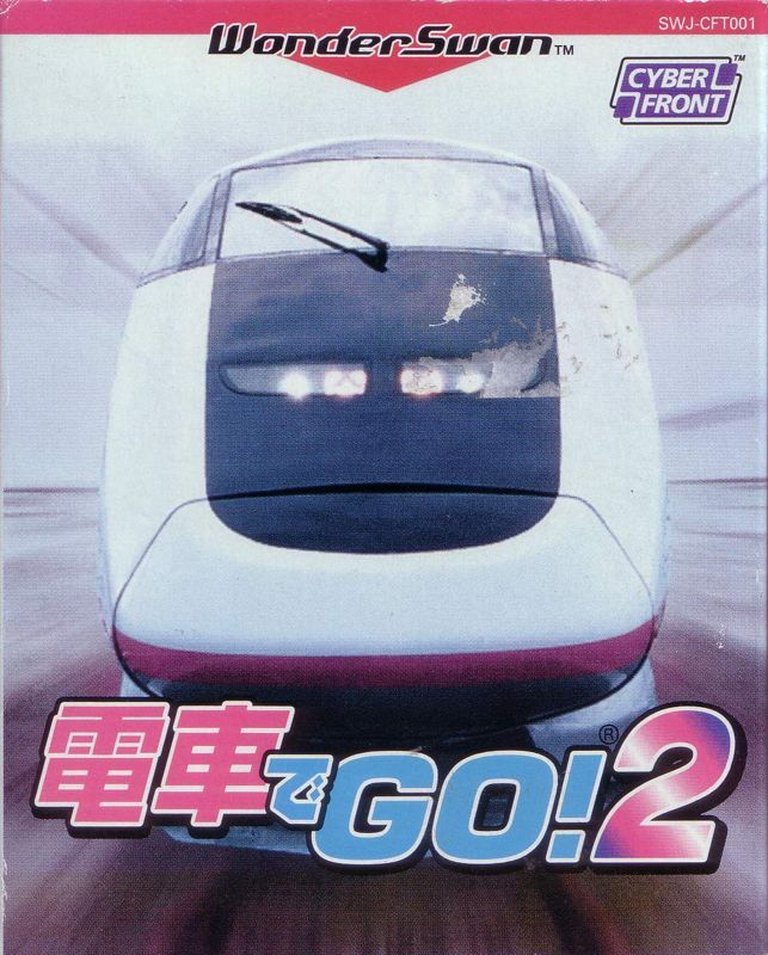
Released in 1999, Densha de Go! 2 is the sequel to Taito’s popular Japanese train-driving simulation game, ported to multiple platforms including PlayStation, Windows, WonderSwan, and Neo Geo Pocket Color. The arcade-style gameplay tasks players with operating trains on various routes like the Hokuhoku Line, Tōhoku Shinkansen, and Akita Shinkansen, focusing on precise station stops, schedule adherence, signal compliance, and passenger comfort. Mistakes deduct points, and reaching zero ends the game. Notably, this PlayStation version introduces snow driving and Shinkansen bullet train operations for the first time in the series.
Gameplay Videos
Densha de Go! 2 Free Download
Game Boy Color
Neo Geo Pocket Color
PC
PlayStation
Densha de Go! 2 Reviews & Reception
retro-replay.com : strikes a fine balance between arcade excitement and train-sim realism
Densha de Go! 2 Cheats & Codes
PlayStation (PSX)
Enter codes using a Game Shark device.
| Code | Effect |
|---|---|
| 8005D984 03E7 | Infinite Time |
| 8005D528 FFFF 8005D52A FFFF | All Movies Unlocked |
| 8005D524 FFFF 8005D526 FFFF | All Photographs & Models Unlocked |
| 8005D52C FFFF 3005D52E 000F | All Vehicle in Arcade Mode Unlocked |
| 8005D53C C9FF 8005D53E 3B9A | Total Running Distance Maxed |
| D005D6D0 0001 8005D9B0 ???? D005D6D0 0001 8005D9B2 ???? | Speed Modifier (Press L2) |
Densha de Go! 2: Review
Introduction
In the annals of simulation gaming, few titles capture the niche yet profound cultural resonance of Japan’s railway obsession like Densha de Go! 2. Released in 1998 for arcades and subsequently ported to numerous home platforms in 1999, this sequel to Taito’s landmark 1997 train-driving simulator expanded its predecessor’s formula with breathtaking ambition. It introduced players to the visceral thrill of commanding Shinkansen bullet trains, braving snow-swept mountain passes, and navigating the intricate dance of Japan’s commuter lines—all while maintaining the series’ signature blend of arcade accessibility and obsessive realism. Densha de Go! 2 is not merely a game; it is a digital pilgrimage through Japan’s rail history, a testament to how hyper-specific simulations can transcend their niche to become cultural touchstones. This review argues that by refining core mechanics, diversifying its routes, and leveraging emerging hardware capabilities, Densha de Go! 2 cemented the series as a cornerstone of simulation gaming, offering a uniquely Japanese experience that remains unparalleled in its depth and authenticity.
Development History & Context
Densha de Go! 2 emerged from the fertile mind of Taito’s R&D Division #2, building upon the explosive success of the original 1997 arcade title. Lead programmer Akira Saito, a lifelong rail enthusiast, envisioned the sequel as an evolution rather than a revolution, addressing player feedback while pushing technological boundaries. The core development team—directed by Noriyasu Togakushi and including planners Tetsushi Abe and Makoto Harigaya—operated under intense pressure to deliver a product that could match, if not exceed, the original’s million-unit sales in Japan. Technologically, the game leveraged Taito’s arcade hardware for its 1998 debut, utilizing textured 3D environments rendered via custom Taito chips like the TC0840GLU. However, the PlayStation port (1999) presented significant challenges: downscaling complex 3D models, optimizing for the console’s MIPS R3000 CPU, and translating arcade-specific controls to standard DualShock pads. To mitigate this, Taito bundled a miniature replica controller for home versions, featuring throttle and brake levers that approximated the arcade’s tactile experience. The WonderSwan and Neo Geo Pocket Color ports faced even starker constraints, with developers like ITL Co. stripping visuals to 2D sprites while retaining gameplay fidelity. This era—the tail end of the PlayStation’s dominance and the rise of niche handhelds—was marked by a surge in Japanese-centric simulations. While Western markets favored action titles, Japan embraced titles like Tokimeki Memorial and Densha de Go!, reflecting a cultural appetite for methodical, real-world systems. Taito’s gamble paid off: the sequel became a cornerstone of their simulation division, proving that even “plain and boring” trains could drive commercial success.
Narrative & Thematic Deep Dive
Though devoid of traditional characters or plot, Densha de Go! 2 weaves a profound narrative through its meticulously crafted routes and gameplay systems. Each journey—be it the snow-laden Hokuhoku Line or the urban sprawl of the Osaka Loop—serves as a chapter in a larger story: the quiet dignity of Japanese rail transport. The game’s central theme is seishitsu (precision), embodied in the physics of acceleration and braking, the tyranny of the timetable, and the millimeter-perfect art of station stops. This isn’t about heroism but about responsibility; the player embodies the unsung engineer, whose mastery ensures thousands of passengers reach their destinations safely and punctually. Dialogue is sparse but evocative, conveyed through station announcements, the blare of horns at crossings, and the sigh of brakes. Visual cues amplify this: passengers flash happy faces on smooth stops but frown at jerky movements, while a depleted time buffer triggers a tense countdown. Environmental storytelling is equally potent—the blizzard on the Hokuhoku Line obscures signals, demanding heightened vigilance, while the neon-drenched Keihin-Tōhoku Line pulses with urban energy. Even the Shinkansen segments, with their blistering speeds, underscore themes of progress and technological harmony. Ultimately, Densha de Go! 2 chronicles a national ethos: the belief that collective well-being hinges on individual excellence, whether in a train cab or a bustling metropolis.
Gameplay Mechanics & Systems
At its core, Densha de Go! 2 is a symphony of systems demanding flawless execution. Players assume the role of a train engineer, balancing speed, braking, and schedule adherence across six diverse routes (seven on PlayStation/Windows). The gameplay loop is deceptively simple: maintain a time buffer by arriving at stations within prescribed windows—typically 30 cm of the target mark and half a second of the scheduled time. Overspeeding, ignoring signals, or jarring stops deduct points, with failure occurring when the buffer hits zero. This creates a relentless tension, where a single mistake can cascade into disaster. Key mechanics include:
- Control Schemes: The arcade cabinet featured dual levers (throttle/brake) and pedals, while home ports offered peripheral support (e.g., the N64’s dedicated controller) or DualShock mappings. The WonderSwan simplified inputs to directional pads, sacrificing immersion for accessibility.
- Signal Discipline: Players must respond instantly to speed limits and signals, with violations costing up to 20 seconds. The N64 version’s Voice Recognition Unit allowed players to announce stations, adding a layer of immersion.
- Route Diversity: New additions like the snow-covered Hokuhoku Line (braking efficiency reduced by 30%) and Shinkansen routes (accelerating to 275 km/h) introduced unique challenges. The PlayStation-exclusive Kagoshima Main Line added coastal vistas.
- Physics and Feedback: Trains model realistic inertia, with brake distances varying by speed and weather. Squealing brakes or horn blasts provide auditory feedback for errors, enhancing immersion.
- Progression: Routes unlock sequentially, with higher difficulties tightening time buffers and reducing error tolerances. The “Osaka Loop Line” (PlayStation-only) tested precision in dense urban environments.
These systems coalesce into a loop of mastery—each run is a puzzle to be solved, demanding memorization of curves, gradients, and timetables.
World-Building, Art & Sound
Densha de Go! 2 is a love letter to Japan’s railway network, with world-building rooted in meticulous authenticity. Routes are geographically faithful: the Tōhoku Shinkansen cuts through volcanic landscapes, while the Akita Shinkansen hugs coastal cliffs. Even minor details—like platform signage at Ōmagari Station or the viaducts on the Ōu Main Line—are recreated from blueprints. Art direction prioritizes functional realism over spectacle. The PlayStation’s 3D environments, though limited by PS1-era polygons, convey place through texture work: snow blankets the Hokuhoku Line in monochrome, while urban routes like Keihin-Tōhoku bustle with low-poly crowds and flickering neon. The WonderSwan’s monochrome screens abstracted this into stark, top-down views, emphasizing route memorization. Sound design is the game’s unsung hero. Recorded brake screeches, diesel chugs (on pre-electrified lines), and station melodies ground players in reality. The horn’s resonant blast at crossings punctuates tension, while the whine of a Shinkansen’s motors evokes speed. Notably, the PlayStation port introduced dynamic weather: snowfall obscures signals, its crunch audible under wheels, forcing players to decelerate earlier. This sensory immersion transforms technical challenges into visceral experiences, making players feel the weight of a 500-ton train on a foggy mountain pass.
Reception & Legacy
Upon release, Densha de Go! 2 was hailed as a refinement of its predecessor, albeit with niche appeal. Critics lauded its expanded routes and Shinkansen additions, with Video Games (German) scoring the PlayStation port 75%, praising its “arcade-style excitement” and “realistic controls.” Planet WonderSwan noted the handheld version’s “well-dosed difficulty,” awarding 71%. Commercially, it mirrored the original’s success, with the PlayStation version becoming a million-seller in Japan by 1999. The N64 port’s unique controller and VRU compatibility garnered cult attention, while the Neo Geo Pocket Color port demonstrated the series’ portability. Long-term, Densha de Go! 2 solidified the franchise’s legacy. It spawned over 20 sequels and spin-offs, from Densha de Go! 64 (N64) to the 2020 Hashirō Yamanote-sen (Switch/PS4), with Square Enix (Taito’s acquirer) modernizing it via VR and online leaderboards. Culturally, it ignited “densha otaku” (train otaku) fever, boosting rail tourism and inspiring merchandise like model kits. Fan translations (e.g., the 2017 N64 English patch) sustained its international appeal, though its Japan-exclusivity limited Western adoption. Critics like IGN later recognized it as a “pioneer of accessible simulation,” influencing titles like Train Simulator. Today, it remains a benchmark for vehicular simulators, its blend of tension and tranquility a masterclass in niche design.
Conclusion
Densha de Go! 2 stands as a towering achievement in simulation gaming—a game that turned the mundane into the mesmerizing. By diversifying its routes, refining its controls, and leveraging PlayStation-era hardware, Taito crafted not just a sequel but a cultural artifact. Its gameplay systems—rooted in precision and consequence—remain as compelling today as in 1999, while its authentic recreation of Japan’s rail lines offers a journey no other game replicates. The game’s brilliance lies in its duality: it is both a demanding arcade test of reflexes and a meditative exploration of duty. Though its niche appeal limited global reach, its legacy is undeniable. It paved the way for decades of rail sims, elevated simulation as a respected genre, and cemented Taito’s reputation for innovative, culturally resonant design. For the rail enthusiast or the curious gamer, Densha de Go! 2 is not just a relic of the past—it is a timeless testament to the quiet thrill of doing one job, perfectly. In the crowded landscape of gaming, it remains, in the words of its German critics, an “absoluter Freak-Titel” and “Top-Hit”: a niche masterpiece that demands to be experienced.