
- Release Year: 2018
- Platforms: Nintendo Switch, PlayStation 4, Windows
- Publisher: Whale Rock Games, LLC
- Developer: Whale Rock Games, LLC
- Genre: Action
- Perspective: Diagonal-down
- Game Mode: Online PVP, Single-player
- Gameplay: Shooter
- Setting: Futuristic, Sci-fi
- Average Score: 75/100
Description
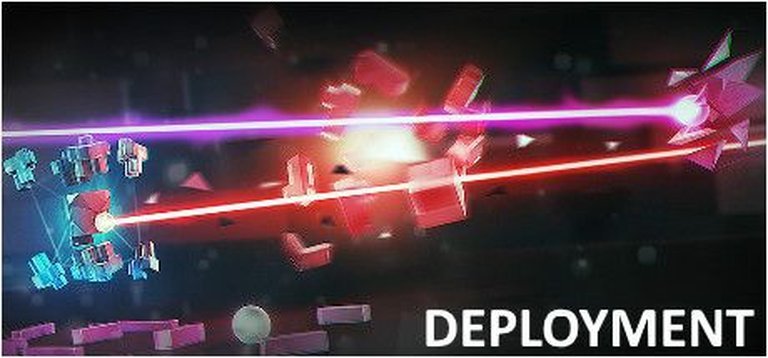
Set in a futuristic post-war world where civilization teeters on collapse, ‘Deployment’ pits players as infosoldiers—artificial intelligences battling for control of critical systems like factories and energy grids connected to the Etherweb. Engage in fast-paced multiplayer combat or face AI bots in procedurally generated mazes, capturing defensive turrets and upgrading classes to dominate leaderboards. With intense isometric shooter gameplay and sci-fi aesthetics, the game blends tactical strategy with competitive action across platforms.
Where to Buy Deployment
PC
Deployment Patches & Updates
Deployment Guides & Walkthroughs
Deployment Reviews & Reception
metacritic.com (62/100): Deployment is a huge amount of fun and ultimately it’s just nice to sit down with a great gameplay experience and enjoy it.
thesixthaxis.com (80/100): Deployment is a huge amount of fun and ultimately it’s just nice to sit down with a great gameplay experience and enjoy it.
Deployment: Review
Introduction
In the crowded arena of multiplayer shooters, Deployment (2018) emerged as a scrappy, ambitious contender from indie studio Whale Rock Games. Set in a decaying cybernetic future, this top-down shooter promised “intense competitive” action, procedural labyrinths, and a class-based progression system. Yet, it arrived with muted fanfare, quickly fading into Steam’s algorithmic abyss. A decade later, Deployment lingers as a paradox: a mechanically competent game undone by its own anonymity, a footnote in the lineage of indie shooters. This review interrogates its rise and fall, asking whether it deserved better—or if its obscurity was justified.
Development History & Context
Studio Vision & Technological Constraints
Developed and self-published by Whale Rock Games—known for 2016’s We Are The Dwarves—Deployment was pitched as a passion project blending Smash TV-esque chaos with tactical class warfare. Built in Unity, the studio emphasized procedural generation and “community-driven development” (IndieDB devlog, 2018), though this ambition clashed with budgetary limits. The 2018 release window placed it against juggernauts like Fortnite and Overwatch, forcing Whale Rock to rely on niche appeal.
The Gaming Landscape
Top-down shooters were resurgent in the late 2010s (Ruiner, Hyper Jam), but Deployment’s multiplayer focus proved risky. Live-service expectations demanded robust player counts, yet the game launched without cross-play—a critical oversight in an era where even AAA titles struggled to retain audiences. Whale Rock’s decision to price at $14.99 (later slashed to $1.19) reflected both hubris and desperation, alienating bargain hunters and hardcore players alike.
Narrative & Thematic Deep Dive
A Thin Cybernetic Veil
Deployment’s lore—civilization surviving via AI “infosoldiers” battling for control of the Etherweb—is serviceable sci-fi boilerplate. Governments and megacorporations wage proxy wars in digital arenas, but the narrative evaporates during gameplay. Unlike Transistor’s evocative worldbuilding, Deployment treats story as set dressing. Dialogue is nonexistent; characters lack names or motivations, reduced to class archetypes (Pyro, Sniper).
Thematic Undercurrents
Beneath the gunfire lies a subtle critique of automation’s fragility—the “Last War” leaving humanity reliant on malfunctioning systems. Yet, this is never explored beyond menu text. The game’s true themes emerge accidentally: the melancholy of abandoned servers, the Sisyphean grind of solo queues against bots. It echoes Reddit user ErixKing’s 2022 verdict: “Olvidaré que jugué este juego” (“I’ll forget I played this game”).
Gameplay Mechanics & Systems
Core Loop: Chaos with Nuance
At its best, Deployment delivers frenetic, isometric combat. Players select from five classes (Trooper, Pyro, Sniper, Laser, Rocketeer), each with distinct weapons and ultimates. The Trooper’s rapid-fire assault contrasts with the Rocketeer’s area-of-eclipse explosions, while the Pyro converts damage taken into fiery retaliation—a clever risk/reward dynamic. Matches unfold in procedurally generated maps, demanding adaptability.
Innovation & Flaws
The “System” capture mechanic—securing turrets and healing nodes—adds tactical depth, rewarding map control over mindless fragging. However, bot AI (crucial for solo play) was universally panned. Steam users noted enemies “stand[ing] idle” (d221, 2019), while progression felt grindy, locking class upgrades behind hours of barren matchmaking. The UI, cluttered with garish neon HUD elements, often obscured threats—a flaw exacerbated by chaotic particle effects.
Technical Quirks
Controller support was borked at launch, forcing KB/M players into menus they couldn’t navigate (*, Steam 2019). Network code remains unstable; one player lamented “550MB minimum save size” (PSN description) for a game barely exceeding 1GB.
World-Building, Art & Sound
Aesthetic Identity Crisis
Deployment’s art direction clashes with itself. Characters pulse with vibrant, almost cartoonish hues (IndieDB praised “colorful characters against grayscale scenarios”), but environments are drab, maze-like server farms lacking visual distinction. The isometric perspective, while functional, feels claustrophobic—a far cry from Halo: Spartan Assault’s cinematic clarity.
Sound Design: Overstimulation & Missed Potential
Weapons crackle with satisfying weight (the Sniper’s railgun hums; the Pyro’s flamethrower roars), but the soundtrack drowns players in frenzied electronic loops. Steam reviews cite headaches from “music with tanta velocidad” (ErixKing). Ambient sounds—server hums, distant explosions—are absent, squandering the cyber-dystopian atmosphere.
Reception & Legacy
Launch & Critical Response
Reviews were sparse but polarized. The Sixth Axis lauded its “addictive gameplay” (8/10), while Metacritic users dismissed it as “basura” (1.5/10). Steam’s “Very Positive” aggregate (83/100) is misleading—1,212 reviews mask a player base that peaked at 3 concurrent users in 2019.
The Bleak Legacy
Deployment influenced nothing. Whale Rock never patched its player-count issues, and the game vanished from discourse. Its sole contribution is as a cautionary tale: a solid core loop cannot save a multiplayer game lacking marketing, cross-play, or post-launch support. Unlike Among Us’s Cinderella story, Deployment rotted in Steam’s crypt—a relic of indie overreach.
Conclusion
Deployment is not a bad game—it is a tragic one. Its gunplay thrills, its class design intrigues, and its procedural arenas surprise. Yet, these merits crumble under technical neglect and a failure to sustain community. Whale Rock crafted a shooter worthy of cult adoration but abandoned it to die unmourned. For historians, it exemplifies the late-2010s indie bubble: a game built for audiences that never came. For players, it’s a $1.19 curio—a fleeting diversion best left buried in the Etherweb. Final Verdict: A fascinating failure; play it only as postmortem.