
- Release Year: 2016
- Platforms: Linux, Luna, Macintosh, Nintendo Switch, PlayStation 4, Windows, Xbox One
- Publisher: Daedalic Entertainment GmbH
- Developer: Daedalic Entertainment GmbH
- Genre: Adventure
- Perspective: Third-person
- Game Mode: Single-player
- Gameplay: Dialogue trees, Graphic adventure, Inventory-based logic, Point and select, Puzzle elements
- Setting: Futuristic, Sci-fi
- Average Score: 78/100
Description
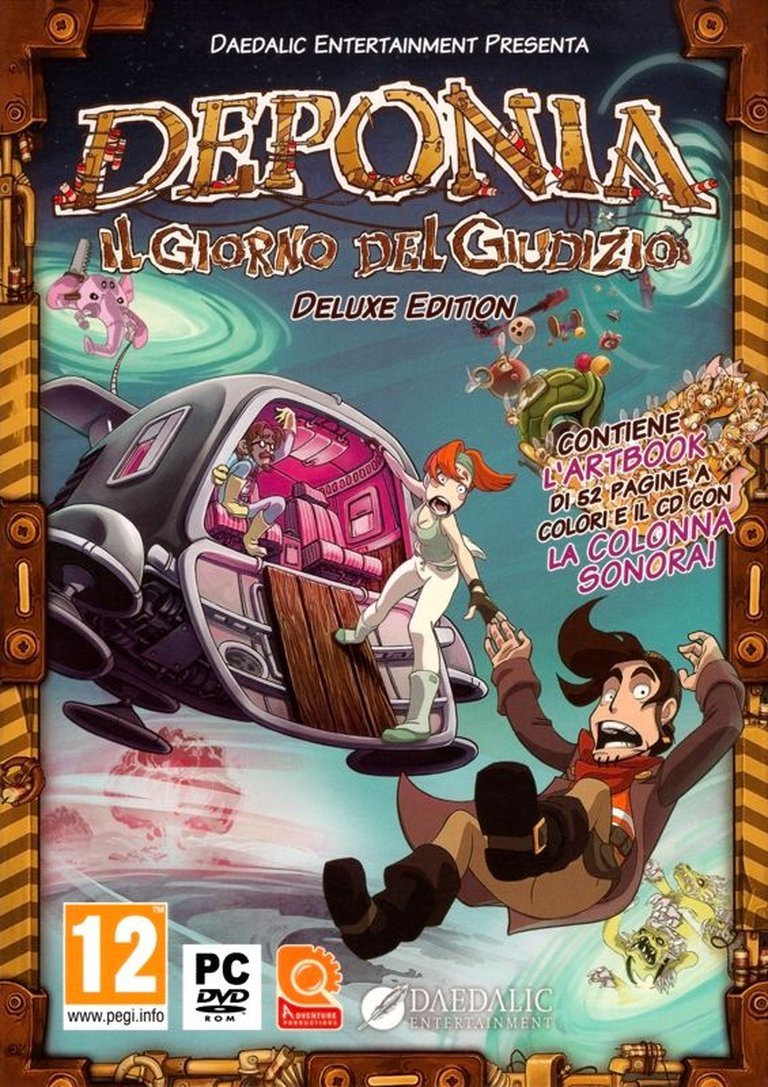
Deponia Doomsday is a comedic point-and-click adventure game where junk planet inhabitant Rufus faces a time-traveling paradox after a catastrophic event erases Deponia. Awakening in a fragmented timeline, he must navigate surreal alternate realities, solve inventory-based puzzles, and make choices that threaten to unravel reality further while attempting to alter history and prevent disaster.
Where to Buy Deponia Doomsday
Deponia Doomsday Free Download
Cracks & Fixes
Guides & Walkthroughs
Reviews & Reception
metacritic.com (76/100): Must-have for point & click fans.
opencritic.com (73/100): A funny, silly temporal romp that is well made and well executed.
gamepressure.com : Regardless, Daedalic Entertainment have prepared the biggest and the richest installment in the series to date.
imdb.com (80/100): A second shot at a happy ending for Rufus and all the players
Deponia Doomsday: Review
Introduction
In the annals of point-and-click adventure games, few series have sparked as much passionate debate as Deponia. Initially conceived as a trilogy, the saga of Rufus, the perpetually unlucky tinkerer from the junk planet Deponia, captivated players with its blend of dark humor, surreal puzzles, and heartfelt storytelling. However, the divisive ending of Goodbye Deponia (2013) left fans clamoring for closure, prompting developer Daedalic Entertainment to craft an unexpected fourth installment: Deponia Doomsday (2016). Described by its creators as a “paralellic” – a narrative running parallel to the original trilogy – this ambitious sequel transcends mere fan service. It is a meta-commentary on fate, sacrifice, and the perils of rewriting history, wrapped in a time-travel paradox that challenges both Rufus and the player. This review argues that Deponia Doomsday stands as the series’ most thematically resonant and narratively complex entry, despite its gameplay flaws, offering a bittersweet, philosophically rich conclusion to one of gaming’s most unconventional anti-heroes.
Development History & Context
Deponia Doomsday emerged from the creative crucible of Daedalic Entertainment, the German studio synonymous with modern point-and-click adventures. Founded in 2007, Daedalic had already carved a niche with titles like The Whispered World and Chains of Satinav, but the Deponia series became its flagship. The game’s primary architect, Jan “Poki” Müller-Michaelis, served as Creative Lead and Game Director, helming a team of 294 credited personnel across design, scripting, and art. Its development was a direct response to fan backlash against Goodbye Deponia‘s ending, where Rufus sacrifices himself to save Deponia, only to be unremembered. Müller-Michaelis framed Doomsday not as a retcon but as an exploration of “what if” scenarios – a narrative experiment where multiple timelines could coexist. Technologically, the game built on Daedalic’s established 2D engine, optimized for Windows, Mac, and Linux before being ported to consoles (PS4, Xbox One, Switch, Luna) by 2019–2020. This cross-platform release reflected the genre’s growing accessibility, though it lacked the graphical leaps of AAA contemporaries like The Witcher 3. Released on March 1, 2016, Doomsday arrived in a gaming landscape dominated by open-world epics and indie darlings. Point-and-click adventures were a niche, but Daedalic’s reputation for sharp writing and distinctive art ensured a dedicated audience, making Doomsday a cult hit that validated the studio’s experimental approach.
Narrative & Thematic Deep Dive
The narrative of Deponia Doomsday is a labyrinthine time-travel epic that recontextualizes the entire series. It opens with an aged Rufus igniting a bomb to destroy ice-covered Deponia, a vision revealed as a nightmare. The young Rufus awakens in a timeline where the events of the trilogy never occurred, setting off a chain of temporal paradoxes. Guided by Professor McChronicle, a time-travel expert, Rufus attempts to avert disaster, but each intervention fractures reality further. The plot unfolds across multiple loops and alt-timelines: one where Rufus grows a “mustache” and becomes a planet-destroying tyrant, another where Goal and Rufus’ interference erases the Utopian civilization, and a “restored” timeline where Rufus finally accepts his fate. This structure is not merely a gimmick; it serves as a profound metaphor for the futility of clinging to idealized pasts. Characters are deconstructed and rebuilt: Rufus remains a chaotic anti-hero, but his relentless quest to “fix” the past is portrayed as self-destructive. Goal, once a damsel in distress, emerges as a tragic figure grappling with grief and agency. Their dynamic shifts from romance to a recognition of their incompatibility, culminating in a poignant sacrifice where both Rufus and his alternate self die to break the time loops – a direct rebuke to fans who demanded a “happier” ending.
Dialogue is the game’s lifeblood, blending absurdist humor with existential commentary. Jokes land with varying success, from parodies of The Lord of the Rings to self-referential jabs at Daedalic’s own games. Yet, beneath the comedy lies a rigorous critique of nostalgia. As one critic noted, the game “hammers home the moral: Everything must end eventually.” The Utopians, time-lost survivors, embody this theme, their extinction a consequence of Rufus’ refusal to let go. This meta-narrative layer elevates Doomsday beyond mere sequeldom, transforming it into a meditation on storytelling itself. As Hardcore Gamer observed, it “examines [Rufus’] character further and plainly expresses one of the original trilogy’s most significant themes much more loudly.” However, the plot’s complexity is a double-edged sword. New characters like McChronicle lack depth, and the time mechanics occasionally strain credulity, as noted by detractors who called the story “nonsensical and pointless.”
Gameplay Mechanics & Systems
Deponia Doomsday adheres to the series’ core point-and-click formula but innovates with time-travel mechanics that redefine puzzle design. Players navigate hand-drawn environments, combining inventory items to solve environmental puzzles – a Daedalic trademark. Timed sequences and Quick Time Events (QTEs) are introduced, adding urgency without consequence (failure simply restarts a loop). These moments, like escaping a “pink elephant” (disguised Utopians), inject variety but can feel jarringly out of place. The time-travel premise spawns unique puzzles: players must alter past events to unlock new paths, such as painting a piano key red to satisfy a nonsensical computer demand. Yet, this creativity is undermined by the return of the series’ infamous “Pluto Logic” puzzles – solutions that defy real-world logic, like milking a goat for feta cheese to power a time portal. As one review lamented, these puzzles “go one-step beyond into Pluto Logic, where not even ‘click on everything’ works.”
Inventory management remains central, but the game’s structure exacerbates backtracking. Time loops force repeated traversal of locations, a necessary evil that justifies the narrative but tests patience. The interface is clean and intuitive, with clear hotspots and inventory management, though it lacks modern innovations like context-sensitive actions. Minigames offer respite, from go-kart races in Elysium to retro dungeon crawlers, but their integration is uneven. Critics praised the Rotten Fruit Game (Tic Tac Toe variant) as a distraction, while others found the QTEs “appalling.” Combat is nonexistent – a series staple – replaced by timed escapes and dialogue choices that influence outcomes. Ultimately, Doomsday’s gameplay is a study in contrasts: its time-travel puzzles are brilliantly inventive, yet its traditional logic puzzles remain a point of frustration, reflecting the game’s broader divide between ambition and execution.
World-Building, Art & Sound
Deponia’s world-building reaches its zenith in Doomsday, expanding from the junk planet’s squalor to the utopian grandeur of Elysium. The game meticulously revisits locales like Krasnegar and the Organon Tower, now ravaged by time and paradox, while introducing new settings: the “Interim Time” limbo and the Fewlock-infested dystopia. This diversity prevents monotony, with over 100 hand-drawn backdrops showcasing Daedalic’s artistry. The visual direction is a triumph, retaining the series’ signature cartoonish style – bold lines, exaggerated character designs, and vibrant colors – while elevating environmental storytelling. Elysium, glimpsed only in the trilogy, is rendered in stunning detail, its gleaming towers a stark contrast to Deponia’s decay. Fewlocks, H.G. Wells-esque Morlock parodies, are hauntingly realized, their presence a visceral symbol of temporal decay.
Sound design complements the visuals, with a dynamic score that oscillates between whimsical and melancholic. Voice acting is exceptional, particularly Kerry Shale’s portrayal of Rufus, capturing his bravado and vulnerability. The English dub is praised, but the German original is often considered superior for its comedic timing. Sound effects – from time-travel whooshes to the creak of Elysium’s elevators – immerse players in the fractured reality. Yet, the audio is not without flaws: the opening theme is criticized as “off-key,” and certain character voices, like the “annoying singing flower,” grate. Despite these missteps, the world-building remains Doomsday’s strongest suit, using art and sound to transform abstract themes of time and loss into a tangible, emotional experience. As GamePressure noted, the game is “packed with quirky humor, offering us an ironic rendition of many modern-day situations,” a testament to its world’s capacity for both satire and poignancy.
Reception & Legacy
Deponia Doomsday’s reception was a microcosm of the series’ fanbase: polarized yet generally favorable. On Metacritic, it scored 76/100 (“Generally Favorable”), with PC-centric outlets like GameStar (89/100) and IGN Deutschland (85/100) praising its humor and narrative ambition. Adventure Corner lauded it as a “safe candidate for Adventure of the Year,” while Twinfinite called it “expertly-crafted.” However, critics like Rock, Paper, Shotgun damned it as “nasty, stupid, and badly constructed,” citing illogical puzzles and Rufus’ unlikeability. User reviews on Steam were similarly mixed, with 86/100 (“Very Positive”) but 15% negative feedback – a testament to the game’s divisiveness. Commercially, it succeeded as a niche hit, selling over 500,000 copies by 2019 and driving sales of the Deponia Collection.
Legacy-wise, Doomsday occupies a unique space in adventure game history. It is celebrated for its meta-commentary on fan culture and its willingness to subvert expectations, inspiring games like The Council to explore similar themes. Daedalic’s handling of time travel influenced narrative design in titles like Before Your Eyes, though Doomsday’s complexity remains unmatched. Its ending – where Goal mourns Rufus’ unremembered sacrifice – has been analyzed by fans for years, with Reddit threads dissecting its “paralellic” implications. Yet, the game’s legacy is tarnished by its problematic elements: a transphobic subplot involving Lotti and puzzles that alienate new players. As Hardcore Gaming 101 noted, it’s “one of those rare sequels that could be considered a masterpiece,” but its “poorer parts” require prior engagement with the trilogy. Ultimately, Doomsday endures as a bold, flawed epitaph for Rufus – a testament to the power of endings, even when they hurt.
Conclusion
Deponia Doomsday is a game of extraordinary ambition and profound contradictions. It is both a love letter to fans and a scathing critique of their demands, a narrative labyrinth that challenges players to accept imperfection. Its time-travel mechanics and thematic depth elevate it above the trilogy, offering a meditation on fate that resonates long after the credits roll. Yet, this ambition is shackled by gameplay flaws: illogical puzzles, repetitive backtracking, and a protagonist whose antics often cross from charming to cruel. The art and sound, however, are masterful, turning a junk planet into a canvas for both beauty and decay. In the end, Doomsday earns its place in video game history not as a perfect game, but as a courageous one. It dares to ask whether a “happy ending” is worth the cost of reality, and in doing so, delivers one of the most bittersweet conclusions in adventure gaming. For fans of the series, it is an essential, if flawed, finale. For newcomers, it is a challenging but rewarding entry into one of the genre’s most unique worlds. As Goal’s final words echo, “Rufus made it possible for his noble sacrifice” – a sentiment that defines Deponia Doomsday: messy, unforgettable, and ultimately, heroic.