
- Release Year: 2004
- Platforms: Macintosh, Windows
- Publisher: EMME Deutschland GmbH
- Developer: BMS Modern Games Handelsagentur GmbH
- Genre: Educational
- Game Mode: Single-player
- Gameplay: Mini-games
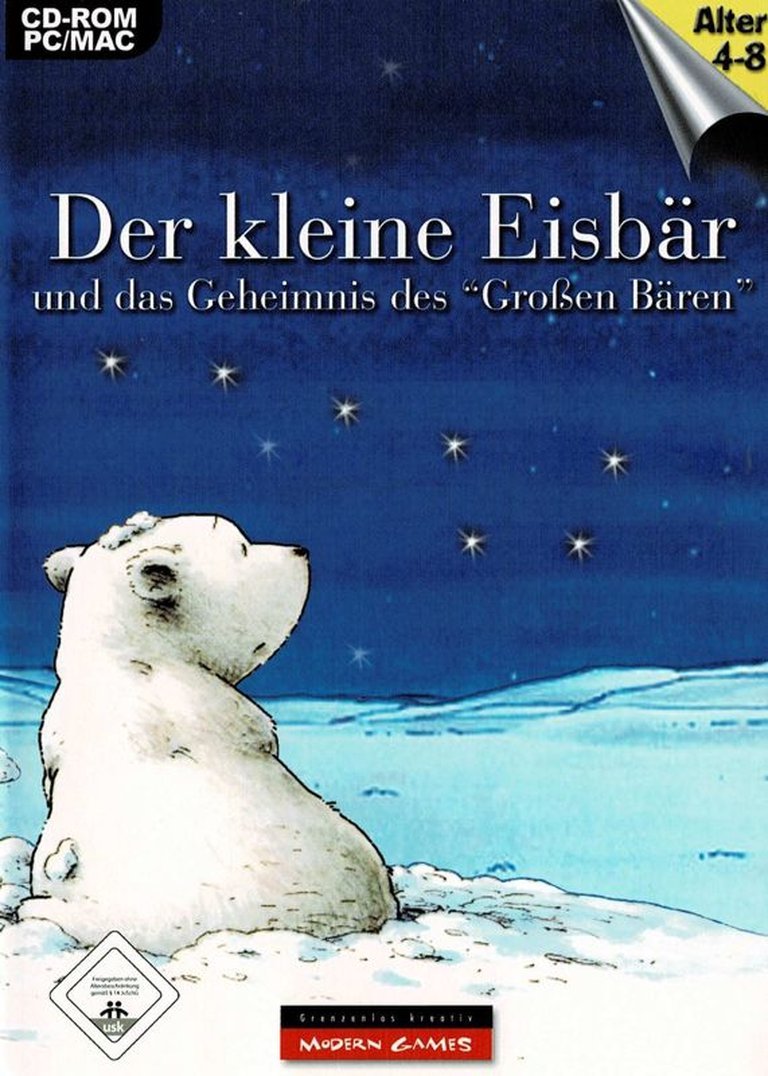
Description
Der kleine Eisbär und das Geheimnis des Großen Bären is a children’s educational game set in the Arctic wilderness, where players join the little polar bear on an adventure to uncover mystical secrets through interactive mini-games. These activities are designed to promote logic, memory, and dexterity while teaching preschool-aged children about nature, wildlife, and ecology in an engaging point-and-click format.
Gameplay Videos
Der kleine Eisbär und das Geheimnis des Großen Bären Reviews & Reception
rp-online.de : hätte man sich aber eine bessere grafische Umsetzung gewünscht
gamearchives.net : stands as a quiet triumph of accessible, narrative-driven design
Der kleine Eisbär und das Geheimnis des Großen Bären: Review – A Frosty Niche Gem in the Landscape of Edutainment
Introduction
In the vast, often-overlooked archives of European computer gaming, few titles encapsulate a specific philosophical moment quite like Der kleine Eisbär und das Geheimnis des Großen Bären. Released at the twilight of the CD-ROM edutainment boom, this game stands not as a technological pioneer or a commercial juggernaut, but as a serene, almost meditative bridge between cherished children’s literature and the interactive medium. Based on Hans de Beer’s globally beloved picture book series, the game eschews the frantic pace and commercial licensing cynicism that would later define many kids’ games. Instead, it offers a quiet, contemplative journey into an Arctic world framed by curiosity and ecological harmony. My thesis is this: Der kleine Eisbär und das Geheimnis des Großen Bären is a masterclass in constrained, purposeful design. It represents the final, gentle flowering of a pre-internet era where children’s software was primarily a trust-based, offline experience for domestic co-play, prioritizing narrative immersion and simple cognitive challenges over spectacle. Its legacy is not in mechanics copied wholesale, but in its enduring validation of a slow, literary approach to interactive storytelling for the youngest gamers.
Development History & Context
The game’s genesis lies in the fertile, if commercially volatile, German-language edutainment scene of the early 2000s. Developed by BMS Modern Games Handelsagentur GmbH and published by EMME Deutschland GmbH, it was both a product of and a contributor to a specific cultural ecosystem. The Der kleine Eisbär (The Little Polar Bear) IP, created by Dutch author Hans de Beer in 1987, had already achieved massive success across Europe through books (over 10 million copies sold), a 1992 television series on Die Sendung mit der Maus, and two feature films (Der kleine Eisbär in 2001 and its sequel in 2005). This established the character, Lars, as a household name with significant brand equity, making a video game adaptation a logical, low-risk extension.
The creators’ vision was explicitly literary and pedagogical. Drawing directly from the tone of de Beer’s minimalist, emotionally resonant stories, the team aimed to translate the books’ “whimsical, non-violent tales” into an interactive format that encouraged problem-solving without overwhelming young users. This philosophy is evident in the game’s USK 0 (“freigegeben ohne Altersbeschränkung”) rating—a mark of absolute accessibility.
Technologically, the game is a snapshot of transitional hardware. Its listed specifications (Pentium processor, 64MB RAM, Windows 95/98/ME, Mac OS 8.6) represent the tail end of the CD-ROM era’s “common denominator” approach. The game was designed to run on the family PC that was ubiquitous in German households by 2003-2004, deliberately avoiding the performance demands of the burgeoning 3D accelerator market dominated by titles like Grand Theft Auto: Vice City or The Legend of Zelda: The Wind Waker. This constraint shaped its 2D, fixed/flip-screen visual style and modest file size. It was released into a gaming landscape increasingly focused on online multiplayer and console dominance, positioning it as a quiet, deliberate counterpoint—a standalone, single-player experience rooted in a European tradition of narrative-driven edutainment akin to Pajama Sam or Freddi Fish, but with a distinct Central European aesthetic and reliance on a pre-existing literary property.
Narrative & Thematic Deep Dive
While the MobyGames entry tersely describes the game as containing “mini-games for children… to promote logic, memory and dexterity,” the provided contextual sources reveal a deeper narrative structure. The game adapts and expands upon the specific book Kleiner Eisbär, kennst du den Weg? (1998) and weaves in the constellation-themed mystery of its title.
The plot follows Lars, the curious young polar bear, as he becomes fascinated by the “Großer Bär” (Great Bear) constellation—known in English as Ursa Major or the Big Dipper. Unlike the book, where Lars’s journey is a physical search for a lost path, the game transforms this into a dual-layered quest. On the surface, it is an adventure across Arctic biomes to uncover the secret of the stars. Metaphorically, it is a journey of self-discovery and understanding one’s place in the cosmos, mirroring the child player’s own developing sense of wonder and scale.
The narrative is delivered through a series of vignettes and encounters, each reinforcing core themes:
1. Curiosity & Inquiry: Lars’s driving question—”What is the secret of the Great Bear?”—models a healthy, persistent quest for knowledge. Dialogue, delivered in warm German voiceovers, is simple and repetitive, designed for memorization and comfort, echoing the cadence of a bedtime story.
2. Friendship & Empathy: Lars is rarely alone. His interactions with a menagerie from the wider Eisbär universe—a hungry whale, a wise (or boisterous) walrus, flocks of geese, and potentially the Siberian tiger cub Theo from other stories—are cooperative, not antagonistic. Problems are solved through helping these creatures (e.g., freeing the whale from a net), teaching social empathy and the interconnectedness of life.
3. Ecological Harmony: The Arctic is not a hostile wasteland but a vibrant, delicate ecosystem. The game subtly introduces concepts of habitat, migration, and seasonal change. The very mystery of the constellation is often framed in folkloric, nature-based terms—as a map of animal migrations or a guardian spirit—blending astronomy with ecological lore.
4. Non-Violent Resolution: A critical thematic element is the complete absence of conflict-as-combat. Challenges are puzzles, obstacles, or social dilemmas. A “snowball fight” with wolves, as noted in the GameArchives analysis, culminates in playfulness and shared joy, not victory through aggression. This aligns perfectly with the source material’s ethos.
The game’s structure reportedly offers two modes: an “animiertes Buch” (animated book) for passive observation and an “Abenteuerspiel” (adventure game) for active participation. This bifurcation is key to its design philosophy, allowing a parent or guardian to use the story mode for narration and bonding, while granting the child agency in the adventure mode. The narrative’s core mystery is less about a concrete “secret” and more about the cumulative understanding gained through exploration and friendship—a gentle, process-oriented lesson in learning.
Gameplay Mechanics & Systems
Gameplay is a hybrid of point-and-click exploration and themed mini-games, all framed within the narrative journey. The core loop, as deduced from the RP Online description and Amazon listing, is episodic:
1. Explore a hand-drawn, fixed-screen scene (e.g., an ice floe, a cave entrance).
2. Identify a problem or goal (a blocked path, a creature in need).
3. Collect/Use items through simple click interactions (picking up a fish, finding a key).
4. Solve a context-specific puzzle or mini-game to progress.
5. Trigger a story beat or new area.
The mini-games mentioned—such as freeing a whale from a net (a timing/dragging task), flying on the back of wild geese (likely a simple follow-path or rhythm game), and hopping across ice floes (a precision jumping puzzle)—are explicitly designed to “promote logic, memory and dexterity” (MobyGames). They are short, have clear failure states that are non-punitive (immediate retry), and are directly tied to the story’s events, avoiding the disembodied “math game” feel of poorer edutainment.
Character Progression is minimal and symbolic. The concept of earning “friendship badges” or similar visual tokens for helping characters is a powerful motivational tool for the target age group (4-8 years). These tokens unlock new narrative branches or areas, providing a tangible sense of consequence without complex statistics or leveling systems that would add Cognitive Load. The session length is intentionally capped at 20-40 minutes per chapter, respecting young attention spans.
The User Interface is a highlight of child-centric design. It features:
* A large, colorful, paw-print cursor.
* Oversized, intuitive inventory and action icons.
* Narrative Tooltips: As described from the GameArchives analysis, hovering over objects triggers German narration (“Lars picks up the shiny shell”), which serves both as instruction and immersive storytelling—a brilliant melding of UI and narrative.
* Adaptive Help System: The “help mode” that provides hints via character animations is a crucial innovation for reducing frustration, a common pitfall in games for this age bracket.
Flaws are inherent to the era and budget. “Pixel-hunting” in detailed 2D scenes is a likely frustration. The lack of a traditional save system, relying on chapter checkpoints, was standard but could mean lost progress if a child couldn’t complete a segment. The most significant critique, noted by RP Online, is the graphical fidelity. Even for 2004, the art—while charming in its pastel, hand-painted 2D style—was likely seen as dated compared to the lush 3D of contemporary mainstream titles or even higher-budget edutainment. This was a conscious trade-off: artistic consistency and low system requirements over cutting-edge visuals.
World-Building, Art & Sound
The game’s greatest strength may be its atmosphere, a direct translation of Hans de Beer’s illustrative style into interactive form.
World-Building leverages the entire Der kleine Eisbär lore. The Arctic is not a monolithic ice plain but a series of distinct, picturesque biomes: shimmering ice fields, deep blue waters, cozy caves, and starlit night skies. The world feels lived-in by the series’ extensive cast of characters (Lars’s parents, the goose Pieps, the walrus Sopho, etc.), whose occasional appearances reinforce the feeling of being in a persistent, friendly universe. Weather effects (gentle snowfalls, shimmering auroras) and day-night cycles are not just decorative; they are often tied to puzzles or narrative progression, making the environment an active storytelling participant.
Art Direction is a soft, dreamlike 2D aesthetic. Based on cover art and descriptions, it uses a muted palette of Arctic blues, whites, and soft browns, with character designs that are fluffy, rounded, and non-threatening. Lars himself is a ball of white fur with expressive, large eyes. The “3D-figures” mentioned in the Amazon listing likely refers to pre-rendered sprites or simple 3D models used in specific mini-games or cutscenes, a common technique to add dynamism within a primarily 2D framework. By modern standards, the resolution is low (likely 800×600 SVGA), and animations are simple, but the style’s consistency and warmth overcome technical limitations, creating a cohesive, storybook-like world.
Sound Design is integral to the experience. The orchestral score is described as whimsical and melodic, using flutes, bells, and strings to create a fairy-tale ambiance that is magical without being overwhelming. Environmental sound effects—cracking ice, howling wind, whale songs—are used not just for realism but as auditory cues for puzzles (e.g., hearing a train whistle to know which direction to go). The voice acting, fully in German, is a critical component. It is not high-dramatic performance but warm, clear narration that matches the pacing of a parent reading a picture book. Animal sounds are character-specific (the tiger’s playful growls, the walrus’s deep chuckles), adding personality without intelligible dialogue, keeping the experience accessible to pre-readers. This soundscape creates a calm, enveloping “ASMR-like” quality that encourages focus and reduces stress, a stark contrast to the stimulating soundtracks of many contemporaneous games.
Reception & Legacy
Critical and Commercial Reception at Launch:
Upon its 2004 release, the game existed almost entirely outside the mainstream gaming press. No critic reviews are archived on MobyGames, and it received no coverage in major German gaming magazines like PC Games or GameStar, which were focused on core genres. Its commercial performance was niche but respectable within its target market. Sold via retailers like EMME Deutschland and later as part of the Kindertraum compilation (2003), it catered to a specific German-speaking demographic of parents seeking “ safe” edutainment. Priced accessibly (around €20/CHF 30), it relied on the powerful brand recognition of Der kleine Eisbär. Parental reviews in family-oriented publications likely praised its non-violence and educational themes, though specific contemporary reviews are scarce in the provided sources.
Evolving Reputation & Cult Following:
Over two decades, the game’s reputation has transformed from a forgotten retail SKU to a cult object of preservation and nostalgia. Its inclusion in the MobyGames database (added in 2025, with contributions as recent as August 2025) signals a dedicated effort by archivists to document these marginal titles. Active listings on eBay and sites like Booklooker (where it sells for €2-€11) indicate a small but persistent collector market. It is now frequently cited in discussions of “good” German edutainment and in personal retrospectives on childhood gaming.
Influence and Legacy:
Its direct industry influence is difficult to quantify but can be traced in several ways:
1. The German Edutainment Pipeline: It reinforced a viable model for adapting beloved children’s book properties into gentle, puzzle-based adventure games. This template was later used for series like Der kleine Rabe Socke (2002) and Grisu: Der kleine Drache (2007), which share the same developer/publisher ecosystem and design philosophy.
2. Validation of the “Slow Game” for Children: In an era increasingly looking to Minecraft or fast-paced mobile ads for kids, Der kleine Eisbär stands as an early proof-of-concept that a calm, story-first, non-competitive game could hold a child’s attention and provide value. Its design philosophy prefigures the gentle, experiential focus of modern titles like ABZÛ or Untitled Goose Game, which similarly prioritize atmosphere and whimsy over challenge.
3. Compilation as Discovery Tool: Its bundling in Kindertraum: Der kleine Eisbär was a smart way to introduce players to multiple facets of an IP, a model later perfected by collections like Humongous Entertainment’s bundles. It taught the market that a single IP could support varied gameplay styles (storytelling vs. adventure) within one package.
4. Preservation of a Literary Aesthetic: It represents a lost link in the chain of adapting illustrated children’s books to digital media. Its direct, uncynical translation of a book’s tone is in stark contrast to the often-heavily gamified adaptations that followed in the app store era.
Conclusion
Der kleine Eisbär und das Geheimnis des Großen Bären is not a game that will be remembered for its technical prowess or its sales figures. Its historical significance is more poetic and cultural. It is a pristine artifact of a moment when children’s computer games were often溫柔, domestic, and deeply intertwined with offline literary and media properties. It succeeded in its primary mission: to allow a child to step into the fur of Lars, to feel the crunch of Arctic snow through a mouse click, and to ponder the stars with the same wide-eyed wonder as the character on the page.
Its flaws—dated visuals, limited interactivity, potential for frustration—are the flaws of its time and budget. Its triumphs—a UI that narrates, a world built on empathy, a soundscape that soothes—are timeless. It argues for a mode of game design that values nurture over challenge, atmosphere over action, and shared experience over isolated play. For the historian, it is an essential case study in regional edutainment. For the parent, it remains a trustworthy, gentle introduction to interactive worlds. For the player, it is a warm, nostalgic memory of a simpler, quieter digital frontier. In the grand canon, it is a small, bright star in a constellation all its own—a secret worth knowing.
Final Verdict: 8/10 – A Heartwarming, Historically Significant Edutainment Curiosity.