
- Release Year: 2024
- Platforms: Browser, Windows
- Developer: Gabriel Machado, MsGummy, PoyoRedRachis, Romain André, Viktor Kraus
- Genre: Strategy, Tactics
- Perspective: Diagonal-down
- Game Mode: Single-player
- Gameplay: Roguelike
- Setting: Fantasy, North America, Western
- Average Score: 77/100
Description
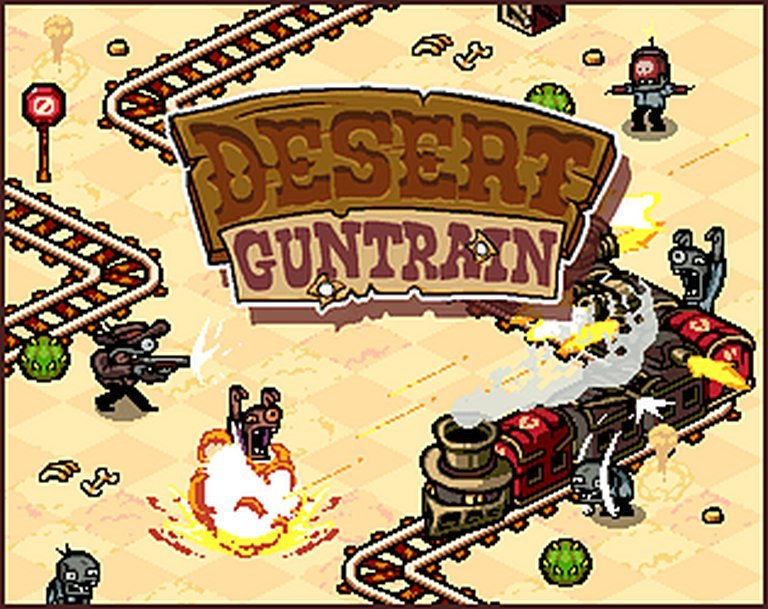
In a post-apocalyptic Wild West gripped by a zombie outbreak, players must board the armored Desert Guntrain to escape to Mexico in this turn-based train roguelike. The game challenges players to endure a perilous four-day journey through hostile landscapes, strategically upgrading their train with powerful gun wagons and using special ability-laced rails to fend off the undead. Progress requires reaching BLUE TRAIN STATIONS daily while collecting crates to enhance your mobile fortress, with tactical pausing and action-queuing systems adding depth to the survival experience.
Gameplay Videos
Desert Guntrain Reviews & Reception
oroshibu.itch.io (82/100): Fantastic!! Way too high-quality for a free browser game! Bravo!
itch.io (72.5/100): This game is awesome. Such a fun unique idea that works really well as a roguelike. The art is absolutely fantastic too
Desert Guntrain: Review
Introduction
In the arid expanse of post-apocalyptic Wild West, where the undead shamble through ghost towns and the last hope is a bullet-riddled train hurtling toward Mexico, Desert Guntrain emerges as a masterclass in constrained creativity. Born from the crucible of the Seven Day Roguelike (7DRL) Challenge 2024, this turn-based strategy game defies its jam origins to deliver a polished, atmospheric, and mechanically profound experience. Its premise—arming a mobile fortress with gun wagons and laying mystical rails to survive a zombie-infested journey—melds the grit of spaghetti Westerns with the strategic depth of roguelikes. In a landscape saturated with survival horror and procedural generation, Desert Guntrain stands not just as a successful jam entry, but as a testament to how focused vision can elevate a micro-budget project into something unforgettable. This review deconstructs how its synthesis of art, mechanics, and narrative creates a cohesive, tension-soaked odyssey that reshapes expectations for indie strategy games.
Development History & Context
Desert Guntrain was crafted by a global collective—Oroshibu (programming), Tetraminose, Poyo, DeadRachis, and MsGummy (art), Viktor Kraus (music & SFX), and Hapty (fonts)—in just seven days for the 7DRL Challenge 2024. This annual event, a cornerstone of the roguelike community, demands that games be developed within a strict week-long window, emphasizing innovation over polish. The developers leveraged the Godot engine, chosen for its flexibility and lightweight nature, enabling rapid prototyping of the game’s complex systems. Their vision was singular: create a “post-apocalyptic turn-based train roguelike” where the train itself is both a mobile base and a weapon.
The constraints of the 7DRL format are evident in the game’s scope—four days of gameplay, minimal dialogue, and a pared-down narrative. Yet these limitations fueled creativity rather than hampered it. The 2024 gaming landscape saw a resurgence of pixel art indies and tactical turn-based games (e.g., Into the Breach, Darkest Dungeon), but Desert Guntrain distinguished itself by merging the vehicular survival genre with roguelike randomness. Its release on March 11, 2024, via browser and Windows, aligned with a growing appetite for accessible, browser-playable titles during the post-pandemic indie boom. The project’s success—ranking #43 out of 158 7DRL entries—proved that a small team, fueled by passion, could deliver a product rivaling commercial releases in cohesion and charm.
Narrative & Thematic Deep Dive
Desert Guntrain’s narrative is a sparse, atmospheric tapestry woven from environmental storytelling and procedural events. The plot is brutally simple: a zombie outbreak has consumed the Old West, and the titular train is the last ark to Mexico. Over four days, players must navigate treacherous terrain, reach a “blue train station” in each procedurally generated map, and stave off the undead. There are no named characters or lengthy dialogue; instead, the narrative emerges from desperation. The train becomes a microcosm of survival—crates found en route represent resources for expansion, while dwindling health symbolizes the fragility of hope.
Themes revolve around inevitability and adaptation. The train’s movement rules—always prioritizing forward progress, randomly choosing left/right when blocked—mirror the futility of escape in an apocalypse. Players confront moral choices: fight zombies for crates (risking damage) or flee, sacrificing resources for speed. The “hero of the old west” motif, embodied by the font choice (ZX Origins) and pixel art cowboys, underscores a nostalgic doomed valor. Even the zombies—silent, shambling hordes—serve as a thematic device, representing relentless entropy. The game’s genius lies in its silence: without exposition, the weight of the journey is conveyed through the creak of wheels, the crack of gunfire, and the constant threat of failure. It’s a story of not just surviving, but enduring.
Gameplay Mechanics & Systems
Desert Guntrain’s core loop is a symphony of strategic tension and reactive planning. Each day, players guide their train across a grid-based map, moving automatically unless interrupted by zombies or terrain. The turn-based structure allows players to pause (SPACE key), queue multiple actions (e.g., shooting, laying rails, rearranging wagons), and plan defenses. The train’s composition is paramount: “crates” found mid-journey unlock new gun wagons (e.g., machine guns, cannons) or special rails (e.g., speed boosts, attack rails). Each wagon and rail type offers distinct tactical advantages, encouraging experimentation. Combat is abstract but impactful—zombies spawn adjacent to the train, dealing damage per turn unless gun wagons eliminate them.
The game’s innovation lies in its dual-resource management: balancing the train’s “health” (wagons) with the player’s ability to expand and adapt. The movement rules create emergent challenges: when the train can’t advance, a random left/right turn might send players into dead ends or zombie hotspots. This injects high-stakes unpredictability. However, the system isn’t flawless. Some critiques noted that controls could feel finicky—camera limitations sometimes caused misaligned rail placements—and the pacing during later days could drag as maps scaled up. Yet these minor issues are overshadowed by the brilliance of the loop: every crate is a gamble, every turn a calculated risk. The “compass wagon,” a late-game upgrade that points toward the exit station, exemplifies the game’s design—it doesn’t simplify the challenge, but rewards player persistence with clarity.
World-Building, Art & Sound
Desert Guntrain’s world is a character in its own right, realized through meticulous art direction and environmental storytelling. The isometric, 2D-scrolling perspective renders a desolate Wild West where crumbling depots, skeletal cacti, and zombie hordes evoke a tangible sense of decay. The pixel art, credited to a quartet of artists, is astonishingly detailed for a jam entry: textures on rusted metal, nuanced shading on dunes, and expressive zombie animations (e.g., jerky lunges) all contribute to immersion. The color palette—dusty browns, faded blues, and occasional bursts of crimson for blood or fire—mirrors the genre’s grit while maintaining visual clarity.
Sound design elevates the experience into a tense ballet. Viktor Kraus’s score blends twangy guitars, melancholic harmonicas, and percussive rhythms that evoke both loneliness and urgency. Sound effects—from the clack-clack of train wheels to the visceral thwack of gunfire—are crisp and impactful, creating a feedback loop between action and audio. The game’s audio-visual synergy is most potent during combat: the staccato of gun wagons firing syncs with pixelated muzzle flashes, while zombie moans swell as health bars deplete. The “hero of the old west” font, a nod to ZX Spectrum classics, adds a layer of retro authenticity. Together, these elements transform a simple grid map into a living, breathing wasteland where every sound and sight reinforces the game’s core theme: survival against impossible odds.
Reception & Legacy
Upon release, Desert Guntrain garnered immediate praise within indie circles, lauded for its “fantastic” art and “immersive” audio despite its free-to-play browser model. On itch.io, it holds a 4.1/5 rating from 18 reviews, with players calling it “way too high-quality for a free browser game.” The 7DRL Challenge judges awarded it an overall rank of #43 (out of 158) and #57 for “Roguelikeness,” noting its “unique take” and “polished execution.” Critics highlighted its atmosphere and innovation, though some echoed player feedback: controls could be “frustrating,” and levels occasionally felt “too long without much challenge.”
Its legacy is twofold. Within the 7DRL community, it exemplifies how a jam project can achieve commercial-grade polish, inspiring entries like Boarding Actions and Derelict-7DRL. Beyond jams, Desert Guntrain influenced indie developers to blend niche genres—vehicular combat with roguelike randomness—with accessible art styles. Its browser-based release model also highlighted itch.io’s role in democratizing game distribution. While not a mainstream hit, it remains a cult favorite, cited for proving that “ambition thrives in constraints.” The game’s ongoing evolution—developers routinely patch bugs and experiment with new mechanics—reflects a commitment to post-jam growth, ensuring its relevance in the ever-shifting indie landscape.
Conclusion
Desert Guntrain is a triumph of constrained design, a game that rises from the ashes of a week-long jam to deliver a cohesive, emotionally resonant experience. Its genius lies in balancing accessibility with depth: the core loop of train-building and zombie defense is easy to grasp but endlessly replayable due to procedural generation and strategic choices. While minor control quirks and pacing issues prevent perfection, they are overshadowed by the game’s strengths: its haunting atmosphere, pixel-perfect art, and masterful sound design that transform a simple premise into an odyssey.
In the pantheon of roguelikes, Desert Guntrain occupies a unique space—it’s not a genre-redefining behemoth like Hades, but a diamond-in-the-rough that honors the spirit of experimentation. It proves that the 7DRL Challenge remains a vital platform for innovation, where small teams can create experiences that linger in the mind long after the credits roll. For players seeking a game that marries the tension of a Western standoff with the strategic rigor of chess, Desert Guntrain is not just recommended—it’s essential. In a world of endless sequels and AAA spectacle, this humble train ride through the apocalypse stands as a monument to the power of passion, pixel art, and the undead.