
- Release Year: 2004
- Platforms: Windows
- Publisher: 1C Company, Atari do Brasil Ltda., Digital Jesters Ltd., Encore, Inc., Global Software Publishing Ltd., Monte Cristo Multimedia, ZOO Corporation
- Developer: Digital Reality Software Kft
- Genre: Strategy, Tactics
- Perspective: Diagonal-down
- Game Mode: LAN, Online PVP, Single-player
- Gameplay: Bonus points for special units, Real-time, Tank combat, Unit experience
- Setting: Africa, Historical events, World War II
- Average Score: 74/100
Description
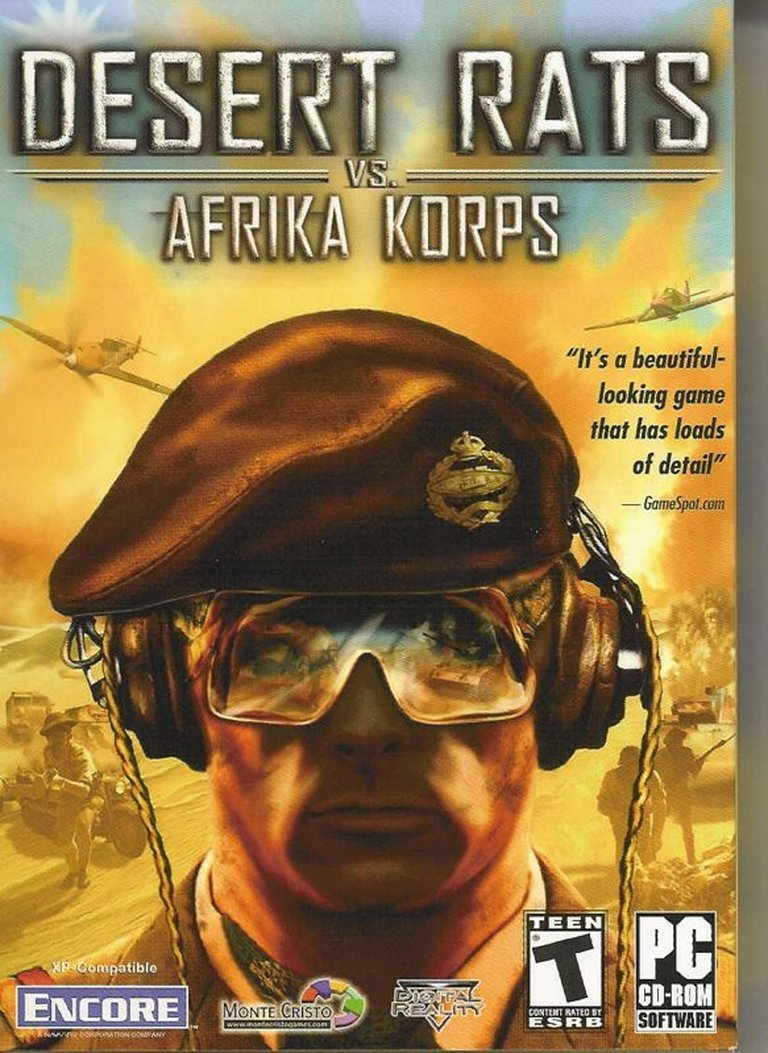
Desert Rats vs. Afrika Korps is a real-time strategy game set during the North Africa Campaign of World War II, allowing players to command either the Axis forces led by Rommel or the Allied forces under Montgomery. The game features distinct storylines for each faction, unit experience systems, and the ability to earn bonus points for special units, blending tactical depth with historical warfare. With a mix of tank combat, resource management, and strategic decision-making, it offers a challenging and immersive experience in one of WWII’s most iconic theaters.
Gameplay Videos
Desert Rats vs. Afrika Korps Cracks & Fixes
Desert Rats vs. Afrika Korps Patches & Updates
Desert Rats vs. Afrika Korps Mods
Desert Rats vs. Afrika Korps Guides & Walkthroughs
Desert Rats vs. Afrika Korps Reviews & Reception
metacritic.com (70/100): A fun game. I can’t find much fault with the time I spent with it. But its overall feel is less than stellar.
ign.com : Real enough to matter, fake enough to be fun.
en.wikipedia.org (70/100): The game received “average” reviews according to the review aggregation website Metacritic.
mobygames.com (76/100): One of the better WW2 RTS’s, as usual more fun from the German POV 😉
worthplaying.com (80/100): A real-time tactical game boasting single and multiplayer modes, Desert Rats vs. Afrika Korps immerses you into the explosive campaigns that took place in North Africa during World War II.
Desert Rats vs. Afrika Korps Cheats & Codes
PC
Unace this archive in gamedir, launch ‘all_scenarios.reg’ to update registry and unlock all scenarios in menu NEW GAME -> SCENARIO. Unrar ‘last_mission.rar’ in gamedir and load ‘Endgame – Rescue Lys!’ in menu LOAD GAME to play the last mission.
| Code | Effect |
|---|---|
| all_scenarios.reg | Unlocks all scenarios in the NEW GAME -> SCENARIO menu. |
| last_mission.rar | Loads the last mission ‘Endgame – Rescue Lys!’ in the LOAD GAME menu. |
Desert Rats vs. Afrika Korps: A Tactical Masterpiece in the Sands of History
Introduction
In the vast and often oversaturated landscape of World War II strategy games, Desert Rats vs. Afrika Korps (2004) emerges as a hidden gem—a title that dared to blend historical authenticity with innovative gameplay mechanics. Developed by Digital Reality and published by Monte Cristo, this real-time tactics game transports players to the scorching battlegrounds of North Africa, where the legendary Afrika Korps and the tenacious Desert Rats clashed in a “war without hate.” With its dual campaigns, deep tactical systems, and a narrative woven around the personal rivalry of two former Olympic friends turned wartime adversaries, Desert Rats vs. Afrika Korps stands as a testament to the potential of historical strategy games. Yet, despite its ambition and critical acclaim, it remains an underappreciated relic of its era. This review delves into the game’s development, narrative depth, gameplay mechanics, and lasting legacy, arguing that it is not only one of the finest WWII strategy games but also a pioneering title that deserves reconsideration in the annals of gaming history.
Development History & Context
The Studio and Vision
Digital Reality, a Hungarian developer known for its work on Imperium Galactica and Haegemonia: Legions of Iron, sought to carve a niche in the burgeoning WWII strategy genre with Desert Rats vs. Afrika Korps. The studio’s vision was clear: create a game that emphasized tactical depth over resource management, leveraging the historical richness of the North African campaign while introducing innovative mechanics like unit persistence and vehicle capture. The game was built on the proprietary Walker 2 engine, which allowed for detailed 3D environments, dynamic lighting, and destructible terrain—features that were cutting-edge for 2004.
The development team, led by CEO Gábor Fehér and executive producer Tamás Daubner, drew inspiration from classics like Panzer General and Sudden Strike, aiming to refine their formulas. The goal was to craft a game that rewarded strategic foresight and adaptability, where players could feel the weight of command in a historically grounded setting. The inclusion of a prestige system, where units gained experience and could be carried over between missions, was a direct nod to Panzer General, while the real-time pause feature borrowed from Blitzkrieg, allowing players to issue complex orders without the pressure of real-time chaos.
Technological Constraints and Innovations
The early 2000s were a transitional period for PC gaming, with hardware capabilities rapidly evolving. Desert Rats vs. Afrika Korps pushed the boundaries of what was possible on mid-range systems, requiring a Pentium III 1GHz processor and 256MB of RAM—specs that were respectable but not prohibitive for the time. The Walker 2 engine enabled the rendering of large-scale battles with over 70 distinct unit types, each meticulously modeled after their historical counterparts. However, the engine’s demands also led to performance issues, particularly in later missions where the sheer number of units could bring even robust systems to a crawl.
One of the game’s most innovative features was its approach to unit interaction. Infantry could board vehicles, enhancing their capabilities—scouts in tanks improved visibility, while machine gunners increased firepower. This mechanic added a layer of customization and tactical flexibility rarely seen in contemporary RTS games. Additionally, the ability to capture and repair enemy vehicles introduced a dynamic element to combat, encouraging players to think beyond brute force.
The Gaming Landscape of 2004
The release of Desert Rats vs. Afrika Korps in February 2004 coincided with a golden age of WWII strategy games. Titles like Blitzkrieg, Sudden Strike, and Close Combat had already established the genre’s conventions, while Company of Heroes was on the horizon, promising to redefine real-time tactics. Amid this competitive landscape, Desert Rats distinguished itself by focusing on the North African theater—a setting that, while historically significant, was often overshadowed by the more glamorous European and Pacific fronts.
The game’s emphasis on narrative-driven campaigns, rather than abstract skirmishes, also set it apart. While many contemporaries relied on generic mission briefings, Desert Rats wove a personal story around the rivalry between a German and British commander, adding emotional stakes to the strategic gameplay. This narrative approach, combined with its tactical depth, positioned Desert Rats as a unique hybrid of storytelling and strategy.
Narrative & Thematic Deep Dive
Plot and Characters
Desert Rats vs. Afrika Korps unfolds across two parallel campaigns: one following the Axis forces under the command of the Afrika Korps, and the other chronicling the Allied efforts of the Desert Rats. The narrative is framed around the personal rivalry between two former Olympic athletes—one German, one British—who find themselves on opposite sides of the conflict. This framing device humanizes the war, presenting it as a “war without hate,” where respect and camaraderie persist despite the brutality of battle.
The German campaign begins with the Afrika Korps’ early victories in 1941, culminating in the siege of Tobruk, while the Allied campaign traces the British and Commonwealth forces’ gradual retaking of North Africa, starting with the pivotal Battle of El Alamein in late 1942. Each campaign is structured as a series of missions, with briefings that provide historical context and diary entries that offer personal reflections from the protagonists. While the storytelling is not as cinematic as later titles, the diary entries and mission briefings effectively convey the emotional and strategic weight of the conflict.
Themes of Rivalry and Respect
The game’s central theme is the duality of war—both as a clash of ideologies and as a personal struggle between individuals who once shared mutual respect. The rivalry between the German and British commanders is not one of blind hatred but of competitive spirit, reflecting the real-life respect that existed between figures like Erwin Rommel and Bernard Montgomery. This nuance is a refreshing departure from the often one-dimensional portrayals of WWII in games, where the Axis is uniformly villainized.
The North African campaign itself is a fascinating backdrop for this theme. Unlike the Eastern Front, where ideological and racial hatred fueled the conflict, the desert war was characterized by a degree of chivalry and professional respect between adversaries. Desert Rats vs. Afrika Korps captures this spirit, presenting a conflict where the lines between hero and villain are blurred, and victory is determined by skill and adaptability rather than moral superiority.
Dialogue and Presentation
The game’s dialogue and voice acting are a mixed bag. While the historical briefings and diary entries are well-written and immersive, the in-game voice acting—particularly for American units—has been criticized for its awkward accents and stilted delivery. This is a common pitfall for non-English developers of the era, and Desert Rats is no exception. However, the game’s soundtrack, composed by Ervin Nagy and Tamas Kreiner and performed by the Vienna Symphony Orchestra, is a standout feature. The music enhances the game’s atmosphere, evoking the vastness and desolation of the desert while underscoring the tension of battle.
Gameplay Mechanics & Systems
Core Gameplay Loop
At its heart, Desert Rats vs. Afrika Korps is a real-time tactics game that eschews traditional RTS resource management in favor of pre-built forces and strategic deployment. Each mission begins with an army management phase, where players allocate points to assemble a force tailored to the mission’s objectives. This system encourages replayability, as players can experiment with different unit compositions to tackle challenges in novel ways.
The core gameplay loop revolves around maneuvering units across the battlefield, leveraging terrain and line-of-sight mechanics to gain tactical advantages. Unlike many RTS games, where overwhelming force often prevails, Desert Rats rewards careful positioning, ambush tactics, and the judicious use of combined arms. Infantry, tanks, artillery, and air support must be coordinated effectively, with each unit type having distinct strengths and vulnerabilities.
Unit Persistence and Experience
One of the game’s most innovative features is its unit persistence system. Units that survive missions gain experience, becoming more effective in subsequent battles. This mechanic fosters an emotional connection to individual units, as players grow attached to veteran soldiers and vehicles. The prestige system further enhances this by allowing players to unlock elite units—such as the formidable Tiger tank—for completing hidden objectives. This adds a layer of long-term strategy, as players must weigh the risks of deploying valuable units against the potential rewards of preserving them.
Vehicle Capture and Repair
The ability to capture and repair enemy vehicles is another standout feature. Players can disable enemy tanks and trucks, then send infantry to seize them, adding them to their own arsenal. This mechanic not only provides a tactical advantage but also introduces a dynamic element to combat, where the battlefield is fluid and opportunities for turning the tide of battle are ever-present. The repair system, which allows damaged vehicles to be restored to fighting condition, further emphasizes the importance of resourcefulness and adaptability.
Combat and AI
Combat in Desert Rats vs. Afrika Korps is brutal and unforgiving. Units can take location-specific damage, meaning a well-placed shot to a tank’s turret or tracks can disable it without destroying it outright. This level of detail adds realism and strategic depth, as players must consider not just the type of unit they are engaging but also its current state.
The AI, while competent, is not without its flaws. Enemy units can be exploited through careful maneuvering, and pathfinding issues occasionally lead to frustrating moments where units become stuck or take inefficient routes. However, the AI’s use of terrain and flanking tactics is generally impressive, providing a challenging opponent that requires players to think critically about their approach.
Multiplayer and Replayability
The game’s multiplayer mode supports up to four players via LAN or online (originally through GameSpy), offering modes like Capture the Flag, Deathmatch, and a unique “Tobruk-to-El-Alamein” mode where teams alternate between attack and defense. While the multiplayer experience is enjoyable, the lack of a skirmish mode against the AI is a notable omission, limiting the game’s long-term replayability.
World-Building, Art & Sound
Setting and Atmosphere
The North African desert is more than just a backdrop in Desert Rats vs. Afrika Korps—it is a character in its own right. The game’s environments are meticulously crafted, with rolling dunes, rocky outcrops, and ruined villages that evoke the harsh beauty of the region. The dynamic weather effects, including sandstorms and mirages, add to the immersion, while the destructible terrain ensures that no two battles play out the same way.
The game’s art direction is functional rather than flashy, prioritizing clarity and tactical readability over visual spectacle. Unit models are detailed and historically accurate, though the similarity between some infantry types can lead to confusion during the heat of battle. The camera system, while flexible, is somewhat limited in its vertical range, making it difficult to get a bird’s-eye view of the battlefield.
Sound Design and Music
The sound design in Desert Rats vs. Afrika Korps is exemplary, with the roar of tank engines, the crack of rifle fire, and the thunder of artillery all contributing to the game’s immersive atmosphere. The soundtrack, composed by Ervin Nagy and Tamas Kreiner, is a highlight, blending orchestral grandeur with subtle Middle Eastern influences to evoke the game’s setting. The music dynamically shifts to match the intensity of the action, heightening the emotional impact of key moments.
Reception & Legacy
Critical and Commercial Reception
Upon its release, Desert Rats vs. Afrika Korps received generally positive reviews, with critics praising its tactical depth, historical authenticity, and innovative mechanics. Publications like Game Chronicles and PC Games (Germany) lauded the game’s attention to detail and engaging campaigns, while others, such as IGN and GameSpot, noted its technical shortcomings and occasionally frustrating AI.
The game’s reception on Metacritic sits at a “mixed or average” 70/100, reflecting its status as a niche title that appealed more to hardcore strategy fans than to the broader gaming audience. Despite its critical acclaim, Desert Rats did not achieve significant commercial success, partly due to the oversaturation of the WWII strategy market at the time.
Influence and Legacy
While Desert Rats vs. Afrika Korps did not spawn a direct sequel, its influence can be seen in later titles that adopted its unit persistence and vehicle capture mechanics. Games like Company of Heroes and Men of War owe a debt to Desert Rats‘ emphasis on tactical realism and combined arms warfare. The game’s focus on the North African theater also paved the way for future titles to explore lesser-known WWII fronts, enriching the genre’s historical diversity.
Today, Desert Rats vs. Afrika Korps is remembered as a cult classic—a game that, despite its flaws, offered a unique and deeply engaging strategic experience. Its legacy is one of innovation and ambition, a testament to the potential of historical strategy games to blend narrative depth with tactical complexity.
Conclusion
Desert Rats vs. Afrika Korps is a game that defies easy categorization. It is neither a pure RTS nor a traditional turn-based strategy game but a hybrid that borrows the best elements of both. Its dual campaigns, unit persistence system, and vehicle capture mechanics set it apart from its contemporaries, while its narrative depth and historical authenticity elevate it beyond mere tactical simulation. Though hampered by technical limitations and occasional design missteps, the game’s strengths far outweigh its weaknesses, making it a must-play for fans of WWII strategy games.
In the pantheon of historical strategy titles, Desert Rats vs. Afrika Korps deserves a place of honor. It is a game that dared to innovate, to tell a story, and to challenge players not just to win battles but to understand the human cost of war. For those willing to overlook its rough edges, it remains one of the most rewarding and immersive strategy experiences of its era—a true masterpiece in the sands of history.
Final Verdict: 8.5/10 – A tactical gem that shines despite its flaws, Desert Rats vs. Afrika Korps is a must-play for strategy enthusiasts and history buffs alike.