
- Release Year: 2015
- Platforms: Android, Linux, Macintosh, Windows
- Publisher: Milosh Games, MovingBlocks
- Developer: MovingBlocks
- Genre: Action
- Perspective: Top-down
- Gameplay: Arcade, Open World, RPG elements, Sandbox
- Setting: Futuristic, Sci-fi
- Average Score: 76/100
Description
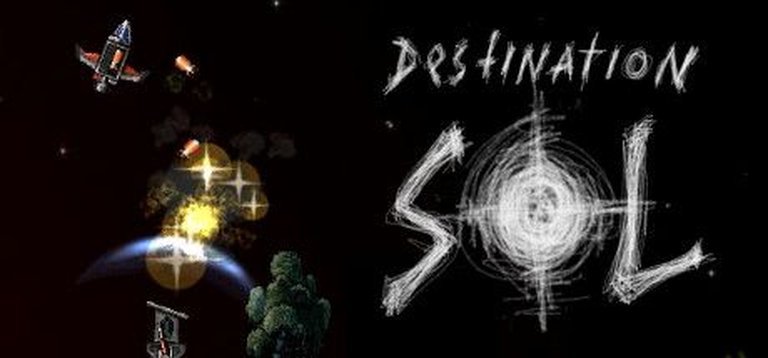
Destination Sol is a free-to-play arcade space shooter with RPG elements, set in a futuristic sci-fi universe. Players begin as a pilot of a small fighter ship on the edge of a star system and can freely explore planets, engage in combat, upgrade their ship and equipment, hire mercenaries, mine asteroids, and more in a sandbox open-world environment, featuring top-down 2D scrolling visuals.
Gameplay Videos
Where to Buy Destination Sol
PC
Destination Sol Guides & Walkthroughs
Destination Sol Reviews & Reception
wasdland.com (76/100): Really fun.
commonsensemedia.org : Space RPG packs redundant play, tricky controls.
Destination Sol: Review
Introduction: The Open-Space Frontier
In the sprawling cosmos of indie game development, few titles embody the spirit of grassroots creation and enduring community love quite like Destination Sol. Emerging from a small team’s passion project in 2015, this “hardcore arcade/RPG” carved out a unique niche by offering a seamless, procedurally generated sandbox of space exploration, combat, and resource management—all for free. Its legacy is not one of blockbuster sales or ubiquitous fame, but of remarkable resilience and open-source vitality. This review argues that Destination Sol’s true significance lies in its successful transition from a clever indie experiment to a sustainable, community-driven open-source project, providing a masterclass in how a game’s life cycle can be extended and enriched through transparency and collective effort. It is a game defined less by a authored narrative and more by the emergent stories of players charting their own courses through a relentless, physics-driven void.
Development History & Context: From Indie Spark to Open-Source Beacon
Destination Sol was originally conceived and developed by Milosh Petrov and a small, initial team (including Nika Burimenko, Kent C. Jensen, and Julia Nikolaeva) under the banner Milosh Games. It was released on February 5, 2015, for Windows, later ported to Linux, Mac, and Android. The developers’ stated vision was to create a “fun little arcade space shooter” that experimented with the involved technology, primarily Java using the libgdx framework. This choice was pragmatic, enabling cross-platform deployment (Windows, Mac, Linux, Android) from a single codebase, a significant advantage for a small team.
The game’s launch context is crucial. It arrived amidst a renaissance of indie space games, from the narrative-driven FTL to the grand strategy of Endless Space. However, Sol distinguished itself immediately with its seamless, loading-screen-free world—a technical achievement where transitioning from asteroid belt to planetary surface required no pause, a rarity in 2D space games. Its “hardcore” moniker stemmed from a commitment to realistic physics-based movement (no automatic braking; momentum must be countered by thrust) and a stark, unforgiving difficulty where death meant losing your ship and progress unless you had a “previous ship” saved.
The pivotal moment in its history came post-launch. After receiving “highly positive reviews” on Steam, the core team, having achieved their primary goal of tech experimentation, wished to move on to other projects. Recognizing the game’s potential and existing community, they sought a new maintainer. The MovingBlocks collective, already known for their open-source voxel game Terasology, stepped in. MovingBlocks institutionalized the project, moving it to GitHub under the Apache 2.0 License (with a separate license for the soundtrack by NeonInsect). This transition, formalized around 2016-2017, transformed Destination Sol from a static product into a living, open-source project with structured contributor leadership, version control, and a public roadmap. This context explains the game’s dual identity: a finished indie title from 2015 that has been continuously evolved by a rotating cast of contributors for nearly a decade.
Narrative & Thematic Deep Dive: The Absence of Plot as a Design Choice
Unlike the vast majority of RPGs, Destination Sol possesses no canonical narrative, no named protagonist, and no overarching story. This is not an oversight but a foundational design pillar. The “thematic deep dive” here must therefore analyze the themes of pure emergence and player agency.
- The Blank Slate Pilot: The player is an anonymous pilot on the edge of a star system. There is no backstory, no motivation beyond survival and accumulation provided by the game. This vacuum forces the player to create their own narrative. Is your pilot a greedy merchant, a ruthless bounty hunter, a cautious explorer, or a reckless miner? The game’s systems—trading, mission-like bounty hunting, planetary exploration—become the raw material for personal storytelling.
- Sandbox as Antagonist: The primary “conflict” is against the environment itself: the unforgiving physics that make piloting a skill, the procedurally generated enemy fleets that scale in danger, and the constant pressure of resource management (credits, ammunition, repair kits). The theme is one of mastery over chaos.
- Community-Suggested Lore: The Steam discussion forums reveal a player base actively yearning for the very narrative the game lacks. Suggestions like adding “lost cargo” or “small colonies” to planetary surfaces are direct pleas for external motivation and world-building. This gap highlights the game’s central tension: it is a sublime engine for space-flight simulation and economic loops, yet it deliberately withholds the classic “hero’s journey” that most players subconsciously seek. The theme becomes existential exploration—flying for flying’s sake, upgrading for the sake of power, with no final boss or galactic resolution. It is a pure, unadulterated playground simulator.
Gameplay Mechanics & Systems: A Physics-Driven Heap of Fun
The core gameplay of Destination Sol is a compelling, if brutally difficult, feedback loop built on several interconnected systems.
1. Core Loop & Exploration: The loop is: Explore -> Engage/Mine -> Gather Loot -> Trade/Upgrade -> Explore Further. The “seamless open world” is the star. Players navigate a 2D top-down map of star systems containing planets (three types: barren, earth-like, and lava), asteroid belts, outposts, and enemy fleets. The lack of loading screens creates an unparalleled sense of continuous space travel.
2. Combat & Ship Systems: Combat is a delicate dance of momentum. Key systems include:
* Hit Points & Shields: Armor (HP) and shields (absorb damage first) are separate, with different weapon vulnerabilities.
* Weapons: Primary (unlimited ammo but weak) and secondary (consumable ammo like “Bullets” or “Slo Mo Charges”). Weapon choice (projectile type, gun type) affects damage, rate of fire, and enemy compatibility.
* Ship Abilities: Activated abilities (like a boost or a bomb) use a shared cooldown or consumable.
* Mercenaries: Hireable AI allies that follow and fight, but also greedily pick up loot and drop it if killed, adding a layer of micromanagement.
3. Progression & Economy: Progression is entirely vertical and gear-based. There is no character level. Power comes from:
* Credits: Earned by destroying asteroids (easy, low risk), enemy ships (risk vs. reward), and trading.
* Ship Types: 6 base ship types (from fragile scouts to heavy frigates), each with different hardpoints and stats.
* Items: Over 50 equippable items—weapons, shields, armor, engines, abilities. The critical catch: new ships often require new, compatible weaponry, which can bankrupt a pilot who buys a ship before its guns.
* The Risk/Reward of Death: If your ship is destroyed, you lose everything on it unless you had saved a “previous ship” configuration. This creates high stakes but also potential frustration, a common point in player reviews.
4. User Interface & Controls: The default control scheme (pure keyboard) is a major barrier. Players use Up to thrust (constant acceleration), Left/Right to rotate, Space to fire. There are no brakes; slowing requires turning retrograde and thrusting. This Newtonian physics model is the game’s most divisive and defining feature—deeply rewarding for some, infuriating for others. The map (Tab) and inventory (I) are functional but sparse. The UI effectively communicates danger (warnings for strong enemies, collision courses) but offers little hand-holding.
5. Innovative & Flawed Systems: The seamless world is the paramount innovation. The procedural generation of systems and planets (a focus of later Google Summer of Code projects) ensures replayability. However, the game’s flaws are tied to its minimalist design: the lack of a save system beyond a single “previous ship” slot is archaic; the absence of structured quests or missions leaves players feeling directionless, as noted by critics like Blowing up Bits; and the economy can feel shallow, revolving almost solely around the “destroy -> sell -> upgrade” cycle without deeper trade routes or faction reputations.
World-Building, Art & Sound: Functional Aesthetics in a Vast Void
Destination Sol adopts a deliberately retro, pixel-art aesthetic reminiscent of 1990s space games like The Ur-Quan Masters. This is not a high-budget visual feast but a functional, clear, and charming style.
* Visual Direction: Sprites are sourced from MillionthVector (Creative Commons licensed). Ships, planets, and asteroids are clearly readable at a glance, a critical requirement for a top-down shooter. The 2D scrolling world uses simple tiles and color palettes to differentiate planet types (blue for earth-like, red for lava). The visual clarity serves the hardcore gameplay; flashy effects are minimal to avoid obscuring the battlefield.
* Atmosphere & Setting: The atmosphere is one of lonely, silent expanse. Space is dark, punctuated by the bright trails of engine thrust and weapon fire. The only signs of civilization are isolated trader outposts and the occasional allied fighter. The three planet types provide superficial environmental variety but little interactive depth (landing is mostly for a change of scenery or mining).
* Sound Design: The soundtrack, provided by NeonInsect under a CC-NC 4.0 license, is an understated, synth-driven score that underscores the tension and vastness without being intrusive. Sound effects for weapons, explosions, and alerts are crisp and functional. The audio design successfully reinforces the game’s core feeling: you are a tiny, noisy speck in a colossal, indifferent universe.
Reception & Legacy: A Cult Classic Sustained by Community
At its 2015 Steam launch, Destination Sol was met with “highly positive reviews” from a niche audience that prized its unique blend of physics, freedom, and challenge. Its Steam status as “Mostly Positive” (79% positive from 1,361 reviews) has remained remarkably stable for years, indicating a dedicated core fanbase that tolerates or cherishes its rough edges.
Common praise in player reviews centers on:
* The thrill of seamless exploration.
* The rewarding difficulty of mastering ship movement.
* The satisfaction of progression through ship and gear upgrades.
* The price (free) and open-source nature.
Common criticisms, echoed in reviews from outlets like Common Sense Media and Blowing up Bits, include:
* Lack of narrative or long-term goals leading to aimlessness.
* Brutally steep learning curve for controls and physics.
* Repetitive gameplay loop after initial novelty wears off.
* Archaic save system causing progress loss.
The game’s true legacy is its sustainable open-source model. By licensing under Apache 2.0 and welcoming contributions, MovingBlocks ensured that Destination Sol would not die with its original creators. This has led to:
* Continued Technical Development: Major projects like the Google Summer of Code (GSoC) initiatives have overhauled core systems. The world-generation project (by IsaiahBlanks) created modular, functional solar systems. The ECS (Entity Component System) migration project (by Isaac Lichter) was a monumental architectural refactor, modernizing the codebase for better performance and easier modding.
* Platform Longevity: Active ports to Android and continued builds for desktop.
* A Living Wiki and Community: The Destination Sol Wiki on Fandom, actively soliciting contributors, is a testament to the player-base’s investment.
* Influence: While not a trendsetter like Minecraft, it serves as a touchstone for the “passion project to open-source institution” pipeline. It demonstrates that a small, well-defined game with a passionate community can outlive its original vision through collective stewardship, influencing how other small studios think about project handover and sustainability.
Conclusion: An Imperfect Gem of the Open-Source Cosmos
Destination Sol is not for everyone. Its lack of hand-holding, its punishing physics, and its narrative vacuum will alienate players seeking guided experiences or polished narratives. Yet, for those who yearn for the pure, unadulterated feel of piloting a spaceship where every maneuver is earned, where the universe is a vast, dangerous, and opportunistic sandbox, it remains a uniquely compelling experience.
Its place in video game history is not as a landmark title in storytelling or graphical fidelity, but as a paragon of the sustainable indie/open-source model. It proved that a game’s life doesn’t end at version 1.0. Through the stewardship of MovingBlocks and contributions from dozens of developers (listed meticulously on its GitHub), it has been maintained, modernized, and expanded for nearly a decade after its debut.
The final verdict is this: Destination Sol is a flawed, fascinating, and enduring artifact. It is a game that asks very little of you in terms of story but demands much in terms of skill and patience. Its greatest achievement is creating a framework—a physics-based, seamless, upgrade-driven space sandbox—so robust and appealing that a community chose to adopt it, nurture it, and keep it flying through the open-source void long after its creators set a new course. For that, it deserves immense respect. It is less a finished product and more a perpetual work-in-progress testament to the power of shared creation, a true “destination” for anyone interested in the intersection of game development and open-source collaboration.
Final Score (as a historical artifact & community project): 8.5/10
Final Score (as a conventional game for the average player): 6.5/10