
- Release Year: 2010
- Platforms: Windows
- Publisher: Game Factory Interactive Ltd., rondomedia Marketing & Vertriebs GmbH
- Developer: Far Mills Game Studio
- Genre: Adventure
- Perspective: 1st-person
- Game Mode: Single-player
- Gameplay: Hidden object, Inventory system, Point and select, Puzzle elements
- Setting: Detective, Mystery
- Average Score: 60/100
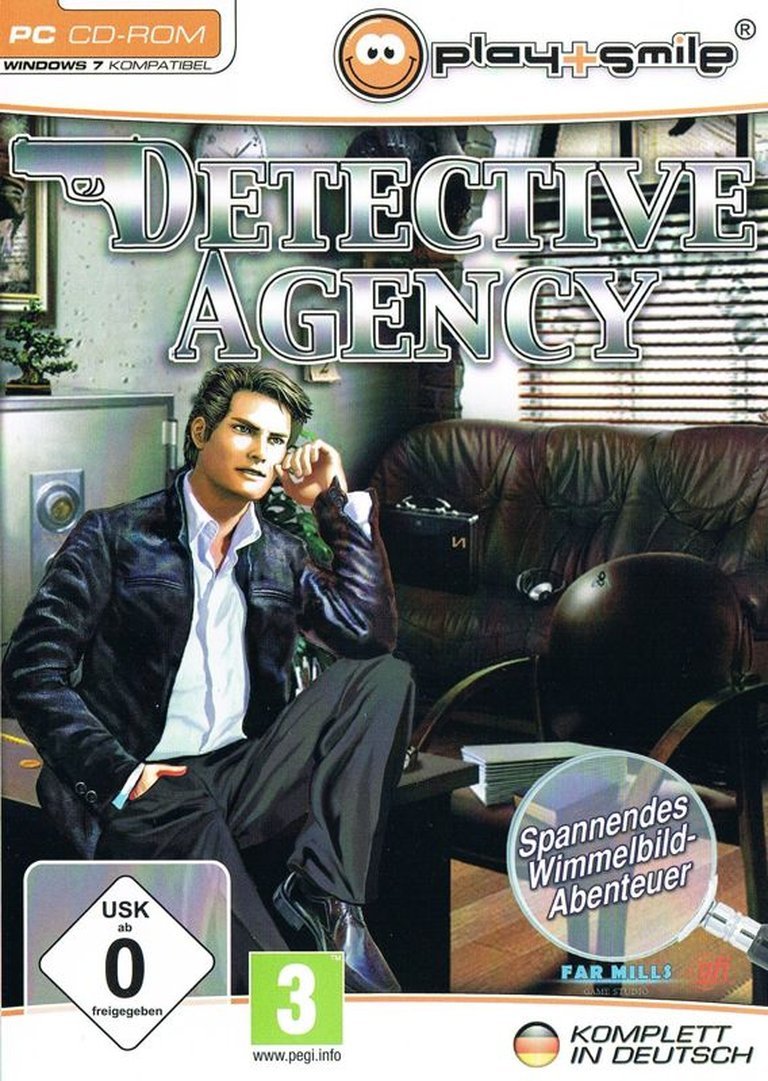
Description
In ‘Detective Agency 2: The Banker’s Wife’, detective James Casey is hired by wealthy banker Carter Burton to investigate the mysterious disappearance of his wife. This hidden-object adventure game builds on its predecessor with improved mechanics, including a dynamic inventory system, non-linear exploration, and refined puzzle-solving. Players traverse various rooms, collect clues, and interact with objects to uncover the truth behind the banker’s wife’s vanishing, all while enjoying updated dialogue portraits and a more flexible gameplay experience.
Gameplay Videos
Detective Agency 2: The Banker’s Wife Cracks & Fixes
Detective Agency 2: The Banker’s Wife Guides & Walkthroughs
Detective Agency 2: The Banker’s Wife Reviews & Reception
sockscap64.com (60/100): A must-play for fans of hidden object games and murder mysteries.
softpile.com : A thrilling hidden object game that keeps you on the edge of your seat from start to finish.
Detective Agency 2: The Banker’s Wife – A Comprehensive Retrospective
Introduction
In the annals of hidden object adventure games, Detective Agency 2: The Banker’s Wife stands as a curious artifact—a sequel that attempted to refine its predecessor’s formula while navigating the constraints of its era. Released in 2010 by Far Mills Game Studio and published by rondomedia Marketing & Vertriebs GmbH, this title emerged during the golden age of casual gaming, a time when hidden object games (HOGs) dominated digital storefronts like Big Fish Games and Steam. Yet, despite its ambitions, The Banker’s Wife remains a niche entry, overshadowed by more innovative contemporaries and forgotten by mainstream audiences.
This review seeks to dissect Detective Agency 2 with surgical precision, exploring its development context, narrative intricacies, gameplay mechanics, and artistic choices. By examining its reception and legacy, we aim to answer a fundamental question: Does The Banker’s Wife deserve its obscurity, or is it an underappreciated gem of the casual gaming boom?
Development History & Context
The Studio and Team
Far Mills Game Studio, the developer behind Detective Agency 2, was a modest outfit with a focus on casual and hidden object games. The team behind The Banker’s Wife consisted of just 12 individuals, a lean crew by modern standards but typical for the era. Key figures included:
– Producers: Sergey Podshivalin and Denis Spiridonov, who oversaw the project’s vision and execution.
– Project Manager: Alexander Sebov, responsible for coordinating the team’s efforts.
– Programmers: Mikhael Nikolaev and Dmitriy Chitanava, who built the game’s engine and mechanics.
– Artists: Tatyana Filimonova, Tatyana Ostroglyad, Elena Zorina, and Alexey Polyanik, who crafted the game’s visual style.
– Sound Designer: Sergei Dmitriev, who composed the game’s ambient soundtrack.
This small team was part of a broader ecosystem of casual game developers who thrived in the late 2000s and early 2010s, creating titles optimized for quick downloads and short play sessions.
Technological Constraints
The Banker’s Wife was developed for Windows PCs, with system requirements that reflected the era’s hardware limitations:
– OS: Windows XP/Vista/7/8/10
– CPU: 1 GHz (minimum)
– RAM: 1 GB (minimum)
– Graphics: 256 MB, DirectX 9
These specifications highlight the game’s design for accessibility, ensuring it could run on a wide range of machines, from older desktops to newer laptops. The game’s fixed/flip-screen perspective and first-person viewpoint were chosen to maximize performance while maintaining a sense of immersion.
The Gaming Landscape
The late 2000s and early 2010s were dominated by casual games, particularly hidden object adventures. Titles like Mystery Case Files, Agency of Anomalies, and Paranormal Agency set the standard for the genre, blending puzzle-solving with narrative-driven gameplay. Detective Agency 2 entered this crowded market with a sequel that promised refinements over its predecessor, Detective Agency (2009), which focused on a museum heist.
The original Detective Agency was a straightforward HOG with a linear structure, but The Banker’s Wife introduced several key changes:
– Dialogue System: Replaced comic-style cutscenes with character portraits over backgrounds, a shift that allowed for more dynamic storytelling.
– Hint System: Abandoned the metal-detector mechanic in favor of a silhouette-based hint system, which could pinpoint the exact location of hidden objects.
– Inventory System: Added an inventory mechanic, enabling players to collect and use items across different scenes, a feature that made the game less linear and more exploratory.
– Puzzle Integration: Puzzles were now accessible directly within scenes rather than being segregated into separate rooms, allowing for a more seamless experience.
These changes reflected the studio’s desire to evolve the formula while staying true to the core appeal of hidden object games.
Narrative & Thematic Deep Dive
Plot Overview
The Banker’s Wife follows Detective James Casey as he investigates the disappearance of Naira Burton, the wife of wealthy banker Carter Burton. The game begins with a phone call from Carter, who is desperate to find his missing spouse. James’s investigation takes him through a series of locations, from the banker’s mansion to a hotel, an antique shop, and a flower shop, each filled with hidden objects and puzzles that must be solved to uncover the truth.
The narrative unfolds through a combination of dialogue (delivered via character portraits) and environmental storytelling. As James gathers clues, he uncovers a web of secrets, including Naira’s past as Nancy Brock and her connections to various characters, such as her ex-husband Arthur Brock and the enigmatic Martin Low.
Characters and Dialogue
James Casey serves as the player’s avatar, a classic detective archetype with little in the way of personality or backstory. His interactions with other characters are functional rather than emotional, focusing on advancing the plot rather than developing relationships. Supporting characters, such as the maid at the banker’s house and the curator at the Liron Gallery, are similarly one-dimensional, existing primarily to provide clues or obstacles.
Dialogue is minimal and often exposition-heavy, with little room for subtlety or nuance. The game’s reliance on character portraits over full cutscenes limits its ability to convey emotion, resulting in a narrative that feels more like a checklist of tasks than a compelling mystery.
Themes and Motifs
At its core, The Banker’s Wife explores themes of deception, identity, and the search for truth. Naira’s disappearance is not just a physical absence but a metaphor for the hidden layers of her life, from her past as Nancy Brock to her relationships with Arthur and Martin. The game’s puzzles and hidden object scenes reinforce these themes, as players must sift through clutter to uncover the truth.
However, the game’s treatment of these themes is superficial. The narrative lacks the depth and complexity of more ambitious detective stories, such as L.A. Noire or Disco Elysium, which use their settings and characters to explore broader social and psychological issues. Instead, The Banker’s Wife remains firmly within the confines of its genre, offering a straightforward mystery with little room for interpretation.
Gameplay Mechanics & Systems
Core Gameplay Loop
The Banker’s Wife is a hidden object adventure game at its core, with gameplay centered around finding items in cluttered scenes and solving puzzles. The core loop is as follows:
1. Exploration: Players navigate through various locations, each filled with objects to find.
2. Hidden Object Scenes: Players search for items listed in their notebook, using hints if necessary.
3. Puzzle-Solving: Mini-games and logic puzzles are scattered throughout the scenes, requiring players to use their wits to progress.
4. Inventory Management: Collected items can be used to interact with the environment, unlocking new areas or revealing hidden clues.
This loop is repetitive but effective, providing a steady stream of challenges that keep players engaged. The game’s lack of a timer and autosave feature ensures a relaxed experience, ideal for casual players.
Combat and Progression
Unlike action-adventure games, The Banker’s Wife features no combat mechanics. Progression is entirely puzzle-based, with players advancing by solving hidden object scenes and mini-games. The game’s difficulty curve is gentle, with hints available to assist players who get stuck.
The inventory system is a notable addition, allowing players to carry items between scenes and use them to interact with the environment. This mechanic adds a layer of strategy, as players must decide which items to keep and which to use immediately.
UI and Controls
The game’s user interface is simple and functional, with a notebook for tracking hidden objects, a briefcase for inventory management, and a hint system for assistance. Controls are mouse-driven, with players clicking on objects to interact with them. The game’s fixed/flip-screen perspective ensures that navigation is straightforward, though it can feel restrictive compared to more modern titles with free-roaming cameras.
Innovations and Flaws
The Banker’s Wife introduces several innovations over its predecessor, including the inventory system and the revised hint system. However, these changes are incremental rather than revolutionary. The game’s biggest flaw is its lack of depth—both in terms of narrative and gameplay. The puzzles, while varied, are often too simple, and the hidden object scenes can feel repetitive after a few hours.
World-Building, Art & Sound
Setting and Atmosphere
The Banker’s Wife is set in a series of locations that evoke a sense of mystery and intrigue, from the opulent banker’s mansion to the dimly lit hotel and the cluttered antique shop. Each location is meticulously detailed, with objects scattered throughout to create a sense of realism. The game’s fixed/flip-screen perspective enhances this immersion, allowing players to focus on the details of each scene.
However, the game’s world-building is limited by its static nature. Unlike open-world games, The Banker’s Wife offers no opportunity for exploration beyond the predefined scenes. This lack of freedom can make the world feel small and confined, despite the game’s attempts to create a sense of scale.
Visual Direction
The game’s art style is colorful and detailed, with hand-painted scenes that are rich in texture and depth. The artists at Far Mills Game Studio have done an excellent job of creating environments that are both visually appealing and functional, with objects that are easy to identify and interact with. The character portraits, while simple, are expressive enough to convey the game’s narrative beats.
Sound Design
The game’s sound design is minimal but effective. The ambient soundtrack, composed by Sergei Dmitriev, provides a subtle backdrop to the gameplay, enhancing the game’s atmosphere without overwhelming the player. Sound effects, such as the click of a magnifying glass or the rustle of papers, are used sparingly but effectively, adding to the game’s immersive qualities.
Reception & Legacy
Critical and Commercial Reception
The Banker’s Wife received little critical attention upon its release, with no major reviews or awards to its name. The game’s MobyScore is listed as “n/a,” indicating a lack of formal critical evaluation. Player reception was similarly muted, with the game collecting only a handful of ratings on platforms like MobyGames and Steam.
Commercially, the game likely performed modestly, appealing to fans of hidden object games but failing to break out into the mainstream. Its $9.99 price point (later reduced to $2.49 on Steam) positioned it as a mid-tier casual title, competing with a flood of similar games on digital storefronts.
Evolution of Reputation
Over time, The Banker’s Wife has faded into obscurity, remembered primarily by fans of the genre and preserved in databases like MobyGames. Its legacy is that of a minor sequel, a footnote in the history of hidden object games rather than a landmark title.
Influence on Subsequent Games
The Banker’s Wife had little direct influence on the broader gaming industry. Its innovations, such as the inventory system and revised hint mechanics, were already being explored by other developers, and its narrative and gameplay were too conventional to inspire imitation. The game’s biggest impact was likely on its own sequel, Detective Agency 3: Ghost Painting (2013), which continued the series’ focus on hidden object puzzles and detective themes.
Conclusion
The Banker’s Wife is a competent but unremarkable entry in the hidden object adventure genre. Its strengths—detailed visuals, a functional inventory system, and a gentle difficulty curve—are outweighed by its weaknesses—repetitive gameplay, a thin narrative, and a lack of innovation. While it may appeal to fans of casual puzzles, it offers little to players seeking depth or challenge.
In the grand tapestry of video game history, The Banker’s Wife is a minor thread, a relic of an era when hidden object games dominated digital storefronts. It is neither a masterpiece nor a disaster, but a solid, if forgettable, example of its genre. For those who enjoy the thrill of the hunt, it provides a few hours of entertainment. For everyone else, it is a curiosity best left to the annals of gaming history.
Final Verdict: 6/10 – A competent but unremarkable hidden object adventure.