
- Release Year: 1996
- Platforms: DOS, Windows
- Publisher: ReadySoft Incorporated, Silmarils
- Developer: Silmarils
- Genre: Action, Simulation
- Perspective: 1st-person
- Game Mode: Single-player
- Gameplay: Business simulation, Managerial
- Setting: Futuristic, Sci-fi
- Average Score: 88/100
Description
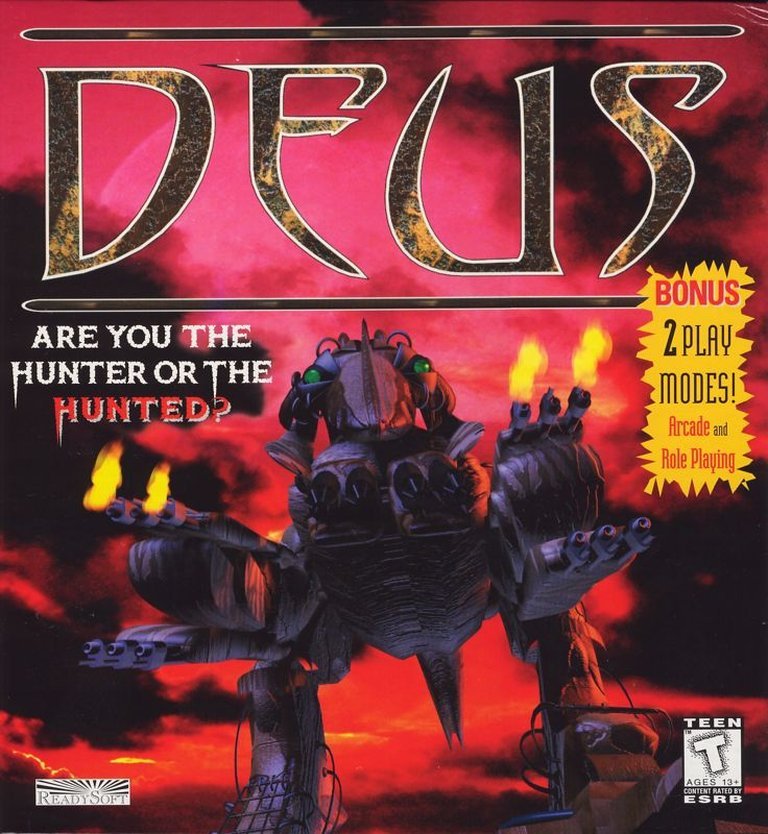
In the sci-fi survival game ‘Deus’, players assume the role of a bounty hunter employed by the Alien World Exploration (AWE) organization to eliminate the terrorist group New Crusaders in a futuristic universe. As an informal sequel to ‘Robinson’s Requiem’, the game combines first-person exploration with intense survival mechanics, challenging players to manage their character’s vital needs—such as avoiding hypothermia, infections, and starvation—across hostile alien environments. Featuring SVGA graphics and two gameplay modes (action-focused or deep simulation with 22 deadly survival challenges), ‘Deus’ offers a solitary, high-stakes mission through unforgiving extraterrestrial terrain.
Where to Buy Deus
Deus Free Download
Deus Guides & Walkthroughs
Deus Reviews & Reception
myabandonware.com (93/100): Finally fun to play doctor/survivalist/hunter in the best Robinson Crusoe tradition. Thumbs up!
Deus Cheats & Codes
PC
To activate Cheat Mode: Go to main panel, move cursor to upper left corner, press Alt+Ctrl+C simultaneously to freeze cursor.
| Code | Effect |
|---|---|
| 3615 | Activates Cheat Mode (enter on numeric keypad after Alt+Ctrl+C) |
| Ctrl+T | Gives all weapons and sets all parameters to maximum |
Deus: A Survival Sim Odyssey Lost in Time
Introduction: An Ambitious Experiment in Alien Survival
In the mid-90s, a period defined by the rise of fast-paced shooters like Doom and Quake, French developer Silmarils dared to ask: What if survival meant more than just shooting demons? Deus (1996), a pseudo-sequel to Robinson’s Requiem (1994), was their answer—a first-person survival simulator that forced players to micromanage every bodily function while combating extraterrestrial threats. Though criticized for its brutal difficulty and clunky design, Deus remains a fascinating artifact of early immersive sim aspirations, blending survivalism, sci-fi, and an unforgiving simulation ethos.
This review argues that Deus is less a “flawed gem” than a cautionary lesson in how ambition can outpace execution—yet its DNA persists in modern survival games like Green Hell and The Forest.
Development History & Context: Silmarils’ Risky Gamble
Studio Vision & Constraints
Silmarils, known for the cult Ishar RPG series, sought to push boundaries with Deus. Originally planned as Deus Ex Machina for the ill-fated Atari Jaguar CD in 1995, the project migrated to PC after Atari’s hardware collapsed. André Rocques, the project lead, infused Deus with the same survivalist rigor as Robinson’s Requiem but aimed for broader appeal by adding an “action mode” to counter criticisms of its predecessor’s inaccessibility.
Technological Landscape
Released in 1996, Deus arrived when SVGA graphics and 3D acceleration were nascent luxuries. Silmarils opted for a hybrid engine: polygonal character models layered atop pre-rendered backgrounds—a compromise that drew mixed reactions. While PC Gamer UK praised its “opulent” visuals, GameSpot lambasted its “clunky” execution compared to id Software’s industry-leading tech.
The Survival Sim Niche
Deus emerged alongside titles like System Shock (1994), which balanced action with systemic complexity. However, Silmarils leaned harder into simulation, prioritizing realism over fun—a risky bet in an era dominated by arcade-style shooters.
Narrative & Thematic Deep Dive: A Bounty Hunter’s Brutal Odyssey
Plot & Characters
Players assume the role of Officer Trepliev, a bounty hunter for the Alien World Exploration (AWE) organization, tasked with dismantling the New Crusaders—a terrorist group occupying a research station on planet Alcibiade. The narrative is sparse, delivered through environmental clues and minimal dialogue, but thematically, Deus explores humanity’s fragility in hostile environments.
Themes of Bodily Autonomy
Deus forces players to confront their avatar’s mortality via 22 possible deaths—hypothermia, infections, even self-inflicted wounds from botched surgeries. A German review noted you could “amputate limbs for fun,” highlighting the game’s darkly comedic potential. This systems-driven approach echoes later “body horror” sims like Pathologic, where survival is a puzzle in itself.
Dialogue & Immersion
Critics panned the stilted voice acting (especially in the German dub), but the lack of narrative handholding was ahead of its time. Players had to interpret symptoms like tremors or blurred vision—a precursor to Metal Gear Solid 3’s injury system.
Gameplay Mechanics & Systems: Survival at a Cost
Core Loop: Doctor, Hunter, Explorer
Deus offers two modes:
1. Simulation: Manage hunger, wounds, and infections while solving environmental puzzles.
2. Action: Streamline survival mechanics for combat-heavy gameplay.
Both modes suffer from unwieldy controls. As PC Zone quipped, “tying tourniquets feels like performing brain surgery with a sledgehammer.”
Combat & Progression
The arsenal—ranging from spears to rocket launchers—lacks weight, and enemies (blobs, robots) behave erratically. Yet critics acknowledged flashes of brilliance, like using anti-venom serum derived from slain creatures—a proto-Monster Hunter mechanic.
UI & Accessibility
Deus’ interface is a labyrinth. The inventory system, while detailed, drowns players in menus. Computer Gaming World’s critique—“DEUS’ realism comes at a price to gameplay”—summarizes its fatal flaw: prioritizing simulation over usability.
World-Building, Art & Sound: Alien Beauty Amid Jank
Visual Design
Silmarils’ art team, led by Eric Galand and Guillaume Maginot, crafted lush alien jungles and claustrophobic research stations. SVGA colors pop, but polygonal models—like blocky Yetis—betray technical limitations.
Atmosphere & Sound
Composer Fabrice Hautecloque’s ambient tracks oscillate between eerie synths and silence, amplifying isolation. However, PC Action criticized the “embarrassing” German voicework, which undermines immersion.
Contribution to Experience
The world feels hostile but cohesive—a precursor to Metroid Prime’s environmental storytelling. Players believe Alcibiade is a place where survival is earned, not given.
Reception & Legacy: A Divisive Experiment
Launch Reception
Deus polarized critics. PC Gamer UK (72%) praised its depth, while Game Revolution (25%) called it “horrible.” The MobyScore of 5.9/10 reflects its bifurcated appeal—admired for ambition, despised for execution.
Post-Release Evolution
Though commercially DOA, Deus found niche appreciation. Retrospective reviews, like MyAbandonware’s, highlight its influence on survival sims, while modders have attempted to fix its UI issues.
Industry Influence
Deus’ systemic approach to bodily management reemerged in DayZ, RimWorld, and even Project Zomboid. Its DNA is undeniable, even if its name is forgotten.
Conclusion: A Proto-Immersive Sim Worth Studying
Deus is not a “good” game by modern standards. Its clunky controls, punishing difficulty, and poor accessibility make it a relic best experienced through historical lenses. Yet, as Rock Paper Shotgun once wrote of Robinson’s Requiem, “It’s the worst game I love.”
For historians, Deus is a testament to 90s experimentation—a bold, flawed swing at blending survivalism with sci-fi. For players? Perhaps a curiosity best left to masochists and archivists. But in its uncompromising vision, Deus carved a path for games that dare to ask: What if surviving was the real fight?
Final Verdict:
A fascinating failure—more influential as a concept than a game, but essential for understanding the evolution of survival sims.
This review synthesizes material from MobyGames, Wikipedia, MyAbandonware, and contemporary critiques.