
- Release Year: 2016
- Platforms: PlayStation 4, Windows, Xbox One
- Publisher: Square Enix, Inc., Square Enix Limited
- Genre: Special edition
Description
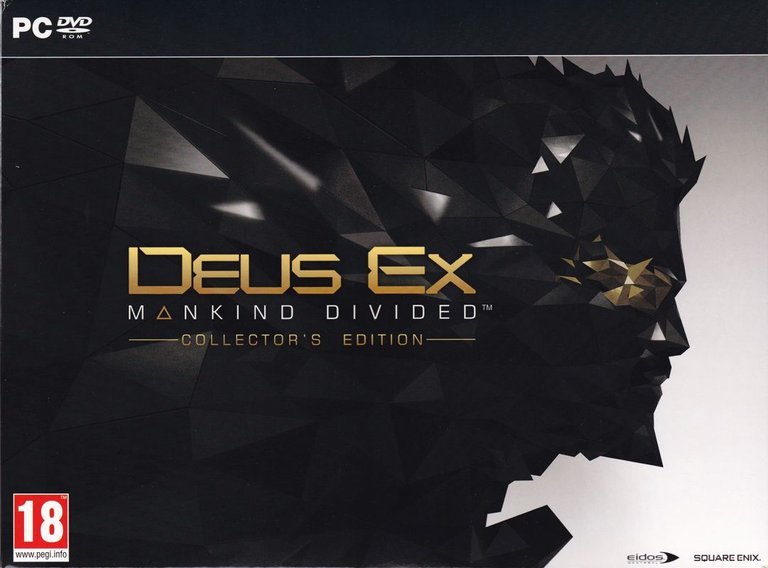
Deus Ex: Mankind Divided (Collector’s Edition) is a 2016 cyberpunk action RPG set in a fractured 2029, two years after the Aug Incident, where society enforces ‘mechanical apartheid’ against augmented humans. Players control Adam Jensen, a covert agent with advanced cybernetics, as he uncovers Illuminati conspiracies while navigating choices that affect the narrative, blending first-person shooter, stealth, and role-playing elements. This special edition packages the base game with physical extras including a steelbook case, a 9-inch Adam Jensen figurine, and a 48-page artbook.
Deus Ex: Mankind Divided (Collector’s Edition) Patches & Updates
Deus Ex: Mankind Divided (Collector’s Edition) Mods
Deus Ex: Mankind Divided (Collector’s Edition) Guides & Walkthroughs
Deus Ex: Mankind Divided (Collector’s Edition) Reviews & Reception
ign.com : this is the best the series has ever been.
nerdsonearth.com : a truly engaging and well-constructed plotline
blogofgames.com : one of the best cyberpunk video games available right now.
Deus Ex: Mankind Divided (Collector’s Edition): A Masterpiece of Player Agency in a Divided World
Introduction: The Weight of a Golden Arm
To hold the Deus Ex: Mankind Divided (Collector’s Edition) box is to hold a tangible piece of cyberpunk history. It is a artifact from a franchise that has always grappled with the profound question: What does it mean to be human in a world of mechanical augmentation? Released in 2016 as the direct sequel to the lauded Deus Ex: Human Revolution, Mankind Divided arrived carrying the immense weight of expectation. It sought to refine a beloved formula, deepen its philosophical inquiries, and navigate a cultural landscape increasingly sensitized to its themes of segregation, discrimination, and state surveillance. This Collector’s Edition, with its 9-inch Adam Jensen figurine, 48-page artbook, and prism-box packaging, is more than a sum of physical trinkets; it is a ceremonial vessel for a game that is simultaneously a triumphant evolution of the immersive sim and a poignant, if flawed, narrative about a world utterly fractured. My thesis is this: Deus Ex: Mankind Divided stands as one of the most mechanically sophisticated and thematically resonate action RPGs of its generation, a game whose unparalleled commitment to player choice and systemic depth is occasionally undermined by a narrative that promises a grand conspiracy but delivers a compelling, yet truncated, chapter in a larger, now-cancelled, saga.
Development History & Context: Forging a New Dawn
The game’s development began not with a blank slate, but with a mandate. Following the critical and commercial success of Deus Ex: Human Revolution (2011), developed by Eidos-Montréal, the studio was tasked with building a worthy sequel. Initially, plans had reportedly considered Obsidian Entertainment for the project, but Eidos-Montréal retained the helm, beginning full production in 2011 after completing the Human Revolution expansion, The Missing Link. The development cycle was lengthy—five years—explained by a combination of building a new technological foundation from the ground up and the narrative’s intricate design.
The studio consciously moved away from the Glacier 2 engine (used in Hitman: Absolution) that powered Human Revolution. Instead, they used it as a base to create the proprietary Dawn Engine. This was a statement of next-generation ambition. The team prioritized physically-based rendering, advanced lighting systems, and the capacity to render massive, detailed environments teeming with interactivity. A key technical achievement was the robust “entity system,” inherited from Glacier 2, which allowed designers to quickly create complex AI behaviors, making the world feel alive and reactive. The scale was a challenge; creating interiors with realistic proportions that fit within larger city blocks required clever programming tricks to maintain the illusion of a cohesive, explorable Prague.
The creative vision was clear: refine, expand, and mature. Writer Mary DeMarle and director Jean-François Dugas aimed to address criticisms of Human Revolution—stiff combat, simplistic boss fights, and a sometimes cartoonish aesthetic. The narrative would move from the “cyber-Renaissance” gold-and-black palette to a subdued, realistic blue-and-gray spectrum, reflecting the story’s darker themes of societal regression and “mechanical apartheid.” This was a bold, almost confrontational, artistic choice that visually communicated the game’s central conflict before a single word was spoken.
Narrative & Thematic Deep Dive: The Price of Progress
Set in the autumn of 2029, two years after the cataclysmic “Aug Incident” that concluded Human Revolution, the world is reeling. The neuropozyne-dependent augmented are now pariahs, herded into ghettos like Prague’s Golem City (a Kafkaesque nod to the mythical golem, inspired by Kowloon Walled City) and stripped of rights. The game’s central, incendiary concept—“mechanical apartheid”—is not mere window dressing but the engine of its plot and a direct commentary on real-world segregation and fear-mongering.
Adam Jensen, our protagonist, is no longer a reactive security chief but a proactive double agent. Secretly working for the hacktivist Juggernaut Collective (led by the unseen Janus) while officially serving in Interpol’s Task Force 29 (TF29), his mission is to expose the shadowy Illuminati. The plot is a tightly-wound investigative thriller. It begins with a terrorist bombing in Prague’s Růžička Station, frames the militant Augmented Rights Coalition (ARC), and sends Jensen on a globetrotting investigation from Dubai to the Swiss Alps to London. The core antagonist becomes Viktor Marchenko, a radicalized ARC member orchestrated by Illuminati operatives within TF29, like director Joseph Manderley, and VersaLife CEO Bob Page.
The narrative’s strength lies in its environmental storytelling and side quests. A random email, a overheard conversation, or a struggling vendor in Golem City can unravel a multi-part saga about corruption, survival, or personal tragedy. These side missions are not filler; they are integral to understanding the human cost of the Aug Incident and the systemic oppression. Main quest choices have tangible consequences—saving a CEO can block draconian legislation, failing can ensure its passage. Most notably, every boss fight can be circumvented through dialogue or pacifist means, a direct refutation of Human Revolution‘s outsourced, mandatory combat encounters.
However, the plot is famously truncated. What DeMarle has described as the game’s “midpoint”—the confrontation with Marchenko and the events in London—feels like a climax that should have been an act two turning point. The true mastermind, the Illuminati’s Lucius DeBeers, is a distant presence. The promised journey to the segregated arcology of Rabi’ah never materializes. Post-credits scenes reveal Jensen is being used by the Illuminati to find Janus, a stunning twist that raises more questions than it answers. This is not a complete story but the first, brilliant, deeply satisfying movement of a symphony we will never hear in full. The DLCs (“Jensen’s Stories”—Desperate Measures, System Rift, A Criminal Past) add vital context and character depth, but cannot fully complete the narrative arc envisioned by the writers, who had planned for Jensen’s actions to eventually trigger the events of the original Deus Ex.
Gameplay Mechanics & Systems: The Art of the Possible
If the narrative is a compromise, the gameplay is an unalloyed triumph. Mankind Divided perfected the “Deus Ex” loop: Explore → Acquire Information/Resources → Upgrade → Approach Challenge → Conquer (or circumvent) with a myriad of tools → Reap Rewards → Repeat.
-
Player Agency & Systemic Design: This is the game’s crown jewel. Every environment, from the sprawling, multi-layered hub of Prague to the tightly scripted missions, is a veritable playground of possibilities. Need to get past a laser grid? Hack the terminal, find the override code on a guard, craft a multitool, use a remote hack augmentation, find a ventilation shaft, or simply shoot the turret controlling it. The cover system is vastly improved, allowing seamless, fluid movement between cover points and mantling. The Icarus Dash augmentation is transformative, enabling not just rapid escapes but creative vertical traversal, turning ceilings into pathways and gaps into trivialities.
-
Augmentation & Progression: The Praxis Kit system returns, refined. New, powerful experimental augmentations like the Titan Armor (a temporary, energy-draining shield), TESLA (a ranged, non-lethal takedown dart system), and the Nanoblade (a silent, armor-piercing projectile) give Jensen a formidable toolkit. However, they are balanced by a revised energy system—a single, slowly regenerating bar where using high-cost augs temporarily lowers your max regeneration, requiring strategic use of Biocells to reset. This prevents power fantasy from trivializing challenge. Customization extends to weapon mods that can be swapped on the fly, allowing a battle rifle to pivot from a loud, fully-auto weapon to a silenced sniper in seconds.
-
Hacking & Social Engineering: Hacking bifurcates into static device hacking (the classic node-cap minigame) and dynamic device hacking (a timed, graph-based minigame for lasers, robots, etc.). The “Social” augmentation returns, reading NPC psychology to unlock better dialogue options. Crucially, as noted in the source material, most boss encounters are navigable through dialogue or non-lethal means, a monumental design shift that honors the series’ ethos of choice.
-
Breach Mode: A brilliant, separate asynchronous multiplayer-adjacent mode. Set in the stylized Neural SubNet, it’s a fast-paced, score-attack challenge where players infiltrate corporate “Blades” (data vaults). It uses analogous but unique augments and has a distinct polygonal aesthetic. Its leaderboards and rewards for completion provided a compelling, bite-sized complement to the main campaign. Its later release as a free standalone title, Deus Ex: Breach, was a smart move that extended the game’s lifecycle.
-
Flaws: The AI, while upgraded with separate systems for stealth and combat, can still be erratic. Some new augmentations feel situational. The microtransactions, sold as “credit packs” and “gear packs,” were seen as cynical insertions into a premium-priced single-player game, a major sore point for many critics and players.
World-Building, Art & Sound: A Beautiful, Oppressive Dystopia
The Dawn Engine delivered on its promise. Prague is a star. It is not a neon-drenched caricature but a lived-in, decaying metropolis where Baroque architecture is scarred by modern surveillance states and augmented ghettos. The color grading—dominated by cold blues, grays, and concrete—is a radical and effective departure from Human Revolution‘s warm golds. This is a world that has lost its shine, and the art direction makes you feel that in your bones. Golem City is a masterpiece of vertical, claustrophobic design, echoing its Kowloon inspirations. Other locales, like the sterile Palisade Bank or the icy G.A.R.M. facility, are equally memorable.
The costume design, a collaboration with fashion house Acronym, is legendary. Jensen’s new trench coat is not just cosmetic; its design incorporates practical fastenings and alterations that visibly accommodate his augmentations (like the arm-mounted P.E.P.S.). This fusion of high-fashion and functional cyberpunk extended to NPCs, making the world feel coherent and eerily plausible.
Sound design is superlative. Michael McCann returned, his atmospheric, synth-driven score now tinged with greater melancholy and tension. Sascha Dikiciyan (known for Borderlands) added aggressive, electronic combat cues, creating a dynamic audio landscape that shifts from ambient dread to pulse-pounding action. The sound of Jensen’s augmentations—the hum of the Icarus Dash, the thwip of the TESLA, the clang of the Nanoblade—is visceral and satisfying.
Reception & Legacy: Critical Acclaim, Commercial Fog, and a Series on Ice
Deus Ex: Mankind Divided received “generally favorable” reviews, with Metacritic scores in the mid-80s across all platforms. Critics universally praised its gameplay depth, level design, and world-building. IGN’s 9.2 hailed it as the peak of the series, lauding the harmonious relationship between mechanics and environments. PC Gamer called it “a great immersive sim with some of the best level design.” The Breach mode was also a surprise hit.
However, consistent criticisms emerged:
1. Narrative Scope vs. Execution: Many felt the main story was too short and narrowly focused, failing to deliver on the vast conspiracy it alluded to. The ending, in particular, was seen as a cliffhanger for a sequel that might never come.
2. Thematic Handling: Pre-release controversies over the marketing terms “mechanical apartheid” and “Augs Lives Matter” led to a heightened sensitivity. Some critics argued the game itself didn’t explore the depths of its racial allegory, instead using it as a backdrop for a standard conspiracy thriller.
3. Microtransactions & Marketing: The infamous, player-backlash-cancelled tiered pre-order campaign and the inclusion of microtransactions in a full-priced game left a bitter taste, overshadowing some of the game’s achievements.
Commercially, it performed solidly but not spectacularly. It topped UK charts but had a weaker debut than Human Revolution, attributed to the smaller install base of current-gen consoles at the time. Square Enix cited it as a factor in their profit increase for 2016, but persistent rumors suggested it underperformed against expectations. By May 2022, the Human Revolution/Mankind Divided bundle had sold 12 million units, a respectable figure but perhaps not the blockbuster hit for a major AAA franchise.
Its legacy is complex and poignant:
* Gameplay Legacy: It set a new standard for player choice and systemic level design in action RPGs. Its approach to non-lethal play, hacking, and multi-path solutions remains a benchmark. It demonstrated that a sequel could deeply refine rather than merely iterate.
* Narrative Legacy: Its story is a cautionary tale about incomplete storytelling in the age of the “games as a service” model. The planned trilogy was scuttled. In 2024, Embracer Group (which had purchased Eidos-Montréal in 2022) officially cancelled the in-development sequel, shattering hopes for a conclusion to Jensen’s arc or the journey to Rabi’ah.
* Cultural Legacy: It forced a conversation about how games handle real-world analogues of oppression. Its world remains one of the most detailed and believable cyberpunk dystopias in the medium.
Conclusion: A Flawed, Essential Artifact
The Deus Ex: Mankind Divided (Collector’s Edition) is not just a game; it is a time capsule. Its physical components—the stark figurine, the dense artbook filled with designs that marry fashion and function, the prism-box—are artifacts from a moment when a major studio believed in creating a dense, morally complex, mechanically deep experience for a dedicated audience. Inside that box lies a game that succeeds more often than it fails.
It provides the most satisfying, empowering, and thoughtful first-person stealth/action experience of the 2010s. Its environments are puzzles box after puzzle box, begging to be dismantled with a combination of gadgets, brains, and brute force. Its themes of division, identity, and state power are woven into the very fabric of its world.
But it is also a game that clearly had its heart cut out. The narrative stops just as the true conspiracy begins to coalesce. We are left with a fantastic first act, brilliant character work, and a world brimming with implicit stories, but without the epic confrontation the Illuminati’s shadow promised. The cancellation of its sequel turns this from a minor flaw into a fundamental tragedy.
In video game history, Mankind Divided must be remembered for two things: first, as the Zen-like peak of immersive sim design in the action-RPG space, a game that truly lets you be the cyberpunk agent you imagine. Second, as a stark lesson in narrative ambition colliding with commercial reality. It is the best “Part 1” ever made, a game so rich and complete in its moment-to-moment gameplay that its unresolved story becomes less a failing and more a haunting, open wound in the franchise—a testament to a world, and a series, forever divided between what was and what could have been. For fans and historians, it is an essential, bittersweet masterpiece.