
- Release Year: 2012
- Platforms: Nintendo Switch, PlayStation 3, PlayStation 4, Windows, Xbox 360, Xbox One
- Publisher: Capcom Co., Ltd.
- Developer: Capcom Co., Ltd., Pipeworks Software
- Genre: Compilation
- Perspective: Third-person
- Game Mode: Single-player
- Gameplay: Action, Combat, High-difficulty, Stylish combat
- Average Score: 69/100
Description
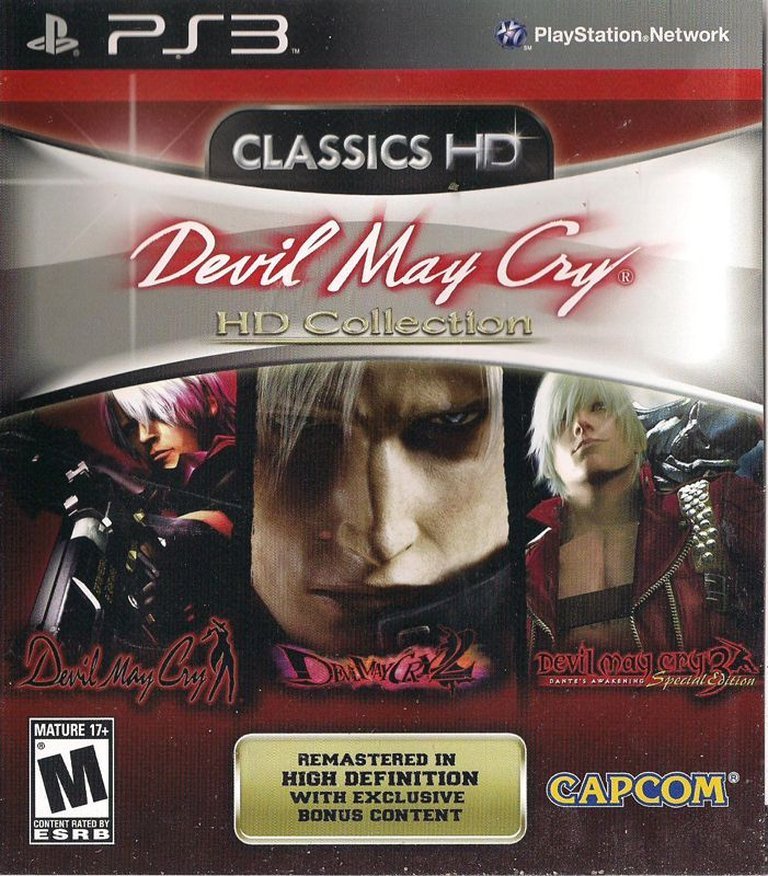
Devil May Cry: HD Collection is a remastered compilation of the first three games in the fast-paced, stylish action-horror series. Players dive into gothic, supernatural worlds as demon hunter Dante and his companions, battling hordes of demons with flashy combat mechanics. This bundle includes Devil May Cry, Devil May Cry 2, and Devil May Cry 3: Dante’s Awakening – Special Edition, all enhanced with high-definition graphics and trophies/achievements for modern platforms.
Gameplay Videos
Where to Buy Devil May Cry: HD Collection
PC
Devil May Cry: HD Collection Free Download
Devil May Cry: HD Collection Patches & Updates
Devil May Cry: HD Collection Mods
Devil May Cry: HD Collection Reviews & Reception
metacritic.com (77/100): A great HD adaptation which keeps the gameplay intact.
ign.com : The collection delivers all the great content of the originals, but it feels aged by the frustrating camera and lack of consistency in their HD upgrades.
Devil May Cry: HD Collection Cheats & Codes
PlayStation
| Code | Effect |
|---|---|
| L3, R3, L1, R1, L2, R2, L3, R3 | Unlocks Level Select mode when entered on the title screen. |
| HOLD L3, R3, L1, R2 until a sound plays | Unlocks Trish character. |
| L1+L2+R1+R2 while selecting mission, if DMD or LMD is cleared | Grants Infinite Devil Trigger when used during mission selection, if DMD or LMD is cleared. |
| Hold R1 + R2 + L1 + L2 + D-pad Up/Left + Left Analog-stick Down/Right | Unlocks all content when entered at the title screen, but disables achievements and saving/loading until the game is reset. |
Xbox
| Code | Effect |
|---|---|
| LS, RS, LB, RB, LT, RT, LS, RS | Unlocks Level Select mode when entered on the title screen. |
| Hold LS, RS, LB, RT until a sound plays | Unlocks Trish character. |
| LB+LT+RB+RT while selecting mission, if DMD or LMD is cleared | Grants Infinite Devil Trigger when used during mission selection, if DMD or LMD is cleared. |
| Hold RB + RT + LB + LT + D-pad Up/Left + Left Analog-stick Down/Right | Unlocks all content when entered at the title screen, but disables achievements and saving/loading until the game is reset. |
Devil May Cry: HD Collection: Review
Introduction: Aarchival Triumph for a Flawed Trinity
To understand the Devil May Cry: HD Collection is to understand a pivotal, chaotic, and foundational moment in action game history. Released in 2012 for PlayStation 3 and Xbox 360—and later for modern platforms—this compilation is not merely a repackaging of three PlayStation 2 classics; it is a curated time capsule, a digital preservation effort for a franchise that defined an entire genre. The collection bundles the seminal Devil May Cry (2001), its controversial sequel Devil May Cry 2 (2003), and the universally lauded prequel Devil May Cry 3: Dante’s Awakening – Special Edition (2006). Its thesis is twofold: to introduce a new generation to the high-octane, style-obsessed combat that birthed the “character action” subgenre, and to provide a definitive, accessible archive for veterans. However, this noble goal is complicated by the stark qualitative disparities between the three titles and a remastering process that is technically competent but visually unambitious. The HD Collection succeeds not as a reimagining, but as a faithful, if occasionally dated, portal into the evolution of one of gaming’s most influential heroes.
Development History & Context: From Resident Evil 4 Prototype to Genre-Defining Franchise
The saga of Devil May Cry began not as its own entity, but as a discarded path for Resident Evil 4. Directed by Hideki Kamiya and developed by Capcom Production Studio 4’s Team Little Devils, the project initially aimed to reinvent survival horror for the PlayStation 2. Kamiya, feeling the prototype strayed too far from Resident Evil‘s slow-burn tension—emphasizing acrobatic, stylish combat over resource management—was given permission by producer Shinji Mikami to spin it into a new franchise. The team’s trip to Europe to photograph gothic architecture for textures directly fed the first game’s aesthetic. A pivotal moment came from a bug in Onimusha: Warlords that allowed players to keep enemies airborne with repeated slashes; this inspired the core “juggling” mechanic that became the series’ stylistic heartbeat.
The first game’s critical and commercial success ($38 million in US sales by 2006, over 3 million copies sold) cemented its place. However, its sequel’s development was fraught. An unidentified director was replaced late in the cycle by Hideaki Itsuno, who was given only 4-5 months to salvage the project. Devil May Cry 2 (2003) reflected a design philosophy of “bigger is better,” with environments reportedly nine times larger than the original. This, combined with a muted, overly mature Dante and convoluted level design, resulted in the series’ most divisive entry. Itsuno returned to steer the ship for Devil May Cry 3: Dante’s Awakening (2005), intentionally scaling back scope and refocusing on tight, rewarding combat. The Special Edition (2006) added Vergil as a playable character and refined difficulty.
The HD Collection itself was a collaboration between Capcom and external studios Pipeworks Software and Double Helix Games. Released in 2012, its primary technical goals were upscaling the resolution to 720p on PS3/Xbox 360 (and 1080p/4K on later ports) and locking the frame rate at a stable 60fps. It notably included trophy/achievement support but, as many critics observed, offered little in the way of extras or substantial graphical overhaul beyond texture filtering. Its timing was significant, coming on the heels of the divisive DmC: Devil May Cry reboot announcement (2013) and serving as a bridge to Capcom’s renewed focus on the classic timeline with Devil May Cry 5 (2019).
Narrative & Thematic Deep Dive: A Triptych of Demonic Angst
The collection presents a trilogy of stories exploring themes of legacy, brotherhood, identity, and the nature of humanity, all framed by the poetry of Dante Alighieri’s Divine Comedy.
Devil May Cry (2001): The foundational myth. We meet Dante, a charismatic, pizza-loving demon hunter operating from a rundown shop, motivated by the childhood murder of his mother Eva and twin brother Vergil by the demon emperor Mundus. The narrative is a classic hero’s journey with a gothic horror veneer. Key plot points involve Dante’s alliance with the enigmatic Trish (a demon created in his mother’s image), his repeated battles with the mysterious armored knight Nelo Angelo (revealed to be the brainwashed Vergil), and the ultimate sacrifice of Trish that awakens Dante’s full demonic power. The story culminates in a dimensional battle where Dante defeats Mundus, banishing him anew. The thematic core is legacy and redemption: Dante embraces his heritage as Sparda’s son, and Trish’s tear—proving “devils may cry”—humanizes him. The shop’s final name, “Devil Never Cry,” symbolizes this evolved perspective.
Devil May Cry 2 (2003): The narrative outlier. Set after the first game, a more subdued, laconic Dante travels to the tropical island of Dumary. He meets Lucia, a protector of the matriarch Matier, who seeks to stop businessman Arius from resurrecting the demon Argosax. Thematically, it explores creation versus destiny and choice. Lucia’s crisis—learning she is an artificial creation of Arius—contrasts with Dante’s philosophy: “Devils never cry,” meaning emotional detachment, which he later refines. Dante’s decision to enter the demon world alone, leaving his lucky coin with Lucia, is a moment of ambiguous altruism and possible foreshadowing of his future roles. The plot is criticized for being disconnected from the core brotherly conflict, introducing a self-contained threat with minimal long-term consequences. Its significance lies in introducing the “Bloody Palace” mode and solidifying Dante’s global demon-hunting reputation.
Devil May Cry 3: Dante’s Awakening (2006): The emotional and narrative pinnacle. A prequel, it depicts a young, brash, and financially struggling Dante, still operating from an unnamed shop. The plot is a tightly wound character drama. The manipulative human Arkham, posing as a friend, toys with both Dante and his cold, power-hungry brother Vergil, who seeks to open the demonic gate Temen-Ni-Gru using their mother’s twin amulets. The tower-climbing structure perfectly mirrors their ascending familial tension. The introduction of Lady (Mary Arkham) is crucial—her quest for vengeance against her father adds a grounded, human counterpoint to the demonic struggle. Her philosophical musing—”Maybe somewhere out there, even a devil may cry”—directly inspires the series’ title. The climax sees the brothers briefly allied against Arkham’s betrayal, followed by their inevitable, tragic duel. Vergil’s choice to remain in the demon world, seeking power, and Dante’s choice to protect the human world, now understanding his father’s sacrifice, defines their eternal dichotomy. The story is a masterclass in familial conflict and the corruption of ideals.
Gameplay Mechanics & Systems: The “Style” Alchemy
The HD Collection preserves the core, revolutionary combat systems that defined the series. The loop is mission-based: fight through enemy-strewn stages, solve light environmental puzzles, find secrets, and face bosses. Performance is graded D through S (and SS, SSS) based on time, orbs collected, style rank, items used, and damage taken.
- The Style System: This is the collection’s genius. An on-screen gauge tracks the “stylishness” of combat. Chains of varied, unbroken attacks (sword combos, gunfire, aerial maneuvers, dodges) increase the gauge from “Dull” to “Stylish.” Using the same move repeatedly stalls progression. This incentivizes creativity and mastery, turning every encounter into a dance. Taunting resets the “Dull” penalty and is a key strategic tool.
- Devil Trigger (DT): A transformative meter that, when activated, increases strength, defense, grants health regeneration, and unlocks weapon-specific special moves. Managing the DT gauge is a core resource mechanic.
- Weapon & Style Switching (DMC3): Devil May Cry 3: Special Edition perfected the system. Dante can switch between four distinct combat styles (Swordmaster, Gunslinger, Trickster, Royal Guard) via a dedicated button, and cycle through two equipped melee and two ranged weapons. This created an unprecedented depth of combo potential, making the player a one-man orchestra of violence.
- Character Progression: Red orbs, dropped by enemies and objects, are used to purchase new abilities and upgrades. In DMC3, style-specific experience points (earned by using a style) unlock advanced techniques without orb cost, a superior system that rewards focused practice.
- UI & Systems: The interface is clean, displaying the vital Style gauge, DT meter, health, and timer. The ranking system is brutally honest but fair. The collection includes the Special Edition content for DMC3, most notably playable Vergil, who uses a unique, faster, and more precise style with his Yamato katana.
Aging Challenges: The collection highlights the series’ historical flaws. The fixed, static camera angles (especially in DMC1) are notoriously frustrating, often obscuring action or causing misjudged jumps. Controls, while tight, lack the modern customization options players expect. Devil May Cry 2 suffers from a fundamentally weaker combat engine, with less responsive feel and a stripped-down style system that fails to incentivize creativity, making its levels feel like a slog rather than a showcase.
World-Building, Art & Sound: A Symphony of Contrasts
The three games present a stark evolution in aesthetic and atmosphere, separated by a mere five years.
- Devil May Cry (2001): The most gothic and atmospheric. Mallet Island is a decaying, rain-swept castle complex filled with gargoyles, stained glass, and imposing, dark architecture. The visual storytelling is strong, establishing a lonely, oppressive mood. The soundtrack, composed by Masami Ueda and Masato Kouda, is iconic, blending operatic choirs (“The Time Has Come”), hard rock, and ambient dread. The FMV sequences, while low-resolution even in the HD remaster, are stylish and memorable.
- Devil May Cry 2 (2003): A jarring shift to a contemporary, sun-drenched Mediterranean metropolis and a jungle-temple island. The color palette is brighter, the architecture mundane. This loss of the unique gothic-fantasy identity is a major contributor to the game’s sense of anonymity. The music, while still energetic, lacks the distinctiveness of the first game’s score.
- Devil May Cry 3: Dante’s Awakening (2006): A triumphant fusion. The towering, surreal Temen-Ni-Gru combines gothic spires with Dante’s Inferno-inspired imagery (the gluttony giant, the fiery river). The city of “Angels” (a stand-in for Los Angeles) beneath it provides a modern base. The art direction is more detailed and colorful, with Dante’s evolving wardrobe signaling his character growth. The soundtrack, again by Ueda and Kouda with contributions, is a masterpiece of mood—from the swaggering “Lock and Load” to the melancholic “Vergil Battle.” The character designs by Tsuchibayashi and Matsushita are legendary, defining the series’ iconic style.
The HD Remaster’s Technical Verdict: As critics consistently noted, the remaster is bare-bones. Textures are upscaled and filtered, aspect ratios corrected for widescreen, and the frame rate stabilized to 60fps. However, pre-rendered FMVs remain at their original, blocky resolution, creating a jarring contrast with the in-game HD visuals. There are no redone models, no significant texture replacements, and no new artistic direction. It is a clean, functional port, not a “from the ground up” remaster. This technical modesty is the collection’s most consistent point of critique.
Reception & Legacy: A Collection of Extremes
The HD Collection was released to generally favorable but notably divided reviews, mirroring the quality of its contents.
- Critical Reception: Aggregate scores vary by platform (Metacritic: PS3 74, Xbox 360 77, PS4/Xbox One ~60-71), reflecting the perception of the later ports as lazy re-releases of a 2012 port. Critics universally praised the inclusion of DMC1 and DMC3 as essential action game texts. Anime News Network’s perfect score hailed it as an “admirable archival purpose.” XboxAchievements/PlayStation Trophies called it “one of the better examples of HD remakes.” Conversely, the inclusion of Devil May Cry 2 was a severe detriment. Jeuxvideo.com (PlayStation 4) called it a “lazy remaster,” and Gameplay (Benelux) stated it “only highlights the series’ flaws.” Starburst Magazine summarized the divide: “Ultimately sharp, but… little to justify upgrading.”
- Commercial Performance: Capcom reported global sales of 1.1 million copies as of September 2018, a solid figure for a compilation of older titles.
- Legacy: The collection’s primary legacy is preservation and curation. It served as the definitive way to experience the classic trilogy before the individual titles received standalone, enhanced ports on Nintendo Switch (with DMC3 adding the Vergil gameplay from the start). It contextualized the series’ evolution for newcomers ahead of DmC and DMC5. More importantly, it solidified the reputations of the first and third games as genre-defining masterpieces and canonized the second as a fascinating misstep. The collection embodies the series’ own history: a revolutionary debut, a stumble, and a triumphant return to form. It is a historical document, warts and all.
Conclusion: A Necessary, Flawed Artifact
The Devil May Cry: HD Collection is an indispensable artifact for any serious student of action game design. It provides direct, playable access to the DNA of the “character action” genre—the exquisite combat juggling of DMC1, the ambitious failure of DMC2, and the bar-raising mastery of DMC3. Its technical presentation is a product of its time: a clean, stable, but uninspired upscale that does the minimum to make PS2 classics playable on HD displays. The lack of substantial bonus features, the unchanged FMVs, and the persistent camera issues of the original games are not papered over.
However, to judge it solely on modern remaster standards is to miss its point. As a curated package, it is a resounding success. It makes the extraordinary (DMC3, one of the greatest action games ever made) and the historically significant (DMC1, the genre’s progenitor) readily available. It also honestly presents the series’ low point (DMC2), allowing for a complete, unvarnished view of its development. For the uninitiated, it is a gateway to a legendary franchise. For veterans, it is a convenient, faithful archive. Its value lies not in re-invention, but in preservation—a testament to a time when Capcom’s Team Little Devils, fueled by a discarded Resident Evil prototype and a love for stylized excess, changed action gaming forever. The HD Collection is the imperfect, yet essential, museum exhibit for that revolution.