
- Release Year: 1997
- Platforms: Macintosh, PlayStation, Windows
- Publisher: Blizzard Entertainment Inc., Dice Multi Media Europe B.V., Electronic Arts, Inc., Empire Interactive Europe Ltd., Sierra On-Line, Inc., SourceNext Corporation
- Developer: Blizzard Entertainment Inc., Blizzard North
- Genre: Role-playing, RPG
- Perspective: Diagonal-down
- Game Mode: Co-op, Single-player
- Gameplay: Action RPG, Hack and Slash, Loot system, Quest system
- Setting: Fantasy
- Average Score: 100/100
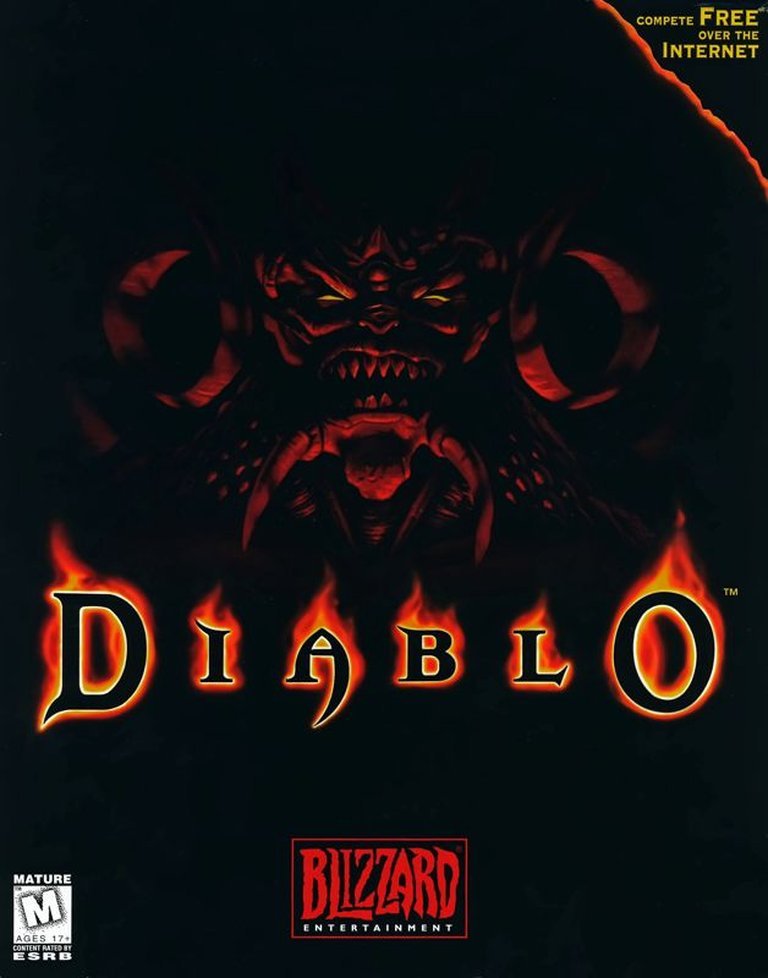
Description
Set in the dark fantasy realm of Sanctuary, Diablo centers on the town of Tristram, built over the weakening prison of the demon Diablo, the Lord of Terror. As his corruption spreads, adventurers explore shifting, isometric dungeons beneath a cursed chapel, battling hordes of monsters, collecting randomized loot, and choosing from distinct classes like Warrior, Rogue, or Sorcerer to stem the tide of evil in this seminal action RPG.
Gameplay Videos
Where to Buy Diablo
Diablo Cracks & Fixes
Diablo Patches & Updates
Diablo Mods
Diablo Guides & Walkthroughs
Diablo Reviews & Reception
metacritic.com (100/100): Diablo is a landmark game.
whoppersbunker.com : Diablo was simple and that was one of it’s greatest strengths.
Diablo Cheats & Codes
PlayStation 1
| Code | Effect |
|---|---|
| 800D9340 029B | Infinite Distribution Points |
| 800DABD0 FFFF | Infinite AC |
| 800D9332 00FF | Max Strength |
| 800D9336 00FF | Max Magic |
| 800D933A 00FF | Max Dexterity |
| 800D933E 00FF | Max Vitality |
| 800D9374 0064 | Max Damage |
| 300D9385 0064 | Max Magic Protection |
| 300D9386 0064 | Max Fire Protection |
| 300D9387 0064 | Max Lightning Protection |
| 800DAB94 0 | Weapon Picture Modifier |
| 800D937A 5FFF | Quick Level Up |
| 800D9354 FFFF | Infinite Life |
| 800D9356 0001 | Infinite Life |
| 800D9368 FFFF | Infinite Mana |
| 800D936A 0001 | Infinite Mana |
| 80070150 0000 | Infinite Gold |
| 800D9388 FFFF | Infinite Gold |
| 800D938A 02FF | Infinite Gold |
| 800D934E 0002 | Max Life |
| 800D9352 0002 | Max Life |
| 800D9362 0002 | Max Mana |
| 800D9366 0002 | Max Mana |
| 800D92F0 FFFF | Have All Spells |
| 800D92F2 FFFF | Have All Spells |
| 800D92F4 FFFF | Have All Spells |
| 800D92AA 0F0F | Active & Max Levels-All Spells |
| 800D92AC 0F0F | Active & Max Levels-All Spells |
| 800D92AE 0F0F | Active & Max Levels-All Spells |
| 800D92B0 0F0F | Active & Max Levels-All Spells |
| 800D92B2 0F0F | Active & Max Levels-All Spells |
| 800D92B4 0F0F | Active & Max Levels-All Spells |
| 800D92B6 0F0F | Active & Max Levels-All Spells |
| 800D92B8 0F0F | Active & Max Levels-All Spells |
| 800D92BA 0F0F | Active & Max Levels-All Spells |
| 800D92BC 0F0F | Active & Max Levels-All Spells |
| 800D92BE 0F0F | Active & Max Levels-All Spells |
| 800D92C0 0F0F | Active & Max Levels-All Spells |
| 800D92C6 0F0F | Active & Max Levels-All Spells |
| 800D92C8 0F0F | Active & Max Levels-All Spells |
| 800D92CA 0F0F | Active & Max Levels-All Spells |
| d00047ac 0000 | Infinite Gold |
| 8007014c 0000 | Infinite Gold |
| d00047ac 0000 | Quick Level Gain (Warrior) |
| 800d937a 5fff | Quick Level Gain (Warrior) |
| d00047ac 0000 | Quick Level Gain (Rouge) |
| 800d937a 4fff | Quick Level Gain (Rouge) |
| d00047ac 0000 | Quick Level Gain (Sorcerer) |
| 800d937a 3fff | Quick Level Gain (Sorcerer) |
Diablo: The Devil’s in the Details – A Foundational Masterpiece Re-Examined
Introduction: The Unlikely Revolution
In the pantheon of video game history, few titles have cast as long a shadow as Diablo. Released in January 1997 by a then-nascent Blizzard Entertainment (via its internal studio Condor, soon to be Blizzard North), it did not merely enter the crowded role-playing game (RPG) arena—it dynamited the very foundations of the genre and rebuilt them in its own dark, compelling image. At a time when computer RPGs were dominated by complex, stats-heavy, turn-based behemoths like Ultima and Baldur’s Gate, Diablo arrived with a terrifyingly simple proposition: what if an RPG played like a visceral, real-time action game, where the joy of discovery, the thrill of combat, and the siren song of loot were paramount? This review argues that Diablo’s genius lies not in groundbreaking originality of concept—its DNA is openly borrowed from Rogue, Nethack, and Gauntlet—but in its flawless, focused execution. It synthesized proven roguelike mechanics with revolutionary graphical presentation, an intuitive interface, and groundbreaking online multiplayer, creating an experience so potent it spawned an entire subgenre—the “action RPG” or “hack ‘n slash”—and established design principles that would echo for decades. It is a game of profound contradictions: repetitive yet endlessly compelling, shallow in narrative yet deep in systemic engagement, critically adored yet intuitively divisive among players. To understand Diablo is to understand a pivotal moment where game design consciously chose accessibility, atmosphere, and “fun” over the convoluted complexity that had come to define its medium.
Development History & Context: From ASCII to Apocalypse
The story of Diablo is a testament to visionary design overcoming industry skepticism and technical limitations. The game was birthed at Condor Games, a small studio founded by David Brevik and the Schaefer brothers (Erich and Max). Brevik, the lead programmer and primary architect, was deeply inspired by the procedural dungeons and permadeath of classic roguelikes like Angband and Nethack, but he saw their text-based interfaces as a barrier. His core thesis, as he later stated, was to achieve the “ease of gaming” found in sports titles like NHL ’94—to let players “just click and you’re in the game.” The initial pitch to publishers, as recalled by producer Bill Roper, was to “take the excitement and randomness of games like Moria, Nethack, and Rogue, and bring them into the 1990s with fantastic graphics and sound.”
Condor’s early vision was for a turn-based, claymation-style game. However, two pivotal interventions from Blizzard (then Silicon & Synapse, riding high on Warcraft: Orcs & Humans) reshaped it forever. First, Blizzard insisted on a real-time combat system, recognizing the energy and accessibility it provided. Brevik, initially resistant, famously prototyped the shift in a single weekend, proving it could be done. Second, Blizzard mandated multiplayer support, having seen the nascent potential of connected gaming with Warcraft. These two changes—real-time action and online co-op/PvP—are the twin pillars upon which the Diablo experience and its legacy rest.
Technologically, the game was a marvel of optimization. Running natively on Windows 95 and using DirectX 3 (with DX5 included on the CD), it delivered a stunning, fully 3D-rendered isometric world with dynamic lighting—torches that truly illuminated darkness, spell effects that painted the dungeons in fiery hues. This was achieved on hardware that would be considered primitive today. The team’s choice of a fixed, pseudo-3D isometric perspective (using pre-rendered 2D sprites for characters and enemies) was a pragmatic masterstroke, allowing for rich detail and fluid animation without the polygon constraints of true 3D engines like Quake. The procedural dungeon generation, a direct inheritance from Rogue, was a technical and design triumph, ensuring no two playthroughs were identical while maintaining coherent, atmospheric level themes (catacombs, caves, hell).
The development was fraught with financial peril. Condor was deeply in debt before being acquired by Davidson & Associates (Blizzard’s parent company) in early 1996, becoming Blizzard North. This acquisition saved the project and allowed the team to integrate with Blizzard’s J. Mike Moore-led art team, led by Samwise Didier, whose iconic, grim, and detailed aesthetic defined the game’s unforgettable look. The result was a product of intense passion, tight iteration, and business necessity, released at the absolute perfect moment: the PC market was hungry for immersive experiences, and dial-up internet (and Blizzard’s nascent Battle.net service) was beginning to connect players in meaningful ways.
Narrative & Thematic Deep Dive: Lore in the Light of a Torch
Diablo‘s narrative is a masterclass in environmental storytelling and economical exposition. The main plot is straightforward: a lone hero arrives in the blighted town of Tristram, descends into a hellish dungeon beneath a cursed cathedral, and must defeat the titular Lord of Terror, Diablo, who has been inadvertently freed. Yet, the genius is in the context. The game’s introductory cinematic, a silent, haunting sequence of Diablo’s soulstone being shattered and his essence possessing Prince Albrecht, sets a tone of inexorable dread. This is not a simple “kill the monster” story; it is a gothic tragedy of corruption and containment.
The thematic core is the “Sin War”—the eternal, manipulative conflict between the High Heavens and the Burning Hells, with humanity as the chessboard. The lore, delivered via item descriptions, NPC dialogue (primarily from the ever-present Deckard Cain), and the game manual, reveals a rich backstory: the Three Prime Evils (Diablo, Mephisto, Baal) were exiled to Sanctuary (the mortal realm), hunted down and imprisoned in Soulstones by the Horadrim, a group of powerful mages. Diablo’s prison was placed beneath a monastery that would become Tristram’s cathedral. Generations later, the Archbishop Lazarus, manipulated by Diablo, shattered the stone, and the Lord of Terror possessed King Leoric, driving the kingdom of Khanduras into a suicidal war. When Leoric’swill proved too strong, Diablo turned to his son, Albrecht, whose nightmares physically manifested as the dungeon’s monstrous inhabitants.
This background elevates the gameplay from mere monster-slaying to a holy mission of containment. The player is not just a mercenary; they are the last hope of the Horadrim’s millennia-long vigil. The final, infamous twist—where the hero must take Diablo’s soulstone into their own forehead to contain the demon—is a brilliantly dark subversion of the “hero’s journey.” It reframes victory as a Pyrrhic defeat, planting the seed for the entire sequel trilogy. The narrative is sparse in dialogue but dense in implication, a dark fable about the corrupting nature of power and the burden of sealing evil away. Tristram itself is a character: a town of shell-shocked survivors (Griswold the blacksmith, Wirt the trapped boy, Adria the witch), their few lines of dialogue painting a picture of despair and desperation that makes the dungeon’s horrors feel consequential.
Gameplay Mechanics & Systems: The Addictive Loop, Laid Bare
Diablo‘s gameplay is a perfectly calibrated engine of compulsion, built on a loop so simple it can be explained in 30 seconds but so deep it could occupy a lifetime. The cycle is: enter dungeon → kill monsters → collect loot → return to town → sell/buy → upgrade → descend again. This loop is enhanced by several revolutionary systems:
- Real-Time, Point-and-Click Combat: Abandoning turn-based grids for a Diablo-specific innovation: direct, real-time control via mouse. Left-click to move/attack (automatically targeting the nearest foe when stationary), right-click to cast a selected spell or use a designated item. This made combat immediate, physical, and accessible. It was “plug and play and kill,” as one review noted.
- Procedural Generation: The 16 levels (4 themed tiers: Cathedral, Catacombs, Caves, Hell) are randomly generated within thematic constraints. Room layouts, monster placements, and treasure locations are unique per game. This eliminated the ” memorization” fatigue of static dungeons and ensured constant novelty. Quest objectives and some quests themselves are also randomized, further extending replayability.
- The Loot System: This is the game’s beating heart. Equipment is categorized by color: white (normal), blue (magic), gold (unique), green (set items in later games). Magic items have randomized prefixes and suffixes (e.g., “Gnarled” + “Root,” “Burning” + “Plate Mail of Fire Resistance”), creating an almost infinite array of combinations. Unique items have predefined, powerful special properties. The constant pursuit of the next “better” item—a +1 sword, a ring with resistances, a unique helmet—is the primary dopamine driver. Item durability adds a tactile, logistical layer; warriors can repair in the field (degrading max durability), others must return to town.
- Character Progression: Three distinct classes with clear, class-defining stat caps (Warrior: high Strength/Vitality; Rogue: high Dexterity; Sorcerer: high Magic). Stats (Strength, Dexterity, Magic, Vitality) are increased with each level. Crucially, equipment has stat requirements, creating a tangible power curve. Spellbooks are consumed to learn spells; multiple copies level them up (to a max of 15). This system is simple yet profound: a Sorcerer’s high Magic cap allows for devastating high-level spells, but their weak physique forces kiting and mana management, while a Warrior must get close and personal, absorbing blows.
- Inventory & UI: A groundbreaking, grid-based inventory system that was both intuitive and brutally limiting. The iconic “Tetris-like” layout forced meaningful trade-offs. The “Quick-Slot” belt for potions was a genius design, keeping healing/utility always a click away. The UI is a masterclass in information density: health/mana orbs, a mini-map, a spell/action bar.
- Multiplayer (Battle.net): This was the seismic shock. Up to four players could adventure together over LAN, modem, or Blizzard’s free Battle.net service. Cooperative play amplified the tension and reward. But the system’s brilliance was its dark side: open, unregulated PvP. “Player Killers” (PKs) could betray and loot allies. “Duping” exploits and cheat programs (trainers) ran rampant, creating a chaotic, sociological meta-game. The line between cooperative dungeon crawl and treacherous free-for-all was paper-thin, a direct result of the game’s tight, loot-focused design.
The flaws, often cited by detractors, are inherently tied to its design purity: extreme linearity (only one town, one downward path), repetitive core combat, a lack of true role-playing (minimal NPC interaction, no branching quests), and famously poor pathfinding—characters get stuck on dungeon geometry, and the “click-to-move” system can feel imprecise during frantic fights. The save system (one saved game per character) was brutally unforgiving. But these were not oversights; they were trade-offs for the game’s blazing speed, accessibility, and singular focus on the loot-hunt.
World-Building, Art & Sound: The Symphony of Suffering
Diablo’s world is one of the most influential and imitated atmospheres in gaming. Tristram is not a bustling metropolis but a rain-swept, torch-lit nightmare refuge. The town’s murky, damp graphics, the constant ambient drip of water, and the eerie, guitar-driven score by Matt Uelmen create an immediate sense of oppressed melancholy. The soundtrack is legendary: the town theme is a beautiful, mournful melody, while dungeon music is minimalist, percussive, and dread-filled, using choral samples and dissonant strings to ratchet up tension.
The isometric visual design is perpetually studied. Every sprite, from the hulking, moaning Fallen to the sleek, skittering Succubi, is animated with a weight and menace that was extraordinary for 1997. Death animations are famously visceral—monsters don’t just vanish; they crumple, dissolve, explode, or are bisected. The lighting engine is the star: the player’s light radius is a core gameplay mechanic. Darkness is a tangible enemy; spells like “Fire Bolt” temporarily illuminate, and the “Torch” item is a precious commodity. You see the torchlight flicker on wet stone walls, you fear what lurks just beyond the glow. The color palette is depressingly liminal—muddy browns, blood reds, cold blues, and deep blacks—reinforcing the oppressive theme.
Sound design is equally impactful. The clang of steel on shield, the wet “thwack” of an arrow, the guttural growls and shrieks of the denizens of Hell, the chilling narration of Deckard Cain (voiced by the late, great Lani Minella) and the iconic, echoing “Fresh meat!” bellow of the Butcher—every audio cue is memorable and functional. The game feels dangerous because it sounds dangerous. This holistic audiovisual package didn’t just depict a dark dungeon; it made the player feel the claustrophobia, the paranoia, and the grim triumph of survival.
Reception & Legacy: The Benchmark and the Blueprint
Upon release, Diablo was met with near-universal critical acclaim. MobyGames records an average critic score of 88% across 71 reviews, with publications like Computer Gaming World (which awarded it 1997 Game of the Year and later inducted it into its Hall of Fame), GameSpot, and PC Gamer (which ranked it #3 in its All-Time Top 50) heaping praise. The accolades cited its “addictive” gameplay, “atmospheric” presentation, and “perfect” interface. The commercial success was immense, selling millions and becoming a flagship title for Battle.net.
Its legacy is immeasurable and multi-faceted:
1. Genre Genesis: It directly created the “Diablo-like” or “ARPG” genre. Its core loop of dungeon crawl, real-time combat, procedural loot, and class-based stats became a template. Games like Baldur’s Gate: Dark Alliance, Titan Quest, Torchlight, and Path of Exile are direct spiritual descendants.
2. Multiplayer Paradigm: It was arguably the first truly successful, accessible online co-op/PvP action game for the mainstream. It demonstrated the magnetic power of shared, emergent storytelling—the tales of treacherous PKs, lucky loot drops, and hard-fought boss kills became the community’s lifeblood. It paved the way for every online ARPG that followed.
3. The Loot Economy: Diablo normalized the concept of “randomized legendary drops” as a core reward loop, a mechanic that now underpins entire games (Borderlands) and major game modes in others.
4. The “Blizzard Polish”: It cemented Blizzard’s reputation for exceptionally polished, accessible, and deeply satisfying game feel. The “just one more level” compulsion became a hallmark of their design.
5. Cultural Impact: The game’s aesthetic—the dark gothic fantasy, the screaming demons, the cryptic lore—permeated pop culture. It inspired novels, comics, and a multi-billion dollar franchise spanning four mainline sequels (with Diablo IV released in 2023).
However, its reputation has nuanced over time. Purist CRPG fans still critique its lack of deep dialogue, branching narratives, or true role-playing choice. Modern players see its linearity and inventory limits as archaic. Yet, its core strengths—atmosphere, loot, and that sublime, simple combat—have aged remarkably well. The Diablo II engine and Diablo III‘s entire design are reactions to, and evolutions of, this first game’s formula.
Conclusion: The Eternal Flame of Tristram
To call Diablo perfect is to misunderstand its genius. It is not a flawless gem; it is a perfectly balanced ecosystem of trade-offs. Its linear path is the price for its relentless pace. Its shallow town is the price for its intense focus on the dungeon. Its simplistic stats are the price for its breathtaking immediacy. It is a game that knows exactly what it is—a power fantasy of destruction and acquisition—and executes that vision with almost ruthless precision.
Twenty-eight years after its release, as we stand in the shadow of Diablo IV and a bustling genre it invented, the original remains essential. It is a museum piece that is still playable, a textbook that is still fun. Its thesis—that an RPG could be about doing rather than talking, about visceral feedback rather than statistical abstraction—was revolutionary. It democratized a complex genre, making the thrill of the loot drop and the satisfaction of a perfectly timed spell accessible to anyone with a mouse and an internet connection. It is flawed, repetitive, and often simplistic. And it is utterly, timelessly, diabolically addictive. Diablo is not just a great game; it is the foundational text for a way of thinking about player engagement, a dark, compelling, and enduring spell cast on the industry that shows no sign of fading. Its soulstone may have been driven into the hero’s brow, but its essence—the insatiable hunt for the next better sword—lives on in countless games and in the hearts of millions who have heard its call and descended, again and again, into thedarkness below Tristram.