
- Release Year: 2005
- Platforms: Macintosh, Windows
- Publisher: Kutoka Interactive Inc
- Developer: Kutoka Interactive Inc
- Genre: Adventure, Educational
- Perspective: 3rd-person (Other)
- Game Mode: Single-player
- Gameplay: Mini-games, Puzzle
- Setting: Countryside, Valley
Description
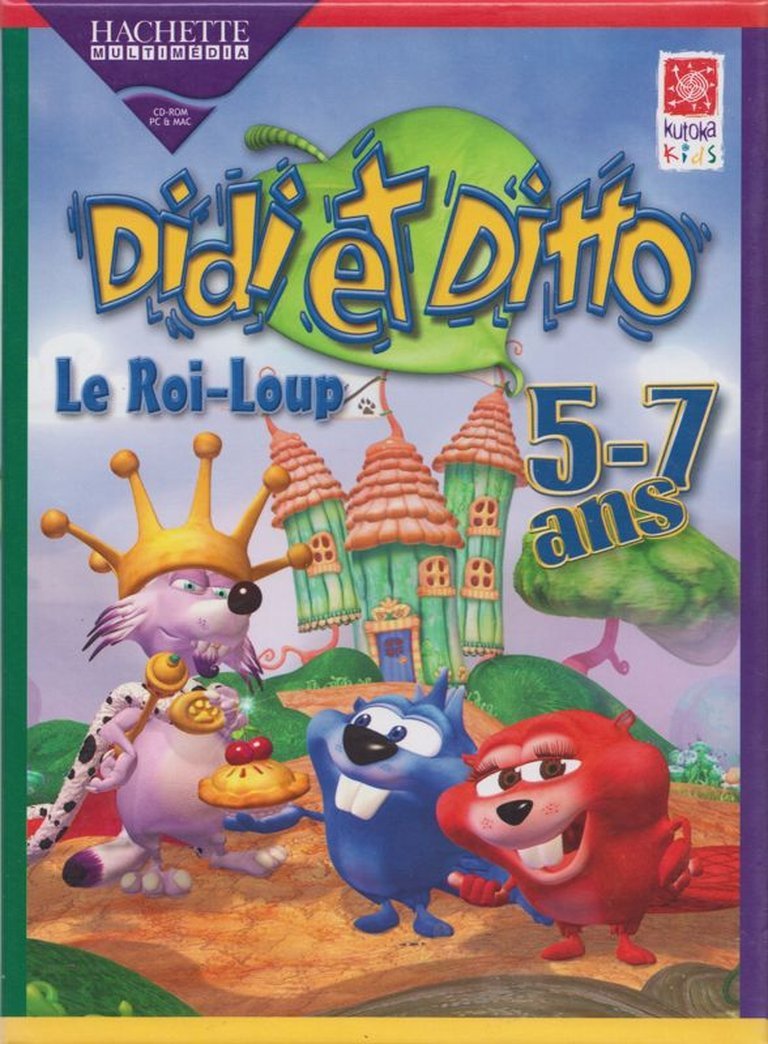
Didi and Ditto: First Grade – The Wolf King is an educational adventure game for children aged 5-7, set in Jako’s Valley where the Wolf King has seized control. Players choose either Didi or Ditto, two courageous beavers, to challenge the king by solving puzzles across the valley to win flags and medallions from his purple lieutenants. The game features 16 educational puzzles covering math, reading, science, and creativity, with each puzzle offering clear tutorials and varying difficulty levels. Despite its engaging map-based exploration and creativity activities like painting and music-making, some puzzles may prove challenging for first graders. The game also includes a Teacher Mode for progress tracking and direct access to educational mini-games.
Gameplay Videos
Didi and Ditto: First Grade – The Wolf King Free Download
Didi and Ditto: First Grade – The Wolf King Reviews & Reception
commonsensemedia.org : Busy beavers help first-graders learn.
Didi and Ditto: First Grade – The Wolf King: Review
Introduction
In an era saturated with simplistic edutainment titles, Didi and Ditto: First Grade – The Wolf King stands as a beacon of ambition and creativity. Released in 2005 by Canadian studio Kutoka Interactive as the second entry in their acclaimed Didi & Ditto series, this game redefines educational software for young learners by seamlessly weaving rigorous first-grade curriculum into a vibrant, narrative-driven adventure. While its contemporaries like JumpStart offered formulaic drills, The Wolf King immerses 5-7 year-olds in the fantastical Jako’s Valley, where every puzzle, math problem, and creative activity serves a purpose in liberating the valley from the tyrannical Wolf King. This review argues that through its masterful blend of storytelling, technical innovation, and pedagogical depth, The Wolf King achieved a rare trifecta: it educated without sacrificing entertainment, captivated without overwhelming, and set a new standard for what edutainment could aspire to be.
Development History & Context
Didi and Ditto: First Grade – The Wolf King emerged from Kutoka Interactive, a Montreal-based studio founded in 1995 with a singular mission: to create children’s software that rivaled mainstream entertainment in quality. The game’s development was spearheaded by Richard Vincent, who served as Concept Designer, Art Director, and Lead Designer, ensuring a cohesive vision from inception. Nadine Robert, the Education Designer, collaborated closely with educators to align activities with first-grade curricula, while Producer Tanya Claessens and Project Manager Nadine Robert oversaw the ambitious scope of 16 interconnected puzzles.
Technologically, the game pushed the boundaries of 2005 multimedia software. Built on Macromedia Director—a platform then dominant for interactive CD-ROMs—The Wolf King leveraged Softimage XSI for its 3D cinematics, which were exported as QuickTime movies. This hybrid approach allowed for rich, character-driven cut-scenes alongside smoothly animated 2D environments. The era’s constraints—CD-ROM limitations, 128MB RAM requirements, and reliance on DirectX—were ingeniously circumvented through optimized sprite-based animations and clever asset streaming.
Released in late 2005, the game arrived in a competitive edutainment landscape dominated by established franchises. While titles like JumpStart 2nd Grade (1996) focused on isolated skill drills, Kutoka positioned The Wolf King as a holistic adventure. Its cross-platform availability (Windows and Macintosh) and bilingual support (French/English) further broadened its appeal, reflecting Kutoka’s commitment to inclusive design. This context underscores the game’s significance: it was a deliberate attempt to elevate edutainment from a supplementary tool to a primary interactive learning experience.
Narrative & Thematic Deep Dive
The narrative of The Wolf King is a masterclass in age-appropriate storytelling, framed as a high-stakes wager that empowers young players. The plot unfolds in Jako’s Valley, a pastoral community abruptly invaded by the Wolf King, a vain purple vegetarian wolf who imposes arbitrary demands on the valley’s animal inhabitants. In a bold move, the twin beavers Didi (red, female) and Ditto (blue, male) challenge the King: if one of them can outsmart his lieutenants in a series of contests, the wolves will depart forever. The player chooses which beaver to embody, immediately investing them in the mission.
This premise cleverly masks its educational purpose. Each lieutenant represents a different valley sector, hosting two puzzles: a “flag” activity (helping a resident) and a “medallion” challenge (competing against a wolf). For example, players might help Couki the puppy measure ingredients for a cake (math) or best a wolf in a tangram puzzle (spatial reasoning). The narrative’s strength lies in its character-rich world. Valley residents like the eccentric magician owl Hootdini (whose tricks consistently backfire), the reclusive Grumpy Bug, and the aspiring Olympian insect Fly Guy are not mere set pieces—they provide context for activities and deliver humor through witty dialogue. The Wolf King, while antagonistic, is portrayed as a flawed rather than menacing figure, with his vegetarianism and vanity making him a comical rather than terrifying foe.
Thematically, the game champions intelligence over brute force. The beavers’ wager subverts traditional power dynamics, framing knowledge as a weapon of liberation. Activities are contextualized as acts of community aid (e.g., saving a teddy bear from a mine) or strategic defiance (e.g., outwitting wolves in language games). This subtle messaging reinforces growth mindset principles: persistence, curiosity, and problem-solving as tools for empowerment. Even the game’s structure—allowing players to tackle puzzles in any order—reflects thematic agency, mirroring the narrative’s emphasis on independent thinking.
Gameplay Mechanics & Systems
The Wolf King’s gameplay is a sophisticated blend of exploration and skill-building, centered on a non-linear map-driven adventure. After selecting a difficulty level (represented by 1-3 “bugs”), players navigate Jako’s Valley through a top-down map, choosing sectors to explore. Each area contains two puzzles: a “flag” (aiding a valley animal) and a “medallion” (defeating a wolf lieutenant). This dual structure ensures educational variety—flag puzzles focus on real-world applications (e.g., measuring tools, classifying living/non-living objects), while medallion puzzles emphasize abstract skills (e.g., spelling, tangrams).
The core loop is deceptively simple: click to enter a zone, complete puzzles, collect flags/medallions, and return to the map. Yet its execution is layered. The “backpack” UI elegantly stores items, only appearing when moused-over to maintain immersion. Puzzles themselves are meticulously scaffolded: each begins with a clear tutorial and scales in complexity across three difficulty levels. For instance, the waterfall-catching task—where players sort “living” vs. “non-living” items—trains both classification and reflexes, with harder levels demanding quicker reactions and ambiguous classifications (e.g., is a seed “living”?).
Notably, the game avoids traditional combat. “Battles” are cerebral: a wolf lieutenant might challenge the player to complete a sentence using punctuation tiles, or solve a pattern-recognition puzzle. This design aligns with the narrative’s theme of wit over force. Progression is tangible: collecting all flags and medallions unlocks a concluding cinematic, rewarding persistence. The inclusion of an “Activities Mode” allows direct access to any puzzle, while “Teacher Mode” enables parents to track skill mastery—a forward-thinking feature for 2005.
However, the game isn’t without flaws. Some puzzles, like the arrow-key-controlled mine-cart rock-dropping challenge, demand motor skills beyond the target age, risking frustration. Yet this is mitigated by the ability to retry puzzles indefinitely, turning setbacks into learning opportunities. Ultimately, The Wolf King’s systems are a triumph of educational game design, transforming rote learning into an engaging, goal-driven quest.
World-Building, Art & Sound
Jako’s Valley is a character unto itself, a lush, hyper-detailed world that blurs the line between game and storybook. Developed with Kutoka’s signature “claymation” aesthetic, the valley’s environments—from misty forests to winding mines—are rendered in rich, saturated colors that pop against the era’s typically muted edutainment palettes. Characters, designed by Marc Aubry and François Poulin, possess exaggerated, expressive features: Didi’s wide eyes and Ditto’s perpetually grinning face convey emotion instantly, while wolves hunch with arrogant postures. This artistry wasn’t mere decoration; it served pedagogical goals. For example, the mine maze’s contrasting dark/light hues guided spatial learning, while the waterfall’s vibrant blues trained color recognition.
Sound design complements the visuals with meticulous attention. Voice acting, recorded professionally, imbues characters with personality—Hootdini’s bumbling charm, Grumpy Bug’s grumpy mutters—enhancing immersion. Sound effects are contextually rich: the plink of a dropped rock, the splash of a waterfall, and the triumphant chime of a solved puzzle. Music, though understated, adapts to environments—lively themes for playful areas, softer melodies for tasks like color mixing. The game’s most innovative audio feature is the “Turtle Music Studio,” where players compose melodies by clicking on rhythm-section turtles, recordings of which can be played back. This creative sandbox exemplifies Kutoka’s philosophy: learning should be joyful and self-directed.
Technically, the game’s hybrid 3D/2D approach was groundbreaking. Pre-rendered 3D cinematics (e.g., the Wolf King’s introduction) establish scale and drama, while 2D interactive zones prioritize accessibility. Even minor details—animated clouds, rustling leaves—foster a living world. As USA Today lauded, “No company provides better graphics than Kutoka. It’s like watching an animated movie.” This visual and auditory fidelity made Jako’s Valley not just a setting but a destination, a place where education felt like discovery.
Reception & Legacy
Upon release, Didi and Ditto: First Grade – The Wolf King was met with critical acclaim, praised for its depth, polish, and educational integrity. Game Vortex awarded it 90%, calling it a “robust playground of 16 games” that “takes full advantage of the computer’s unique ability to create exciting interactive learning.” Common Sense Media highlighted its “real depth,” noting how 16 activities were “woven together in an adventure format,” while PC Mag commended its ability to “keep any 5-to-7-year-old happy.” The game’s accolades included the Parents’ Choice Gold Award, Bessie Award for Early Learning Multi-Subject, and Seal of Approval from The National Parenting Center—testaments to its dual success as entertainment and education.
Commercially, the game benefited from Kutoka’s established reputation and its placement in educational channels. While exact sales figures are elusive, its enduring presence in archives (e.g., the Internet Archive) and inclusion in school curricula underscore its longevity. Its legacy extends beyond sales: The Wolf King pioneered the “adventure-first” edutainment model, influencing titles like Kutoka’s own Didi & Ditto Preschool – Mother Nature’s Visit (2008). The series’ emphasis on character-driven narratives, open-ended exploration, and comprehensive skill coverage set a benchmark for later games such as Mia’s Big Adventure Collection.
Critically, the game is remembered for its artistic bravery. In a market dominated by 2D sprites, Kutoka’s 3D cinematics and hybrid environments pushed technical boundaries. Its celebration of creativity—through music, art, and unstructured play—prefigured modern sandbox learning games. Yet its reputation isn’t unblemished; some critics noted puzzle difficulty spikes, and its CD-ROM format feels archaic today. Nevertheless, The Wolf King remains a cult favorite among edutainment enthusiasts, a reminder that learning can be as captivating as any blockbuster adventure.
Conclusion
Didi and Ditto: First Grade – The Wolf King is more than a game—it is a manifesto for educational interactivity. Kutoka Interactive’s audacious vision transformed first-grade lessons into a grand odyssey, where every math problem, spelling test, and creative act was a step toward freeing a beloved world. Its narrative—rooted in wit and community—empowers young players, while its technical artistry and thoughtful design ensure engagement never wavers. Though some puzzles challenge the target age’s motor skills, and its CD-ROM delivery is now obsolete, these flaws are overshadowed by its brilliance: the seamless fusion of play and purpose.
In the pantheon of edutainment, The Wolf King stands alongside classics like Oregon Trail and Carmen Sandiego not merely for its educational content, but for its soul. It proved that children’s software could be both demanding and delightful, rigorous and imaginative. As Jako’s Valley celebrates its liberation, so too does the legacy of this remarkable game—a timeless reminder that the best learning adventures are the ones where joy and wisdom grow side by side.