
- Release Year: 2007
- Platforms: Windows
- Publisher: Atari Deutschland GmbH
- Developer: Studiya Krysha
- Genre: Adventure
- Perspective: Third-person
- Game Mode: Single-player
- Gameplay: Inventory, Point-and-click, Puzzle
- Setting: Contemporary, Fantasy, Urban
- Average Score: 25/100
Description
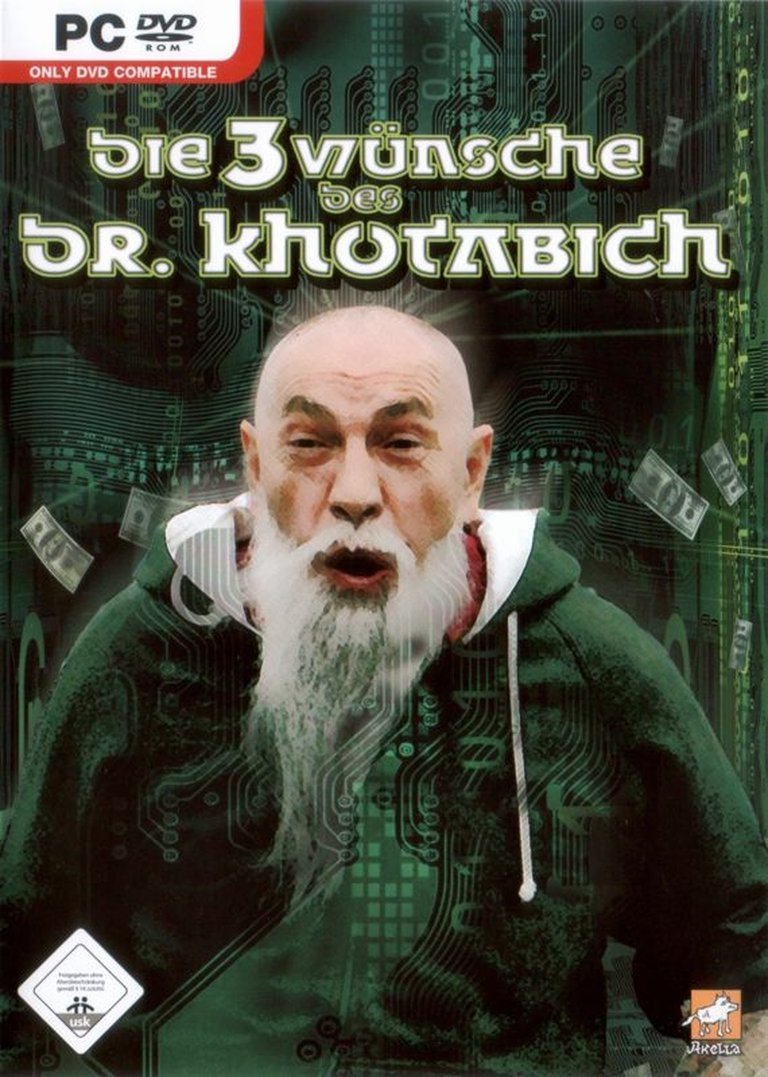
In the 2007 German adventure game Die 3 Wünsche des Dr. Khotabich, players assume the role of Gena, a computer‑savvy hacker who steals an antique vase from an online auction. The vase houses a genie that grants him three wishes, but his theft draws the attention of a relentless FBI agent and a ruthless crime syndicate. Navigating a 2‑D comic‑style world, players solve inventory‑based puzzles through a point‑and‑click interface, using context menus to look, talk, take, or use items, while the game’s humor leans heavily on computer analogies and adult jokes.
Die 3 Wünsche des Dr. Khotabich Guides & Walkthroughs
Die 3 Wünsche des Dr. Khotabich: Review
Introduction
When Atari Deutschland announced a “comic‑style, computer‑nerd adventure” for 2007, the German press hinted at a quirky blend of internet culture and classic genie folklore. The resulting title, Die 3 Wünsche des Dr. Khotabich, promised a modern twist on the Aladdin‑type wish‑granting myth, filtered through the eyes of a self‑styled hacker named Gena. In practice, the game delivers a short, low‑budget point‑and‑click experience that is as memorable for its technical shortcomings as for its crude humor. This review dissects every facet of the title, from its development origins to its lingering (if any) legacy, and ultimately asks: does it deserve a place in the annals of adventure gaming, or is it simply a footnote of early‑2000s German indie production?
Development History & Context
| Aspect | Details |
|---|---|
| Developer | Studiya Krysha (also referenced as Parus Studio/Parus Games in some German outlets). The team appears to have been very small—rumored at eleven people, with some reviewers suspecting that the studio was a makeshift operation. |
| Publisher | Atari Deutschland GmbH (German branch of Atari). Some sources also list Akella as a co‑publisher for the Russian market. |
| Release | 2007, Windows (CD‑ROM/DVD‑ROM). No console ports. |
| Technological Constraints | The game runs on a 2‑D comic‑style engine with a resolution that was already dated by 2007. No 3‑D graphics, no hardware acceleration beyond basic DirectX 5/6. |
| Market Landscape | 2007 was a transitional year for adventure games. While Western titles such as The Longest Journey (1999) and Syberia (2002) had set high standards for narrative and art, the German market still nurtured low‑budget “point‑and‑click” experiments, often distributed on CD‑ROM and sold at budget prices (≈ 5,99 €). The genre was also competing with the rise of action‑oriented indie titles. |
| Vision | According to the packaging (“Eine faszinierende Suche und eine moderne Internet‑Komödie…”), the creators aimed for a “modern internet comedy” that would satirize hacker culture through exaggerated dialogue and a whimsical genie premise. The comedic tone leans heavily on computer analogies, profanity, and slap‑stick absurdity. |
Narrative & Thematic Deep Dive
Plot Overview
- Protagonist: Gena, a self‑described “computer freak” and hobbyist hacker.
- Inciting Incident: Gena hacks the website of a large corporation (named “Macrohard Corp.” in the German version) and wins an antique vase at an online auction.
- Conflict: The theft draws the attention of an FBI‑style agent, a Russian mafia faction, and a corporate security team.
- Supernatural Aid: Inside the vase resides a centuries‑old djinn, Dr. Khotabich, who offers Gena three wishes.
- Resolution: The player must navigate a series of absurd situations, using the wishes (or lack thereof) to escape the escalating chaos.
Characterisation & Dialogue
- Gena: Portrayed as a stereotypical nerd, his comments are peppered with technical jargon (“Wow, if I had that fridge in my inventory, my processor wouldn’t survive a day”). The dialogue is deliberately vulgar, with profanity used as a punchline.
- Khotabich: The genie is a caricature of the Russian “хоттабыч” folklore figure, but the game never explains the cultural reference, leaving non‑Russian speakers confused.
- Antagonists: Both the FBI agent and the mafia are presented as one‑dimensional foils, serving mainly as plot devices to push Gena into comedic predicaments.
Themes & Subtext
- Technology vs. Tradition: The clash between a high‑tech hacker and an ancient magical entity serves as a metaphor for the early 2000s anxiety about the internet’s rapid expansion.
- Wish‑Fulfilment & Moral Ambiguity: The classic “three wishes” trope is subverted; Gena’s wishes are either nonsensical (e.g., infinite money) or never realized, highlighting the futility of shortcuts in a world of bureaucratic and criminal obstacles.
- Cultural Mis‑translation: The German localization suffers from literal, often broken translations (e.g., “Steige nicht aus, das ist tödlich. Das bedeutet nicht einsteigen.”). This creates a layer of unintentional comedy that underscores the difficulty of adapting Russian‑origin humor for Western audiences.
Gameplay Mechanics & Systems
| System | Description | Critical Assessment |
|---|---|---|
| Core Loop | Point‑and‑click navigation, inventory collection, and context‑menu actions (Look/Talk, Use/Take, Walk). | The loop is functional but uninspired; the menu appears for every hotspot, slowing pacing. |
| Puzzles | Largely inventory‑based; few true “logic” puzzles. Many “trial‑and‑error” moments where the correct item must be clicked by chance. | Critics label the puzzles as “practically nonexistent” or “abstract riddles” that rely on luck rather than design. |
| Progression | Linear story progression; no character leveling or branching paths. | No replay value; the game ends after roughly three hours of play. |
| User Interface | Mouse‑driven, hot‑spot icons occasionally ambiguous, no keyboard shortcuts. | Hot‑spot visibility is inconsistent; some items become unclickable after early interactions, leading to dead ends. |
| Bug & Stability | A known crash occurs after ~3 hours (often during a dialogue sequence), with no official patch. | This fatal bug is frequently cited as the primary reason for the game’s negative reputation. |
| Audio | Voice‑over for Gena (German), background music, and sound effects. | Voice acting is competent, but the music is described as “torture‑like” and mismatched with the comic art style. |
Overall, the mechanics are a faithful, if dated, implementation of the classic adventure formula. The lack of innovative systems (e.g., dialogue trees, branching quests) and the presence of glaring bugs make the experience feel more like a tech demo than a finished product.
World‑Building, Art & Sound
Visual Direction
- 2‑D Comic Style: Static background panels with hand‑drawn characters, reminiscent of early 2000s budget adventure titles.
- Resolution & Detail: Low‑resolution assets; some environments appear “pixelated” even on modern displays.
- Animation: Minimal; only a handful of animated objects (e.g., a giant CD‑ROM box in Gena’s kitchen) exist, and they often feel out of place.
Atmosphere & Setting
- The game’s world is confined mostly to Gena’s apartment and a few adjacent locations (the mafia hideout, FBI office, online auction site). The limited scope contributes to a feeling of claustrophobia rather than intentional design.
Sound Design
- Music: A looping, synth‑heavy track that many reviewers likened to “Guantanamo torture music.” It fails to reinforce the comic tone.
- Voice Acting: German voice‑over for Gena is clear and technically competent, but the script’s poor translation undermines its effectiveness.
- SFX: Basic click and ambient noises; no notable audio cues for puzzles or narrative beats.
Contribution to Experience
The mismatched art and audio create a dissonant experience: bright comic panels clash with an ominous soundtrack, while the humor—rooted in computer slang and profanity—fails to land due to poor localization. The visual novelty is limited to occasional bright colors, but the overall aesthetic feels “cheap” and unfinished.
Reception & Legacy
| Source | Score | Summary |
|---|---|---|
| IGROMANIA | 45 % | “Low resolution tolerable, but locations are a visual nightmare; sound doesn’t match graphics.” |
| PC Action (Germany) | 38 % | “Typical point‑and‑click with outdated tech; translation errors abound.” |
| GameStar (Germany) | 25 % | “Hackers chased by police & mafia; nonsensical puzzles; wish‑granting premise wasted.” |
| PC Games (Germany) | 25 % | “Story is a string of absurd situations; music feels like a torture device; voice‑over is the only redeeming factor.” |
| Adventurearchiv | 19 % | “Bad translation, numerous logic holes, early‑game crash; overall a failure.” |
| Adventure‑Tref | 15 % | “Worst software in years; graphics, gameplay, story, and characters all sub‑par; fatal bug after three hours.” |
| Absolute Games (AG.ru) | 5 % | “Amateurish graphics, incoherent plot, primitive gameplay; the only thing not terrible is the lack of programming errors.” |
| Player Rating (MobyGames) | 1.3 / 5 | Single user rating, reflecting the community’s disdain. |
Commercial Performance
– No sales figures are publicly available, but the low review ranking (#9,235 of ~9,276 Windows titles on MobyGames) and the minimal number of collectors (7) suggest a negligible commercial impact.
Legacy
– The title is largely remembered as a cautionary example of low‑budget adventure development.
– It has achieved a modest “cult trash‑collector” status among adventure‑genre archivists who enjoy cataloguing “so‑bad‑they’re‑interesting” games.
– No discernible influence on later titles; the game did not inspire notable mechanics or narrative tropes.
Conclusion
Die 3 Wünsche des Dr. Khotabich is a textbook case of ambition outpacing resources. Its premise—mixing hacker culture with a genie’s three wishes—had the potential to satirize early‑Internet anxieties in a fresh way. However, the execution suffers from:
- Technical Deficiencies: Low‑resolution 2‑D graphics, a buggy engine that crashes after a few hours, and a UI that hampers fluid interaction.
- Narrative Missteps: Incoherent dialogue, mistranslations, and a story that leans heavily on absurdity without a solid comedic foundation.
- Design Shortcomings: Minimal puzzle design, linear progression, and a lack of meaningful player agency.
While the voice acting and occasional comic‑style art provide fleeting moments of charm, they are insufficient to offset the overwhelming flaws. In the broader context of adventure gaming, the title occupies a footnote—an example of the challenges faced by small German studios attempting to compete with higher‑budget Western adventure games of the early 2000s.
Verdict: Die 3 Wünsche des Dr. Khotabich is best approached as a curiosity for collectors rather than a recommended playthrough. Its place in video‑game history is that of a cautionary anecdote about the importance of polish, localization, and coherent design.