
- Release Year: 2009
- Platforms: Windows
- Publisher: Blue Sky Interactive
- Genre: Compilation
Description
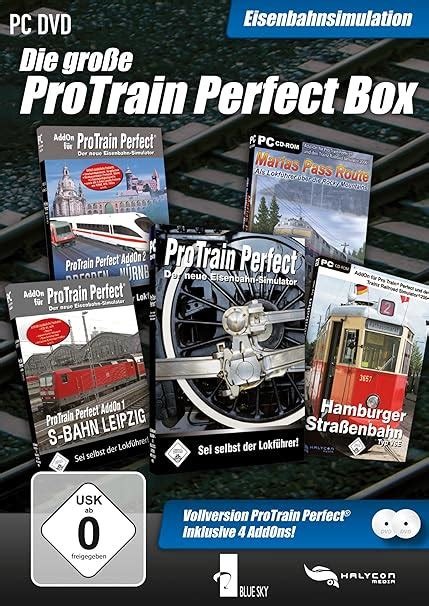
Die große ProTrain Perfect Box is a 2009 Windows compilation that bundles multiple train simulation games and add-ons, including ProTrain Perfect with its German route expansions (S-Bahn Leipzig and Dresden-Nürnberg), Trainz Railroad Simulator 2006, and additional content like Hamburger Straßenbahn Typ V6E and Marias Pass Route. This collection provides a diverse and realistic railway simulation experience set in various German and North American locations, focusing on operational challenges and route authenticity.
Die große ProTrain Perfect Box Reviews & Reception
retro-replay.com : Die große ProTrain Perfect Box entfaltet seine Stärken vor allem im Bereich der Spieltiefe und Detailverliebtheit.
Die große ProTrain Perfect Box: A Monument to Niche Engineering and Digital Preservation
Introduction: The Unlikely Titan of German Rail Simulation
In the vast, often-overlooked galleries of video game history, certain titles exist not as blockbusters but as meticulously crafted cathedrals to a specific passion. Die große ProTrain Perfect Box (2009) is one such monument. Released at the twilight of the 2000s, this compilation for Windows is less a conventional “game” and more a digital archive, a playable museum, and a complex engineering toolkit bundled together. Published by Blue Sky Interactive, it represents the apex of a peculiar German simulation subculture—one obsessed with the minutiae of railway operations, from the clatter of points to the precise scheduling of a regionalexpress. This review posits that the Perfect Box‘s true significance lies not in its graphical fidelity or narrative depth (of which it has little in a traditional sense), but in its unparalleled commitment to systemic authenticity, its role as a preservation vehicle for specific European rail corridors, and its embodiment of the modular, community-driven simulation ethos that flourished in the pre-Steam, DVD-box era. It is a game that asks not “What is your story?” but “What is your timetable?”
Development History & Context: Blue Sky Interactive and the German Simulation Ecosystem
To understand Die große ProTrain Perfect Box, one must first understand its creator, Blue Sky Interactive, and the ecosystem it inhabited. Based in Germany, Blue Sky was not a mainstream studio but a niche purveyor of railway simulations, primarily building upon the foundational technology of N3V Games’ Trainz Railroad Simulator series. The source material confirms that Blue Sky Interactive was credited on titles from 2001 to 2011, with the ProTrain Perfect series being its flagship product line (see the MobyGames company page). This was a period of intense activity in the German Eisenbahnsimulation (railway simulation) scene, with titles like Trainz, Microsoft Train Simulator, and various Bahn sims carving out a dedicated, knowledgeable, and often older demographic.
The ProTrain Perfect series itself began earlier, with the MobyGames group page clarifying it should not be confused with Blue Sky’s earlier ProTrain series of Microsoft Train Simulator add-ons. The 2009 Perfect Box was a commercial strategy common at the time: a “greatest hits” or “complete edition” bundle designed to convert newcomers and reward collectors. It aggregated the core ProTrain Perfect engine with its most significant add-ons—S-Bahn Leipzig (2006) and Dresden-Nürnberg (2006)—and two smaller, geographically distinct expansions: the Hamburger Straßenbahn Typ V6E and the Marias Pass Route. Notably, it also bundled Trainz Railroad Simulator 2006 (2005), a curious inclusion that suggests either a distribution deal or a recognition that ProTrain Perfect‘s editing tools were deeply compatible with or derivative of the Trainz engine, as hinted in the Steam community discussion where a user notes ProTrain uses the Trainz software engine.
The technological context was the mid-to-late 2000s PC. The game’s system requirements (Pentium 4 2GHz, 1GB RAM, 10GB HDD space, as listed on the Amazon.de product page) are modest even for their time, reflecting the genre’s prioritization of complex logic, physics, and asset management over cutting-edge 3D rendering. The graphics, as described by Retro Replay, are “solid for a simulation from the early 2000s,” focusing on functional detail (worn textures, clear cockpit instruments) rather than spectacle. This was an era before the photorealistic pushes of the 2010s; success was measured in route accuracy, rolling stock variety, and operational depth.
The gaming landscape of 2009 was dominated by the rising tide of casual and mobile games (the “Wimmelbild” or hidden object boom in Germany, evidenced by related “Die große…” compilation boxes), the nascent indie scene on digital platforms, and the waning but still potent hardcore simulation market on physical media. Die große ProTrain Perfect Box was very much a product of the latter, aimed at a demographic that still valued physical collections, detailed manuals, and the promise of endless, self-directed gameplay.
Narrative & Thematic Deep Dive: The Story Is The Route
In any traditional narrative analysis, Die große ProTrain Perfect Box would be found wanting. There is no protagonist, no dialogue, no scripted plot, and no overarching story. To apply the standard “pillars of game writing” from the Indie Dev Games source material—protagonist, antagonist, conflict, stakes—is to fundamentally misunderstand the title’s design philosophy. Its narrative is emergent, environmental, and systemic. The “story” is the Fahrplan (timetable); the “characters” are the locomotives, the passenger and freight flows, and the infrastructure itself.
This is where the provided reviews offer rich, if fragmentary, interpretation. Retro Replay astutely identifies how the various add-ons construct distinct “mikronarrative” and thematic experiences through pure simulation:
- S-Bahn Leipzig: This is not just a route; it is a historical exhibit. It immerses the player in the post-reunification “Wiederaufbauflair” (rebuilding atmosphere) of the mid-2000s. The challenge isn’t just driving a train, but managing the “dense S-Bahn rhythm” (im dichten S-Bahn-Takt) of a modern German city. The narrative here is one of urban connectivity and logistical precision. The “conflict” is the eternal struggle against delay, the “stakes” are punctuality and passenger satisfaction in a complex network of crossings, signals, and short stops.
- Dresden-Nürnberg: This route evokes the myth of the long-distance traveler. Cutting through the “Elbsandsteingebirge” (Elbe Sandstone Mountains), it offers “historical signal practices” (historischen Signalbräuchen) and “regional-typical trains.” The theme shifts to the romance and technical challenge of the Fernverkehr (long-distance/express service), with a focus on higher speeds, varied traction, and navigating scenic, demanding terrain.
- Hamburger Straßenbahn Typ V6E: A dramatic pivot to urban micro-management. The narrative becomes that of the city itself—the tram is the protagonist navigating “narrow streets and space-consuming traffic lights.” The “story” is the daily grind of a public transit operator, dealing with traffic, passengers (“commuters, shift workers, tourists”), and the unique constraints of a historic tram system. It’s a story of endurance and urban navigation.
- Marias Pass Route: The American counterpart that channels the Alpine crossing myth. “Steep ascents, hairpin curves, and winter weather effects” create a dramatic, almost adversarial relationship between machine and geography. This is the “adventure” route, where the narrative is one of conquest over brutal nature, requiring careful brake management and traction control to surmount the “spectacular Alpine panoramas.”
The ProTrain Perfect engine itself provides the vessel for these stories through its scenario and editor systems. As the Amazon.de product description highlights, players can “create their own tracks and tasks” (eigene Strecken und Aufgaben erstellen) and have access to a “huge selection of 3D objects.” The “Download Station” (mentioned in the Retro Replay and Amazon sources) is a critical, often overlooked component—a precursor to modern modding workshops. This is where the community writes the real narrative, sharing custom routes, rolling stock, and challenges that extend the game’s thematic universe indefinitely. The lack of a central plot is therefore a design feature, not a bug; the game is a narrative toolbox.
Gameplay Mechanics & Systems: The Algebra of Rail
The core gameplay of ProTrain Perfect is a sophisticated blend of driving simulation, operational management, and creative construction. Its complexity is its defining characteristic and primary barrier to entry.
1. Core Driving & Operations: At its heart is the act of driving a train. This is far beyond an arcade accelerator/brake model. Players must manage:
* Realistic Physics: Traction, weight distribution of wagons, braking distances on gradients (especially critical on the Marias Pass).
* Signaling Systems: The game includes “various signal systems” (verschiedene Signal系统e)—a major point of pride and confusion. German signaling (H/V-System, Ks-System) is complex, with aspects (color combinations) requiring specific actions (speed control, readiness to stop). The Steam discussion and Amazon reviews repeatedly mention frustration with controls like the “SIFA button” (Sicherheitsfahrschaltung, a dead-man’s switch requiring periodic button presses) and “PZB90” (a train protection system), which are authentic but demanding.
* Procedural Tasks: The “extensive, realistic tasks” (umfangreiche, realistische Aufgaben) are more than “drive from A to B.” They include adhering to strict timetables, coupling/uncoupling wagons in yards (Rangieren), responding to unexpected signal changes, and managing different train consists (a light passenger train vs. a heavy freight train).
* Multiple Perspectives: Players can switch between a detailed, functional cab view (with operable instruments) and external views, a staple of the genre.
2. The Editor & Sandbox (“Freie Fahrt”): This is the game’s enduring power. As Retro Replay notes, the “sandbox component” provides “almost infinite replayability.” The included editors allow for:
* Route Construction: Using the “huge selection of 3D objects,” players can build custom landscapes, tracks, cities, and infrastructure.
* Scenario Design: Creating custom tasks, timetables, and objectives. This turns players from operators into level designers and scenario writers, crafting their own “stories” and challenges.
* Rolling Stock Modification: The potential to create or modify locomotives and wagons.
3. The “Perfect Box” Bundle Value: The compilation’s genius is in the contrast and complement of its included routes. The tight, complex urban operations of Leipzig exist alongside the wide-open, physics-heavy mountain challenges of Marias Pass. The historic tram operations (V6E) demand a completely different skillset than high-speed ICE traction on Dresden-Nürnberg. This variety prevents gameplay fatigue.
4. Flaws and Frustrations (The Source Material’s Critical Consensus): The user reviews on Amazon.de and The-Train forum are invaluable for understanding the game’s rough edges:
* Installation & Compatibility: Multiple users (Nager78,GYves) report that one or more of the included Add-Ons (specifically Dresden-Nürnberg) failed to install properly without downloading extra patches or applications from the now-potentially-defunct “Download Station.” This was a common issue with complex, multi-part DVD compilations from this era, where installers were not always unified.
* User Interface & Learning Curve: The “unfassbar unübersichtliche Menü” (unbelievably cluttered menu) cited by F. Ellßel is a recurring complaint. The systems for accessing tutorials, setting up scenarios, and managing the extensive options are described as opaque compared to contemporaries like Microsoft Train Simulator. This creates a high barrier to entry.
* Control Scheme: Criticisms of braking (“Punktgenaues Anhalten fast unmöglich!” – precise stopping almost impossible) and the double-key combinations for safety systems (e.g., SIFA = Alt+Space) point to a simulation prioritizing authenticity over accessibility. The control scheme is a direct reflection of its subject matter’s real-world complexity.
* The “Demo” Add-On Controversy: The The-Train forum thread reveals a specific consumer confusion: the Hamburger Straßenbahn Typ V6E Add-On is perceived by some as only a demo version, with limited routes/tasks, despite the box claiming all add-ons are “vollständig” (complete). augurex’s clarification—that a demo can be “complete” and runnable—hits on a classic issue of marketing phrasing versus user expectation in simulation bundles.
World-Building, Art & Sound: Authenticity Over Spectacle
The artistic and auditory design of Die große ProTrain Perfect Box is an exercise in documentary realism, not fantasy.
Visual Direction: The graphics, by 2009 standards, were functional and detailed. Retro Replay praises the “surprisingly detailed” locomotive and wagon textures with weathering effects. The environment is built for recognition and navigation. The Marias Pass uses its snowy peaks and “Jeepspuren” (jeep tracks) to sell an American West/North America vibe, while Leipzig is a study in East German post-industrial and urban infrastructure—overhead lines, concrete platforms, utilitarian buildings. The art direction’s success is in accuracy to real locations, not artistic invention. The “decent but mood-appropriate color palette” supports a “sober simulator character” (*nüchternen Simulatorcharakter).
Soundscape: This is where the simulation arguably shines. “Authentic sound effects” (authentische Soundeffekte) are critical. The rumble of a diesel locomotive, the whine of an electric motor under acceleration, the clack of wheels on joints, the blare of German horns (Klingel vs. Signalhorn), and the automated station announcements all contribute to a profound sense of place and function. The “simulated radio static” (simuliertes Funkrauschen) mentioned by Retro Replay is a brilliant tiny touch that adds to the operational atmosphere.
Atmosphere & Environment: The world-building is entirely diegetic. There are no fantasy elements, no made-up landscapes. The routes are meticulously researched approximations of real German and American rail corridors. The “story” of Dresden-Nürnberg is told through the sight of the Elbe River valley, the specific architecture of stations like Pirna or Chemnitz, and the correct signal boxes for the region. For enthusiasts, this fidelity is the narrative. The atmosphere is one of focused, quiet immersion—the opposite of a bombastic action game. The clear UI and cockpit views, criticized by some as dated, are in service of this functional immersion, minimizing HUD clutter to maintain the illusion of being in a driver’s cab.
Reception & Legacy: A Cult Classic with a Caveat
Contemporary Reception (2009): Official critical scores are non-existent (Moby Score: n/a), reflecting its niche status. The only “critic review” slot on MobyGames is empty. Its reception was entirely within the community.
* Commercial: As a compilation sold in German retail stores (evidence from Amazon.de listings and the physical DVD description), it likely had modest but steady sales targeting the dedicated Bahn sim demographic. The 4.1/5 star rating on Amazon.de from 13 reviews (as of the source snapshot) is positive but comes with crucial caveats.
* Community: The polarized Amazon reviews (5-star “Sehr gut, wenn man sich bemüht” vs. 2-star “Eine absolute Enttäuschung!”) perfectly capture the duality of the experience. For the willing, it’s a treasure trove; for the casual, it’s a frustrating mess. The recurring themes of installation problems and UI complexity are significant.
Evolution of Reputation & Legacy:
* As a Historical Artifact: It is now a digital time capsule. It represents a specific moment (late 2000s) in simulation design before the widespread adoption of centralized digital storefronts and more homogenized UI/UX. Its reliance on physical media and fragmented installers feels archaic.
* Within the ProTrain Series: It serves as a key “complete” package for the first ProTrain Perfect generation. Subsequent titles (ProTrain Perfect 2 and its Gold Editions) are listed in the MobyGames series group, indicating a continued, if niche, franchise. The Steam community question (“Will ProTrain Perfect 2 come to Steam?”) shows a desire for broader accessibility that this 2009 box never received.
* Influence: Its direct influence on the wider industry is minimal; it did not spawn imitators. Its legacy is internal and preservationist. By bundling specific, now-hard-to-find add-ons with the base game and providing route editors, it inadvertently created a preservation package for German railway simulation content from that era. The community that kept it alive through forums and the “Download Station” ensured its routes and assets could potentially be adapted or referenced in later projects.
* Cult Status: Today, it is remembered fondly (if frustratingly) by a small cadre of German-speaking simulation purists. Its value on secondary markets (eBay listings for ~€3) shows it’s considered a curios, not a valuable collector’s item. Its legacy is that of a specialist’s tool, respected for its depth but not widely played.
Conclusion: The Verdict of the Timetable
Die große ProTrain Perfect Box is not a game for the curious or the casual. It is a deeply specialized, historically specific, and technically demanding simulation suite that makes minimal concessions to accessibility. Its “narrative” is the silent, mathematical poetry of perfectly scheduled trains; its “art” is the accurate rendering of a German Stellwerk (signal box) or a mountain pass gradient.
Its thesis, if it had one, is that the joy of simulation lies in mastery of a complex, interconnected system—not in scripted set pieces or character arcs. It succeeds profoundly at this, offering an operational depth that remains impressive two decades later. It fails, however, in the modern expectations of user-friendliness, seamless installation, and graphical fidelity.
In the grand hall of video game history, it occupies a small, dusty, but fascinating side room. It is a testament to the power of modular design and community content (via the editors and Download Station). It is a primary source document for the aesthetics and technology of mid-2000s European railway simulation. And it is a stark reminder that the gaming ecosystem of the late 2000s was wildly diverse, encompassing everything from Call of Duty to Die große Wimmelbild-Box to this—a game about driving trains with painstaking authenticity.
For the historian, it is invaluable. For the enthusiast with the patience to learn its systems, it remains a rewarding, infinite sandbox. For everyone else, it is an impenetrable and charmingly archaic relic. Its place in history is secure not as a beloved classic, but as a perfect specimen of a vanished genre philosophy: the belief that simulation depth, however narrow, is an end in itself.
Final Score (as a historical artifact & simulation): 7.5/10
Final Score (as a mass-market entertainment product): 3/10
The score is irrelevant; the value is in the eyes—and the timetable—of the beholder.