
- Release Year: 2020
- Platforms: Nintendo Switch, PlayStation 4, Windows, Xbox One, Xbox Series
- Publisher: Console Labs S.A., HeartBeat Games, Image Power S.A., PlayWay S.A.
- Developer: Image Power S.A., Roasted Games
- Genre: Simulation
- Perspective: 3rd-person (Other)
- Gameplay: Shooter
- Setting: dieselpunk
Description
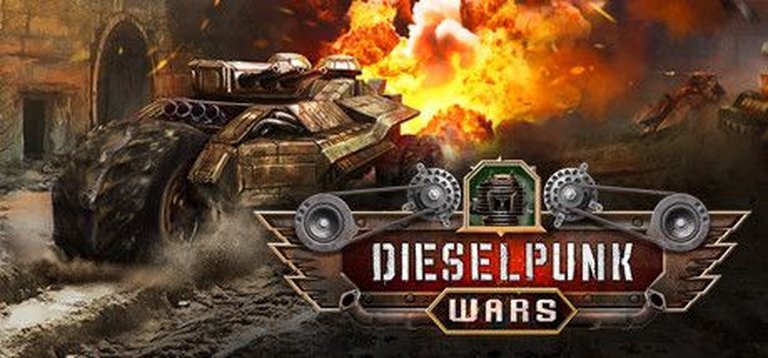
Dieselpunk Wars is a simulation shooter set in a retrofuturistic dieselpunk universe, blending interwar to 1950s aesthetics with speculative technology. Players design, build, and pilot custom war machines through diverse and exotic landscapes, focusing on tactical combat and the joy of creative destruction in a world where diesel-based innovation meets alternate history.
Gameplay Videos
Where to Buy Dieselpunk Wars
PC
Dieselpunk Wars Free Download
Dieselpunk Wars Mods
Dieselpunk Wars: Review – Forging Chaos in a Gritty Retro-Future
Introduction: The Allure of the Scrapheap Symphony
In an era dominated by polished AAA productions and meticulously curated indie darlings, Dieselpunk Wars arrives like a rust-ejected piston from a forgotten alternate history. It is not a game of scripted heroics or curated narratives, but a raw, chaotic, and profoundly flexible sandbox—a digital erector set set ablaze. At its core, it asks a single, intoxicating question: What monstrous, magnificent, and utterly dysfunctional war machine can you weld together from the detritus of a world that never left the 1940s? This review will argue that Dieselpunk Wars is a fascinating, if deeply flawed, artifact—a game that sacrifices accessibility and polish for an almost unparalleled depth of systemic interaction and player agency. It is less a finished product and more a sprawling, kinetic engineering toolkit, whose legacy will be defined not by its commercial performance but by the improbable, player-forged creations it inspires. Its true narrative is not written in its thin campaign, but in the shared blueprints of its community, a testament to the enduring, DIY spirit of the very dieselpunk ethos it so vividly embodies.
Development History & Context: Polish Pragmatism Meets a Niche Dream
Dieselpunk Wars emerged from the workshops of Image Power S.A., a Polish studio with a modest portfolio including simulation titles like Yacht Mechanic Simulator and Ambulance Simulator. The project was spearheaded by Damian Wieczorek, who served as Game Concept, Design, Programming, and 3D Modeling—a one-man (or at least core-person) army indicative of the indie development ethos. Collaborating with Roasted Games and published by the prolific PlayWay S.A. (known for simulator-focused titles), the game was built in Unity, a common but capable choice for such a physics-intensive endeavor.
The development timeline, pieced together from Steam news archives, reveals a project born from a clear, focused vision. A free “Prologue” version was released on November 19, 2020, serving as both a technical showcase and a community engagement tool. The developers explicitly cited the game’s “advanced physics simulation” and “sandbox nature” as reasons for entering Early Access, acknowledging that “testing all possible interactions proved impossible” and that “player feedback” was essential for polishing balance and fixing obscure bugs. This was a pragmatic, community-driven development strategy, common in the Steam Early Access ecosystem but one that requires a patient and tolerant player base.
The dieselpunk setting was not an afterthought but the project’s foundational pillar. As the developers stated in a June 2020 dev blog: “We love seeing how people’s imagination builds up and materializes in even the wildest visions… dieselpunk seemed like a perfect fit.” They identified a gap in the market: a setting where “machinery and creativity join together to form a progressive world… Where past meets future, modern technologies meet dirt.” This philosophy directly informed the game’s mechanics. The aesthetic—gritty, industrial, optimistic yet pessimistic—demanded a simulation where every bolt, every angle, and every material choice mattered, mirroring the genre’s thematic tension between decayed beauty and brutal functionality.
Technologically, the game’s ambition was its greatest constraint. Simulating complex aerodynamics, buoyancy, separate projectile ballistics, and modular destruction for vehicles built from hundreds of parts is a monumental computational task. The stated system requirements (a GTX 750 Ti as minimum) suggest a game that pushes the boundaries of what a small studio could optimize for, likely contributing to the performance issues noted in user reviews. The game was released on Windows in May 2021 (after its Early Access period), with later ports to PlayStation 4, Xbox One, Xbox Series X/S, and Nintendo Switch in 2022, a testament to PlayWay’s multi-platform ambitions, though the simulation-centric gameplay likely found its most forgiving audience on PC.
Narrative & Thematic Deep Dive: A Campaign as a Sandbox Tutorial
Unlike narrative-driven dieselpunk classics like BioShock (with its Objectivist dystopia) or The Man in the High Castle (with its political alternate history), Dieselpunk Wars does not tell a story about its world. Instead, it uses its world as a stage for systemic storytelling. The “single-player campaign” with its “interesting plot and lots of missions” is, based on available descriptions, a thinly sketched framework. The provided Steam store description mentions “conquer entire islands” and exploring “various unique biomes,” but no specifics on characters, factions, or ideological conflicts emerge from the source material.
This narrative minimalism is, in fact, thematically congruent with a certain strain of dieselpunk—the “Piecraftian” school, as defined by the genre’s own theorists. Named after proponent “Piecraft,” this theme focuses on “a world where survival (largely based on a reliance on diesel power) is placed above aesthetical evolution… where human culture could theoretically cease to evolve due to constant, widespread warfare.” In Dieselpunk Wars, there are no grand speeches about fascism or utopianism; there is only the mission. The “plot” is the logistical challenge: cross the desert, sink the mothership, survive the arena. The enemy is not a symbolic ideology but a design problem—a specific vehicle configuration with a weak point to be exploited.
The true “theme” of Dieselpunk Wars is applied pragmatism. The game’s world, with its deserts, swamps, mountains, and flying islands, is not a backdrop for human drama but a testing ground for engineering principles. The dieselpunk aesthetic—Art Deco lines mixed with grimy rivets, the hum of engines amidst decay—becomes the language of problem-solving. A player’s narrative is generated not by cutscenes, but by the emergent results of their design: the triumphant first flight of a wobbling biplane hybrid, the catastrophic engine fire on a hilltop siege engine, the elegant ricochet that saves a half-sunken landship. The game posits a world where the central conflict is not man vs. man, but design vs. physics, creativity vs. entropy. It’s a pure, almost scientific, dieselpunk: the world is a machine, and the player’s job is to build a better one to master it.
Gameplay Mechanics & Systems: The Engineering Simulator
To dissect Dieselpunk Wars is to dissect a physics playground. Its core loop is a trinity of Build, Test, Iterate, wrapped in the guise of a vehicular combat game.
1. The Building System: Modularity as a Philosophy
The game provides over 300 unique elements (sources vary between “over 250” and “over 300,” indicating ongoing updates). This is not a cosmetic kit; it is a functionalist’s lexicon. Parts are categorized functionally (weapons, engines, wheels, armor, propulsion) and materially (different metals/compounds with distinct weights, strengths, and fire resistances). The core block is the sacred heart of the vehicle; its destruction means total annihilation. Every other block must be connected to it, creating a logical, branching structure. This forces genuine engineering: you cannot simply armor-plate a whimsical shape; you must consider load-bearing paths, center of mass, and connectivity.
The painting and material selection system adds a crucial layer. Thicker armor is heavier. A lighter material might allow for faster airships but crumple under fire. The ability to paint armor is not cosmetic; different paint types confer different properties. This transforms building from a LEGO-like exercise into a trade-off simulation. Every design decision has a tangible consequence in the simulation.
2. The Physics & Damage Engine: Where Theory Meets (Rusted) Reality
This is the game’s beating heart and its most celebrated—and frustrating—feature.
* Destruction: It is “advanced.” Blocks don’t just have hit points; they have individual resistances to fire, impact, and explosion. A vehicle can be cut in half, lose a wing, or have its engines flood. Damage is localized and consequential. Losing a wheel doesn’t just look cool; it alters handling catastrophically. A “strategic block placement” isn’t about aesthetics but redundancy and vital system protection.
* Ballistics: Each weapon is a separate object with its own logic. Penetration, ricochet, and drop are calculated. Angled armor is not a gimmick but a primary defense mechanism, capable of deflecting shots. This creates a meta-game of designing not just strong vehicles, but smartly shaped ones.
* Environmental Forces: Aerodynamics are based on hull shape—”a brick” versus an “aerodynamic” form. Buoyancy and lift must be balanced against mass and center of gravity. Wind affects sails and flight. Water has wave simulation, impacting naval vessels. Engine overuse causes fires. The world is an active, sometimes hostile, participant in combat.
3. Game Modes: From Canvas to Crucible
- Creative/Sandbox Mode: The pure expression of the game’s intent. Unlimited resources, no constraints. It is here that the community’s most surreal designs—Multi-legged walkers, submarine-blimp hybrids, absurdly tall towers with a single gun—are born. It’s a digital foundry.
- Campaign Mode: Functions primarily as a guided tutorial and progression system. Completing missions earns new parts and unlocks skills/active powers (like temporary speed boosts or repair drones). The campaign’s biomes (desert, swamp, mountains) serve as natural laboratories, forcing the player to adapt their designs to different environmental challenges (e.g., water buoyancy for swamps, robust cooling for deserts). Its “plot” is merely the sequence of these engineering challenges.
- Battle/Arena Mode: The proving ground. Here, player-designed or pre-set AI vehicles clash in large-scale battles. The AI, while noted by developers as needing improvement (“tweaked to behave more naturally”), utilizes its own design logic, creating predictable but functional archetypes to test against.
4. Systems Analysis: Innovation Tempered by Friction
The innovation is the holistic, interconnected simulation. The glory of Dieselpunk Wars is that it respects the player’s intelligence. It says: “Here are the rules of physics and material science. Now go and create.” The flaws arise from the sheer complexity and the interface/camera needed to manage it.
* UI and Controls: The “direct control” and “point and select” interface (per MobyGames) for maneuvering complex, multi-weapon vehicles in a 3D space is a perennial challenge. Reviews suggest it can be clunky and unintuitive, a common pitfall in simulation-heavy games. The learning curve is not just about understanding physics, but wrestling with the controls that let you apply that understanding.
* Balance: With thousands of potential vehicle permutations from a parts list of 300+, achieving perfect combat balance is a Herculean task. The developers admitted this was a key reason for Early Access. Some player designs will inevitably be “broken”—either invincibly tanky or ludicrously fast. This is a feature from a sandbox perspective but a bug from a competitive one.
* Performance: The simulation of hundreds of interacting physical objects and projectiles is a taxing load. The “minimum” specs suggest optimization is a significant hurdle, and user reports of frame rate drops during large battles are to be expected. This technical friction can break the immersion the meticulous simulation otherwise creates.
World-Building, Art & Sound: Gritty Glamour and Mechanical Symphony
The dieselpunk aesthetic is not merely a skin; it is the environmental storytelling. Dieselpunk Wars visualizes the genre’s core dichotomy: the “decodence” (Art Deco optimism) of the 1920s/30s colliding with the “Piecraftian” grime of perpetual, industrial warfare.
- Visual Direction: The world is a patchwork of desolate biomes—sun-bleached deserts, murky swamps, stark mountains—each populated by the ruins of a more advanced civilization (flying islands, submerged cities). The vehicles themselves are拼贴 (collages) of riveted plates, exposed pistons, ductwork, and gun barrels, all rendered in a slightly muted, saturated palette that feels both vintage and weathered. It lacks the sleek chrome of “Decopunk” and leans into the “gritty” side of dieselpunk, where machinery is a tool of war, not art. The voxel-like or block-based construction (inferred from the modular, grid-aligned part placement) reinforces the “built from scrap” feel.
- Atmosphere: The atmosphere is one of desolate grandeur. There is no bustling civilian life; the world is a silent battlefield. The aesthetic successfully marries pulp adventure’s sense of scale with noir’s visual bleakness. The sky is often a hazy orange or stormy gray, and the lighting emphasizes long shadows cast by massive silhouettes.
- Sound Design: Here, the source material is sparse, but we can infer the direction. The soundscape would be dominated by the chug of diesel engines, the clank of metal on metal, the roar of propellers, and the deep thud of artillery. The main theme by CHEMIA (a Polish band) and background music by John Leonard French (a veteran game composer) suggests a soundtrack that blends industrial rhythms with orchestral bravado, fitting the genre’s blend of the mechanical and the heroic. The sound of destruction—the shriek of tearing metal, the splash of flooding compartments—is likely a key auditory feedback, as crucial as the visual.
These elements coalesce to create an experience that feels less like playing a game and more like conducting a mechanical symphony in a junkyard. The world doesn’t just host the combat; it justifies it. Every design choice is a dialogue with this aesthetic of functional, brutalist beauty.
Reception & Legacy: A Cult Classic in the Making
At launch, Dieselpunk Wars received a mixed-to-lean-positive reception, crystallized in the single critic score of 70% from The Indie Game Website. The review’s summation is telling: “I don’t think it’s for everyone, but I do think the joy of seeing your own war machine rampaging through strange lands and wrecking face is one that’ll appeal to a very specific audience in a powerful way.”
This is the definitive verdict. User reviews on Steam are “Mixed” (56% positive), with a current Steambase Player Score of 63/100. The praise centers on the unmatched creative freedom and the sheer satisfaction of seeing a personally designed machine function—and destroy—as intended. Critics and satisfied players celebrate it as a “digital engineering sandbox” and a “physics toy” of rare depth.
The criticisms are equally consistent and point to the game’s developmental scars:
1. Performance and Optimization: The demanding physics engine leads to frame rate issues, especially in large battles.
2. User Interface/Controls: The clunky interface and difficult camera make piloting complex builds a frustrating exercise, undermining the creative satisfaction.
3. Game Balance & AI: The balance is volatile due to the open-ended design, and the AI is often criticized as rudimentary or predictable.
4. Jank and Bugs: As an Early Access title that stayed there for a significant period, users report physics glitches, clipping issues, and inconsistent behavior.
Its legacy is not one of mainstream success or award wins, but of niche influence. It sits in a small pantheon of games that prioritize player-driven systemic creativity over curated challenge—alongside titles like Besiege (with a clearer design goal) or Trauma Center (in its mechanical focus). Its most significant impact is likely to be within the dieselpunk community itself, providing a literal, interactive realization of the genre’s central fantasy: building the improbable machines of an alternate past.
Furthermore, its use of the Steam Workshop is not an add-on but a core component of its lifecycle. The developers actively encouraged this, using player creations for internal testing. This symbiotic relationship between creator and community is a model for sandbox games, suggesting a potential long tail of content and engagement far beyond what the base campaign offers.
Conclusion: A Flawed Masterpiece of Systemic Potential
Dieselpunk Wars is not a great game by conventional metrics. It is unpolished, occasionally frustrating, and demands a patience most modern gamers lack. Its narrative is negligible, its UI a chore, and its technical hiccups a constant irritant. To judge it by the standards of a tightly scripted action game or a balanced competitive shooter would be to fundamentally misunderstand its purpose.
Instead, it must be judged as an engineering platform and a creative toolkit. In that light, it is a remarkable, even profound, success. It captures the essence of dieselpunk—the love of intricate, grimy machinery, the “what if” of alternate technological evolution, the romance of the scrapheap—and translates it into an interactive language. The joy it offers is not in overcoming a designed challenge, but in overcoming the laws of physics you yourself have helped define.
Its place in video game history is secure as a cult classic and a benchmark for simulation depth. It proves that a niche aesthetic, married to truly emergent systemic design, can find an audience. It is a game for the tinkerer, the engineer, the pulp novelist drafting blueprints in the margins. Dieselpunk Wars is the sound of a rusted engine turning over for the first time—it sputters, it smokes, but when it finally roars to life and lurches forward on its improvised tracks, the spectacle is unforgettable. Its legacy will be the machines players built in its image, each one a unique, player-authored chapter in the endless, diesel-soaked war of imagination against entropy. Recommended, but with the stern caveat: only for those willing to get their hands infinitely dirty.