
Description
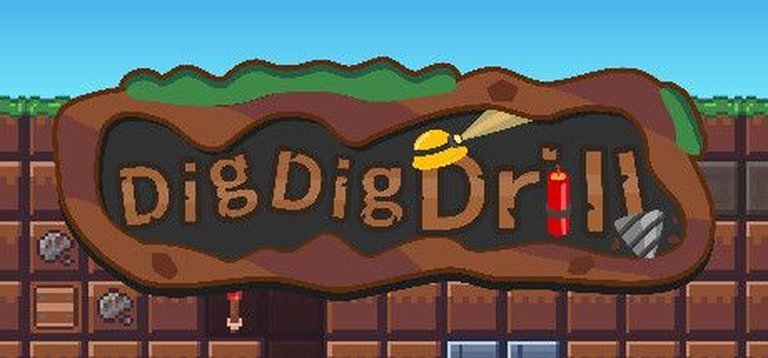
DigDigDrill is a casual 2D side-scrolling action-puzzle game set in an underground mining environment. Players control a miner equipped with a drill to excavate soil, gather minerals and treasures, and upgrade their gear through a hack-and-slash inspired crafting system, all while navigating obstacles like trees. Blending elements from classics such as Dig Dug, Boulderdash, and Minesweeper, it offers a relaxing yet engaging experience focused on exploration, resource management, and puzzle-solving in a pixel-art aesthetic.
Gameplay Videos
Where to Buy DigDigDrill
DigDigDrill Mods
DigDigDrill Guides & Walkthroughs
DigDigDrill Cheats & Codes
iOS Version
| Code | Effect |
|---|---|
| eHNhSgvB97N6 | Redeems for Exclusive In-Game Bundle |
| gMqxCFoVPlwD | Redeems for Exclusive In-Game Bundle |
| 2X3cLck8z6C7 | Redeems for Exclusive In-Game Bundle |
| lSQA5M9bIhXY | Redeems for Exclusive In-Game Bundle |
| YEeJb27MSBPs | Redeems for Exclusive In-Game Bundle |
| kcPsNNqGRjNE | Redeems for Exclusive In-Game Bundle |
| MlQq4K9AntIg | Redeems for Exclusive In-Game Bundle |
| ek1yZKiZgSO4 | Redeems for Exclusive In-Game Bundle |
| KWAvZIhYFrlX | Redeems for Exclusive In-Game Bundle |
| vai2kELjZ1eb | Redeems for Exclusive In-Game Bundle |
| TeeJWmWkXTFe | Redeems for Exclusive In-Game Bundle |
Android Version
| Code | Effect |
|---|---|
| eHNhSgvB97N6 | Redeems for Exclusive In-Game Bundle |
| gMqxCFoVPlwD | Redeems for Exclusive In-Game Bundle |
| 2X3cLck8z6C7 | Redeems for Exclusive In-Game Bundle |
| lSQA5M9bIhXY | Redeems for Exclusive In-Game Bundle |
| YEeJb27MSBPs | Redeems for Exclusive In-Game Bundle |
| kcPsNNqGRjNE | Redeems for Exclusive In-Game Bundle |
| MlQq4K9AntIg | Redeems for Exclusive In-Game Bundle |
| ek1yZKiZgSO4 | Redeems for Exclusive In-Game Bundle |
| KWAvZIhYFrlX | Redeems for Exclusive In-Game Bundle |
| vai2kELjZ1eb | Redeems for Exclusive In-Game Bundle |
| TeeJWmWkXTFe | Redeems for Exclusive In-Game Bundle |
DigDigDrill: Review
Introduction: A New Classic Forged in the Cozy Gaming Cavern
In an era dominated by sprawling open worlds, cinematic narratives, and relentless monetization, a quiet revolution simmers in the corners of digital storefronts. It is the rise of the “cozy game”—a design philosophy that prioritizes soothing repetition, tangible progression, and a distinct lack of punitive pressure. From this fertile ground emerges DigDigDrill (known in Japan as ほりほりドリル, HoriHori Dorilu), a 2024 indie title from the small Japanese studio Toorai (often published in partnership with Phoenixx Inc.). On the surface, it is a simple mining collectathon: dig down, collect resources, upgrade your drill, repeat. Yet, beneath its pixelated soil lies a masterclass in minimalist game design, a game that understands the profound satisfaction of a perfectly optimized loop and the meditative power of solitary, goal-oriented work. This review argues that DigDigDrill is not merely a pleasant diversion but a significant pillar in the modern cozy gaming canon. It distills the essence of classic arcade action (particularly Namco’s Dig Dug) and infuses it with the slow-burn, build-crafting psychology of the idle game and the modern “comfort game,” creating an experience that is both instantly accessible and possesses staggering long-term depth. Its legacy is already being cemented by a port to the Nintendo Switch in 2026, a testament to its resonant appeal.
Development History & Context: The Indie Miner’s Pickaxe
Toorai, the sole developer credited on most platforms (with Phoenixx handling publication and the 2026 Nintendo Switch port), represents the archetypal successful indie narrative: a passionate creator leveraging modern tools to realize a specific, focused vision. The game was built in Unity, a game engine that has democratized development but also presents unique constraints for a single developer or tiny team. The choice of a 2D, pixel-art aesthetic is both an artistic statement and a practical one, allowing for a rich visual language without the resource demands of 3D modeling. This aesthetic also places DigDigDrill in a nostalgic dialogue with 8-bit and 16-bit era titles it conceptually references, like Dig Dug (1982) and Boulderdash (1984), while feeling thoroughly contemporary in its UI and “hack-and-slash” equipment systems.
The game’s development timeline, as pieced together from MobyGames and store pages, shows a release across mobile (Android/iOS), Windows, and Mac in late 2024, followed by a physical/digital push to PC storefronts like Steam and GOG and the significantly higher-profile Nintendo Switch port in March 2026. The latter move is a crucial milestone, signaling confidence in the game’s portability and replayability. The “GooglePlayIndieGameFestival2023Japan Top20” award listed on Steam hints at a development cycle that included mobile prototyping and festival circuits, common paths for Japanese indie developers to gain traction before a wider PC release.
DigDigDrill arrived into a gaming landscape increasingly segmented. The “cozy game” category, popularized by titles like Stardew Valley, Animal Crossing, and the Atelier series, had matured. Players were seeking low-stakes, high-reward experiences that could be played in short bursts or long, immersive sessions. Simultaneously, the “roguelite” and “build-crafting” genres (Slay the Spire, Hades) had taught players to derive immense satisfaction from combinatorial system mastery. DigDigDrill sits at the intersection of these trends: it offers the stress-free exploration of a cozy sim with the deep, synergistic build optimization of a hardcore ARPG, all wrapped in the instantly gratifying “crunch” of destructive gameplay. Its lack of enemies, time limits, or failure states (besides an inventory full) is a radical design choice that directly counters the “permanence anxiety” of many contemporary games.
Narrative & Thematic Deep Dive: The Story of the Earth’s Skin
DigDigDrill presents one of the most stark narrative vacuums in contemporary gaming, and this is its first and most brilliant thematic choice. There is no story, no characters, no dialogue, no world-building text. You are a protagonist without a name, a backstory, or a motive beyond the implicit drive to “dig.” This absence is not a lack but a canvas. The game’s narrative is environmental and systemic, told entirely through the act of excavation itself.
The world is a series of descending geological strata. Each layer introduces new rock types (dirt, stone, granite, etc.), new ores (copper, iron, gold, mythril), and new treasures (chests, artifacts). The progression toward the “999th floor” is not a rescue mission or a planetary salvation; it is a pure,ascetic trek downward. This evokes the philosophical concept of “infinite labor”—the Sisyphian task made palatable and rewarding. The theme is one of patient conquest over inert matter. The earth is not hostile; it is passive, a vast puzzle of resources waiting to be understood and disassembled. The only antagonists are physical limitations: your drill’s power, your inventory capacity, and the density of the rock.
The post-999 “additional stages” referenced in the Steam description introduce “curses” (as mentioned in the Nintendo Everything article), which finally inject a layer of opposition. However, these are not narrative foes but systemic modifiers—mechanical twists that challenge your optimized build. A curse might slow movement or reduce drill power, forcing adaptation. This late-game shift subtly reframes the entire journey: the first 999 floors were a tutorial in mastering your tools against a neutral world; the true game begins when the world fights back with subtle, unfair biases.
Ultimately, the game’s story is the player’s own story of incremental mastery. The narrative arc is the evolution of your drill from a basic hand-tool to a multi-effect, synergistic powerhouse. The “treasures” and “special effects” (e.g., “Sight area +5 after brightening up blocks 200 times”) are the plot points. The game argues that meaning can be derived solely from the transformation of tools and the expansion of capability, a deeply empowering and remarkably mature theme for a game with a PEGI 3 rating.
Gameplay Mechanics & Systems: The Drill Forge Deep Dive
DigDigDrill‘s genius lies in its exquisitely tuned core gameplay loop, which can be broken down into four distinct, cyclical phases:
- The Descent (Dig): Using a drill with a fixed horizontal reach, you clear blocks in a 2D side-view plane. The control is direct and physical. There is no combat; you simply erase terrain. This phase is pure tactical destruction. You must decide where to dig: downwards for depth, sideways for ore pockets, or in explosive patterns to maximize a future blast effect. The sound design—a satisfying “crunch” for dirt, a resonant “clang” for stone—is feedback as crucial as the visual.
- The Haul (Collect & Manage): Cleared blocks may reveal ores or chests, which are automatically added to your bag (with a limited capacity). The tension here is resource management. Do you push deeper with a nearly full bag, risking missing rare ores in newly accessible layers, or return to the surface to bank your haul? This is the game’s primary risk/reward moment.
- The Upgrade (Forge): Returning to the surface empties your bag and converts ores into currency. This currency is spent in the puzzle-like smithing system. Drills are built from blueprints that function like Tetris or mosaic puzzles. You have a grid and a set of “ore tiles” (each representing a specific resource and statistic). Placing these tiles into the blueprint grid determines the final drill’s properties: drill speed, power, explosion radius, bag capacity, etc. Some placements unlock special effects or “synergies” (e.g., placing a Fire Ore next to a Blast Tile might add fire damage to explosions). This is where the “hack-and-slash style equipment system” from the Steam description truly manifests; you are not just choosing from a list, but solving for the optimal shape that fits your resources and desired playstyle.
- The Repeat: With a new drill, you descend again, now able to dig faster, break harder rocks, carry more, or explode larger sections. The loop resets, but your capabilities have expanded.
This loop is deceptively simple. The innovation is in the seamless integration of collection, crafting, and action. Every dig is directly tied to a future upgrade. Every upgrade feels immediately tangible in your next dig. The flaw, as noted by the Dutch Gameplay (Benelux) review (“dan heb je het wel gehad”—”then you’ll have had it”), is a potential lack of long-term hooks for some. The core loop, while deeply satisfying, is singular in focus. The “curses” and post-999 stages are critical for countering this, adding the necessary complexity and challenge to sustain engagement beyond the initial 50-100 hours.
The UI/UX is clean and informative, showing drill stats, bag capacity, and floor depth at a glance. The “point and select” interface for the blueprint puzzle is intuitive on mouse and arguably less so on touch/controller, though the Switch port will test this. The 47 Steam achievements are largely progression-based (reach floor X, collect Y of Z), serving as extrinsic goals for completionists.
World-Building, Art & Sound: The Mediative Depths
DigDigDrill presents a world through restraint. The setting is a series of procedurally generated (or hand-crafted layer sets) 2D side-scrolling caverns. There is no sky, no surface village to explore—only your starting base and the infinite, descending dark. This creates a powerful sense of solitude and focus. The visual style is pixel art, but a particularly polished and luminous variant. Blocks “brighten up” as they are mined (referenced in the “Sight area +5” effect), providing a beautiful, glowing feedback loop that turns the act of clearing terrain into a lighting puzzle. The color palette deepens and changes as you descend, with ores shimmering in distinct hues against the dark earth. It’s retro in form but modern in clarity and polish.
The sound design is arguably the game’s secret weapon. Credited to 効果音ラボ (Sound Effect Lab), 効果音辞典 (Sound Effect Dictionary), and OtoLogic, the audio is a masterclass in tactile feedback. Every material has a unique, crunchy, metallic, or woody sound. The “bloop” of a chest appearing, the “whoosh” of a successful long-distance dig, the deep thrum of a large explosion—all are perfectly pitched to satisfy. The BGM by 甘茶の音楽工房 (Amecha no Ongaku Koubou) consists of a small number (player discussions note “only two tracks”) of looping, serene, melodic compositions. This limited soundtrack is a feature, not a bug; it prevents auditory fatigue during long digging sessions and reinforces the meditative, almost hypnotic state the game aims to induce. The music is calm, slightly melancholic, and perfectly suited to the rhythm of repetitive, satisfying labor.
Together, the art and sound create an atmosphere of “cosy dread”—the comforting yet overwhelming scale of the planet’s crust, which you are slowly, methodically unraveling. There is no threat, only scale, and your tools are the instruments of your intimate conquest over that scale.
Reception & Legacy: The Quiet Ascent to the Surface
DigDigDrill has enjoyed a remarkably positive commercial and critical reception, especially for an obscure indie title. On Steam, it has maintained an “Overwhelmingly Positive” rating (95% of 555+ reviews as of early 2026) since its December 2024 release. The Steam Deck compatibility and “Very Positive” recent reviews (92% of last 30 days) indicate strong performance on handheld PC, a crucial factor for its upcoming Switch port. The player score of 95/100 on Steambase corroborates this enthusiasm.
Critical reception is sparser but telling. The Dutch review from Gameplay (Benelux) is the most substantive official critique, summarizing the experience as “Dig Dug with a bit of Boulderdash and Minesweeper, in a casual jacket.” This is an incisive, accurate capsule. It praises the relaxing, endless digging but notes the potential for shallowness (“dan heb je het wel gehad”). This captures the game’s central dichotomy: it is exactly what it sets out to be, and whether that is a profound experience or a fleeting time-killer depends entirely on the player’s affinity for its core loop.
The game’s legacy is still being written, but its influence is perceptible. It stands as a flagship title in the “cosy mining” subgenre, alongside games like SteamWorld Dig (which it is bundled with on Steam) and Wall World. Its pure, enemy-free focus on collection and build-crafting provides a clear alternative to the combat-heavy Minecraft or the management-focused Mining Mechs. The “puzzle-like smithing” system is its most likely legacy element—a blueprint-based crafting method that could be adopted by other collectathon games seeking more player agency in build creation.
Its upcoming Nintendo Switch release (March 18, 2026), announced by Phoenixx and Toorai, is the single most important event for its historical standing. Porting to the world’s dominant handheld console validates the game’s design for “on-the-go” sessions, a core tenet of the cozy genre. The Switch’s audience is perfectly aligned with DigDigDrill‘s recommended player base: those seeking relaxing, grinding, collectible-driven experiences.
Conclusion: A Definitive Verdict on an Underground Masterpiece
DigDigDrill is not a game that will redefine graphics, revolutionize storytelling, or capture mainstream headlines. It is, instead, a perfect distillation of a specific, satisfying fantasy: the fantasy of the skilled artisan, the efficient miner, the master of their tools. Its narrative is the progression of your drill’s stats; its world is the cumulative glow of a million excavated blocks; its theme is the quiet triumph of systematic optimization.
For the player who finds joy in the clink of a perfect combo in a slot machine, the snap of a perfectly placed Tetris piece, or the satisfying chime of a resource counter filling, DigDigDrill is an essential experience. Its flaws are the flip side of its virtues: the lack of narrative and combat will leave some cold, and the core loop, while deep, may not evolve enough for hundreds of hours for all but the most dedicated collectors.
Historically, it represents a culmination of the “cozy” indie movement’s first decade, taking the solitary, repetitive work simulation and injecting it with the deep progression hooks of the ARPG. It proves that a game can be both utterly simple in premise and staggeringly complex in its build possibilities. Its successful jump from PC to a flagship handheld console secures its place as a modern classic of the meditative, collectathon genre. In the grand museum of video game history, DigDigDrill will not hang in the main hall beside The Legend of Zelda or Final Fantasy. Instead, it deserves a revered, quiet corner of its own—a cozy cavern where players can sit, dig, forge, and lose themselves in the timeless rhythm of creation through destruction. It is, in its own quiet way, a masterpiece.
Final Score: 9/10 – A flawless execution of its singular vision, establishing a new gold standard for the cozy mining sim.