
- Release Year: 2008
- Platforms: Macintosh, Windows, ZX Spectrum
- Publisher: Tardis Remakes
- Developer: Tardis Remakes
- Genre: Action
- Perspective: Top-down
- Game Mode: Single-player
- Gameplay: Arcade, Enemy Avoidance, Fruit Collection, Projectile Throwing
- Setting: Farm, Jungle
Description
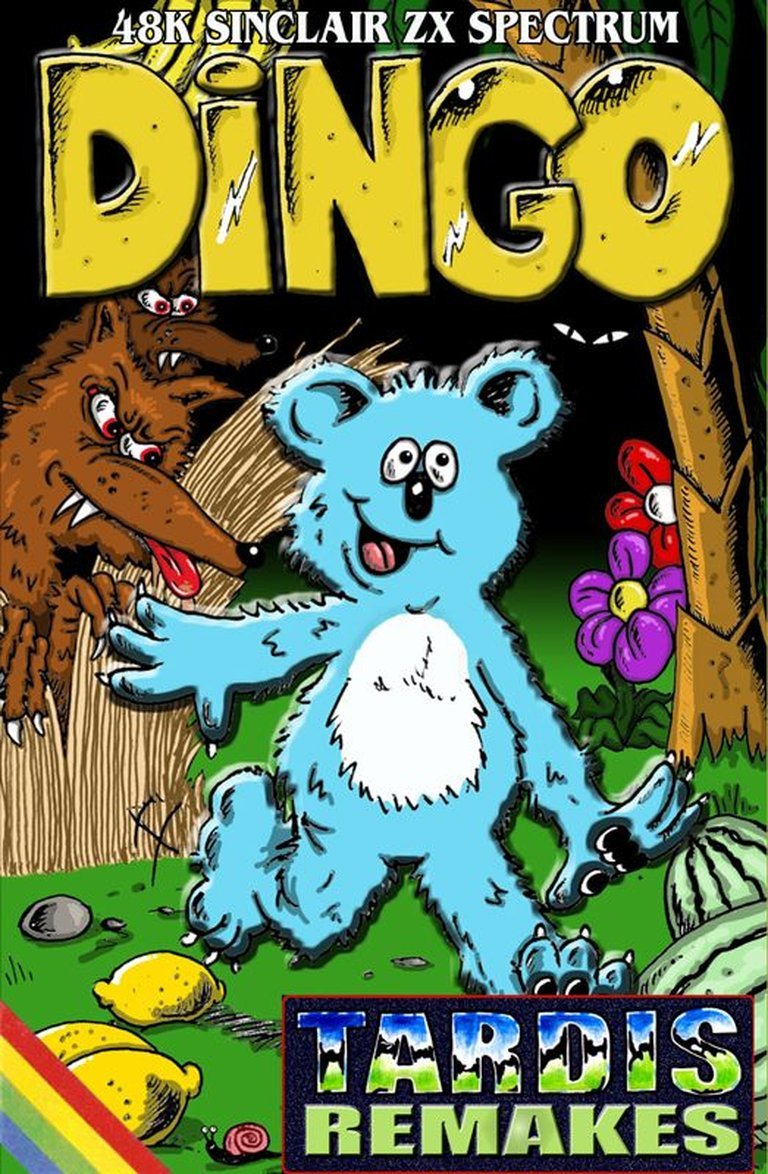
Dingo is a top-down arcade action game and remake of a 1983 arcade title by the creators of ‘Ultimate Play the Game’. Set in a jungle, players control Big Ted the koala, who must harvest his melon patch while defending against evil dingoes that stomp on fruit and retaliate by throwing projectiles back. With fixed/flip-screen visuals and arcade-style gameplay, the challenge involves collecting fruit to stun dingoes while avoiding contact to preserve Ted’s three lives.
Where to Buy Dingo
PC
Dingo Reviews & Reception
hardcoregaming101.net : In the end, there’s little reason to recommend Dingo, aside from the pedigree behind it.
Dingo: Review
Introduction
In the annals of video game history, certain titles exist as footnotes—obscure artifacts from a bygone era, remembered only by the most dedicated archivists. Dingo is one such relic. A 1983 arcade game created by the pioneers of Ultimate Play the Game (laterRare), it has long languished in the shadow of the studio’s more celebrated achievements like Jetpac and Atic Atac. Yet, in 2008, a passionate remastering effort by Tardis Remakes breathed new life into this forgotten gem, offering modern audiences a chance to experience a raw, unfiltered slice of early arcade action. This review delves deep into Dingo’s legacy, dissecting its gameplay, narrative, and cultural significance to argue that beneath its simplistic veneer lies a surprisingly potent artifact—a game that, while flawed, encapsulates the unbridled creativity and technical constraints of its time.
Development History & Context
#### Origins and Obscurity
The original Dingo emerged in 1983, a product of Ashby Computer & Graphics, the studio behind Ultimate Play the Game. At the zenith of their influence, Ultimate was renowned for pushing the boundaries of 8-bit technology with titles like Sabre Wulf and Knight Lore. Dingo, however, stands apart as a straightforward arcade chase game—a stark contrast to their more ambitious adventures. Its vertical-screen design was typical of early arcade cabinets, emphasizing reflexes over narrative depth. Despite Ultimate’s pedigree, Dingo was met with indifference. It received no ports, no sequels, and was conspicuously omitted from later retro compilations. Even Rare’s own archives treat it as a ghost—a footnote acknowledged only in a fleeting 2015 tweet by founder Tim Stamper, who shared a sales flyer for the game with the caption, “DINGO WILL REMEMBER YOU.”
#### The Tardis Remakes Revival
Decades later, Tardis Remakes—a collective dedicated to preserving gaming history—undertook the game’s resurrection. Their 2008 Windows release, followed by Mac and ZX Spectrum versions in 2011, transformed Dingo from a forgotten arcade cabinet to a digital artifact. The remake preserved the core mechanics but adapted the screen orientation from vertical to horizontal, a pragmatic choice to accommodate modern displays. This shift altered the pacing but retained the game’s frantic top-down essence. The development was a labor of love by a small team: programmer Søren Borgquist (under the alias Sokuran), and artist/musician Mark R. Jones. Their work underscored a broader trend in the late 2000s: a surge of indie remakes celebrating arcade simplicity amid an industry increasingly dominated by cinematic, narrative-driven experiences.
Narrative & Thematic Deep Dive
#### Plot and Characters
Dingo’s narrative is a microcosm of arcade storytelling: minimalist yet evocative. Players control Big Ted, a koala whose life’s work—a sprawling melon patch—faces existential peril. A pack of “evil dingoes” has invaded the jungle, stomping on his harvests with malicious glee. The plot unfolds through the gameplay loop: harvest all fruit to advance, or lose the patch to the marauders. There are no cutscenes, no dialogue, only the silent drama of a guardian defending his bounty against relentless foes. The dingoes, rendered as pink, vaguely canine sprites, embody cartoonish villainy—their sole motivation to destroy Ted’s labor.
#### Themes and Symbolism
Beneath its surface, Dingo explores primal conflicts: order vs. chaos, stewardship vs. destruction, and the futility of perfection. Big Ted represents the precarious balance of cultivation—nurturing nature only to have it ravaged by external forces. The dingoes, meanwhile, are agents of entropy, their “stomping” a metaphor for senseless destruction. The fruit itself symbolizes fragility: once thrown, it’s consumed, wasted, and lost—underscoring the ephemeral nature of resources and victories. This lack of complexity is intentional. Dingo is not a story about heroes or villains but about survival in a hostile world, where success is measured by persistence, not glory.
Gameplay Mechanics & Systems
#### Core Loop and Controls
At its heart, Dingo is a masterclass in distilled arcade design. The objective is deceptively simple: traverse a single-screen melon patch, collect all fruit while avoiding dingoes, and repeat across increasingly difficult levels. Controls are minimalist—directional movement and a single action button for throwing fruit. Yet this simplicity masks a tense, high-stakes loop. Each fruit collected depletes the field, forcing Ted into tighter spaces as the dingoes close in.
#### Combat and Defense
The game’s innovation lies in its mutual-throw mechanic. Ted can stun dingoes by hurling fruit at them, but the dingoes retaliate by picking up and throwing fruit back. This creates a dynamic risk-reward system: stunning an enemy offers temporary safety but wastes a potential point. The timer on throws (fruit are instantly consumed) adds urgency, demanding quick decisions. With only three lives and no health bars, Dingo punishes recklessness, rewarding patience and pattern recognition. Levels escalate by introducing more dingoes and faster movement, transforming the melon patch from a garden into a gauntlet.
#### UI and Progression
The interface is brutally functional: a life counter, score display, and level indicator. There’s no narrative framing, no power-ups—only the unrelenting pursuit of completion. This austerity is Dingo’s strength. In an era of bloated RPGs and open worlds, its focus on pure arcade action feels radical. Yet, its rigidity is also a flaw. The lack of variety in enemy behavior (dingoes move and throw randomly) limits strategic depth, reducing the game to a test of reflexes rather than intellect.
World-Building, Art & Sound
#### Visual Design and Atmosphere
The remake’s art pays homage to the original’s 8-bit roots. Big Ted is rendered as a recognizable koala, his wide eyes conveying vulnerability. The melon patch bursts with color—vibrant greens, reds, and yellows—contrasting against the dingoes’ muted pink. The jungle setting, though static, evokes a sense of lush, untamed wilderness. The fixed-screen design creates a claustrophobic tension; as fruit disappear, the open field shrinks into a deadly maze. This visual economy is effective, but the remake’s horizontal orientation occasionally distorts the original’s vertical rhythm, making movement feel less precise than in the arcade.
#### Sound Design and Music
Mark R. Jones’ soundtrack is a triumph of atmospheric chiptune. A frantic, looping piano melody mimics the urgency of the chase, its tempo rising as the screen fills with enemies. Sound effects—thuds for fruit throws, yelps for dingo stuns—are punchy and immediate. The music’s relentless cheerfulness clashes with the game’s stakes, creating a darkly humorous tone: a frantic battle set to a jaunty tune. This dissonance reinforces Dingo’s theme of absurd survival, turning its chaos into a ballet of pixelated mayhem.
Reception & Legacy
#### Launch and Critical Silence
Upon its 1983 debut, Dingo vanished without a trace. Contemporary reviews are nonexistent; it was overshadowed by Ultimate’s other releases and the arcade market’s saturation of maze-chase games (e.g., Pac-Man clones). The 2008 remake fared little better. Niche retro gaming communities embraced it as a curiosity, but mainstream critical reception was muted. Metacritic and other aggregated platforms show no scores, reflecting its status as a cult item. Its legacy rests not on innovation but on preservation—a testament to Tardis Remakes’ dedication to gaming archaeology.
#### Enduring Influence
Dingo’s true impact lies in its historical context. It represents a bridge between the golden age of arcade games and the modern indie movement. Its revival in 2011 for the ZX Spectrum—a platform it was never originally intended for—highlights the community’s role in rescuing forgotten titles. While it hasn’t directly inspired subsequent games, its ethos of minimalist, high-stakes design echoes in titles like Super Hexagon or Laser Dolphin (another obscure title by Dingo Games). For enthusiasts, Dingo is a Rosetta Stone: a relic that reveals how early developers distilled gameplay to its essence, proving that a single-screen, three-life challenge could still evoke profound tension.
Conclusion
Dingo is a paradox: a game devoid of ambition yet brimming with character. As a remaster, it faithfully resurrects the 1983 arcade experience, transforming technical limitations into strengths. Its core loop of harvesting, fleeing, and throwing is a masterclass in tension—a pressure cooker of reflexes and risk. While its narrative and mechanics are primitive by modern standards, this simplicity is its charm. In an industry obsessed with scale and spectacle, Dingo reminds us that gaming’s power lies in its ability to distill complex emotions into pixelated moments of triumph or defeat.
Verdict: A flawed but fascinating artifact. Dingo will never rank among gaming’s greatest works, but as a historical document, it is invaluable. It is the ghost in Rare’s machine—a reminder that even forgotten games can offer profound insights into the medium’s evolution. For the curators and historians, it is a treasure; for casual players, it is a challenging, charming diversion. In either case, Dingo deserves its place in the pantheon of gaming curiosities—a testament to the fact that sometimes, the smallest games leave the biggest footprints.