
- Release Year: 1994
- Platforms: 2, OS, Windows 16-bit, Windows
- Publisher: DynoTech Software, The Thompson Partnership
- Developer: DynoTech Software
- Genre: Educational
- Perspective: Top-down
- Game Mode: Single-player
- Gameplay: Maze, Spelling challenges, Turn-based
- Setting: Fantasy, Prehistoric
Description
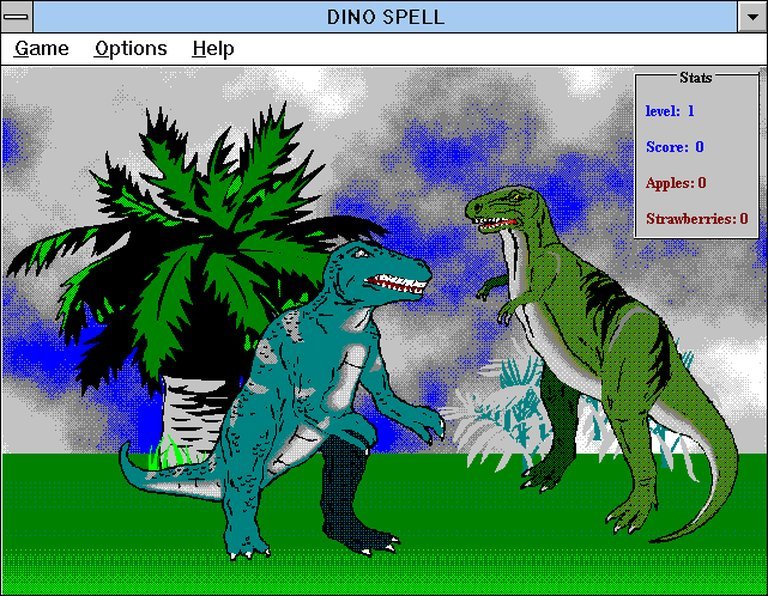
Dino Spell is a shareware educational game for children aged 7-12, set in a colorful top-down maze world where players guide Derik the Dinosaur to recover hidden fruits stolen by the jealous Rex the Tyrannosaurus. The game teaches basic spelling through interactive challenges triggered when Derik encounters obstacles or fruit, requiring players to complete words or select correct spellings using mouse and keyboard controls.
Dino Spell Free Download
Dino Spell Guides & Walkthroughs
Dino Spell: Review
Introduction
In the vibrant, pre-Internet boom of the 1990s, educational software thrived as parents sought engaging tools to supplement classroom learning. Among the most charming artifacts of this era is Dino Spell, a 1994 shareware title from DynoTech Software that masterfully blended whimsy with pedagogy. As part of the celebrated “Dino Trilogy”—alongside Dino Numbers and Dino Match—it carved a niche by using the timeless appeal of dinosaurs to demystify spelling for children aged 7–12. This review dissects Dino Spell‘s intricate design, contextual legacy, and enduring relevance in the landscape of edutainment, arguing that its simplicity and heartfelt narrative make it a quintessential piece of gaming history—a title that proved educational games could be both instructive and genuinely delightful.
Development History & Context
DynoTech Software: The Pioneering Vision
Founded in 1994 in Missouri by James Lindly (Vice-President) and David W. Carlson (President), DynoTech Software emerged from a small, passionate team equipped with a decade of combined experience. Their vision was clear: create accessible, shareware-based educational games that prioritized fun over rote memorization. Dino Spell was their third release, following Dino Numbers and Dino Match, cementing a “Dino Trilogy” that would become a hallmark of 90s edutainment. The studio’s collaborative ethos is evident in the credits, which list eight contributors, including artists Anthony Powers (animation) and Donna Carlson (backgrounds), and crew members like Paul Davidson and Melissa Berger. This small-scale, hands-on development approach allowed for rapid iteration but also constrained the game’s scope, reflecting the resources of a pre-indie-era studio.
Technological Constraints and the Shareware Model
Developed initially for Windows 16-bit (later ported to OS/2 in 1996 and Windows in 1997), Dino Spell operated within the modest technical parameters of the early 1990s. It required a 386+ processor, 4MB RAM, and an optional sound card—specifications that made it accessible to households with entry-level PCs. The shareware model was central to its distribution: the trial edition offered only two levels, while the registered version (priced at $20-$25) unlocked 30 levels and a word-list manager for custom spelling lists. This model balanced accessibility with monetization, allowing DynoTech to leverage the burgeoning shareware networks of platforms like Tucows and Archive.org. The 1994 release timing was strategic: it capitalized on the rise of Windows 3.1 and the educational software boom, competing with titles like Mario Teaches Typing while carving a distinct identity through its dinosaur theme.
Gaming Landscape: The Edutainment Explosion
The mid-1990s saw educational games flourish as parents and educators recognized their potential. Companies like MECC and Broderbund dominated, but DynoTech thrived by targeting a younger demographic with bite-sized, focused challenges. Dino Spell stood out by avoiding the complex mechanics of contemporaries like Where in the World Is Carmen Sandiego?, instead opting for a streamlined, maze-based approach. Its inclusion in compilation packs like 100 Great Kid’s Games (1995) and 100 Great Kid’s Games: Vol II (1998) underscored its commercial viability and cultural resonance. Yet, the era’s limitations—such as reliance on physical media and dial-up downloads—meant Dino Spell’s reach was bound to niche communities, a constraint that defined much of early edutainment.
Narrative & Thematic Deep Dive
A Simple Story with Profound Themes
At its core, Dino Spell spins a timeless tale of rivalry and redemption. Rex the Tyrannosaurus, envious of Derik the Dinosaur’s academic prowess, skips school to hide their shared favorite treats—apples and strawberries. Derik, the diligent student, must navigate a maze to recover the fruits but cannot “eat” them unless he correctly answers spelling challenges posed by Rex. This narrative, while minimalist, is rich with thematic undertones. It champions diligence through Derik’s studiousness, contrasting it with Rex’s jealousy and truancy. The lesson is subtle yet impactful: learning is a reward in itself, and knowledge empowers you overcome obstacles. Rex’s transformation from antagonist to reluctant tutor reinforces the idea that even antagonists can engage in education, softening the story’s moralizing tone.
Character Dynamics and Emotional Resonance
Derik and Rex are archetypes designed for immediate child identification. Derik embodies the “good student”—earnest, focused, and rewarded for his efforts. Rex, however, is more nuanced: his struggles with spelling humanize him, making his jealousy relatable rather than villainous. Their shared love for apples and strawberries creates a common ground, framing the conflict as a misunderstanding rather than malice. The game’s dialogue is sparse but effective, limited to text prompts during challenges. Rex’s taunts (“Can you spell it? I bet you can’t!”) are playful rather than harsh, turning anxiety into engagement. This psychological subtlety ensures young players aren’t intimidated but motivated to prove themselves.
Symbolism and Metaphor
The maze acts as a metaphor for the winding path of learning, with each fruit representing a milestone of achievement. Obstacles like Rex’s “fake trees” symbolize distractions or pitfalls in education. The spelling challenges themselves are framed not as tests but as keys to unlocking rewards, reframing academic effort as a game. Even the bonus items—strawberries, golden apples—carry weight, suggesting that optional challenges deepen understanding. This symbolic layer elevates Dino Spell beyond rote learning, embedding educational values into its very structure.
Gameplay Mechanics & Systems
Core Loop: Maze Navigation and Spelling Challenges
* Dino Spell*’s gameplay revolves around a top-down maze where players guide Derik using arrow keys. The objective is to collect all apples and strawberries on each level, but interaction is gated by spelling mini-games. When Derik touches fruit, Rex appears with a “Spell the Word” challenge: a list of words is displayed, and a partially completed word (e.g., “app…”) must be typed using a mouse-driven on-screen keyboard. This dual input system—keyboard for movement, mouse for interaction—was innovative for its time, catering to different player preferences. The challenges escalate in difficulty, progressing from simple three-letter words to complex multisyllabic terms as levels advance.
Puzzle Variety and Player Agency
Beyond the primary spelling challenges, the game introduces optional “Pick the Correct Spelling” puzzles. When Derik encounters obstacles like fake trees, players are presented with jumbled letters (e.g., “e,” “r,” “t,” “o”) and must select the one that forms a valid word (e.g., “to”). These puzzles reward points but are non-essential for progression, allowing players to engage with difficulty at their own pace. This design accommodates diverse skill levels, ensuring both struggling and advanced learners remain challenged. The registered version’s 30 levels and customizable word lists further enhance replayability, letting parents or teachers tailor content to specific curricula.
Progression and Reward Systems
Levels are structured to mirror educational scaffolding. Early stages focus on common nouns (“cat,” “dog”), while later levels incorporate adjectives, verbs, and thematic vocabulary (e.g., “dino,” “spell”). Completing a level triggers a celebratory animation and score tally, with bonus items like golden apples offering extra points. The absence of lives or failure states reduces frustration, emphasizing mastery over punishment. High scores are tracked, fostering friendly competition, but the game’s true reward is narrative: each collected fruit brings Derik closer to victory, reinforcing the idea that learning yields tangible progress.
UI and Interface Design
The interface is a study in 90s minimalism. A fixed-screen display shows the maze, with Derik’s movements limited to grid-based steps. The spelling interface overlays the game world, featuring a clear list of words and a functional keyboard. Visual cues—color-coded fruits, blinking obstacles—guide players without text clutter. Sound effects (e.g., chimes for correct answers, growls for errors) provide immediate feedback, though they are optional to accommodate classroom use. This accessibility reflects DynoTech’s understanding of its audience: young players need clarity, not complexity.
World-Building, Art & Sound
A Prehistoric Playground
The game’s world is a vibrant, child-friendly prehistoric environment. Mazes are set against simple but charming backdrops—lush green fields, rocky outcrops, and cartoonish trees—that evoke a primeval yet approachable setting. The maze layout itself is a character, with narrow corridors and dead-end paths that encourage exploration. This world-building is functional: the maze’s design ensures players encounter spelling challenges frequently, embedding education into exploration. Derik and Rex are rendered as expressive, chunky dinosaurs with exaggerated features—Derik’s wide eyes and Rex’s snarling grin—making them visually distinct and emotionally resonant.
Art Direction and Aesthetic
Developed by Anthony Powers (animation) and Donna Carlson (backgrounds), the art leans into its 16-bit constraints with bold colors and clean lines. Derik’s idle animations—a playful hop or a curious head tilt—add personality, while Rex’s appearances are framed dramatically, with shadows and scaling to emphasize his role as a hurdle. The fruit is meticulously detailed: apples are red and glossy, strawberries are dotted with seeds. These choices create a tactile, inviting world that offset the era’s often-primitive graphics. The fixed-screen flip mechanic, though limiting by modern standards, gave the game a storybook-like quality, with each “page” of the maze feeling like a new scene.
Sound Design and Atmosphere
Sound is Dino Spell’s secret weapon. The registered version includes cheerful MIDI tunes that loop like a playground soundtrack, punctuated by sound effects: Derik’s footsteps, Rex’s comical roars, and a satisfying “ding” when a word is spelled correctly. Sound, while optional, transforms the experience from a passive exercise to an immersive adventure. The absence of voice acting is notable but intentional—it forces players to engage with text, reinforcing literacy skills. This auditory layer, combined with the visuals, creates a cohesive atmosphere where learning feels like play.
Reception & Legacy
Launch Reception: A Quiet Impact
* Dino Spell* arrived in 1994 with little fanfare in mainstream gaming media. Metacritic and GameFAQs show no critic reviews, reflecting the era’s dismissal of edutainment as “real” games. Yet, its shareware model ensured grassroots popularity. Online communities on platforms like Usenet and early forums praised its approachability, while parents appreciated its lack of violent or inappropriate content. The inclusion in 100 Great Kid’s Games compilations underscored its commercial success, positioning it alongside classics like Carmen Sandiego. However, its influence was largely confined to educational circles, with no major industry awards or sequels.
Evolution of Reputation
Over time, Dino Spell has been reassessed as a relic of a bygone era. Retro-oriented sites like Alxala’s World and Giant Bomb revisit it with nostalgic fondness, noting its “fun to play” simplicity. Modern educators cite its effective integration of narrative and mechanics, contrasting it with today’s gamified learning apps, which often prioritize engagement over substance. The game’s preservation on the Internet Archive (with over 1,000 downloads) attests to its enduring appeal among abandonware enthusiasts and retro gamers. While not a landmark title like Oregon Trail, it represents the artisanal spirit of 90s edutainment—small, focused, and crafted with love.
Influence on Edutainment
* Dino Spell’s legacy lies in its trilogy structure. The *Dino Trilogy’s success demonstrated that themed, interconnected educational games could build brand loyalty, a model later adopted by series like JumpStart. Its shareware tactics—limiting content to incentivize purchases—became a blueprint for freemium apps. More importantly, it normalized the idea that spelling could be fun, paving the way for titles like Word Munchers and modern hits like Duolingo. DynoTech’s later shift to business software in the 2000s marked the end of an era, but Dino Spell remains a touchstone for developers seeking to merge education with play.
Conclusion
Dino Spell is more than a nostalgic curiosity; it is a masterclass in targeted design. Within the constraints of 1990s technology, DynoTech Software crafted a game where every element—from the jealous-dinosaur narrative to the mouse-driven spelling interface—served its educational mission. Its simplicity is not a flaw but a strength, proving that engaging mechanics and heartfelt storytelling can transcend graphical limitations. While its impact was quiet in the gaming mainstream, it resonated deeply with its intended audience, becoming a beloved staple of childhood bedrooms and school computer labs. Today, Dino Spell stands as a testament to the power of edutainment: it didn’t just teach spelling; it taught that learning could be an adventure. In the annals of gaming history, it is a humble yet vital artifact—a reminder that some of the most enduring games are those with the simplest, most important goals.