
- Release Year: 2003
- Platforms: Windows
- Publisher: GameOver-Games, Ltd, Play.com.pl
- Developer: GameOver-Games, Ltd, Play.com.pl
- Genre: Action
- Perspective: Side view
- Game Mode: Co-op, Single-player
- Gameplay: Arcade, Platform
- Setting: Fantasy
Description
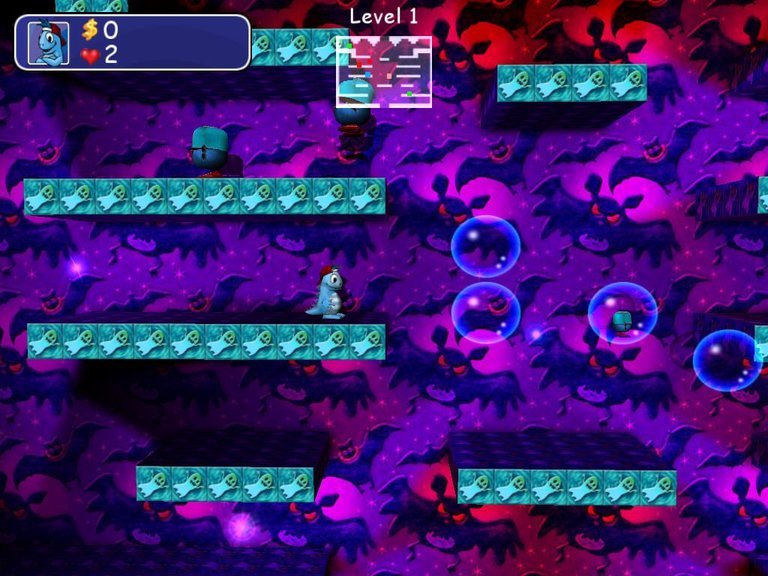
Dinos and Bubbles is a child-targeted platform game and a low-budget variant of Bubble Bobble, set in a fantasy world. Players control one of four dinosaurs to split bubbles, catch enemies, and collect items across 100 two-dimensional levels, with cooperative multiplayer support on a single keyboard.
Gameplay Videos
Dinos and Bubbles Guides & Walkthroughs
Dinos and Bubbles Reviews & Reception
rutracker.org : Весёлая игрушка.
Dinos and Bubbles Cheats & Codes
v1.01
| Code | Effect |
|---|---|
| 010 | get ready |
| 020 | go west |
| 030 | just do it |
| 040 | do your best |
| 050 | be careful |
| 060 | dont cry |
| 070 | viva dinos |
| 080 | mayday |
| 090 | bubble bobble |
| 010 | let it be |
| 020 | listen to your heart |
| 030 | watch your back |
| 040 | bandits on 12 |
| 050 | help your friend |
| 060 | run dinos run |
| 070 | pop bubbles |
| 080 | your dream |
| 090 | finish |
Dinos and Bubbles: A Fossilized Fragment of Bubble Bobble’s Legacy
Introduction: A Ghost in the Machine of Gaming History
In the vast, ever-expanding museum of video game history, some titles are monumental pillars—Super Mario Bros., The Legend of Zelda, Bubble Bobble. Others are the intriguing, often overlooked relics tucked away in dimly lit side rooms, their plaques faded and stories half-told. Dinos and Bubbles (2003) is one such relic. It is not a game that reshaped genres or captured global imagination. Instead, it represents a specific, poignant moment in the post-millennial landscape: the era of low-budget, regionally-focused PC gaming for children, built directly upon the bones of arcade classics. This review will argue that Dinos and Bubbles is a fascinating case study in derivation, localization, and the quiet persistence of a core gameplay loop. It is a game that understands the Bubbles but misses the Bobble, offering a technically proficient yet spiritually hollow iteration of a beloved formula, preserved now primarily as a data point on the breadth of the Bubble Bobble variant tree and a nostalgic artifact for a small, region-specific audience.
Development History & Context: From Czechoslovakian Cabinets to Polish PCs
1. The Studio and the Vision: The game was developed and published by GameOver-Games, Ltd in conjunction with Play.com.pl. Information on GameOver-Games is scarce, but the dual association with a Polish publisher/retailer (Play.com.pl) strongly suggests a Central or Eastern European origin, likely Polish development targeting the regional PC market. This was a common model in the early 2000s: small studios creating affordable, family-friendly titles for the burgeoning home PC audience in post-Soviet states and Eastern Europe, often relying on distribution via demo discs bundled with magazines or sold at kiosks, as hinted by user memories from “Komputer för alla demo cds.” The “vision” was not one of innovation but of accessibility and capitalization on established, beloved intellectual property.
2. Technological Constraints & Era: Released on January 1, 2003, for Windows (98/2000/Me/XP), the game existed in a transitional technological window. The system requirements—Pentium III 700 MHz, 64 MB RAM, DirectX 8 drivers, and a 3D accelerator—were modest for the time but indicate an attempt to use then-contemporary 3D hardware. The key twist is that this 3D power was marshaled to render a 2D scrolling gameplay plane. This was a common cost-saving and stylistically nostalgic technique, allowing for pre-rendered or simpler 3D assets (sprites, backgrounds) while avoiding the complexity of true 3D level design and physics. It speaks to a development team constrained by budget and expertise, leveraging the visual “pop” of 3D graphics without the systemic burden of a 3D world.
3. The Gaming Landscape: 2003 was a year dominated by 3D behemoths (Call of Duty, KOTOR, Prince of Persia: Sands of Time) and the final gasps of the PlayStation 2/Xbox launch era. For the PC children’s market, space was crowded with edutainment, simple arcade ports, and licensed cartoon titles. Dinos and Bubbles entered this arena not as an innovator but as a spiritual successor to a legendary arcade franchise. Its primary competition was not modern kids’ games, but the enduring legacy of Bubble Bobble itself and its many sequels/variants (Bubble Symphony, Puzzle Bobble). It was a game fighting for attention on the crowded “budget CD-ROM” shelf, relying on the recognizable “bubble-blowing dinosaur” concept and a low price point.
Narrative & Thematic Deep Dive: The Legend of the Lost Fire
The narrative of Dinos and Bubbles is presented in its source descriptions with a charming, mythic simplicity. It is a “legend” or a “quest” framework, explicitly designed to be comprehensible and engaging for its child target audience.
1. The Core Lore: The game establishes a profound mythological shift for its protagonists. Dinosaurs, as “relatives” of dragons, once possessed the awe-inspiring, elemental power of fire-breathing. This innate ability was stolen by a “treacherous evil sorcerer.” The theft is not merely a physical disarmament but a symbolic reduction. The mighty, primal force of fire is replaced by the gentle, ephemeral, playful force of bubbles. This is the central thematic conceit: a story of loss, adaptation, and reclamation.
2. The Characters as Archetypes: The four selectable dinosaurs are not individuals with personalities but gender-coded archetypes: Blue and Green are explicitly “boys,” Pink and Orange are “girls.” This binary, color-coded selection is a clear, unambiguous design choice for its young players, allowing immediate identification without narrative complexity. Their personalities are defined by their function: they are cheerful, resilient, and bubbling (literally) with potential.
3. The Quest and its Symbolism: The ultimate goal is to “regain their lost ability and defeat the evil sorcerer.” The journey through 100 levels is thus a heroic epic of restoration. Each caught enemy and collected item is a step closer to undoing the sorcerer’s corruption. The “fire” they seek is multilayered: it is literal (their breath weapon), symbolic (their heritage, power, identity), and metaphorical (the “fire” of adventure and victory). The antagonists—the creatures they trap in bubbles—are not given motivation or backstory; they are simply obstacles (“monsters”) in the sorcerer’s domain, part of the corrupted world the dinos must cleanse. The narrative is pure, unadulterated fairy tale structure: a wrong to right, a villain to defeat, a treasure (fire) to reclaim.
Gameplay Mechanics & Systems: The Bubble Bobble Blueprint
Dinos and Bubbles is defined by its near-identical adherence to the Bubble Bobble (1986) rule set, a deliberate design choice to tap into established player muscle memory and affection.
1. Core Gameplay Loop: The loop is quintessential arcade precision:
* Move/Jump: Navigate the 2D platforming stage.
* Blow Bubbles: Primary action. Pressing the button fires a bubble in the facing direction. Bubbles travel a fixed distance and can trap enemies who come into contact with them.
* Pop Bubbles: The dinosaur character (spikes on back/head) can jump into and pop a trapped enemy’s bubble, defeating it and turning it into a collectible item (usually fruit for points). This is the only offensive mechanism.
* Clear the Stage: To progress, all enemies on the screen must be caught and popped. This creates a puzzle-like tension where players must manage enemy movement, bubble placement, and their own positioning.
* Collect Items: Stages contain bonus items: point-scoring fruits, power-ups (inferred from Bubble Bobble tradition: speed, fire breath, invincibility), and likely the E-X-T-E-N-D letters for extra lives/level skip, a hallmark of the series.
2. Co-operative Multiplayer: A direct port of Bubble Bobble‘s most beloved feature. Two players on one keyboard can control dinosaurs simultaneously. This transforms the game from a solitary puzzle-platformer into a chaotic, communicative, and deeply social experience. Coordination (or hilarious accidental interference) is key, mirroring the arcade couch-coop that made the original iconic.
3. Structure & Scale: The promise of “100 perfectly designed spectacular levels” speaks to a game built on volume and incremental challenge. Likely, these levels introduce new enemy patterns, terrain hazards (traps, moving platforms), and potentially novel bubble mechanics as the player progresses. However, with no documented innovation beyond the skin-deep 3D visuals, the level design is almost certainly derivative of the original game’s clever, trap-based arenas.
4. Systems Analysis: Innovation vs. Fidelity:
* Fidelity: This is the game’s strength and its weakness. By copying the core mechanics, it guarantees a functional, understandable, and deep arcade experience for fans of the genre. The strategic depth of bubble placement, combo chaining, and enemy management remains intact.
* Lack of Innovation: There is no evidence of new mechanics tied to the “dinosaur” theme (beyond cosmetic character choice) or the 3D presentation. The bubbles behave as they did in 1986. The “fantasy” setting is not mechanized. This makes the game feel like a “skin” for Bubble Bobble rather than a new entry. The only “new” systemic element hinted at is the online high scoreboard, a standard early-2000s feature that connected local high-score rivalries to the nascent online sphere.
5. Potential Flaws: Given its “low-budget” descriptor and reports of technical issues from abandonware forums (e.g., “background absent,” “characters not rendering”), the game may suffer from:
* Software Rendering Issues: The dependence on a 3D accelerator for 2D gameplay could lead to crashes or graphics failures on incompatible or outdated hardware, as reported by a user on RuTracker.org.
* Repetition: 100 levels, built on a single, un-advanced core mechanic, risks significant repetition without compelling new enemy types, hazards, or power-up variations to sustain interest.
* Thin Progression: No RPG-like stats or permanent upgrades are mentioned. Progression is purely skill-based and level-based.
World-Building, Art & Sound: A 3D Veneer on a 2D Foundation
1. Visual Direction & Atmosphere: The most striking declared feature is the “3D graphics” over a 2D gameplay plane. This suggests:
* Pre-rendered 3D Sprites: Dinosaurs, enemies, and possibly items were likely modeled in simple 3D software, rendered to 2D sprites. This gives a pseudo-3D, polygonal look common in budget titles of the era (Ecco Jr., certain Rayman locales).
* Backgrounds: Stages may use 2D parallax backgrounds or static 3D-rendered scenes to create depth.
* Aesthetic Goal: The description calls them “nice-looking,” “pleasant,” and notes “monsters are not scary at all. They will rather make you smile!” This is child-targeted aesthetic through and through: bright, saturated colors, soft-edged models, non-threatening cute designs. The “fantasy” setting is a whimsical, magical realm—caves, clouds, perhaps enchanted forests—far from the “cave of monsters” of the original Bubble Bobble lore.
* Contribution to Experience: The 3D veneer was likely a selling point on box art (“Stunning 3D graphics!”) to differentiate it from the 2D sprites of the 1986 original. However, it does not alter the gameplay feel. It creates a mild cognitive dissonance: controlling a sprite that looks like a low-poly 3D model in a side-scrolling plane. The atmosphere is one of bright, safe, cartoonish adventure, perfectly calibrated for young children.
2. Sound Design: Unfortunately, the provided sources are completely silent on audio. We must infer based on genre and target audience:
* Music: Likely cheerful, melodic, looping background tracks in a MIDI or simple tracked format (common for Eastern European PC games). Tempo would increase during “Hurry Up!” moments if the classic mechanic is copied.
* Sound Effects: High-pitched, cartoony sounds for bubble blowing/popping, character jumps, enemy defeats, and item collection. Emphasis on audio feedback that is satisfying but not harsh or violent.
* Voice: Unlikely due to budget, but if present, it would be simple, cheerful exclamations in English (the only language mentioned for interface) or the original Polish.
Reception & Legacy: The Sound of One Hand Clapping
1. Contemporary Reception: Concrete critical reception is virtually non-existent. MobyGames shows a user score of 3.0/5 based on 1 rating and 0 written reviews. This is the digital equivalent of a tumbleweed blowing through an empty saloon. Its sales figures are unknown but, given its “low-budget” nature and distribution through channels like Play.com.pl and demo discs, it was almost certainly a niche, regional success at best—a game found in Polish and Russian households with young children in the early-to-mid 2000s, but not a mainstream hit. The user comments on MyAbandonware (“I used to play this game when I was ten,” “I remember playing this on my Komputer för alla demo cds”) are the most telling evidence: it was a childhood game, experienced throughbundled software or local retail, remembered with specific, personal nostalgia but without cultural footprint.
2. Evolutionary Reputation: Dinos and Bubbles has not undergone a significant reappraisal. It is not celebrated in “best-of” lists, nor is it the subject of deep-dive retrospectives. Its reputation remains that of a cult obscurity. Its presence on sites like MyAbandonware and RuTracker.org, and its discussion in forum threads troubleshooting compatibility, confirms its status as a preservation candidate—a game worth saving not for its quality, but for the snapshot it provides of a specific gaming subculture.
3. Influence on the Industry: It has no discernible influence. It did not spawn sequels, inspire mechanics in major titles, or enter the collective game design vocabulary. Its influence is purely within the lineage of Bubble Bobble variants, where it is a footnote—one of dozens of officially and unofficially licensed adaptations. Its true legacy is as an example of the “regional clone” phenomenon: a game that takes a proven Japanese arcade formula, applies a local coat of paint (dinosaurs instead of generic bobblins, 3D graphics), and services a specific, underserved market (Eastern European children with PCs but no consoles).
Conclusion: Verdict – A Curio, Not a Classic
Final Assessment: Dinos and Bubbles is a competently engineered, charmingly presented, but fundamentally unnecessary game. It demonstrates a clear understanding of what made Bubble Bobble timeless: the tight gameplay loop, the co-op joy, the puzzle-platforming tension. However, it possesses none of the original’s magic, inventiveness, or soul. It is a precise but passionless replication, a game made to fulfill a market niche rather than an artistic vision.
Place in History: Its place is not on a pedestal but in a display case labeled “Regional Variants & Legacy Titles.” It is an important artifact for historians studying the global dissemination of game genres, the economics of low-budget PC development in the 2000s, and the ways in which beloved Japanese arcade properties were localized and re-themed for specific cultural contexts. For the player, it offers a brief, nostalgic trip to a era of demo-disc discovery and simple, cooperative fun. But as a work of game design, it is a fossil—a perfectly preserved example of an earlier form, with no evolutionary steps forward.
Rating: ★★★☆☆ (3 out of 5) – As a functional Bubble Bobble clone, it works. As an original experience, it offers little. Its value lies entirely in its historical curiosity and its capacity to evoke a very specific, personal childhood memory for a small group of players. For everyone else, it is a fascinating what-if: what if Bubble Bobble had been made in Warsaw in 2003 with a slightly higher polygon count and a story about stolen fire? The answer is: it would have been exactly like this.