
- Release Year: 2018
- Platforms: Windows
- Publisher: Ubisoft Entertainment SA
- Developer: Ubisoft Entertainment Inc.
- Genre: Educational
- Perspective: Behind view
- Game Mode: Single-player
- Gameplay: Exploration
- Setting: Ancient Egypt
- Average Score: 79/100
Description
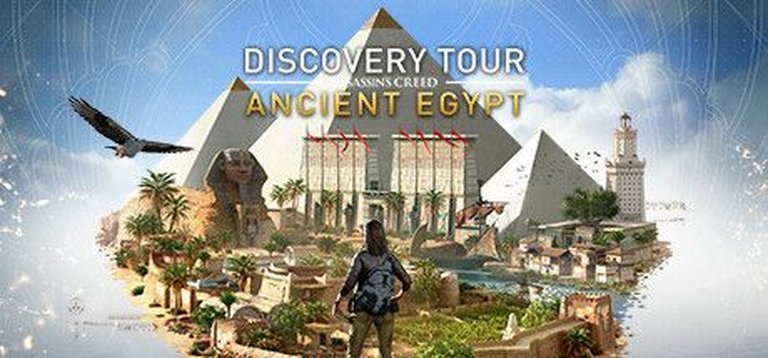
Discovery Tour: Assassin’s Creed – Ancient Egypt is an educational mode and standalone title derived from Assassin’s Creed: Origins, where players freely explore a conflict-free recreation of Ptolemaic-era ancient Egypt through 75 interactive guided tours. Covering topics like the Nile River, pyramids, Alexandria, daily life, Roman influences, and key historical sites, it offers an immersive way to learn about Egypt’s geography, culture, flora, fauna, and history during the time of the Ptolemaic pharaohs.
Gameplay Videos
Where to Buy Discovery Tour: Assassin’s Creed – Ancient Egypt
PC
Discovery Tour: Assassin’s Creed – Ancient Egypt Guides & Walkthroughs
Discovery Tour: Assassin’s Creed – Ancient Egypt Reviews & Reception
rockpapershotgun.com : made with much ambition, but seemingly little understanding of how education actually works.
metacritic.com (75/100): These Discovery tours are a great addition to a very well-known series.
Discovery Tour: Assassin’s Creed – Ancient Egypt: Review
Introduction
Imagine stepping into the sun-baked sands of Ptolemaic Egypt, where the Nile’s life-giving waters carve through vast deserts, the Great Pyramids pierce the horizon, and the bustling streets of Alexandria hum with the intellectual fervor of a Hellenistic powerhouse—all without drawing a blade or dodging a spear. Discovery Tour: Assassin’s Creed – Ancient Egypt, released in 2018 as a free update to Assassin’s Creed Origins (and a $19.99 standalone on PC), transforms Ubisoft’s critically acclaimed open-world recreation of ancient Egypt into a “living museum.” This isn’t just a DLC; it’s a bold pivot from the franchise’s stealth-action roots toward edutainment, curated by historians and Egyptologists. As a game journalist and historian, I’ve long admired how the Assassin’s Creed series weaves historical fidelity into spectacle, but Discovery Tour elevates this by stripping away combat to let the past breathe. My thesis: While imperfect in its delivery, this mode pioneers immersive historical education in gaming, cementing Ubisoft’s worlds as invaluable digital heritage sites that outlast their host games.
Development History & Context
Developed by Ubisoft Montreal—the studio behind Assassin’s Creed Origins—Discovery Tour emerged from a four-year odyssey of research that birthed one of gaming’s most ambitious historical sandboxes. Creative directors Jean Guesdon and Maxime Durand, Ubisoft’s in-house historian, envisioned repurposing Origins‘ Ptolemaic Egypt (circa 49-43 BCE) as an educational tool after teachers approached Ubisoft a decade earlier about using AC games in classrooms. “What they needed was an easily accessible educative tool based in our historical reconstructions,” Durand noted, highlighting collaborations with Egyptologists like Jean-François Champollion scholars and archaeologists who informed everything from hieroglyphs to natron mining.
Launched February 20, 2018, on Windows, PS4, and Xbox One, it arrived amid a gaming landscape dominated by open-world epics like The Legend of Zelda: Breath of the Wild (2017) and Red Dead Redemption 2 (later that year), where procedural fidelity met narrative sprawl. Technological constraints? None crippling—Origins‘ AnvilNext engine handled massive draw distances and dynamic crowds seamlessly, with 42-50 GB storage reflecting dense asset packing. Yet, the era’s anti-piracy like Denuvo DRM caused launch hiccups, as Rock Paper Shotgun (RPS) griped about server woes. Business-wise, it was commercial (standalone PC sales via Steam/Uplay) but free for Origins owners, aligning with Ubisoft’s post-Unity (2014) redemption arc toward quality. This “vanity project,” as some critics dubbed it, responded to Origins‘ praise for its world-building, preempting annualization fatigue by extending asset life—a savvy move in 2018’s live-service boom.
Narrative & Thematic Deep Dive
Lacking a traditional plot, Discovery Tour‘s “narrative” unfolds through 75 guided tours across five thematic pillars: Egypt (regions like Siwa, Faiyum, Memphis; Nile ecology, flora/fauna), Pyramids (Djoser’s Step Pyramid to Giza’s enigmas, Houdin’s internal ramp theories), Alexandria (Greek pharaohs, Cleopatra, Library/Mouseion/Serapeion), Daily Life (mummification, agriculture, medicine, beer/bread/wine), and Romans (forts, aqueducts, crucifixion). These aren’t scripted yarns but scholarly vignettes, narrated by gravelly male (Michael Giunta) and ethereal female (Katherine Dines) voices—evoking museum audio guides, per RPS—delivering bite-sized facts on Ptolemy XIII, Julius Caesar, or Osiris myths.
Themes probe Ptolemaic Egypt’s cultural fusion: Greco-Egyptian syncretism (e.g., Serapis blending Osiris/Apis/Zeus), technological ingenuity (pyramid evolution from Sneferu’s “Bent” to Khufu’s marvels), and daily resilience (natron for mummification, linen fashions). Avatars like Bayek (Medjay hero), Aya, Cleopatra, or even generic Egyptian noblewomen/ Roman soldiers let players embody history, with outfits like Bayek’s “Hedj” (white) or “Irtyu” (blue) underscoring social strata. No dialogue trees or branching paths—it’s expository, sometimes myth-as-fact (e.g., birds devouring Alexander’s flour markers, unquestioned per RPS)—but thematically rich, challenging Eurocentric views by revealing vibrant pyramid colors and Cyrene’s silphium exports. Flaws emerge in superficiality: tours tease armillary spheres or Eratosthenes’ camel-shadow Earth math without depth, blending awe with frustration. Yet, this structure mirrors historiography—piecemeal reconstruction—making Egypt’s timeline from Djoser (2670 BCE) to Cleopatra a mosaic of rediscovery.
Gameplay Mechanics & Systems
At its core, Discovery Tour deconstructs Origins‘ loops into pure exploration: a “behind view,” direct-control walker in a conflict-free world. Combat? Eradicated—weapons holstered, NPCs non-hostile (though poltergeist-like bumping persists). Core loop: Fast-travel via an intuitive tour map (75 icons, filterable by category), follow glowing paths to hotspots, trigger audio/text narration (toggleable), hit “MORE INFO” for redundant transcripts. Free roam beckons: Climb pyramids, swim Nile tributaries, mount horses/chariots for traversal, or activate photo mode for postcard vistas.
Progression is tour completion—unlock none, just personal checklists— with 25 avatars for replayability (e.g., Ptolemaic soldier vs. Greek noble). UI shines: Clean radial menus, timeline overlays, multilingual support (English, French, etc.). Innovations include interactive hotspots (amulets, hieroglyphs) and boat tours (Faiyum), but flaws abound—narrators’ repetitive “jokes” (“My kingdom for a glass of water!”), camera auto-resets during fixed narration, no object interaction beyond tours. Pacing suits 6-7 hour completion (HowLongToBeat), medium difficulty via navigation. It’s a “walking simulator” elevated by scale: Qattara Depression treks or Pharos Island sails feel epic, yet ghost-like detachment (no NPC reactions) underscores its museum ethos. Compared to Origins‘ RPG loot/levels, this is minimalist brilliance—freedom without friction.
World-Building, Art & Sound
Ptolemaic Egypt lives here, arguably gaming’s pinnacle of historical verisimilitude. From Giza’s necropolis (Sphinx riddles, Khafre/Menkaure complexes) to Alexandria’s Heptastadion-divided harbors, every vista pulses: Bustling agorae, thermal baths in Cyrene, crocodile-infested Krokodilopolis. Art direction—credited to Raphael Lacoste, Jean-Claude Golvin—restores polychrome temples (vibrant pinks/blues, contra beige myths), with AnvilNext’s lighting casting golden-hour realism. Deserts shimmer, Nile fauna (hippos, ibises) roam dynamically, hieroglyphs adorn obelisks authentically.
Atmosphere immerses: Crowds chant in agorae, distant chants echo from temples. Sound design amplifies—ambient Nile laps, marketplace haggling, wind-swept sands—bolstering tours on agriculture (seasons, domesticated animals) or rituals (Osiris mummies, amulets). Narration, however, polarizes: Giunta/Dines’ theatrical timbre suits spectacle but grates on dry facts (RPS: “movie trailer” voices), lacking expert interviews or references. Multilingual audio/subtitles enhance accessibility, but no dynamic score disrupts the serene “time machine” vibe. Collectively, these forge an unparalleled sensory portal, where world-building isn’t backdrop—it’s the star.
Reception & Legacy
Launch reception was unscored but polarized: RPS lamented “museum audio tour” superficiality (no Wikipedia links, unexplained jargon like “kerkouros”), deeming it a “colossal dud” educationally yet loving its existence. Gameplay (Benelux) praised it as a “vakkundig” (skillfully made) tool for Ptolemaic lore. Steam’s Very Positive (84% of 164 reviews) and IMDb’s 7.8/10 reflect player delight in sandbox history; MobyGames’ lone 3/5 hints niche appeal. Metacritic user score: Mixed (7.4/10). Commercially, modest—leveraging Origins‘ success—but legacy endures: Spawned Discovery Tour: Ancient Greece (Odyssey, 2019) and Viking Age (Valhalla, 2022), influencing edutainment like Civilization‘s scenarios or VR heritage apps.
Its impact ripples: Teachers integrate it for Egyptology (pyramids, Cleopatra’s siege), studies (Gee 2003, Mayer 2019) validate immersive learning’s efficacy. Ubisoft’s expert collaborations set standards, inspiring VR futures. In AC canon, it nods Bayek/Aya origins sans fiction, evolving the series toward cultural empathy amid 2018’s inclusivity push.
Conclusion
Discovery Tour: Assassin’s Creed – Ancient Egypt distills Ubisoft Montreal’s magnum opus into a serene, scholarly sandbox—75 tours illuminating Ptolemaic wonders from mummification to Meteoroskopion astrolabes—flawed by shallow narration and absent references, yet triumphant in preservation. It transcends DLC status, proving video games as potent history engines: Interactive, scalable, empathetic. In gaming history, it carves a niche beside Civilization or Oregon Trail—not flawless, but foundational. Verdict: Essential for history buffs, a 9/10 milestone. Buy standalone or via Origins; explore, learn, and witness Egypt reborn.