
- Release Year: 2017
- Platforms: PlayStation 4, Windows Apps, Windows, Xbox One
- Publisher: Bethesda Softworks LLC
- Developer: Arkane Studios SASU
- Genre: Action
- Perspective: 1st-person
- Game Mode: Single-player
- Gameplay: Shooter, Stealth
- Setting: Fantasy, Steampunk
- Average Score: 63/100
Description
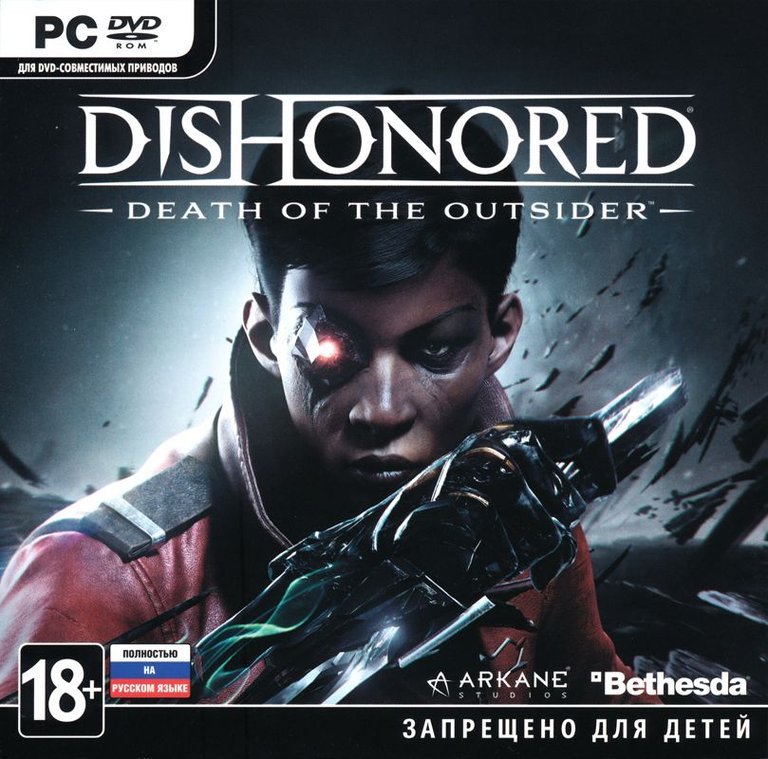
Dishonored: Death of the Outsider is a standalone expansion to the Dishonored series, set in the grim and steampunk-inspired city of Karnaca. Players take on the role of Billie Lurk, a former assassin seeking to kill the enigmatic Outsider, the god-like figure who grants supernatural powers. The game blends first-person action, stealth, and immersive sim elements, offering players a variety of approaches to complete objectives, from lethal combat to non-lethal infiltration. With its richly detailed world and morally ambiguous narrative, the game explores themes of power, redemption, and the consequences of one’s choices.
Gameplay Videos
Where to Buy Dishonored: Death of the Outsider
Dishonored: Death of the Outsider Free Download
Dishonored: Death of the Outsider Mods
Dishonored: Death of the Outsider Guides & Walkthroughs
Dishonored: Death of the Outsider Reviews & Reception
metacritic.com (82/100): A triumphant return to form for the series.
metacritic.com (81/100): Dishonored: Death of the Outsider captures everything that’s great about Arkane’s assassination series, while also showing that it can still surprise.
metacritic.com (7.2/100): Great installment, its the worst of the three but its still amazing.
opencritic.com (82/100): Not as consistently intricate or surprising as Dishonored 2, but still a worthy epilogue that adds depth and atmosphere to the series’ world.
Dishonored: Death of the Outsider Cheats & Codes
PC
Enter codes at the main menu.
| Code | Effect |
|---|---|
| +com_showLoadingScreen 0 | Skips intro videos |
PC
Enter codes at the main menu.
| Code | Effect |
|---|---|
| 451 | Opens the safe in Robbie’s apartment (Mission: One Last Flight) |
| 398 | Opens the locked door leading to the market shop in Upper Cyria (Mission: Follow the Ink) |
| 315 | Opens Morgan Yu safe in the Dolores Michaels Deposit & Loan Bank (Mission: The Bank Job) |
| 379 | Opens Jeorge’s safe in the Dolores Michaels Deposit & Loan Bank (Mission: The Bank Job) |
| 287 | Opens Dr Galvani’s safe in the Dolores Michaels Deposit & Loan Bank (Mission: The Bank Job) |
| 011 | Opens Jindosh’s safe (Vault one) in the Dolores Michaels Deposit & Loan Bank main vault (Mission: The Bank Job) |
| 235 | Opens the safe second from the left (Vault two) in the Dolores Michaels Deposit & Loan Bank main vault (Mission: The Bank Job) |
| 813 | Opens the safe third from the left (Vault three) in the Dolores Michaels Deposit & Loan Bank main vault (Mission: The Bank Job) |
| 455 | Opens the safe to the right of Jacobi and Shan Yun’s (Vault five) in the Dolores Michaels Deposit & Loan Bank main vault (Mission: The Bank Job) |
| 891 | Opens the safe to the far right (Vault six) in the Dolores Michaels Deposit & Loan Bank main vault (Mission: The Bank Job) |
| 962 | Opens the safe in Malchiodi’s room (Mission: A Hole in the World) |
Dishonored: Death of the Outsider – A Masterclass in Immersive Sim Design and Narrative Closure
Introduction: The Final Chapter of the Kaldwin Era
Dishonored: Death of the Outsider (2017) is a standalone expansion to Dishonored 2, developed by Arkane Studios and published by Bethesda Softworks. It serves as the definitive conclusion to the “Kaldwin era,” a narrative arc spanning three games and multiple DLCs, beginning with the assassination of Empress Jessamine Kaldwin in the original Dishonored (2012). This review will dissect the game’s development, narrative depth, gameplay innovations, world-building, critical reception, and legacy, arguing that while it may not surpass its predecessors in every aspect, it is a bold, experimental, and thematically rich finale that redefines the boundaries of the Dishonored franchise.
Development History & Context: A Standalone Experiment
From DLC to Standalone: A Creative Gambit
Originally conceived as downloadable content for Dishonored 2, Death of the Outsider evolved into a standalone title due to Arkane’s ambition to explore radical departures from the series’ established formulas. Lead designer Dinga Bakaba and co-creative director Harvey Smith championed this shift, recognizing that the story of Billie Lurk and the Outsider demanded more than a mere add-on. The decision was also influenced by the studio’s desire to attract new players while rewarding longtime fans—a balancing act that shaped the game’s design philosophy.
Technological and Design Constraints
The game runs on Arkane’s proprietary Void Engine, the same technology powering Dishonored 2, which allowed for seamless integration of assets, mechanics, and visual fidelity. However, the standalone nature of the project imposed constraints:
– Shorter Development Cycle: Unlike Dishonored 2, which had years of development, Death of the Outsider was produced in roughly a year, limiting the scope of level design and narrative complexity.
– Reuse of Assets: Critics and players noted the recycling of locations (e.g., the Royal Conservatory from Dishonored 2), a necessity given the tight schedule.
– Streamlined Systems: The removal of the Chaos System and the simplification of power progression were deliberate choices to encourage experimentation and accessibility.
The Gaming Landscape in 2017
Released on September 15, 2017, Death of the Outsider entered a market dominated by open-world juggernauts like The Legend of Zelda: Breath of the Wild and Horizon Zero Dawn. Yet, it carved a niche as a focused, narrative-driven immersive sim, a genre that Arkane had helped revitalize. The game’s standalone status was a risk—would players invest in a shorter, more linear experience? The answer, as we’ll explore, was a resounding “yes” from critics, though commercial success was modest.
Narrative & Thematic Deep Dive: Killing a God
Plot Summary: A Tale of Revenge, Redemption, and Cosmic Consequences
Set months after Dishonored 2, the game follows Billie Lurk (voiced by Rosario Dawson), a former assassin and protégé of Daud, as she reunites with her mentor to hunt the Outsider (Robin Lord Taylor), the enigmatic, god-like figure who grants supernatural powers to select individuals. The narrative unfolds across five missions:
1. One Last Fight: Billie rescues Daud from the Eyeless, a cult obsessed with the Outsider.
2. Follow the Ink: Billie infiltrates the Eyeless’ stronghold to uncover the location of the Twin-Bladed Knife, the artifact used to create the Outsider.
3. The Bank Job: A heist mission to steal the knife from the Dolores Michaels Deposit & Loan Bank, featuring intricate level design and multiple approaches.
4. The Stolen Archive: Billie retrieves ancient texts revealing the Outsider’s true name and the nature of the Void.
5. A Hole in the World: The climax, where Billie confronts the Outsider in the Ritual Hold, a surreal, time-dilated pocket of the Void.
Themes: Forgiveness, Free Will, and the Cost of Power
The game’s central theme is forgiveness, explored through the relationships between Billie, Daud, and the Outsider:
– Billie and Daud: Their bond is one of mentorship and betrayal. Daud’s redemption arc, which began in The Knife of Dunwall DLC, culminates here as he seeks to atone for his past sins by destroying the Outsider. Billie, meanwhile, grapples with her own guilt over betraying Daud years earlier.
– The Outsider’s Dilemma: The Outsider is revealed to be a tragic figure—a boy sacrificed by an ancient cult, trapped in a dreamlike state for millennia. His “gifts” are not acts of malice but experiments in curiosity, devoid of moral judgment. The game forces players to question: Is the Outsider truly evil, or merely indifferent?
– The Void’s Nature: The game delves deeper into the Void’s lore, portraying it as a sentient, almost Lovecraftian force that bleeds into the mortal world. The Envisioned, humans transformed by prolonged exposure to the Void, embody this horror.
Character Analysis: Billie Lurk’s Paradoxical Existence
Billie Lurk is a fascinating protagonist, distinct from Corvo and Emily:
– A Liminal Being: Due to Emily Kaldwin’s time manipulation in Dishonored 2’s A Crack in the Slab mission, Billie exists in a quantum state—simultaneously whole and maimed. This paradox allows the Outsider to grant her powers without marking her, making her the only person capable of killing him.
– Agency and Voice: Unlike Corvo (a silent cipher) and Emily (a reluctant ruler), Billie is vocally defiant, challenging the Outsider’s authority and questioning Daud’s motives. Her dialogue with the Outsider is some of the most compelling in the series.
– Player Choice and Endings: The game offers two endings:
1. Mercy: Billie spares the Outsider, returning him to mortality. Daud’s spirit speaks the Outsider’s true name, freeing him.
2. Vengeance: Billie kills the Outsider, leaving the Void without a god. This choice leaves Billie feeling “trapped in villainy,” suggesting moral ambiguity.
Dialogue and Writing: A Masterclass in Subtext
The writing in Death of the Outsider is sharper and more philosophical than its predecessors:
– The Outsider’s Monologues: His conversations with Billie are laced with existential dread and dark humor. One standout line: “You’re not here to kill me. You’re here to be disappointed.”
– Daud’s Final Words: His audio logs reveal a man haunted by his past, seeking redemption not for himself but for Billie.
– Environmental Storytelling: Notes, books, and overheard conversations (e.g., the Oracular Sisters’ chants) deepen the lore without exposition dumps.
Gameplay Mechanics & Systems: Innovation Through Simplification
Core Gameplay Loop: Stealth, Combat, and Supernatural Abilities
Death of the Outsider retains the immersive sim DNA of its predecessors, emphasizing player agency and emergent gameplay. However, it introduces key changes:
1. No Chaos System: Unlike previous games, Billie’s actions do not alter the world or endings. This removal is controversial but liberating, allowing players to experiment without fear of “breaking” the narrative.
2. Regenerating Mana: Billie’s powers recharge over time, eliminating the need for elixirs. This encourages constant use of abilities, making combat and stealth more dynamic.
3. Three Fixed Powers:
– Displace: A teleportation ability that replaces Blink. Players mark a location and teleport to it, enabling creative traversal and ambushes.
– Semblance: Allows Billie to steal the faces of living NPCs, creating temporary disguises. This power is narratively justified (the Outsider’s gift) and mechanically versatile (e.g., infiltrating guarded areas).
– Foresight: A time-stopping scout mode that lets Billie plan routes and mark enemies. Less combat-focused but invaluable for stealth runs.
Combat and Stealth: A Refined Experience
- Weaponry: Billie wields a short sword, wrist-mounted crossbow, and new gadgets like the hook mine (a grappling tool that stuns enemies).
- Enemy AI: Guards and cultists are smarter than in Dishonored 2, with improved patrol routes and reactions to noise/visual cues.
- Non-Lethal Options: The game supports pacifist playthroughs, though some contracts (e.g., assassinating a mime) require lethal solutions.
Contracts and Side Content: Optional but Rewarding
- Black Market Contracts: Side missions acquired from black markets add replayability. Examples include:
- Assassinating a mime (a darkly comedic nod to player frustrations with NPCs).
- Stealing a painting by Duke Luca Abele (a callback to Dishonored 2).
- Collectibles: Paintings, bone charms, and audio logs flesh out the world, though some are missable (e.g., the Outsider painting in the first mission).
Level Design: A Mixed Bag of Brilliance and Reuse
The game’s five missions are tightly designed but vary in originality:
1. The Bank Job: A standout heist mission with multiple entry points, security systems, and a collapsing elevator set piece.
2. The Royal Conservatory: Reuses assets from Dishonored 2 but introduces new enemy types (Oracular Sisters) and lore.
3. Shindaerey Mines: A surreal, time-warped finale that ranks among the series’ best levels.
New Game Plus: A Nod to Fans
Completing the game unlocks Original Game Plus, allowing players to use Corvo/Emily’s powers (Blink, Domino, Dark Vision). This mode extends replay value but feels like a missed opportunity to introduce new abilities.
World-Building, Art & Sound: A Dark, Dreamlike Karnaca
Setting: The Underbelly of Karnaca
Death of the Outsider is set entirely in Karnaca, the coastal city introduced in Dishonored 2. However, it explores new districts:
– Albarca Baths: A rundown boxing club hiding the Eyeless’ operations.
– Upper Cyria District: A wealthy enclave with opulent banks and underground fight clubs.
– Shindaerey Mines: A Lovecraftian nightmare, where time bends and the Void seeps into reality.
Art Direction: Whalepunk Meets Eldritch Horror
- Visual Style: The game retains Dishonored 2’s “whalepunk” aesthetic—Victorian architecture, steam-powered machinery, and whale-oil lamps—but infuses it with Void corruption. The Envisioned and Void creatures are grotesque yet mesmerizing.
- Lighting and Atmosphere: The use of shadow and color is masterful. The Ritual Hold, bathed in eerie blue light, contrasts with the golden hues of the bank.
Sound Design: A Haunting Symphony
- Daniel Licht’s Score: The late composer’s final work for the series is moody and atmospheric, blending orchestral swells with dissonant, otherworldly tones. The Outsider’s theme is particularly chilling.
- Ambient Sounds: The whispers of the Void, the clanking of Clockwork Soldiers, and the chants of the Eyeless create an immersive soundscape.
Reception & Legacy: A Divisive but Respected Finale
Critical Reception: Praise for Gameplay, Criticism for Narrative
The game received generally favorable reviews, with critics lauding its gameplay refinements while critiquing its narrative brevity:
– Metacritic Scores:
– PC: 81/100
– PS4: 82/100
– Xbox One: 84/100
– Common Praise:
– Level Design: The bank heist and Shindaerey Mines were highlighted as standout moments.
– Freedom of Play: The removal of the Chaos System and regenerating mana were praised for encouraging experimentation.
– Billie Lurk: Rosario Dawson’s performance and Billie’s defiant personality were well-received.
– Common Criticisms:
– Short Length: The 5-10 hour campaign felt rushed compared to Dishonored 2.
– Reused Assets: Some levels (Royal Conservatory) were criticized for lacking originality.
– Underwhelming Ending: The final confrontation with the Outsider was seen as anti-climactic by some.
Player Reception: A Love Letter to Fans
Player reactions were polarized:
– Fans of the Series appreciated the lore depth, character moments, and gameplay tweaks.
– New Players struggled with the lack of context (e.g., Billie and Daud’s history).
– Purists missed the Chaos System and deeper RPG mechanics.
Awards and Nominations
- Nominated: Outstanding Achievement in Videogame Writing (Writers Guild of America Awards).
- Won: Best PC Game (Ping Awards).
Legacy: The End of an Era
Death of the Outsider concluded the Kaldwin era, wrapping up the stories of Corvo, Emily, Daud, and Billie. Arkane confirmed that future Dishonored games would feature new protagonists and settings, though the series is currently on hiatus. The game’s bold narrative choices (killing a god, removing the Chaos System) have influenced later immersive sims, including Arkane’s Deathloop (2021), which shares thematic DNA with Dishonored.
Conclusion: A Fitting, Flawed, and Fascinating Finale
Dishonored: Death of the Outsider is a flawed masterpiece—a game that dares to break the mold of its predecessors while delivering a thematically rich, mechanically refined experience. It may not reach the narrative depth of Dishonored 2 or the world-building grandeur of the original, but it excels in its focus, offering a tight, experimental conclusion to one of gaming’s most compelling universes.
Final Verdict: 8.5/10 – A Bold, Beautiful, and Bittersweet Goodbye
- For Fans: A must-play epilogue that rewards lore knowledge and offers fresh gameplay twists.
- For Newcomers: Approach with caution—play Dishonored 2 first to fully appreciate the story.
- For the Genre: A testament to the power of immersive sims, proving that simplification can breed innovation.
In the pantheon of Dishonored, Death of the Outsider stands as the black sheep—unconventional, divisive, but undeniably essential. It is not the best in the series, but it is the most audacious, and for that, it deserves to be remembered as a defining moment in Arkane’s legacy.
Post-Script: The Future of Dishonored
With rumors of Dishonored 3 swirling (thanks to Microsoft’s leaked documents), one can only hope that Arkane returns to the Empire of the Isles with the same boldness that defined Death of the Outsider. Until then, Billie Lurk’s journey remains a haunting, beautiful reminder of what makes this series so special: choice, consequence, and the courage to kill a god.