
- Release Year: 2000
- Platforms: Windows
- Publisher: Buena Vista Games, Inc.
- Developer: Engineering Animation Inc.
- Genre: Action, Educational
- Perspective: Diagonal-down
- Game Mode: Single-player
- Gameplay: Mini-games
- Setting: Fantasy
Description
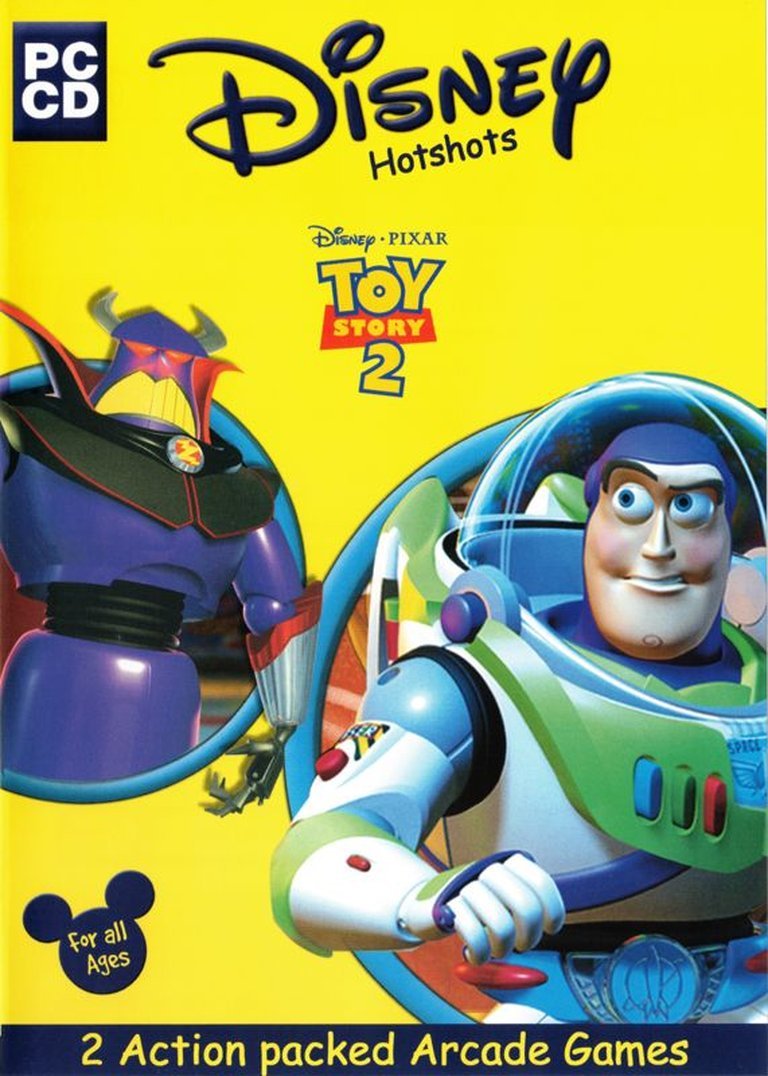
Disney Hotshots: Toy Story 2 – Cone Chaos / Toy Shelf Showdown is a collection of two action-packed mini-games based on the beloved Disney/Pixar film Toy Story 2. Players can enjoy ‘Cone Chaos,’ a fast-paced challenge where characters navigate through obstacles, and ‘Toy Shelf Showdown,’ a competitive game set in Andy’s room. Both mini-games feature direct control and are designed for a single player, offering a mix of action and educational elements in a fantasy setting. The games are also part of the larger Disney’s Activity Center: Toy Story 2 compilation and are installed together via a single process.
Disney Hotshots: Toy Story 2 – Cone Chaos / Toy Shelf Showdown: A Forgotten Gem of Early 2000s Licensed Gaming
Introduction: The Overlooked Legacy of a Pixar Tie-In
In the vast pantheon of Toy Story video games, Disney Hotshots: Toy Story 2 – Cone Chaos / Toy Shelf Showdown (2000) occupies a peculiar niche. Released during the golden age of licensed children’s software, this dual mini-game compilation is often dismissed as mere edutainment fluff—a footnote in the franchise’s gaming history. Yet, beneath its unassuming surface lies a fascinating artifact of early 2000s game design, a product of its time that reflects the technological limitations, creative ambitions, and commercial strategies of Disney Interactive’s Hotshots series. This review seeks to reclaim Cone Chaos / Toy Shelf Showdown from obscurity, examining its development, gameplay, and cultural significance with the rigor it deserves.
Development History & Context: The Hotshots Series and the Pixar Partnership
Developed by Engineering Animation Inc. (EAI) and published by Buena Vista Games, Disney Hotshots: Toy Story 2 was part of Disney’s Hotshots series, a line of budget-friendly, family-oriented games designed to capitalize on the studio’s animated properties. The Hotshots brand, which included titles like Disney Hot Shots: Disney’s Tarzan Jungle Tumble (1999), was positioned as accessible, low-risk entertainment for younger audiences—a stark contrast to the more ambitious (and expensive) console adaptations like Toy Story 2: Buzz Lightyear to the Rescue (1999).
The game’s development coincided with the production of Toy Story 2 (1999), presenting unique challenges. As noted by Glennis McClellan, the game’s senior producer and art director, the team worked under strict secrecy, with many of the film’s newer characters (e.g., Zurg, Jessie, and the Prospector) receiving minimal representation due to Disney’s tight control over assets. This constraint forced EAI to focus on the core cast—Woody, Buzz, and the original toy ensemble—while crafting gameplay that could be developed in parallel with the film’s completion.
Technologically, Cone Chaos / Toy Shelf Showdown was a product of its era. Designed for Windows 95/98/ME/XP, it required modest hardware:
– Pentium 133 MHz processor
– 16 MB RAM
– 4 MB video memory
– 4X CD-ROM drive
These specs reflect the game’s target audience: families with mid-range PCs, likely purchased for educational or casual use. The decision to bundle the two mini-games (Cone Chaos and Toy Shelf Showdown) under a single installer was a practical one, maximizing value while minimizing development overhead.
Narrative & Thematic Deep Dive: A Fragmented but Faithful Adaptation
Unlike its console counterparts, Disney Hotshots: Toy Story 2 does not attempt a cohesive narrative. Instead, it presents two standalone mini-games, each loosely tied to the film’s themes of adventure and camaraderie.
Cone Chaos: A Frogger-Inspired Street Crossing
- Premise: Players guide Woody, Buzz, or other toys across a busy street, dodging traffic cones, cars, and obstacles to reach the other side.
- Themes: The game distills Toy Story 2’s emphasis on teamwork and perseverance into a simple, arcade-style challenge. The street setting evokes the film’s urban chase sequences, while the cone obstacles subtly reference the construction site where Buzz and Woody reunite.
- Dialogue & Characterization: Minimal voice acting is present, with characters offering brief encouragements or reactions. The lack of deep narrative is compensated by the game’s faithful recreation of the toys’ personalities—Buzz’s confidence, Woody’s determination—through visual and auditory cues.
Toy Shelf Showdown: A Puzzle-Platformer
- Premise: Players control Buzz as he navigates a toy shelf, battling evil robots and assembling a rocket ship piece by piece.
- Themes: This mini-game leans into the film’s sci-fi parody elements, with Buzz’s delusions of being a space ranger translated into a literal battle against robotic foes. The rocket assembly mechanic reinforces the theme of creativity and problem-solving, mirroring the toys’ resourcefulness in the film.
- Narrative Context: While not explicitly tied to the movie’s plot, the robot enemies and rocket-building objective evoke the Toy Story universe’s blend of childhood imagination and action-adventure tropes.
The absence of a unified story is both a weakness and a strength. On one hand, the game lacks the emotional depth of its cinematic source material. On the other, it embraces the episodic, playful nature of Toy Story’s world, where every toy’s adventure is a self-contained vignette.
Gameplay Mechanics & Systems: Simple but Effective Design
Cone Chaos / Toy Shelf Showdown adheres to the design philosophy of early 2000s children’s games: easy to learn, hard to master, and endlessly replayable.
Cone Chaos: Arcade-Style Precision
- Core Loop: Players must time their movements to avoid oncoming traffic cones, which move in predictable patterns. The game escalates difficulty by increasing cone speed and introducing multi-lane challenges.
- Controls: Direct keyboard input (arrow keys) ensures accessibility for young players, though the lack of controller support dates the experience.
- Progression: No traditional “leveling up” exists, but players can unlock different characters (e.g., Hamm, Slinky), each with slight variations in speed or hitbox size.
- Flaws: The game’s simplicity borders on repetitiveness, and the absence of a scoring system beyond “time survived” limits long-term engagement.
Toy Shelf Showdown: Puzzle-Platforming Hybrid
- Core Loop: Buzz must collect rocket parts scattered across the shelf while avoiding or defeating robot enemies. The shelf’s verticality introduces light platforming elements.
- Combat: Enemies are dispatched via a basic attack button, with no combos or special moves. The focus is on positioning and timing rather than skill expression.
- Puzzle Elements: Some rocket parts are hidden behind obstacles, requiring players to manipulate the environment (e.g., pushing blocks) to proceed.
- Innovations: The rocket assembly mechanic is a clever touch, rewarding exploration and adding a tangible goal beyond mere survival.
UI & Accessibility
- The game’s interface is a model of clarity, with large, colorful buttons and minimal text—ideal for its target demographic. However, the lack of customizable controls or difficulty settings reflects the era’s limited approach to accessibility.
World-Building, Art & Sound: A Faithful Recreation of the Toy Story Aesthetic
Despite its technical constraints, Cone Chaos / Toy Shelf Showdown captures the visual and auditory essence of Toy Story 2 with remarkable fidelity.
Visual Design
- Character Models: The 2D sprites and 3D models (where applicable) are simplified but recognizable, retaining the film’s distinctive animation style. Woody’s cowboy attire and Buzz’s space ranger gear are instantly identifiable.
- Environments: The street in Cone Chaos is rendered with bright, cartoonish colors, while the toy shelf in Showdown is cluttered with familiar objects (e.g., books, action figures), reinforcing the “world within a world” theme.
- Animation: Limited but effective—characters emote through exaggerated movements, and environmental details (e.g., flickering streetlights) add life to the scenes.
Sound Design & Music
- Voice Acting: While sparse, the game features snippets of dialogue from the original cast (e.g., Tom Hanks as Woody, Tim Allen as Buzz), lending authenticity.
- Sound Effects: The Toy Story universe’s signature sounds—Buzz’s laser, Woody’s boot steps—are faithfully reproduced, enhancing immersion.
- Music: The soundtrack consists of upbeat, looped tunes that evoke the film’s playful tone, though the lack of original compositions is noticeable.
Reception & Legacy: A Cult Classic in the Making?
Disney Hotshots: Toy Story 2 was not a critical darling upon release. Contemporary reviews (where they exist) praised its accessibility but criticized its lack of depth. Commercial performance was modest, with the game primarily sold as a budget title in bargain bins or bundled with other Disney software.
Yet, the game’s legacy is more nuanced. For many millennials, it was a gateway to gaming—a safe, engaging introduction to the medium. Its inclusion in Disney’s Activity Center: Toy Story 2 (a larger compilation) ensured it reached a wider audience, and its simplicity made it a staple in schools and libraries.
Influence on Later Games
While Cone Chaos / Toy Shelf Showdown did not spawn direct sequels, its design ethos influenced later Toy Story games, particularly in the mobile and casual spaces. Titles like Toy Story Drop! (2019) and Toy Story: Smash It! (2013) echo its mini-game structure and pick-up-and-play appeal.
Conclusion: A Flawed but Charming Relic
Disney Hotshots: Toy Story 2 – Cone Chaos / Toy Shelf Showdown is not a masterpiece, nor was it intended to be. It is, however, a fascinating time capsule—a product of an era when licensed games were often dismissed as shallow cash grabs but could still deliver genuine joy. Its strengths lie in its faithful adaptation of the Toy Story universe, its accessible gameplay, and its role as a cultural artifact for a generation of gamers.
Final Verdict: 6.5/10 – A nostalgic curiosity worth experiencing for Toy Story completists and retro gaming enthusiasts, but not a lost classic.
For modern players, the game’s technical limitations (e.g., lack of Windows 10 support, rudimentary mechanics) may prove frustrating. Yet, for those who grew up with it, Cone Chaos / Toy Shelf Showdown remains a cherished memory—a reminder of when gaming was simple, colorful, and full of wonder.
Post-Script: The game’s current status as a collector’s item (with copies selling for $3–$20 on eBay) underscores its cult appeal. Whether as a historical oddity or a nostalgic trip, it deserves a place in the annals of Toy Story gaming history.