
- Release Year: 2011
- Platforms: Blacknut, Gloud, PlayStation 3, Wii, Windows, Xbox 360
- Publisher: ak tronic Software & Services GmbH, Disney Interactive Studios, Inc.
- Developer: Eurocom Developments Ltd
- Genre: Action
- Perspective: 3rd-person
- Game Mode: Co-op, Single-player
- Gameplay: Combat, Costume collection, Platform, Puzzle elements
- Setting: Aladdin, Alice, Inc., Lion King, Monsters, Pirates of the Caribbean, Wall-E
- Average Score: 66/100
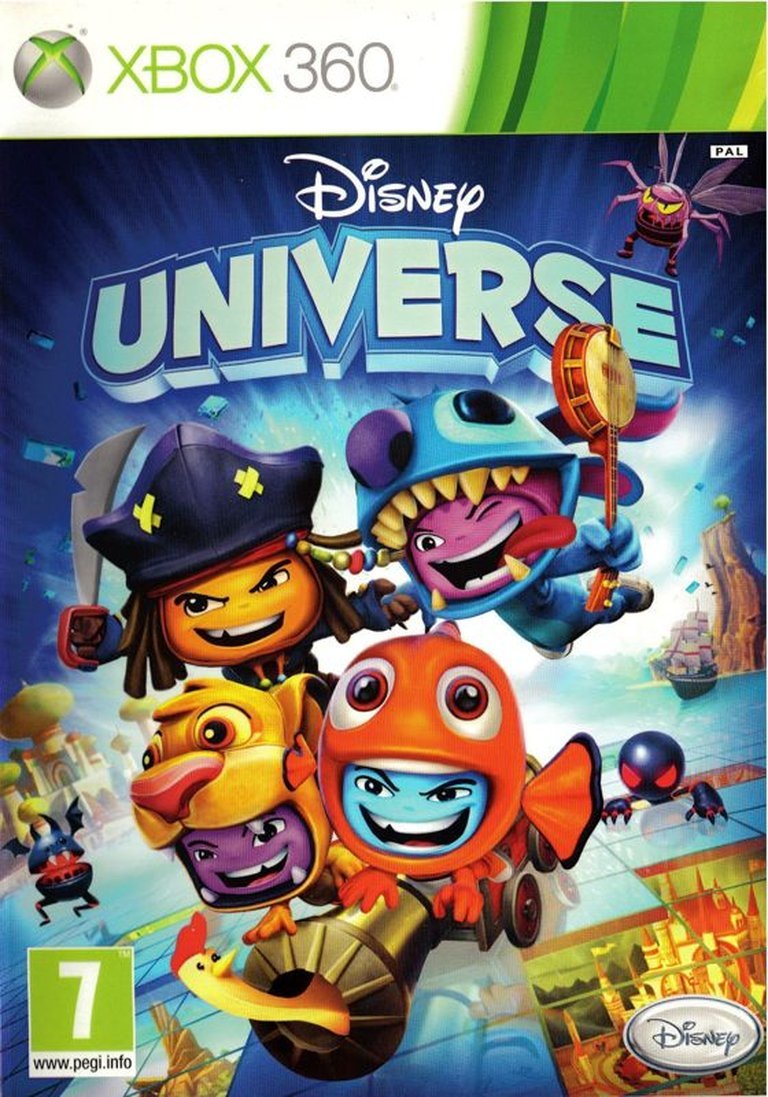
Description
In Disney Universe, players enter a virtual amusement park infected by a virus named Hexx, causing chaos throughout Disney and Pixar-themed worlds. As the protagonist, you must defeat Hexx to restore order while exploring six distinct worlds—including Pirates of the Caribbean, Lion King, and Wall-E—solving puzzles, battling enemies, and collecting Mickey Mouse head icons to unlock new Disney-themed character costumes and progress through the game.
Gameplay Videos
Where to Buy Disney Universe
PC
Disney Universe Free Download
Disney Universe Cracks & Fixes
Disney Universe Mods
Disney Universe Guides & Walkthroughs
Disney Universe Reviews & Reception
metacritic.com (66/100): This ‘LittleBigLego’ turned out to be one of the best Christmas gifts for the whole family and a great journey across six Disney and Pixar worlds especially enjoyable in 4 player co-op mode.
ign.com : When I found Disney Universe to be a fun experience, I was pleasantly surprised.
insidethemagic.net : The newest video game from Disney Interactive Studios is not an easy one to describe, but definitely easy and fun to play.
Disney Universe Cheats & Codes
Nintendo Wii
| Code | Effect |
|---|---|
| 288E49D8 00000200 | Start with 9999 coins |
| C264F764 00000002 | Start with 9999 coins |
| 3800270F 90030008 | Start with 9999 coins |
| 60000000 00000000 | Start with 9999 coins |
| CC000000 00000000 | Start with 9999 coins |
| C264F764 00000001 | Start with 9999 coins |
| 90030008 00000000 | Start with 9999 coins |
| E0000000 80008000 | Start with 9999 coins |
| 48000000 80B24E50 | Infinite Health |
| DE000000 80008180 | Infinite Health |
| 58010000 0000024C | Infinite Health |
| DE000000 80008180 | Infinite Health |
| 14000004 41A00000 | Infinite Health |
| E0000000 80008000 | Infinite Health |
| 208E49D8 0000XXXX | Button activator |
Disney Universe: Review
Introduction
In the autumn of 2011, as the seventh generation of consoles reached its zenith, Disney Interactive Studios unveiled Disney Universe: an audacious experiment in collaborative play and licensed fantasy. Conceived as a “virtual amusement park” where iconic characters from across the House of Mouse’s vast empire collide, this co-op action-adventure promised to unite generations through a shared digital playground. Yet, while its concept shimmered with Disney-esque wonder, Disney Universe ultimately emerged as a flawed but fascinating artifact—a valiant attempt to replicate the LEGO formula’s success that, despite its charming veneer, revealed itself as a product of its era’s constraints. This review dissects its legacy, arguing that Disney Universe remains a poignant, if imperfect, testament to Disney’s ambition to dominate family-friendly gaming through unprecedented crossover potential.
Development History & Context
Crafted by the veteran UK studio Eurocom—then riding high on the success of James Bond titles like GoldenEye 007 Reloaded—Disney Universe was Disney’s direct answer to the Traveller’s Tales LEGO dominance and Media Molecule’s LittleBigPlanet. Announced at E3 2011, it sought to leverage Disney’s unparalleled IP catalog to create a “game of all games,” where players could seamlessly inhabit heroes and villains across six curated worlds. Technologically, it utilized Eurocom’s proprietary EngineX/EngineXT, optimized for the Xbox 360, PlayStation 3, Wii, and PC. This engine enabled vibrant, stylized environments but struggled with performance inconsistencies, particularly on the Wii, which notably lacked motion controls despite the platform’s gimmick-driven zeitgeist.
The 2011 gaming landscape was saturated with licensed action-platformers. The LEGO series had perfected accessible, humor-driven co-op, while LittleBigPlanet championed user-generated content. Disney, however, had a spotty history with game adaptations, often prioritizing brand synergy over innovation. Disney Universe aimed to split the difference, offering curated worlds inspired by Alice in Wonderland, Pirates of the Caribbean, The Lion King, Monsters, Inc., Aladdin, and WALL-E. Yet, the game’s development was rushed to hit a holiday release window, leading to a truncated campaign and a reliance on DLC—ambitiously planned with packs for The Nightmare Before Christmas, Phineas and Ferb, The Muppets, and The Jungle Book—to extend its lifespan. This strategy, while commercially savvy, underscored the core game’s brevity and the publisher’s lack of confidence in its base content.
Narrative & Thematic Deep Dive
Disney Universe’s narrative is a paper-thin framework designed to justify its chaotic, crossover-centric gameplay. Players are welcomed into the eponymous digital theme park by VIC (Virtual Information Cube), a cheerful AI voiced by Neil Ross, only to have the system hijacked by the malevolent virus H.E.X. (voiced by Bob Bergen), a rogue program modeled after Disney villains. HEXx infects the park, transforming it into a labyrinthine battleground where players must liberate “guests” trapped in corrupted worlds. The plot serves purely as a narrative glue, with minimal dialogue and no meaningful character arcs. VIC acts as a tutorial guide, while HEXx’s motivations—conquering the “virtual reality” of Disney—are never explored beyond generic evil tropes.
Thematically, the game explores chaos versus order, using HEXx’s infection as a metaphor for the breakdown of Disney’s meticulously controlled universe. The “guests” represent captured innocence, requiring rescue to restore the park’s harmony. This aligns with Disney’s core ethos of heroism and perseverance, yet the narrative lacks depth, reducing beloved characters to costume-clad avatars. Even the villains—whose robots are inspired by icons like Maleficent or Jafar—are nameless foes, stripping them of their original menace. The result is a thematic vacuum: the game’s emotional resonance depends entirely on player nostalgia for the source material, not its storytelling.
Gameplay Mechanics & Systems
At its core, Disney Universe is a derivative of the LEGO template, blending simple combat, light puzzle-solving, and exploration. Players control customizable avatars suited in 45+ costumes (e.g., Mickey Mouse, Sulley, or Jack Sparrow), each with unique weapons but identical skillsets. Combat is rudimentary: light/heavy attack combos and a dodge mechanic. Enemies—robots themed after Disney villains—attack in waves, dropping “Mickey Mouse head” icons as currency. These icons unlock new worlds and costumes, creating a superficial progression loop.
Levels are linear, divided into three sections per world, culminating in “guest” rescue objectives. Puzzles often require environmental interaction (e.g., levers, switches) or specific costumes (e.g., Rapunzel’s长发 for climbing), but the game rarely enforces these mechanics, making them feel optional. A novel enemy AI feature sees foes actively hindering progress by hiding keys or setting traps, adding a layer of unpredictability. However, this is undermined by repetitive objectives (destroy all enemies, collect items) and a forgiving difficulty that negates challenge.
Character progression is cosmetic: costumes gain power from “stars” found in levels, boosting weapon damage without altering abilities. This renders most costumes interchangeable beyond novelty. The UI is clean but sparse, with a hub world allowing costume selection and level access. Multiplayer (local-only, up to four players) amplifies the fun, with co-op puzzles and chaotic battles, but suffers from poor camera controls and friendly-fire frustrations. Ultimately, the game’s systems feel shallow, prioritizing quantity over quality and failing to capitalize on its diverse roster.
World-Building, Art & Sound
Disney Universe’s greatest strength lies in its world-building and presentation. Each of the six core worlds is a lovingly crafted microcosm of its film counterpart. Alice in Wonderland’s kaleidoscopic landscapes mirror Tim Burton’s 2010 live-action aesthetic, with towering mushrooms and clockwork contraptions. Pirates of the Caribbean echoes the fourth film’s swashbuckling flair, while Monsters, Inc. captures Monstropolis’ neon-lit dread. These environments are bursting with detail—WALL-E’s junkyard landscapes include Pizza Planet trucks and A113 Easter eggs—yet they often feel “watered down” as Wired critic Michael Venables noted, sacrificing the source material’s distinctiveness for a unified art style.
Character designs are a highlight: costumes blend iconic traits (e.g., Cruella de Vil’s fur coat) with a stylized, chibi-like proportions that fit the game’s tone. However, the art is inconsistent; dark, muted lighting in levels like The Lion King’s Pride Rock obscures the vibrant palette seen in screenshots. Sound design leans heavily on nostalgia, remixing John Williams’ Star Wars-esque Pirates score or Randy Newman’s Monsters, Inc. themes. Voice acting is minimal but effective, with VIC’s warmth contrasting HEXx’s robotic menace. Though the audio-visual package creates a charming, cohesive “Disney” atmosphere, it cannot mask the gameplay’s repetitiveness, turning potential immersion into background noise.
Reception & Legacy
Disney Universe’s 2011 release garnered mixed reviews, reflecting its divided identity. Aggregated scores hovered around 61–70% (Metacritic: 66 for Xbox 360, 70 for PS3), with critics split between praising its accessibility and bemoaning its depth. COGConnected lauded its “cute, charming, and sometimes funny” execution (80%), while Tech with Kids noted it was “a combat game with puzzles, not a gentle puzzle adventure” (80%). Conversely, Games TM dismissed it as “a by-numbers romp” (30%), and Nintendo World Report called it “one of the most disappointing releases of the year” (50%). Players rated it a modest 3.7/5, with praise reserved for multiplayer fun but criticism aimed at its brevity.
Commercially, the game underperformed, likely due to stiff competition from LEGO Harry Potter and Skylanders: Spyro’s Adventure. Its legacy is defined by its ambitious DLC plan—six themed packs added characters like Jack Skellington and Agent P—and the Ultimate Edition (2012), which bundled all content for PAL regions. Yet, it failed to spawn sequels or a lasting franchise, overshadowed by Disney’s later Disney Infinity (2013), which refined the formula with toy-based gameplay. Historically, Disney Universe is remembered as a cult favorite among Disney fans for its sheer scope, but its gameplay flaws cement it as a footnote—a cautionary tale about licensed games prioritizing quantity over quality. Its backward compatibility on Xbox One/Series X/S (2021) and re-releases on streaming services like Gloud (2018) underscore a niche, enduring appeal.
Conclusion
Disney Universe occupies a unique space in Disney’s gaming pantheon: a bold, flawed experiment that epitomizes the era’s licensed-game ambitions. Its greatest triumphs—vibrant worlds, nostalgic charm, and seamless cross-franchise appeal—are undermined by repetitive gameplay, shallow mechanics, and a narrative that reduces icons to mere cosmetics. As a co-op experience for younger players or Disney devotees, it offers fleeting joy, but it lacks the depth or innovation of contemporaries like LEGO Star Wars. Its legacy is one of unrealized potential: a “virtual park” that captures the magic of Disney’s empire yet fails to deliver a compelling game. Ultimately, Disney Universe is a charming, if forgettable, artifact—a reminder that even the most beloved brands can stumble when ambition outpaces execution. For historians, it remains a curious artifact of 2011’s gaming landscape; for players, it’s a nostalgic footnote best revisited through rose-tinted glasses.