
- Release Year: 1995
- Platforms: Macintosh, Windows 16-bit, Windows
- Publisher: Disney Interactive, Inc., Tandem Verlag GmbH
- Developer: Gryphon Software Corporation
- Genre: Educational
- Game Mode: Single-player
- Gameplay: Mini-games
- Setting: Africa
- Average Score: 80/100
Description
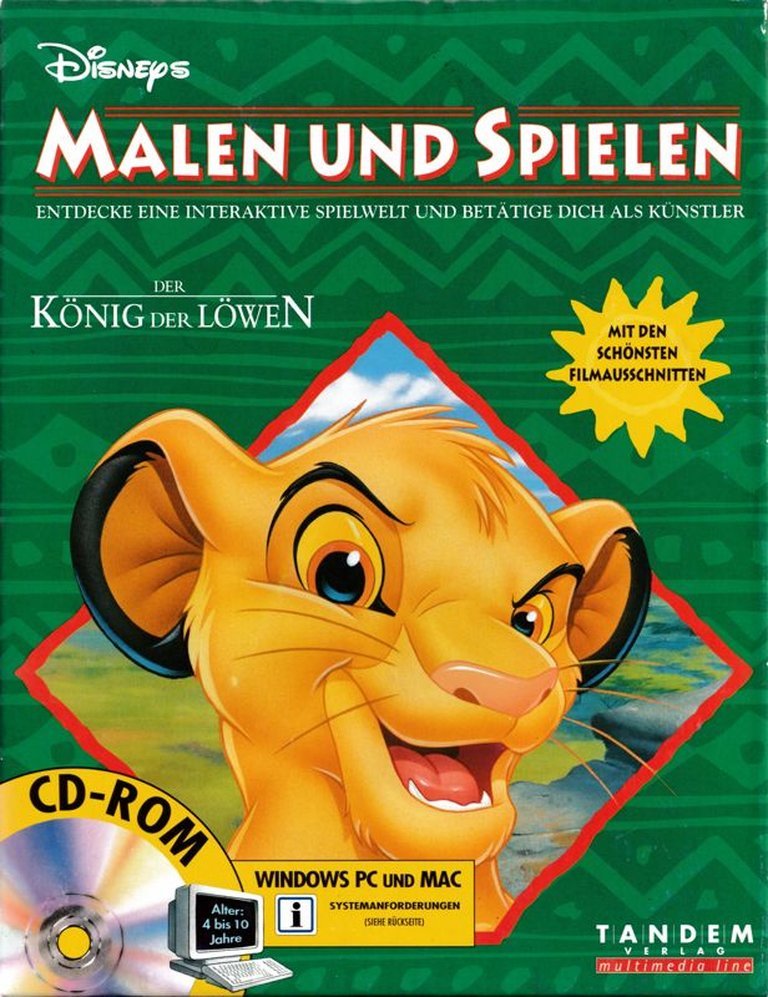
Disney’s Activity Center: The Lion King is an educational game set in Africa that brings the beloved 1994 Disney film to life for preschool-aged children. Released in September 1995, the activity center features Zazu as a guide who leads players through various mini-games, puzzles, spelling exercises, and video clips of popular songs from the movie that children can sing along to. The game offers multiple difficulty levels (represented by different lion growth stages) and provides an interactive learning experience that combines entertainment with educational activities appropriate for young children.
Gameplay Videos
Disney’s Activity Center: The Lion King Guides & Walkthroughs
Disney’s Activity Center: The Lion King Reviews & Reception
mobygames.com (81/100): A fun educational game featuring beloved characters from The Lion King.
myabandonware.com (90/100): A nostalgic and fun educational game for young children.
disney.fandom.com : An activity center game based on Disney’s 1994 film The Lion King.
disney.fandom.com (70/100): A series of games providing various activities and minigames using Disney’s licensed properties.
Disney’s Activity Center: The Lion King: Review
Introduction
In the golden age of edutainment, when CD-ROMs unlocked vibrant digital realms for children, Disney’s Activity Center: The Lion King emerged as a cornerstone of a burgeoning genre. Released in September 1995 by Disney Interactive and developed by Gryphon Software, this title capitalized on the seismic cultural impact of Disney’s 1994 animated masterpiece. As the second entry in the Disney’s Activity Center series—following Aladdin and preceding Toy Story—it promised a “jungle gym for the mind,” blending learning with the beloved characters and landscapes of the Pride Lands. Yet beyond its educational veneer lies a meticulously crafted digital playground that, while simple by today’s standards, remains a poignant artifact of 90s interactive design. This review argues that The Lion King Activity Center transcends its “educational” label through its faithful world-building, innovative mini-games, and seamless integration of film nostalgia, securing its place as a timeless gem in Disney’s gaming legacy.
Development History & Context
Vision and Constraints
Conceived by Gryphon Software Corporation, a studio with expertise in licensed adaptations, The Lion King Activity Center was a product of both ambition and limitation. Disney Interactive spearheaded the project with a clear mandate: translate the film’s magic into interactive experiences that subtly reinforced cognitive skills like memory, spelling, and pattern recognition. Released initially for Windows (1995) and later Macintosh (1996), the game operated within the constraints of early CD-ROM technology—relying on point-and-click interfaces, compressed video clips, and modest storage capacities. The era’s gaming landscape was dominated by edutainment titans like Myst and Putt-Putt, but Disney’s IP-driven approach targeted a younger demographic, prioritizing accessibility over complexity.
Creative and Technical Execution
The development team, led by producer B. Susan Kirch and senior producer George Morency, worked closely with Disney animators to ensure visual and thematic fidelity. With 115 contributors across art, animation, and sound, the game leveraged the film’s original assets—screenshots for puzzles, voice clips from archival recordings—while creating new assets like the “Achi” board game and bug-matching mechanics. Notably, technological hurdles like the ARBC video codec (which caused compatibility issues with later Windows versions) were mitigated through hybrid Mac/Windows design. The result was a polished, self-contained experience that mirrored the film’s journey: ambitious but accessible, structured yet open-ended play.
Narrative & Thematic Deep Dive
World-Building Through Gameplay
Unlike narrative-driven games, The Lion King Activity Center weaves its story through interactive locations. The hub, Pride Rock, introduces young Simba as a guide, whose playful narration (“I’ve never been to the jungle, but I heard it’s cool!”) sets a tone of discovery. The game’s four locales—Jungle, Rafiki’s Tree, Shadowlands, and Magic Pool—function as thematic chapters:
– Jungle: Hosted by Timon and Pumbaa, it embodies “Hakuna Matata” through lighthearted chaos. The bug-matching game (“Timon’s Lunch”) and “Find the Friends” activity (locating hidden animals) celebrate whimsy and curiosity.
– Rafiki’s Tree: Represents wisdom and creativity. Puzzles and art tools (“coloring pages with movie-accurate outlines”) mirror Rafiki’s role as a mentor, while the African strategy game “Achi” ties into cultural authenticity.
– Shadowlands: Simba and Nala oversee challenges like the maze (evading hyenas) and “Memory Match” stone cards, emphasizing courage and resilience.
– Magic Pool: A passive area showcasing film clips on a rippled “water” surface, reinforcing nostalgia.
Character Arcs and Thematic Resonance
The game’s activities subtly echo the film’s core themes:
– Identity and Growth: Difficulty levels (lion cub to adult) mirror Simba’s journey. The spelling game, where Pumbaa falls into mud upon success, frames mistakes as learning moments.
– Friendship and Community: Cooperative play in “Achi” and “Memory Match” against characters like Ed the hyena reinforces teamwork.
– Cultural Roots: “Achi,” a traditional African board game, grounds the experience in heritage, while animal-print recognition in “Find the Friends” teaches diversity.
Though simplified for young audiences, these elements transform gameplay into a metaphor for the “Circle of Life,” where skills bloom through playful repetition.
Gameplay Mechanics & Systems
Mini-Game Design and Progression
The game’s nine mini-games are masterclasses in disguised learning:
– Matching Bugs: A memory test where players pair identical insects. Completing 10 matches yields a printable certificate, blending achievement with tangible reward.
– Spelling: A Hangman-like game where correct letters burst vines in Pumbaa’s hammock. Difficulty scales from guided words (Easy) to free-form guessing (Hard), teaching phonics and pattern recognition.
– Achi: A strategic variant of tic-tac-toe using stones, where players must create three-in-a-row or move stones like checkers. Its “twist” mechanic introduces tactical thinking.
– Xylo-bone: A Simon-style rhythm game where players repeat Ed the hyena’s patterns or compose tunes, linking music to memory.
User Interface and Accessibility
The point-and-click interface is intuitive, with iconic icons for actions:
– Zazu (help): Voice-overs for rules.
– Magnifying glass: Contextual hints (e.g., revealing hidden animals).
– Sun icon: Restart games without penalty.
– Lion silhouette: Adjustable difficulty (Easy/Medium/Hard) on the fly.
Strengths and Flaws
The system excels in adaptability—parents can tailor challenges to age groups. However, the lack of progression tracking or high scores limits replayability for older children. Some mini-games, like the maze, feel repetitive, and the “Easy” level’s removal of hyenas robs tension. Yet these quibbles are mitigated by the sheer variety; with 6+ hours of content across locations, the game feels expansive, not exhausting.
World-Building, Art & Sound
Visual Fidelity and Atmosphere
The game’s art is a love letter to the film:
– Environments: Hand-drawn backgrounds of Pride Rock’s sun-drenched peaks and the Jungle’s lush foliage mimic Disney’s animation. The Shadowlands’ muted palette conveys danger, while Rafiki’s Tree bursts with color.
– Character Design: Recreated assets from the film ensure consistency. Timon’s expressive animations during bug-matching and Nala’s stone-card appearances bridge gameplay and narrative.
– Creative Tools: The art studio’s “magic brush” auto-fills scenes with movie colors, while dot-to-dot puzzles teach motor skills through iconic imagery (e.g., Mufasa’s face).
Sound Design and Voice Acting
Audio elevates immersion:
– Score: Lush renditions of “Hakuna Matata” and “I Just Can’t Wait to Be King” underscore activities.
– Voice Cast: While Nathan Lane (Timon), Jonathan Taylor Thomas (Simba), and Rowan Atkinson (Zazu) were absent (busy with Tom and Huck and other projects), replacements like Quinton Flynn (Timon) and Ryan O’Donohue (Simba) captured the characters’ spirits. Ernie Sabella (Pumbaa) and Jim Cummings (Ed) reprised their roles, adding authenticity.
– Sound Effects: Pumbaa’s mud-splashes and Ed’s giggles create tactile feedback, making activities feel tactile and alive.
This sensory fusion transforms the game into a living postcard of the Pride Lands, where every click resonates with film magic.
Reception & Legacy
Critical and Commercial Response
At launch, the game garnered modest praise. CNET (1996) lauded its “multiple skill levels” and “enduring fun,” awarding it a “Buy It” verdict. Hacker’s 1997 review scored it 81%, noting its appeal for “lavic ili lavica” (lion cubs) and praising the “personalized certificates” as motivational. Commercially, it followed the Aladdin game’s success (which sold over 100,000 copies quickly), becoming a staple in educational software charts for Mac and Windows.
Enduring Influence
The Lion King Activity Center cemented Disney’s edutainment formula:
– Series Impact: It set a template for later titles like Toy Story Activity Center (1996) and Tarzan Activity Center (1999), which expanded on its multi-locale, skill-based structure.
– Industry Influence: Its use of licensed assets and adaptive difficulty foreshadowed modern kids’ games like Disney Junior Play.
– Cultural Footprint: Abandonware communities (e.g., MyAbandonware) and archives (Internet Archive) preserve it as a nostalgia touchstone. Modern players appreciate its non-violent, creativity-focused ethos amid today’s hyper-stimulated gaming landscape.
Conclusion
Disney’s Activity Center: The Lion King is more than a relic; it is a testament to the power of licensed media when executed with care. By distilling the film’s essence into bite-sized, enriching activities, Gryphon and Disney crafted a game that entertains while nurturing young minds. Its art, sound, and faithful world-building remain charmingly effective, while its innovative mini-games—particularly “Achi” and the art studio—showcased the untapped potential of edutainment. Though overshadowed by narrative-driven games today, its legacy endures in its simplicity: it proves that play, at its best, is both learning and celebration. For anyone who ever dreamed of wandering the Pride Lands, this game is not just an activity center—it’s a time capsule of 90s wonder.
Final Verdict: A 4/5 masterpiece of its genre, blending education with enchantment to create an experience that, decades later, still roars.