
- Release Year: 1998
- Platforms: Windows
- Publisher: Disney Interactive
- Developer: Disney Interactive Victoria
- Genre: Action
- Perspective: Top-down
- Game Mode: Co-op, Single-player
- Gameplay: Evasion, Item collection, Maze chase, Power-ups
- Setting: Savanna
Description
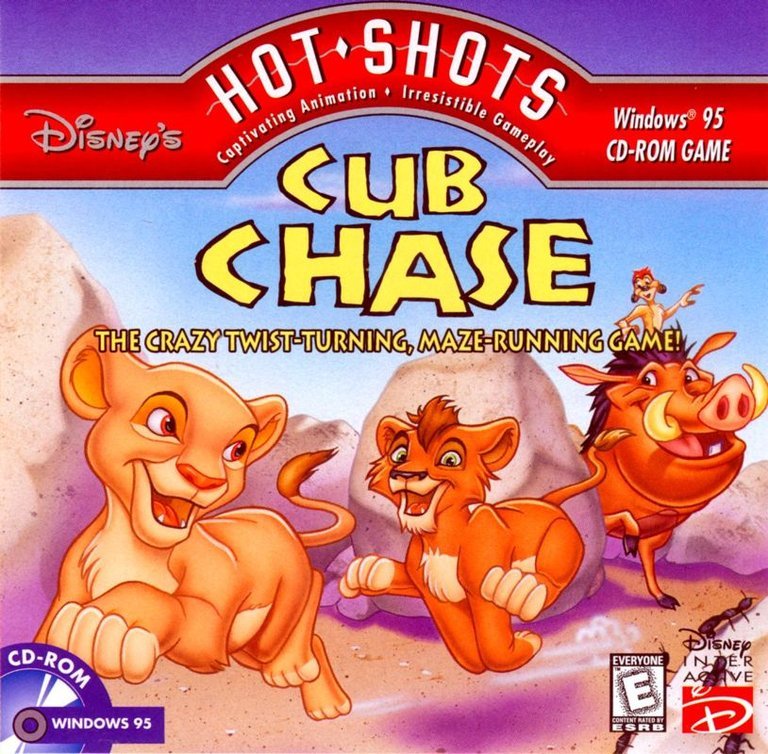
Disney’s Hot Shots: Cub Chase is a casual, top-down action game featuring Kovu and Kiara from Disney’s The Lion King II: Simba’s Pride. Players navigate rock-delimited mazes, covering pathways with paw prints to unlock exits while avoiding capture by babysitters like Timon, Pumbaa, and Zazu. Inspired by Pac-Man, the game includes power-ups such as hyena masks and bug nests, and supports 1-2 player modes with competitive gameplay.
Disney’s Hot Shots: Cub Chase Free Download
Disney’s Hot Shots: Cub Chase: A Prismatic Prison Break in the Pride Lands
In the sprawling museum of video game history, certain titles reside not in the grand halls of canonical masterpieces, but in the lovingly curated wings of cultural ephemera—games that are less about redefining their medium and more about perfecting a specific, often fleeting, moment of synergy between intellectual property and interactive design. Disney’s Hot Shots: Cub Chase (1998) is one such title. A crystalline artifact from the late-1990s casual gaming boom, it represents a deliberate, charming, and mechanically precise fusion of the academy’s most revered arcade formula with the unmistakable magic of Disney’s The Lion King II: Simba’s Pride. This review argues that while Cub Chase may never have graced a “Greatest of All Time” list, its execution of a hybrid “maze coverage” mechanic, its nuanced AI differentiation, and its faithful thematic encapsulation of its source material make it a noteworthy, if overlooked, study in licensed game development—a compact, polished gem that captures a specific Disney ethos and a crucial evolutionary step in the family-friendly software market.
Development History & Context: The “Hot Shots” Incubator
Cub Chase was birthed from Disney Interactive Victoria, one of the studio’s internal development arms responsible for a flurry of youth-oriented and educational titles during the 1990s. This was not a mainline Kingdom Hearts or Epic Mickey endeavor; it was part of the Disney’s Hot Shots series, a line explicitly targeting the burgeoning “edutainment” and “casual” PC market of the Windows 95/98 era. The series, which included titles like Swampberry Sling (1998) and Hippo Hop (1996), was designed for short play sessions, low system requirements, and accessibility for children.
The technological constraints of 1998 are palpable. The game was a CD-ROM release, allowing for richer audio and visuals than floppy disk titles but still operating within the 2D sprite-based, top-down paradigm. The cited development team—70 individuals across programming, art, and design—reflects a mid-scale, Scott-tasked project. Lead Art Direction & Game Design by Robert Barrett and Sr. Game Design by Nick Porcino point to a focused design vision, while Darren McGrath’s Musical Direction and Billy Martin’s composition ensured an aural experience commensurate with the Disney brand. The choice of the Pac-Man template was a masterstroke of economical design: a universally understood gameplay loop that could be reskinned with minimal risk but maximum thematic payoff. The game exists at a fascinating crossroads: before the explosion of mobile casual gaming and the mainstream embrace of “minimalist” indie design, Disney was already experimenting with tight, loop-based mechanics for a broad audience.
Narrative & Thematic Deep Dive: The Subversion of Royal Supervision
Cub Chase possesses a narrative framework so thin it is almost transparent, yet it is this very simplicity that allows its thematic core to shine through the gameplay itself. Drawing directly from The Lion King II: Simba’s Pride, the premise positions Kovu and Kiara, the destined couple and future monarchs of the Pride Lands, not as heroes on a grand quest, but as mischievous royal cubs engaged in a universal childhood act: testing the boundaries of supervision.
Their “antagonists” are the trio of babysitters: the ever-optimistic Timon, the gently lumbering Pumbaa, and the hyper-vigilant Zazu. This isn’t a battle of good versus evil; it’s a playful,generational tug-of-war. The cubs’ objective—to cover every pathway in the maze with their paw prints—is a metaphor for claiming territory, for leaving their mark on the world, a stark contrast to the ordered, risk-averse world their protectors strive to maintain. The fact that this act must be completed to “escape” the maze suggests a rite of passage: proving one’s capability and cunning before being granted full freedom.
The thematics are reinforced by the game’s very mechanics. The three-paw life system represents the leniency of caregivers—they allow for a few mistakes. The hyena masks are tools of temporary psychological warfare, using the fears of the lionesses (from the first film) to create chaos, a clever nod to the wider universe. The bug nests provide distractions, appealing to Timon and Pumbaa’s insatiable hunger. Even the mud puddles mentioned in promotional material (from the Metacritic blurb) serve the theme of disguise and camouflage, allowing the cubs to become part of the environment. The game, therefore, is not about a story; it is the story. Each successful maze traversal is a small victory of youthful curiosity over cautious authority, perfectly capturing the spirit of Kiara and Kovu’s relationship in the film.
Gameplay Mechanics & Systems: Pac-Man’s Heir and Its Royal Inheritance
At its mechanical heart, Cub Chase is a maze coverage game, a sub-genre distinct from the “clear-screen” or “reach-the-goal” objectives of its peers. The core loop is elegant: 1) Navigate a top-down maze, 2) Traverse every walkable tile to leave a paw print, 3) Reach the exit once 100% coverage is achieved, 4) Avoid three pursuers for the duration. This transforms Pac-Man‘s frantic pellet-collecting into a more deliberate, spatial-puzzling race against time and AI.
The genius lies in the asymmetric AI behaviors:
* Timon and Pumbaa are bound by the rock walls, making their pursuit predictable and susceptible to pathing manipulation. They represent the terrestrial, tangible threats.
* Zazu’s flight is the game’s masterstroke. His ability to ignore the maze’s boundaries makes him an unpredictable, omni-directional terror. Players cannot rely on “safe” corridors; Zazu can descend from any direction at any time. This forces a constant, heightened state of awareness and makes the simple act of covering a corner tense.
The power-up system is not merely cosmetic but deeply strategic:
* Hyena Masks act as a temporary “fright” effect, scattering all pursuers. This is the game’s “power pellet,” but its use is more tactical—often saved to create a safe corridor to cover a tricky section or to make a desperate dash for the exit.
* Bug Nests (cracked open by running over them) create localized distractions. This is a subtle but critical tool for breaking line-of-sight or luring a babysitter away from a high-traffic area while you cover a parallel path.
The three-paw penalty system is psychologically potent. Each capture is a tangible loss, a depletion of your “lives” that feels more personal than a abstract “game over.” It encourages caution but also risk-taking, as the margin for error is starkly visible. The two-player competitive mode is a brilliant twist on the formula. Instead of cooperation, it’s a territorial battle on the same screen. Players must balance covering ground with the temptation to herd their opponent into a babysitter, turning the game into a psychological duel wrapped in a cute Disney aesthetic. The UI is minimal and effective, showing paw icons and a clear coverage meter, keeping the focus on the vibrant maze.
World-Building, Art & Sound: The Pride Lands in Pixels
The game’s world is a series of rock-bounded mazes set in a stylized, sunny savanna. The art direction, while constrained by 1998 PC capabilities, is clean, colorful, and faithful. Pathways are vibrant green grass, contrasting with earthy brown rocks. Character sprites are small but distinct: Kovu’s dark fur and posture, Kiara’s lighter build, Timon’s upright waddle, Pumbaa’s round bulk, and Zazu’s quick, flapping animation. The environments avoid clutter, ensuring readability is never sacrificed for detail—a crucial design choice for a game where spatial awareness is everything.
Sound design is a standout feature. The musical score by Billy Martin is bright, adventurous, and infused with a African-inspired percussion that subtly evokes the Lion King soundtrack without direct quotation. More importantly, the game includes “commentary from Kiara and Kovu” (as per Metacritic’s feature list). These are brief, voiced exclamations—a chuckle upon grabbing a mask, a gasp when caught—that add immense personality and reinforce the playful, mischievous tone. The sound of paws on grass, the chatter of the distracted bug nests, Zazu’s squawk—all these audio cues are not just decoration but vital informational signals in the heat of gameplay, demonstrating a sound design philosophy where aesthetics and utility are perfectly married.
Reception & Legacy: The Quiet Success of the Niche
Official critical reception for Cub Chase is virtually non-existent in the digital archives. It garnered no critic reviews on Metacritic and only three user ratings on MobyGames, averaging a 4.1 out of 5. This dearth of contemporary coverage is typical for a children’s PC game from a major publisher, often reviewed only in family-oriented magazines or not at all, deemed outside the “core” gaming press’s remit.
Its commercial performance is similarly opaque, but the fact that it received a standard retail release, was localized (as evidenced by its French title Chassé-Croisé dans la Savane), and spawned no direct sequels suggests it met its modest sales targets within the Hot Shots line. Its legacy is twofold:
- As a Series Artifact: It stands as a prime example of the Disney’s Hot Shots philosophy—taking a simple, proven game mechanic and wrapping it in a beloved IP’s aesthetic and thematic trappings. It was part of a business model that kept Disney Interactive solvent through the late 90s, selling millions of copies to families via retail and bundling with PCs.
- As a Mechanic Refinement: The “coverage” mechanic and the asymmetric AI (specifically Zazu’s flight) represent an interesting deviation in the maze-chase genre. While not influential in the AAA space, its design choices resonate in later party games and casual mobile titles where territorial control and varied enemy behaviors create strategic depth from simple rules. Its most direct descendant is the spirit of competitive, screen-filled local multiplayer seen in games like Pac-Man Championship Edition or Super Monkey Ball‘s multiplayer modes.
Preservation efforts, like its availability on the Internet Archive, have cemented its status as a culturally preserved artifact for retro Disney game collectors. It is remembered fondly by those who played it as children for its perfect encapsulation of Lion King II‘s playful sibling dynamic.
Conclusion: A Crown Jewel of the Discount Bin
Disney’s Hot Shots: Cub Chase is not a lost classic crying out for rediscovery through the lens of modern sensibilities. It is, and was, exactly what it set out to be: a polished, engaging, and deeply thematic casual game for children and families. Its strengths are its focused design, its intelligent adaptation of the Pac-Man template into something distinctively its own, and its unwavering commitment to the Lion King II universe. Its weaknesses are those of its era and genre—limited depth, repetitive structure, and a lack of narrative progression beyond incremental maze difficulty.
In the grand canon, its place is small but secure. It is a testament to the viability and charm of the “premium casual” PC game in the late 1990s, a category that has since been largely absorbed by mobile app stores. It proves that even the simplest mechanics can be elevated by thoughtful AI, clear feedback, and authentic thematic integration. For the historian, Cub Chase is a perfect case study in efficient licensed development. For the nostalgic player, it is a warm, 20-minute escape into the Pride Lands, guiding cubs through a maze of rocks and rules, reveling in the small, digital rebellion of leaving your mark on the world, one paw print at a time. Its final verdict is not one of awe, but of profound, respectful appreciation for a game that knew its purpose and executed it with a lion’s share of skill and charm.