
- Release Year: 2019
- Platforms: Windows
- Publisher: Square Enix Co., Ltd.
- Genre: Compilation
- Game Mode: Single-player
- Average Score: 85/100
Description
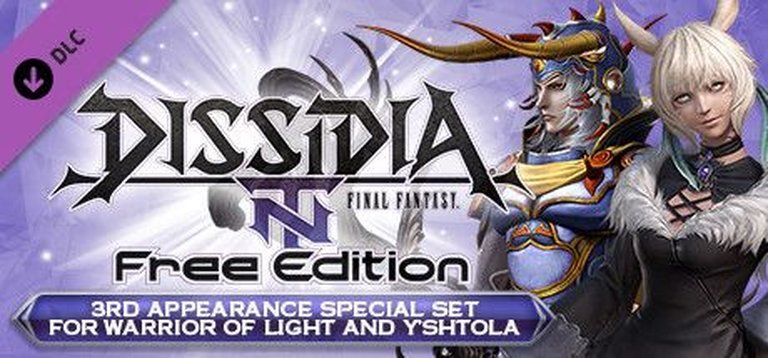
Dissidia: Final Fantasy NT Free Edition – 3rd Appearance Special Set for Warrior of Light and Y’shtola is a downloadable content compilation for the online battle arena game Dissidia: Final Fantasy NT Free Edition, which brings together iconic FINAL FANTASY characters and worlds from the franchise’s 30-year history in competitive multiplayer battles. This special set enhances customization options by introducing new appearance-themed outfits and additional weapons for the characters Warrior of Light, featuring a ‘Knight in Shining Armor’ set, and Y’shtola, adorned in a ‘Scion Sorceress’s Robe’ set, allowing players to personalize their gameplay experience within the free-to-play title.
Where to Buy Dissidia: Final Fantasy NT Free Edition – 3rd Appearance Special Set for Warrior of Light and Y’shtola
PC
Dissidia: Final Fantasy NT Free Edition – 3rd Appearance Special Set for Warrior of Light and Y’shtola: Review
Introduction
In the sprawling cosmos of Final Fantasy spin-offs, few franchises capture the series’ essence with the electrifying spectacle of Dissidia. Born from the PSP’s innovative fusion of RPG depth and arcade combat, the series evolved into Dissidia: Final Fantasy NT (2018), shifting to 3v3 team battles under the stewardship of Square Enix and Koei Tecmo. This DLC, released on December 4, 2019, is a microcosm of NT’s ambitious monetization strategy—a $16.99 compilation pack offering cosmetic and mechanical upgrades for two iconic heroes: the Warrior of Light (FFI) and Y’shtola (FFXIV). As a professional historian and journalist, this review deconstructs this DLC not merely as content, but as a artifact reflecting NT’s design philosophy, player expectations, and the tensions between artistic vision and commercial reality in modern gaming. My thesis is that while the set exemplifies NT’s commitment to character fidelity and customization, it also underscores the series’ struggle to balance accessibility with an increasingly fragmented monetization model.
Development History & Context
The Dissidia series underwent a seismic transformation with NT, moving from PSP’s 1v1 duels to 3v3 team combat developed by Team Ninja. This shift aimed to capitalize on the rise of esports-friendly arena brawlers like League of Legends, but alienated purists who cherished the original’s strategic depth. The Free Edition (2019) was a strategic pivot to broaden its player base, offering core combat with rotating weekly character rosters but gating story mode and full character access behind paid purchases. The “3rd Appearance Special Set” emerged from this ecosystem—a premium DLC bundle priced at $16.99 on Steam (MobyGames) and ₹1,415 on PlayStation Store (PlayStation.com). Technologically, it integrates seamlessly with NT’s Unreal Engine 4 framework, requiring no significant engine modifications. The DLC’s release timing—December 2019—coincided with the holiday season, positioning it as a high-value gift for dedicated fans. However, the context reveals a studio grappling with legacy expectations: NT’s 3v3 redesign, collaborative development with Koei Tecmo, and reliance on microtransactions created a divisive identity that this DLC, for better or worse, reinforced.
Narrative & Thematic Deep Dive
While the DLC itself adds no new narrative cutscenes, its thematic resonance lies in how it amplifies the core characters’ identities within Dissidia’s cosmic conflict. The Warrior of Light, as franchise archetypal hero, embodies Order and unwavering resolve. His “Knight in Shining Armor” appearance set—comprising three variants (I, II, III)—recalls his role as a noble paladin, with gilded armor and regal aesthetics reinforcing his status as a paragon of virtue. Y’shtola, the blind yet prodigal scholar-mage from FFXIV, represents Knowledge and arcane mastery. Her “Scion Sorceress’s Robe” set features layered, ethereal robes adorned with mystical sigils, visually echoing her connection to the Echo and Scions of the Seventh Dawn. Thematically, the set juxtaposes light (Warrior of Light) and shadow (Y’shtola’s forbidden knowledge), mirroring Dissidia’s eternal chaos/order dichotomy. The new weapons—Warrior of Light’s “Barbarian’s Sword/Aegis” and Y’shtola’s “Nightseeker”—further this dichotomy: one a symbol of unyielding defense, the other a conduit for forbidden sorcery. Though the dialogue remains limited to combat quips, these cosmetics transform players into living embodiments of Final Fantasy‘s thematic pillars.
Gameplay Mechanics & Systems
This DLC’s gameplay impact is twofold: cosmetic customization and functional weapon upgrades. For the Warrior of Light, the “Knight in Shining Armor” set provides three recolors of his base armor, ranging from polished silver to battle-worn gold, alongside the “Barbarian’s Sword/Aegis” weapon—a hybrid blade and shield altering his attack patterns. For Y’shtola, the “Scion Sorceress’s Robe” introduces three elaborate robe variants, and the “Nightseeker” weapon—a crystalline staff—enhances her magical potency. These additions integrate into NT’s layered progression system:
– Character Roles: Both characters occupy distinct niches. Warrior of Light is a Vanguard, specializing in melee crowd control and tanking. Y’shtola, a Specialist, excels at zone control with spells like “Holy” and “Succor.” The new weapons refine these roles—Barbarian’s Sword boosts his EX Burst damage, while Nightseeker extends Y’shtola’s spell range.
– Customization Depth: The DLC exemplifies NT’s approach to progression, where weapons fundamentally alter move properties. For instance, Y’shtola’s Nightseeker may increase her “Bind” spell duration, enabling longer lockdowns.
– Monetization Hurdles: Critically, the DLC requires purchasing base character starter packs first, a barrier noted in store descriptions. This “double paywall” frustrated free-to-play users, who already lacked access to full character rosters. The UI, however, cleanly integrates these items into the “Appearance” and “Weapon” menus, maintaining visual cohesion with NT’s polished interface.
World-Building, Art & Sound
Artistically, the set is a testament to Tetsuya Nomura’s character design legacy. Warrior of Light’s armor gleams with reflective metals and intricate engravings, his cape billowing dynamically in combat—an homage to his original sprite’s simplicity while elevating it for 3D. Y’shtola’s robes flow with mesmerizing particle effects, her blindfold replaced by a translucent visor showcasing her glowing eyes, blending FFXIV’s fantasy realism with NT’s anime flair. Environments like the “Moogle Forest” stage amplify these visuals, with vibrant backdrops that shift between FF locales, though the DLC itself doesn’t introduce new stages. Sound design is equally meticulous: the Barbarian’s Sword emits a resonant clang on parries, while Nightseeker’s staff crackles with arcane energy. New voice lines, such as Y’shtola’s “The void whispers to me,” add personality but remain sparse. The set’s audiovisual polish elevates NT’s already stellar presentation, though it remains confined to cosmetic and mechanical enhancements rather than expanding the game’s auditory or spatial scope.
Reception & Legacy
Commercially, the DLC positioned NT as a high-investment title, with 153+ DLC fragments listed on GG.deals. User reception was mixed. On Steam, the base game holds a “Mixed” rating (42% positive), with DLC costs cited as a barrier (“monetization is frankly embarrassing,” one 575-hour reviewer lamented). Community forums (Steam Community) debated whether sets like this justified their price, with proponents praising the weapon’s gameplay impact and detractors criticizing the “nickel-and-diming” of essential character content. Critically, the set was rarely reviewed in isolation, overshadowed by broader discourse on NT’s design shifts—from PSP’s tactical battles to NT’s team-focused chaos. Its legacy lies in embodying a transitional era: NT pioneered a free-to-play model for Final Fantasy fighters but failed to sustain a dedicated player base, leading to server closures on PS4. Yet the “3rd Appearance Special Sets” remain collector’s items, with Y’shtola’s foil trading card fetching $0.27 on SteamCardExchange—proof of its cult appeal. Influentially, it paved the way for future FF fighter DLC, such as Final Fantasy Brave Exvius‘s character packs, though none matched NT’s ambition.
Conclusion
DISSIDIA FINAL FANTASY NT – 3rd Appearance Special Set for Warrior of Light and Y’shtola is a microcosm of the series’ triumphs and tribulations. It delivers exceptional artistry, meaningful gameplay customization, and faithful character representation—qualities that made Dissidia a beloved franchise. Yet, its $16.99 price and reliance on prerequisite purchases epitomize NT’s commercial overreach, alienating players who sought the accessibility promised by the Free Edition. Historically, the set stands as a cautionary tale: it exemplifies how DLC can extend a game’s lifespan but also fracture its community. For completists and Final Fantasy purists, it’s a worthwhile addition that deepens engagement with two iconic heroes. For the broader industry, it reflects the precarious balance between artistic ambition and monetization in live-service games. Ultimately, while the set enhances NT’s combat and customization, it cannot redeem the game’s fundamental identity crisis. Its place in history is secure as a vibrant, if flawed, artifact of Final Fantasy‘s evolving legacy—a reminder that even the most epic sagas stumble when passion collides with commerce.