
- Release Year: 2004
- Platforms: Windows
- Publisher: rondomedia Marketing & Vertriebs GmbH
- Developer: Zone 2 Media GmbH
- Genre: Action, Strategy, Tactics
- Perspective: Isometric
- Game Mode: Single-player
- Gameplay: Arcade, Business simulation, Managerial, Puzzle, Resource Management
- Setting: Urban
- Average Score: 64/100
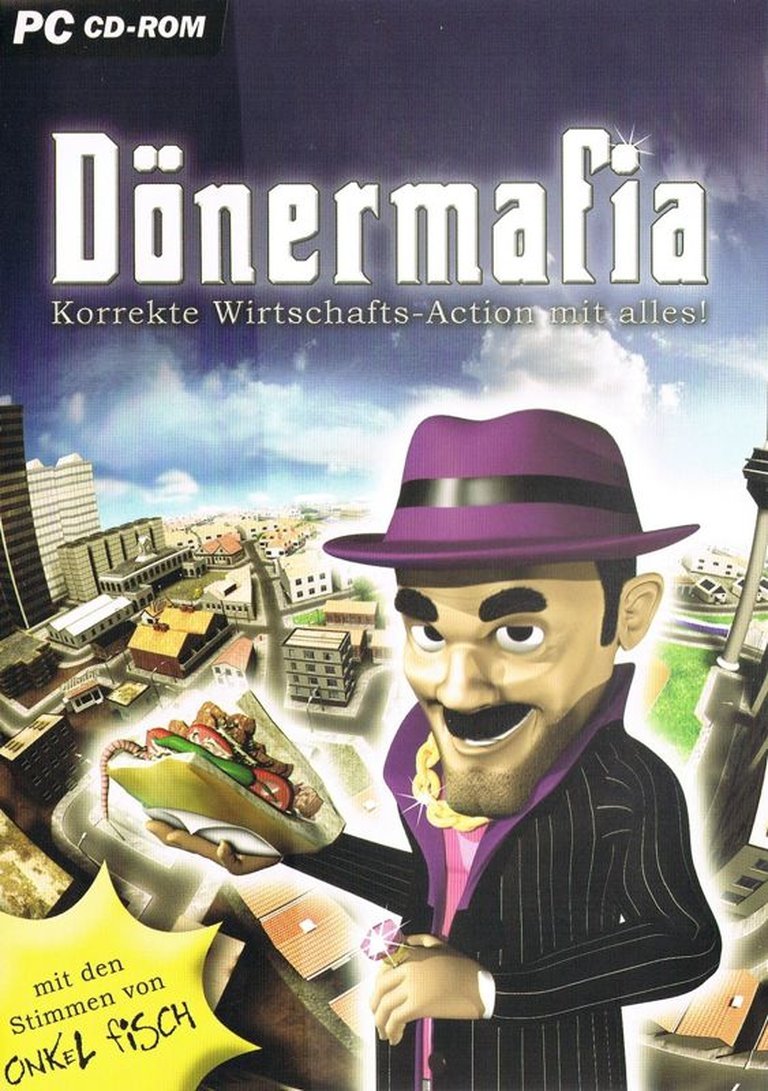
Description
In ‘Dönermafia: Korrekte Wirtschafts-Action mit alles!’, players start as a kebab restaurant owner in an isometric city, balancing legal operations like hiring staff, buying ingredients, and advertising with illegal activities such as smuggling and intimidating rivals to expand their empire. The goal is to take over all restaurants, supported by arcade mini-games triggered by events like police raids where players must hide evidence, blending tycoon management with criminal action.
Dönermafia: Korrekte Wirtschafts-Action mit alles! Cracks & Fixes
Dönermafia: Korrekte Wirtschafts-Action mit alles! Patches & Updates
Dönermafia: Korrekte Wirtschafts-Action mit alles! Reviews & Reception
retro-replay.com : Dönermafia blends traditional tycoon mechanics with arcade-style mini-games to create a varied and addictive gameplay loop.
retrocosmos.com : Was Dönermafia wirklich auszeichnet, ist sein lebendiger und eigenwilliger Grafikstil, ergänzt durch einen eingängigen Soundtrack, der den Charme des Spiels unterstreicht.
Dönermafia: Korrekte Wirtschafts-Action mit alles!: Review
Introduction: The Kebab Capitalist’s Dream
In the annals of unconventional video game concepts, few titles spark as much bewildered fascination as Dönermafia: Korrekte Wirtschafts-Action mit alles! (2004). This German-developed simulation dared players to ascend from humble kebab-stand proprietor to the undisputed “Döner-Paten” of the city, blending restaurant management with organized crime and retro-fueled arcade escapades. While its critical reception was lukewarm (averaging 54% across five reviews), Dönermafia carved out a niche as a cult oddity—a satirical love letter to entrepreneurial ambition and the seedy underbelly of the fast-food industry. This review dissects its legacy, dissecting how its ambitious hybrid of tycoon mechanics and arcade chaos birthed a flawed yet strangely endearing artifact of mid-2000s gaming.
Development History & Context: A German Niche Born from Industrial Constraints
Dönermafia emerged from Zone 2 Media GmbH, a German studio specializing in localized, budget-conscious titles, and was published by rondomedia Marketing & Vertriebs GmbH. Released in 2004 exclusively for Windows on CD-ROM, it reflected an era where mid-sized studios could thrive on hyper-specific cultural niches. The game’s concept—tycoon simulation meets kebab-mafia satire—was audacious, blending two established genres (business management and action) into a thematic Frankenstein’s monster. Technologically, it was constrained by the era’s standards, relying on isometric visuals and static menu screens reminiscent of classics like Theme Park, but with a distinctly Germanic flair for dry humor. Its USK 6 rating (suitable for ages 12 and up) signaled its intent as accessible, edutainment-tinged fun, though its illegal activities (smuggling, extortion) pushed boundaries for family-friendly titles. The gaming landscape of 2004 saw tycoon games as a stable but staid genre; Dönermafia’s criminal twist was a bold, if commercially risky, attempt to invigorate it.
Narrative & Thematic Deep Dive: The Rise of the Fladenbrotpaten
The narrative arc is gloriously straightforward: players start as a kebab-stand owner and claw their way to dominate the city’s entire restaurant scene. This “rags-to-riches” plot serves as a satirical vehicle for dissecting immigration, entrepreneurship, and organized crime. Characters are archetypal yet memorable: the rival restaurateurs you “convince” to sell (via goon squads), the corrupt officials open to bribes, and the underworld contacts offering smuggling gigs. Dialogue is sparse but pithy, with Retro Replay noting “witty one-liners” and “humorous briefings” that inject levity into spreadsheets. The game’s core theme is the duality of legitimacy and crime. Legal gameplay involves optimizing ingredient sourcing, crafting custom kebabs (e.g., tweaking spiciness levels), and advertising campaigns. Yet, these mundane tasks are juxtaposed with Soko-Ban-style evidence-hiding puzzles during police raids or Frogger-esque smuggling chases. This juxtaposition creates dark comedy: your accountant might praise quarterly profits while your crime lord contact whispers about “acquiring” rare spices. It’s a tongue-in-cheek commentary on capitalism’s gray areas, where success hinges on balancing fryer maintenance with felony logistics.
Gameplay Mechanics & Systems: A Tug-of-War Between Tedium and Thrills
Dönermafia’s gameplay is a hybrid beast, divided into two distinct but interconnected systems:
Legal Management Simulation
- Core Loop: Players manage multiple restaurants through menus covering staff hiring/firing, ingredient procurement, furniture upgrades, and advertising. Custom kebab creation is a standout feature, allowing players to experiment with combinations to attract diverse customers.
- Economic Depth: Financial management is robust but repetitive. MobyGames notes “betting on match days” adds risk-reward layers, while Retro Replay highlights “customer satisfaction” metrics tied to decor choices. Yet, PC Games criticized the “eintönigen Spielablauf” (monotonous gameplay), as screens dominate playtime with “statistiken und Menüs mit statischen Hintergründen” (statistics and menus with static backgrounds).
- Progression: Players expand geographically across the isometric city map, unlocking new districts. Each takeover triggers satirical cutscenes or newspaper headlines, but these milestones feel sparse.
Illicit Arcade Escapades
- Criminal Ventures: Smuggling, goon “negotiations,” and bribery inject chaos. These activities trigger arcade mini-games derived from classics: Soko-Ban for hiding contraband during police raids, and Frogger-style chases for illicit deliveries.
- Risk-Reward: Illegal ventures yield higher profits but increase police attention. The arcade segments, as Gamesmania.de lamented, are “zu schlecht umgesetzt” (poorly implemented). Their simplicity and brevity fail to justify the management tedium.
- Controls: Pure mouse-driven, with intuitive isometric navigation. However, the “text-heavy” menus (Retro Replay) can overwhelm newcomers.
The systems clash: meticulous menu management clashes with chaotic arcade interludes, creating an identity crisis. While the ambition is commendable, the execution leans toward “banales Gameplay” (banal gameplay), as Gamesmania.de concluded.
World-Building, Art & Sound: A Satirical Kebab Utopia
Dönermafia’s world is a colorful, isometric microcosm of a German city, rendered with charming cartoonish simplicity. The city map, populated by kebab joints, offices, and back-alley hideouts, evokes Grand Theft Auto’s satirical scope but on a miniature scale. Restaurants are customizable with furniture, though Retro Replay notes the “lack of crowd animations” makes environments feel “frozen.” The visual style leans into absurd humor: exaggerated character designs (e.g., flamboyant smugglers) and vibrant tile sets reinforce the game’s comedic tone.
Sound design is less documented but implied by sources. Retro Replay’s mention of an “eingängigen Soundtrack” (catchy soundtrack) suggests upbeat, looping melodies to offset management stress. Voice acting is absent, relying on text-based dialogue and sound effects for cooking, cash registers, and arcade sequences. Together, the art and sound create a self-aware, cartoon underworld—a playground where Döner stands and criminal enterprises coexist with gleeful anachronism.
Reception & Legacy: From Panned Peculiarity to Cult Curiosity
Critical Reception at Launch
- PC Action (68%): Praised it as “eine Wirtschaftssimulation [die] nicht nur witzig, sondern auch unkompliziert sein kann” (a business simulation that can be not just funny but also uncomplicated), lauding its clever minigames.
- PC Games (60%): Called it “zum fairen Preis von fünf gut belegten Döner-Fladen” (fairly priced for five well-filled kebabs) but lamented the “eintönigen Spielablauf” (monotonous gameplay).
- Gamesmania.de (57%): Damned faint praise: “gute Ansätze durch schlechtes und banales Gameplay verdirbt” (good ideas ruined by bad and banal gameplay).
- Computer Bild Spiele (49%): Rejected it as “zu wenig Zutaten” (too few ingredients), suitable only for filling time while waiting for pizza.
- GameStar (34%): Harshest, dismissing it as “keine Katastrophe, aber auf Dauer zu anspruchslos” (no disaster, but too unchallenging long-term).
Critics universally praised its conceptual novelty but condemned its execution flaws: repetitive menus, shallow minigames, and lack of depth.
Legacy and Influence
- Cult Status: Retro Cosmos notes it gained a “Kultstatus” (cult status) through community anecdotes of absurdist playthroughs and satirical humor. Its niche premise resonated with a dedicated, if small, audience.
- Sequel: The Gold Edition (2005) addressed some criticisms with an “verbesserte[r] wirtschaftliche[r] System” (improved economic system), a new minigame (thimblerig), and a kebab ingredient (lard), but failed to redefine the franchise.
- Historical Footprint: As a German cultural artifact, Dönermafia preserved the kebab’s role as a symbol of immigrant entrepreneurship in popular media. Its hybrid genre remains rare, presaging later experiments like Cook, Serve, Delicious!’s arcade dashes but with a darker, satirical edge.
Conclusion: A Flawed but Unforgettable Fast-Food Fable
Dönermafia: Korrekte Wirtschafts-Action mit alles! is a game of two halves: a competent, if repetitive, tycoon simulation married to underbaked arcade sequences. Its true legacy lies not in its mechanics but in its unapologetic eccentricity. In a gaming landscape dominated by AAA epics, Dönermafia dared to be small, niche, and proudly German—a satirical romp through the greasy, glorious world of kebab capitalism. Its flaws are undeniable: the menus bloat, the minigames fizzle, and the narrative never transcends archetypes. Yet, the game’s charm endures in its audacity, its dark humor, and its heartfelt ode to the immigrant dream. For historians and genre enthusiasts, Dönermafia is less a masterpiece than a fascinating footnote—a testament to the power of cultural specificity in an increasingly homogenized medium. As a culinary capitalist caper, it may leave you hungry for more, but as a historical artifact, it’s a satisfying, if flawed, feast.