
- Release Year: 2023
- Platforms: Linux, Windows
- Genre: Simulation
- Perspective: 1st-person
- Game Mode: Single-player
- Gameplay: Business simulation, City building, construction simulation, Managerial, Open World, Sandbox
- Average Score: 68/100
Description
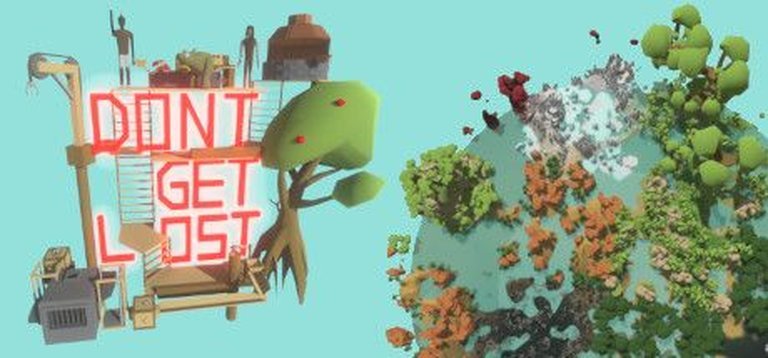
In ‘Don’t Get Lost’, players are immersed in a procedurally-generated, open-world colony simulation. The game offers a first-person perspective and allows players to build and manage colonies, harvest resources, and defend against attacks. With an intuitive gridless building system, players can expand in 3D, design logistics systems, and manage the needs of their townsfolk. The game also features multiplayer options, enabling players to collaborate or compete with friends as they explore an infinite multi-biome world.
Where to Buy Don’t Get Lost
PC
Don’t Get Lost Guides & Walkthroughs
Don’t Get Lost Cheats & Codes
PC
Press ‘/’ to open the console, then type the command.
| Code | Effect |
|---|---|
| Give (#) (item) | Gives the specified number of items |
| Time (1) | Sets time to night |
| Time (2) | Sets time to day |
| Weather (sunny) | Sets weather to sunny |
| Weather (rain) | Sets weather to rain |
| save | Saves the game |
Don’t Get Lost: A Pioneering Open-Source Colony Simulator in an Infinite World
Introduction
In an era dominated by indie darlings and sandbox experiments, Don’t Get Lost (2023) emerges as a fascinating outlier: a free, open-source, first-person colony simulator that marries the granular management of RimWorld with the boundless exploration of Minecraft. Developed by solo creator Michael Hutcheon under the banner of miicck, this procedurally generated odyssey invites players to build, defend, and survive in an infinite world teeming with resources and threats. But does its ambitious fusion of city-building, tower defense, and cooperative multiplayer elevate it above its peers—or does it drown in its own scope? This review dissects every facet of Don’t Get Lost, from its开源 roots to its minimalist artistry, to determine its place in the pantheon of simulation classics.
Development History & Context
Don’t Get Lost was born from Hutcheon’s vision to democratize colony sims through open-source development. Built using Unity’s High-Definition Render Pipeline (HDRP) and released under the GPL-3 license, the game’s codebase is freely accessible on GitHub, encouraging community-driven refinements. Launched on February 1, 2023, for Windows and Linux, it entered a crowded market dominated by polished titans like Dwarf Fortress and Valheim. Yet, Hutcheon’s decision to forgo a price tag—opting instead for a “pay-what-you-want” model—allowed it to carve a niche among budget-conscious players and modding enthusiasts.
The game’s development reflects a post-Minecraft sensibility: procedural generation, gridless building, and multiplayer co-op are no longer novelties but expectations. However, Don’t Get Lost distinguishes itself by emphasizing logistical complexity and settler autonomy, with townsfolk who level skills, manage jobs, and defend against escalating raids—all without the constraints of a grid-based system.
Narrative & Thematic Deep Dive
Narrative is not Don’t Get Lost’s forte. There’s no overarching plot or lore; instead, themes emerge organically through gameplay. The game is a meditation on human resilience and community-building. Settlers—initially nameless and voiceless—gain personality through their roles: a miner who becomes a master blacksmith, a farmer who evolves into a logistician. Their happiness hinges on food, safety, and efficient resource distribution, mirroring real-world societal challenges.
The title’s recurring mantra—“Don’t get lost”—doubles as a thematic warning. Players must balance exploration with consolidation, as venturing too far risks leaving colonies vulnerable to raids. The procedural world, with its hostile creatures and shifting biomes, reinforces a Darwinian struggle for order against chaos—a theme echoed in the tower-defense mechanics, where poorly designed fortifications lead to collapse.
Gameplay Mechanics & Systems
At its core, Don’t Get Lost is a symbiosis of macro-management and hands-on creativity:
-
Colony Management:
- Settlers automate tasks like crafting and farming, but players must assign jobs, prioritize research (e.g., unlocking railways or vitality crystals), and manage supply chains.
- A gridless 3D building system allows fluid construction, from treehouse villages to mountain fortresses. Logistics hubs and buffer chests optimize resource distribution.
-
Tower Defense:
- Raids escalate in difficulty, requiring catapults, guards, and strategic chokepoints. The 2023 “Beta Update” introduced arachnophobia mode, highlighting the developer’s responsiveness.
-
Exploration & Multiplayer:
- The infinite world spans deserts, forests, and tabletop mountains (post-patch, after initial biome bugs). Fishing, goat herding, and rail networks add depth.
- Steam and LAN multiplayer enables cooperative town-building or PvP skirmishes, though network latency occasionally disrupts synchronization.
-
Progression & Flaws:
- Settlers gain XP, improving efficiency—a mechanic reminiscent of Oxygen Not Included. However, the lack of a tutorial (until a 2024 update) alienated newcomers.
- Early bugs, like item duplication and pathfinding hiccups, were mitigated by Hutcheon’s rapid patches, including autosave fixes and UI scaling options.
World-Building, Art & Sound
Don’t Get Lost opts for a stylized, minimalist aesthetic: biomes are defined by exaggerated topography (e.g., floating “tabletop” mountains) and flat-color vegetation. While not graphically groundbreaking, the art direction ensures clarity—critical when managing sprawling settlements.
The sound design is utilitarian: creaking wheels, clanging anvils, and the hum of machinery reinforce immersion. Missing, however, is a dynamic soundtrack; ambient noise alone accompanies the grind of resource gathering.
Reception & Legacy
At launch, Don’t Get Lost earned a “Mostly Positive” Steam rating (79% of 471 reviews), praised for its open-ended gameplay and modding potential but criticized for its steep learning curve. Curators highlighted its “innovative blend of genres,” while players lauded post-launch updates like key rebinding and railway enhancements.
As an open-source project, its legacy lies in community empowerment. The GitHub repository has spawned forks tweaking balance and UI, echoing the collaborative spirit of Dwarf Fortress. Yet, its lack of mainstream press coverage—no Metacritic page, scant critic reviews—underscores its status as a cult classic rather than a household name.
Conclusion
Don’t Get Lost is a triumph of ambition over polish. It doesn’t surpass genre leaders in narrative depth or visual splendor, but its open-source framework, gridless building freedom, and emergent storytelling through colony management make it a standout experiment. For tinkerers and simulation veterans, it’s a labyrinth worth getting lost in—flaws and all. In the annals of indie gaming, Hutcheon’s creation will be remembered as a proof-of-concept: that community-driven, procedurally generated worlds can thrive without AAA budgets.
Final Verdict: A flawed gem that redefines player agency in the colony sim genre. Don’t Get Lost isn’t for everyone—but for the right player, it’s unforgettable.