
- Release Year: 2015
- Platforms: SNES, Windows
- Publisher: Piko Interactive LLC
- Developer: Norse, Piko Interactive LLC
- Genre: Action
- Perspective: Side view
- Gameplay: Platform
- Setting: Fantasy
- Average Score: 61/100
Description
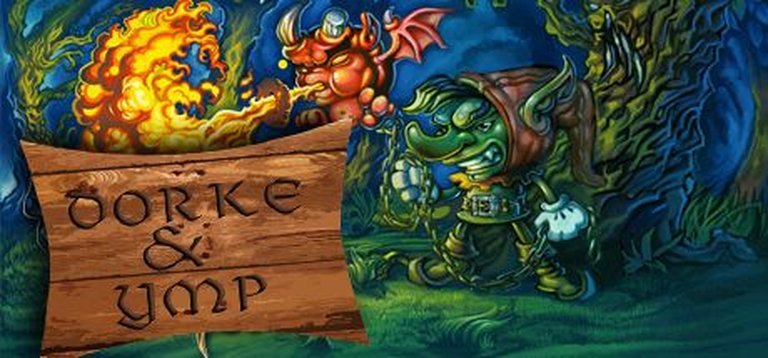
Dorke & Ymp is a 2D side-scrolling fantasy platformer where players control a hooded goblin in a onesie, accompanied by a flying demon friend, as they quest through various environments. Originally developed in the early 1990s for the Super Nintendo without a Nintendo license, the game was abandoned but later recovered and completed by Piko Interactive, leading to its official release on SNES and Windows in 2015.
Where to Buy Dorke & Ymp
PC
Dorke & Ymp Guides & Walkthroughs
Dorke & Ymp Reviews & Reception
familyfriendlygaming.com (61/100): This 2D side scroller did not impress me. Not one bit.
Dorke & Ymp Cheats & Codes
Super Nintendo
Enter passwords in Password Mode to start playing at different areas.
| Code | Effect |
|---|---|
| CIRMOJVM | Start at Area: Dwarven Mines |
| FYWZSXNC | Start at Area: Skies |
| EYHVCUTZ | Start at Area: Volcanoe |
Dorke & Ymp: The Swedish Vaporware That Rose from the Ashes
Introduction: A Ghost from the 16-Bit Era
In the vast graveyard of unreleased video games, few titles possess the peculiar biography of Dorke & Ymp. Conceived in the early 1990s Swedish homebrew scene, this fantasy platformer for the Super Nintendo Entertainment System (SNES) vanished into obscurity, a mere footnote in regional gaming magazines. For over two decades, it existed only as scanned screenshots and fading memories. Then, in 2015, a small American publisher specializing in lost cartridges performed a resurrection. Dorke & Ymp did not simply get a re-release; it was completed, transformed from a 50%-finished relic into a full commercial product. This review argues that Dorke & Ymp is not a lost classic unjustly denied its day in the sun, but a fascinating, flawed artifact whose true value lies not in its gameplay, but in its status as a palimpsest—a game where the original 1990s vision is visibly overwritten by 2010s completionism, creating a disjointed experience that is ultimately more historically significant than it is enjoyable.
Development History & Context: Birth in the Scandinavian Underground
The story of Dorke & Ymp begins with Norse, a tiny, two-person studio based in Stockholm. The early 1990s were a time of explosive SNES popularity, but the official development landscape was notoriously difficult for independents, especially in Scandinavia, which had virtually no presence in the console market. Norse operated without a Nintendo development license, a common but risky practice for small teams. They built their game on Amiga computers using unlicensed, homemade tools, a testament to their technical ingenuity andresourcefulness. This approach allowed them to prototype a game that, according to a 1993 preview in the now-defunct Swedish magazine Interface, was poised to become the first Scandinavian platformer on the SNES. Their vision was a charming, puzzle-focused adventure starring a hooded goblin and his flying imp companion.
Despite this early publicity and a announced release window, Norse failed to secure a publisher. The game vanished, the team disbanded, and Dorke & Ymp joined the ranks of “vaporware.” It remained a ghost until 2013, when Eli Galindo of Piko Interactive, a publisher dedicated to finishing and releasing unreleased retro games, spotted it in that scanned Interface article. Galindo tracked down the original programmer, artist, and composer. The recovered source code was, critically, only about 50% complete. After a stalled initial effort, Galindo recommitted to the project in 2014 following the passing of Norse member Jim Studt, stating he “felt like I needed to finish his game in his honor.” Over roughly 300 hours of work, Piko’s team systematically transformed the fragment into a shippable product.
Narrative & Thematic Deep Dive: A Sketch of Evil
The narrative of Dorke & Ymp is presented through brief, newly added cut-scenes and the Steam store description. The premise is straightforward fantasy tropism: Dorke, an incompetent but aspiring goblin apprentice, and his more capable flying demon companion, Ymp, are sent on errands by their “evil Master Wizard” to collect magical artifacts. The ultimate, unspoken goal is for Dorke to become the wizard’s apprentice, though the story hints at an inevitable showdown (“a showdown between the two is inevitable,” per one description).
The plot is skeletal, serving primarily as a justification for the game’s 40+ levels across four worlds (Forest, Cave, Ice, and the newly added Volcano world). The characters are archetypes with minimal development. Dorke is defined by his incompetence and ambition; Ymp is a loyal, snarky sidekick. The “evil wizard” is an unseen, distant employer. The themes are equally rudimentary: a quest for power/knowledge, a master-apprentice dynamic laced with deception, and a journey through hostile environments. The newly created cut-scenes and ending, while providing narrative closure, feel like a functional afterthought—necessary to frame the gameplay but lacking the depth or charm that might elevate the premise. They are the scaffolding Piko added to a building that was never fully architected by Norse.
Gameplay Mechanics & Systems: A Rigid and Punishing Platformer
Dorke & Ymp is classified as a “puzzle adventure platformer,” but its core DNA is that of a demanding, precision-based action-platformer from the difficult school of Ghosts ‘n Goblins.
- Core Loop & Movement: Players control Dorke (with Ymp as a separate, limited-use companion). Movement is precise but unforgiving. Dorke can walk, jump, climb ledges (a praised feature allowing him to hang and pull up), and throw rocks. This rock-throw is the primary combat mechanic, requiring careful distance and angle calculation to hit enemies, who often move in patterns. Jumping on enemies causes mutual damage, a risky tactic.
- Difficulty & Design Philosophy: The Steam store explicitly states the game is “very very hard and challenging.” This is its most consistent attribute. The level design is littered with tiny platforms, spike pits, and aggressively placed enemies. Player reviews frequently cite poor collision detection and frustrating enemy placement as major pain points. The game provides a whopping 50 lives, a blunt acknowledgment of its lethal nature, but this feels less like generosity and more like a necessary concession to its brutal difficulty curve.
- Ymp’s Role: Ymp is not a constant partner but a limited-use tool. He can be summoned to attack enemies or possibly access certain areas, but his use is governed by a resource, making his assistance a strategic choice rather than a reliable crutch.
- Progression & Structure: The game is organized into four main worlds with multiple levels each, culminating in a boss fight (four in total, designed by Piko based on the original story). Progress is gated by completing levels in sequence. A password system was implemented by Piko for continuity, a standard feature for SNES games but one added to this posthumous release.
- Innovations & Flaws: There are no groundbreaking systems here. The “innovation” is purely in the realm of preservation and completion. The flaws are numerous: controls that feel stiff by modern standards, a combat system (rock-throwing) that is clunky and imprecise, and level puzzles that often rely on trial-and-error death rather than logical deduction. The Volcano world, added by Piko, integrates seamlessly from a visual standpoint but doesn’t feel tonally or mechanically distinct from the other environments.
World-Building, Art & Sound: A Fragmentary Aesthetic
The game’s aesthetic is pure, unadulterated early-90s SNES platformer. The visuals employ the console’s signature * Mode 7* capabilities for some backgrounds and feature a cartoony, pixel-art style.
- Setting & Atmosphere: The four worlds (Forest, Cave, Ice, Volcano) are generic fantasy archetypes. The art is functional but unremarkable, lacking the memorable character design or environmental storytelling of contemporaneous classics like Super Metroid or Castlevania: Dracula’s X. The atmosphere is one of barren, hostile landscapes, fitting the difficult gameplay but not inspiring a sense of wonder.
- Visual Direction: The graphics are technically competent for a homebrew project but visually dated even for 1993. Sprites are simple, animations limited, and color palettes sometimes muddy. The newly added Volcano world uses a hotter color palette but doesn’t advance the technical or artistic vision beyond the original Norse assets.
- Sound Design: The music, composed by the original Norse composer, is serviceable MIDI-style SNES fare—catchy enough in loops but forgettable. Sound effects are standard platformer pings and crashes. There is no standout audio signature. The audio, like the art, feels like a competent execution of a well-worn template, lacking the iconic punch of a Koji Kondo or a Yasunori Mitsuda.
Reception & Legacy: A Curiosity, Not a Classic
Dorke & Ymp‘s reception has been consistently mixed to negative.
- Contemporary (2015/2016) Reception: Upon its physical SNES cartridge release and Steam debut, the game garnered little mainstream attention. On Steam, it holds a “Mixed” rating (as of aggregated data, a Player Score of 49/100 from 37+ reviews). User reviews frequently cite the unforgiving difficulty, imprecise controls, and uninspired design as major detractors. One review from Family Friendly Gaming bluntly stated it did “not impress me. Not one bit,” criticizing the “very angry and ugly” characters and confusing design logic. The Steam store’s own description warning that it is “very very hard” serves as both a pitch and a caution.
- Critical Analysis: No major critic reviews exist on aggregators like Metacritic. MobyGames lists it with no official MobyScore and only two scant player ratings. Its legacy is not born of acclaim but of historical intrigue.
- Influence & Industry Impact: Dorke & Ymp has had zero influence on game design. Its true importance is as a case study in video game archaeology and preservation. Piko Interactive’s work—locating the team, recovering code, completing missing halves, adding new worlds and bosses—is a remarkable feat of restoration. It demonstrates a model for saving unfinished regional games. Its release on modern storefronts (Steam, bundled in the Piko Collection 1) and physical cartridges makes it accessible as a digital museum piece.
- Evolving Reputation: Its reputation has solidified not as a “great lost game” but as a “lost game, period.” It is discussed in niches of retro gaming and preservation circles (e.g., VICE, Retrovolve) as a curiosity—a game that got a second chance but, upon examination, reveals why it may have been left unfinished in the first place. Its value is documentary, not entertainment.
Conclusion: A Testament to Preservation, Not to Play
Dorke & Ymp is a paradox: a completed game that feels fundamentally incomplete. The chasm between Norse’s 1993 vision and Piko Interactive’s 2015 completion is palpable. The original assets and design DNA are present, but they are padded with functional,有时-generic additions (the Volcano world, boss fights, cut-scenes) that lack the spark of a cohesive, original plan. The result is a game that is historically priceless—a tangible artifact of Scandinavian homebrew ambition and a testament to modern preservation passion—but one that is, by almost all objective gameplay metrics, mediocre to poor.
Its rigid, punishing difficulty is not a revered “hardcore” challenge like that of Dark Souls, but a product of dated, often frustrating design. Its art and sound are competent but instantly forgettable. Its story is a bare-bones excuse for level progression. To play Dorke & Ymp in 2024 is to engage in a act of anthropological study. You are not playing a lost classic; you are examining a fossil, seeing the distinct layers of 1990s ambition and 2010s restoration. For historians and preservationists, it is a triumph. For players seeking a timeless platforming experience, it is a frustrating, uneven relic best appreciated from a distance. Its final, definitive place in history is not on a pedestal, but in a curated archival cabinet—a fascinating “what if” that ultimately answers its own question with a resounding “it was probably better left a mystery.”