
- Release Year: 1999
- Platforms: Windows
- Publisher: Swing! Entertainment Software GmbH
- Genre: Compilation
- Game Mode: Single-player
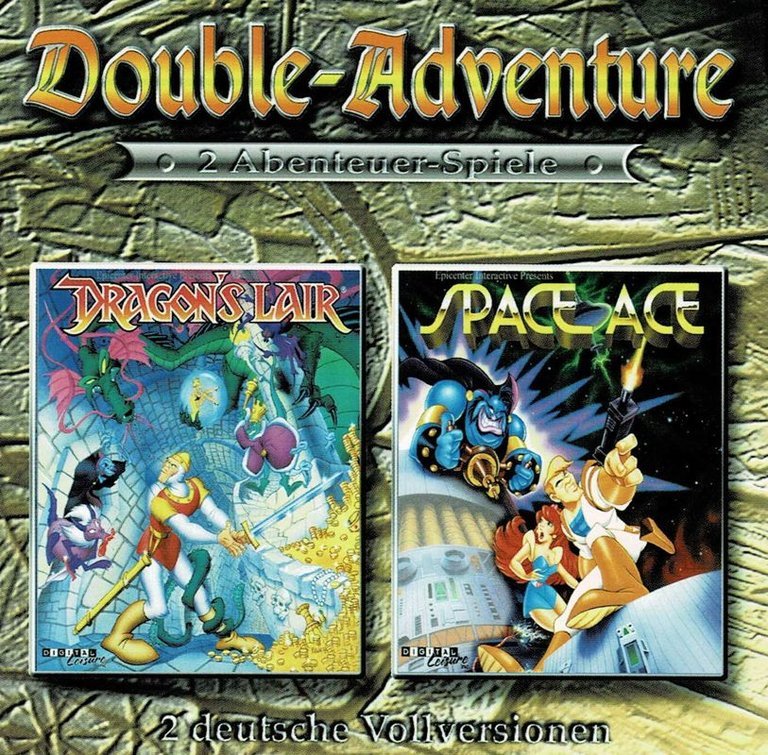
Description
Double-Adventure is a 1999 Windows compilation bundling two classic laserdisc arcade games: Dragon’s Lair and Space Ace. In Dragon’s Lair, players guide valiant knight Dirk the Daring through a haunted castle to rescue Princess Daphne from the dragon Singe, while Space Ace casts players as hero Ace battling the alien villain Borf to save his girlfriend Kimberly. Both games feature pioneering full-motion video animation and require precise timing to navigate perilous challenges in their fantasy and sci-fi settings.
Double-Adventure: Review
Introduction
In the annals of gaming history, few compilations hold as much nostalgic weight as Double-Adventure, the 1999 Windows release from Swing! Entertainment Software GmbH. This anthology bundles two titans of the laserdisc era—Dragon’s Lair and Space Ace—into a single package, offering a portal to a time when video games were defined by cinematic ambition over technical complexity. Yet, in the shadow of 1999’s landmark releases (Age of Empires II, Unreal Tournament, System Shock 2), Double-Adventure stands as a relic of a bygone era, a digital time capsule celebrating an era of arcade spectacle. This review dissects its legacy, gameplay, and cultural impact within the context of its time and beyond.
Development History & Context
Swing! Entertainment Software GmbH’s Double-Adventure emerged in 1999, a year synonymous with PC gaming’s golden age. While contemporaries pushed boundaries with 3D engines, multiplayer innovations, and immersive storytelling, Swing! opted for a different approach: curating and repackaging two 1980s laser-disc arcade legends. Dragon’s Lair (1983) and Space Ace (1984) were developed by industry pioneers Rick Dyer and animator Don Bluth, whose work revolutionized arcade visuals with hand-drawn animation. By 1999, CD-ROM technology made these experiences accessible to home audiences, though Swing! faced significant constraints: converting laserdisc footage for PCs required compression compromises, while the era’s hardware struggled to emulate the seamless responsiveness of arcade cabinets. The gaming landscape of 1999 was dominated by strategy epics, first-person shooters, and MMORPGs, rendering Double-Adventure a niche offering for purists and nostalgics seeking arcade authenticity.
Narrative & Thematic Deep Dive
Double-Adventure is not defined by original narrative but by the enduring stories of its components:
– Dragon’s Lair: Players embody Dirk the Daring, a valiant knight navigating a peril-filled castle to rescue Princess Daphne from the evil dragon Singe. The narrative unfolds as a series of cinematic sequences, demanding split-second reactions to avoid death traps—spikes, monsters, and collapsing corridors. Its theme is heroic fantasy distilled to pure pulp: courage, sacrifice, and the triumph of good over evil.
– Space Ace: A darker sci-fi sequel follows Dexter as he is transformed into the villainous Ace by the malevolent Commander Borf. Players must alternate between Dexter’s weak form and Ace’s powered-up state to rescue girlfriend Kimberly and thwart Borf’s plans. This tale explores duality, redemption, and the corruption of power.
Both games epitomize “interactive movie” storytelling, where narrative serves as a framework for set-piece challenges. Their themes—heroism, identity, and consequence—resonate despite minimal dialogue, relying on visual storytelling that was groundbreaking for its era.
Gameplay Mechanics & Systems
Double-Adventure’s core mechanic is the Quick-Time Event (QTE), predating the term by decades. Players observe pre-rendered animations and input directional commands or action buttons at precise moments. Success advances the story; failure results in gruesome, often comedic, deaths.
– Strengths:
– Pacing: Each session is a high-stakes adrenaline rush, demanding focus and reflexes.
– Visual Clarity: Despite 1999-era compression, the hand-drawn animations retain their charm.
– Weaknesses:
– Trial-and-Error Gameplay: Memorization is key; replaying sequences is frustrating rather than rewarding.
– Limited Interactivity: No inventory puzzles or exploration—merely reflex checks on a linear path.
– UI & Adaptation: The PC interface simplifies arcade controls, replacing joysticks with keyboard inputs. However, input lag and imprecise timing mar the experience, turning potential triumphs into controller-throwing moments.
World-Building, Art & Sound
Double-Adventure’s world-building is confined to its environments: a gothic castle (Dragon’s Lair) and a futuristic space station (Space Ace). These settings are less interactive spaces than dioramas for Bluth’s iconic art.
– Art Direction: Don Bluth’s animations remain the crown jewel—fluid, expressive, and bursting with personality. Characters like Dirk’s lanky swagger and Ace’s manic energy are timeless. Environments, though static, are rich in detail (e.g., the dripping catacombs of Dragon’s Lair).
– Sound Design: Composed by David “Dave” Franks and Chris Stone, the music orchestrates tension and triumph. Voice acting (provided by actors like Michael Rye as Dirk) is campy yet effective, though recycled across scenes.
– Atmosphere: The games evoke a sense of wonder and peril. In 1999, seeing these visuals on a home PC was revolutionary, but the lack of interactivity made the world feel passive rather than immersive.
Reception & Legacy
Double-Adventure received little critical fanfare in 1999, overshadowed by AAA releases. Contemporary reviews (scant as they are) noted its technical limitations and repetitive gameplay, praising its art but lamenting its dated mechanics. Commercially, it appealed to aging arcade fans rather than new players. Its legacy, however, is twofold:
1. Archival Significance: It preserved two landmark games before digital preservation became mainstream.
2. Influence on Design: QTEs would later permeate action games (e.g., God of War), though Double-Adventure’s trial-and-error model fell out of favor in favor of player agency.
MobyGames catalogs it as a historical footnote, with only one collector listed—a testament to its niche status. Its most enduring impact lies in its role as a bridge between laserdisc history and modern remasters (e.g., HD editions on Steam), reminding players of gaming’s experimental roots.
Conclusion
Double-Adventure is a time capsule—an imperfect but vital artifact of gaming’s evolution. In 1999, Swing! Entertainment’s compilation offered PC players a ticket to arcade glory, warts and all. While its QTE-driven gameplay feels archaic by today’s standards, Don Bluth’s artistry and the sheer audacity of its vision remain captivating. For historians, it’s a study in transition; for gamers, a curiosity best experienced with patience and reverence. In the pantheon of 1999 releases, it doesn’t compete with System Shock 2’s innovation or Age of Empires II’s depth, but as a love letter to an era of spectacle over substance, it stands as a poignant reminder of gaming’s bold, formative years. Verdict: A niche classic, essential for preservationists and nostalgics, but a challenging play for modern audiences.