
- Release Year: 1996
- Platforms: Amiga, DOS, Windows
- Publisher: Flair Software Ltd.
- Developer: Flair Software Ltd.
- Genre: Action, Strategy, Tactics
- Perspective: Side view
- Game Mode: Hotseat, Single-player
- Gameplay: Combat, espionage, Mission-based, Traps
- Setting: espionage, Spy
- Average Score: 66/100
Description
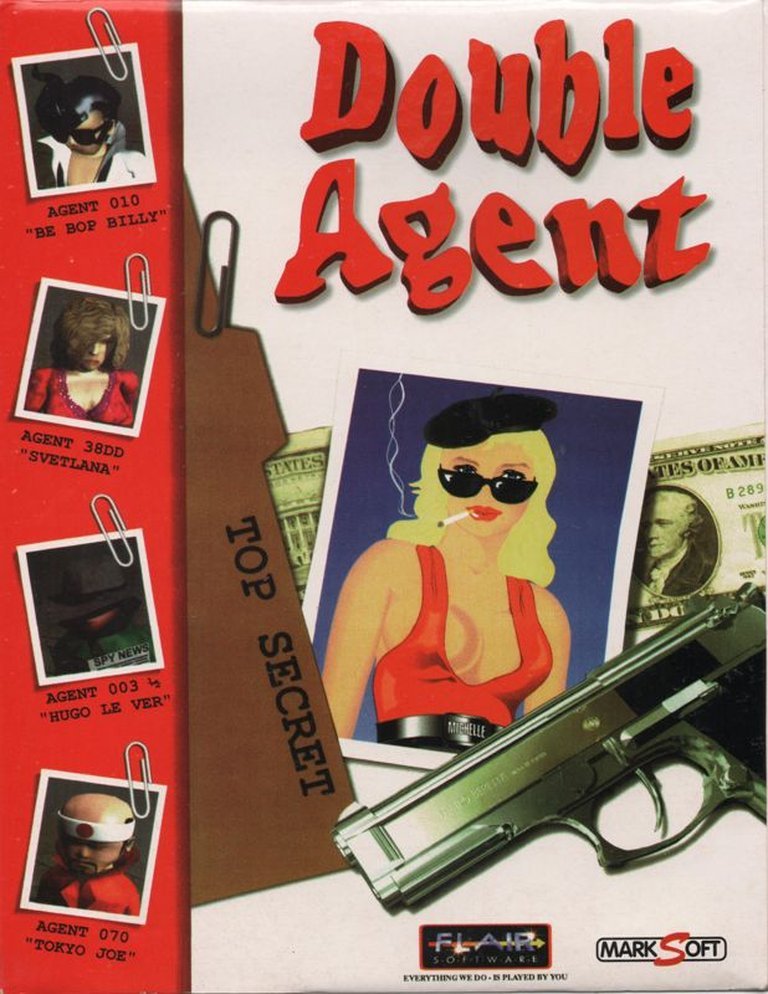
Double Agent is a side-view action-strategy game inspired by the classic Spy vs. Spy, where players compete in espionage missions against each other or the AI. Set in various environments, agents complete objectives like retrieving documents or eliminating enemies while setting creative booby traps using items like electrical devices or heavy balls. A third agent appears mid-game, adding chaos by attacking both players. The DOS/Windows version features animated sequences and four playable characters, emphasizing split-screen multiplayer tactics and trap-based sabotage.
Where to Buy Double Agent
PC
Double Agent Free Download
PC
Double Agent Reviews & Reception
gamepressure.com (47/100): Double Agent is an arcade game produced by Flair Software studio, which in many ways resembles the famous cycle of Spy vs. Spy, celebrating the greatest triumphs in the mid-eighties of the last century.
metacritic.com (85/100): The result is sweaty-palmed fun, teaming the adult joys of a well-paced thriller with the childish delight of playing hide-and-seek in the dark.
Double Agent Cheats & Codes
PC
Edit ‘splintercelluser’ and ‘splintercelluser1’ files in game directory. Bind codes to function keys (e.g., F2, F3) and press during gameplay.
| Code | Effect |
|---|---|
| fly | Flight mode |
| invisible 1 | Invisible to NPCs |
| invincible 1 | Invincibility |
| health | Get health |
| ammo | Get ammunition |
| ghost | No clipping mode |
| walk | Disable no clipping |
| playersonly | Freeze enemies |
| killpawns | Kill all enemies |
| summon echeloningredient.eringairfoilround | Spawn airfoil round |
| summon echeloningredient.eflashbang | Spawn flashbang |
| summon echeloningredient.efraggrenade | Spawn frag grenade |
| summon echeloningredient.esmokegrenade | Spawn smoke grenade |
| summon echeloningredient.estickycamera | Spawn sticky camera |
| summon echeloningredient.estickyshocker | Spawn sticky shocker |
| summon echeloningredient.ewallmine | Spawn wallmine |
PlayStation 2 (CodeBreaker NTSC-U)
Use CodeBreaker device or emulator to enter hex codes.
| Code | Effect |
|---|---|
| B4336FA9 4DFEFB79 80B48F33 17994785 5535C55D 34A2B89E 22455AF2 F8A18B94 |
Enable Code (Must Be On) |
| 9088FF7A 46B0E4BD | Infinite Ammo |
| 42923548 B6462AEC | Extra Ammo |
| F049B8A4 D0A04AEC | Max Infinite Ammo |
| A5D06BF8 E77BFE7F | Never Reload |
| A42F7012 0FC877BA | Never Reload With Max Clip |
| 74A48A3E 4A4C53F1 | Infinite OCP Flasher |
| CFC6F833 398358E1 | Always No Noise |
| 6ECE0870 7DD0DA85 | Enemies Cant See You |
| C1D54FB6 F781E37D | Load Game-Unlock All Missions |
| 18B726E6 0D7AE120 7788C5B7 26FAB12E |
Infinite Health |
| FA09110B BFA37958 56EF75AC CE526419 486E3195 3A8A0983 F55289C5 3F4AF037 |
Infinite Health (Alternate) |
Tom Clancy’s Splinter Cell: Double Agent: A Dual-Identity Masterpiece Under Review
Introduction
In the shadowy pantheon of stealth-action games, few titles have courted controversy and complexity like Tom Clancy’s Splinter Cell: Double Agent (2006). A pivotal entry in Ubisoft’s acclaimed franchise, Double Agent dared to fragment its identity into two distinct experiences — a bold experiment in parallel storytelling and gameplay innovation. Released amidst the console generation transition, it grappled with technological ambition, narrative heft, and the weight of expectations following Chaos Theory. This review dissects Double Agent as both a technical milestone and a tragic meditation on moral compromise, arguing that its bifurcated design — while divisive — cemented its status as a haunting, philosophically rich entry in gaming history.
Development History & Context
Double Agent emerged during a seismic shift in gaming. Ubisoft, leveraging its multi-studio model, tasked Ubisoft Shanghai (fresh off Pandora Tomorrow) and Ubisoft Montreal (series architects) with creating separate versions targeting new (Xbox 360, PS3, PC) and legacy consoles (Xbox, PS2, GameCube, Wii). This bifurcation reflected the industry’s transitional woes: the former group developed a custom engine for next-gen visuals and systemic depth, while Montreal prioritized iterative refinements to Chaos Theory’s framework.
The 2006 gaming landscape was defined by Gears of War’s cover-shooter revolution and narratives embracing moral ambiguity (BioShock loomed). Against this, Double Agent sought to evolve stealth by embedding its mechanics within a psychological thriller. Director Clint Hocking (Montreal version) aimed to blur the line between “right” and “mission-critical,” while Shanghai’s team focused on a trust-system dictating weapon access and narrative outcomes. Technological constraints forced Montreal to recycle animations and AI routines, whereas Shanghai’s version boasted dynamic lighting and physics but suffered optimization issues — particularly in its maligned PC port.
The result was a game at war with itself. For players, this meant two unique campaigns: Version 1 (Shanghai) offered branching choices affecting Sam’s allegiance, while Version 2 (Montreal) emphasized linear espionage with co-op interludes. This duality became Double Agent’s curse and legacy.
Narrative & Thematic Deep Dive
At its core, Double Agent is a tragedy: Sam Fisher, shattered by his daughter Sarah’s death, infiltrates the domestic terror group John Brown’s Army (JBA). The plot diverges sharply between versions:
-
Version 1 (Shanghai): Sam must balance NSA/JBA objectives across morally fraught choices — executing allies (e.g., Lambert), sacrificing civilians, or sabotaging the JBA from within. Characters like Enrica Villablanca (JBA’s conflicted technician) and Emile Dufraisne (charismatic ideologue) humanize the enemy, forcing players to empathize before betraying. The story’s canonical ending — Sam killing Lambert to maintain cover — is a gut-punch, framing his descent as a Pyrrhic victory.
-
Version 2 (Montreal): A more action-driven tale featuring co-op missions supporting Sam’s infiltration. Here, Sam’s relationship with Enrica veers toward romance, making her eventual death by Third Echelon operatives a visceral betrayal. While less nuanced, this version’s climax — a rooftop bomb defusal followed by Sam’s renunciation of the agency — channels The Departed’s fatalism.
Thematically, both versions interrogate loyalty and identity. The JBA — named after abolitionist John Brown but twisted into a far-right militia — mirrors post-9/11 anxieties about ideological extremism. Sam’s double life forces players to complicitly enable atrocities (e.g., bombing a Cozumel cruise ship) to preserve cover — a mechanic critiqued as “trial-and-error morality” (Hyper), yet undeniably impactful. Enemies recite propaganda that uncomfortably echoes real-world dogma (“The government is a corporate puppet”), deepening the narrative’s unsettling resonance.
Gameplay Mechanics & Systems
Double Agent fractured expectations with its dual design philosophies:
Version 1 (Shanghai)
- Trust System: A binary meter tracking NSA/JBA allegiance. Completing faction-specific objectives unlocked gear (e.g., NSA gadgets vs. JBA weaponry). High JBA trust opened restricted areas in hub-like JBA Headquarters, where players performed mundane tasks (e.g., assembling bombs) to avoid suspicion.
- Moral Dilemmas: Pivotal choices altered missions. Sparing Hisham Hamza in Kinshasa unlocked a rescue sequence; framing Enrica for bomb sabotage preserved dual trust. Failing key objectives led to early endings — a bold Deus Ex-like gambit.
- Stealth Reimagined: Light/sound meters were replaced by a three-state alert system. Regenerative health and context-sensitive takedowns (e.g., corner melees) modernized combat but drew purist ire.
Version 2 (Montreal)
- Classic Splinter Cell: Retained Chaos Theory’s light/shadow meter, lock-picking, and methodical pacing. Co-op missions (e.g., prison riots, bunker raids) expanded lore but felt underbaked.
- Karma Meter: A single axis tracking Sam’s alignment, encouraging lethal/non-lethal hybrid play.
- Boss Fights: A contentious addition, pitting Sam against Emile in a laser-gridded showdown — a jarring departure from series realism.
Both versions suffered UI inconsistencies (Version 1’s HUD-free design confused players) and AI glitches. Montreal’s version won praise for polished stealth loops; Shanghai’s ambition was hamstrung by bugs, particularly in PS3/PC ports.
World-Building, Art & Sound
- Visual Direction: Version 1’s Iceland geothermal plant and Shanghai skyscraper missions showcased next-gen dynamism — volumetric fog, destructible environments, and weather effects. Conversely, Version 2’s New Orleans JBA HQ and Okhotsk tanker embraced gritty realism, leveraging Unreal 2.5’s grit.
- Sound Design: Michael McCann’s score fused electronic dread with melancholic strings — a sonic metaphor for Sam’s fractured psyche. Cris Velasco/Sascha Dikiciyan’s main theme remains iconic, while ambient chatter in JBA hubs heightened tension (“Fisher’s too quiet…”).
- Atmosphere: Version 1’s Kinshasa — a war-torn cityscape echoing Blood Diamond — juxtaposed chaotic firefights with stealth, forcing players to navigate moral and literal crossfires.
The result was immersive but inconsistent: Shanghai’s atmospheric highs (e.g., blizzard-swept Okhotsk) clashed with Montreal’s functional level design.
Reception & Legacy
Upon release, Double Agent polarized critics:
– Version 1: Praised for narrative ambition (IGN: 9/10) but critiqued for technical flaws (PC Gamer: 68%). It won “Best Xbox Action Game” (IGN, 2006) and influenced The Last of Us’s moral weight.
– Version 2: Lauded for refined stealth (GameSpot: 8.5/10) yet derided for outdated design (GameCube: MC 64/100).
Historically, Double Agent is a cautionary tale of scope creep. Its trust system inspired later games (Dishonored 2’s chaos mechanic), while its endings foreshadowed Conviction’s rogue-Sam arc. Yet the split-dev model strained resources, contributing to Ubisoft’s pivot toward open worlds (Assassin’s Creed).
Conclusion
Tom Clancy’s Splinter Cell: Double Agent is gaming’s Blade Runner 2049: a flawed, thematically audacious work overshadowed by its predecessors. Version 1’s moral quandaries and Version 2’s refined stealth each offer distinct value, but neither fully escapes compromise. For all its technical stumbles, Double Agent remains essential for its narrative bravery — a harrowing portrait of a hero dismantling his soul to save a world that will never absolve him. In the annals of stealth, it’s a fractured masterpiece, standing as a testament to an era when AAA games dared to ask: How much of yourself will you burn for the mission?
Final Verdict: A dissonant, unforgettable symphony of shadows — imperfect yet indispensable.